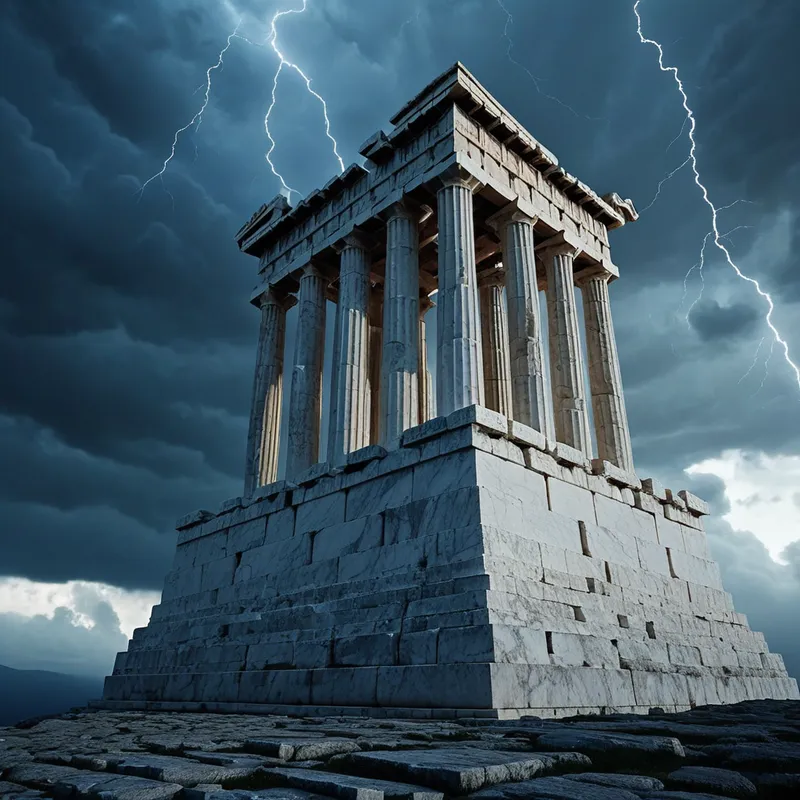
The Leaning Tower of Pisa Myth Meaning & Symbolism
A tale of a Titan's ambition to build a perfect tower for the gods, undone by a divine tremor, creating an eternal monument to flawed beauty.
The Tale of The Leaning Tower of Pisa
Hear now a tale not of heroes and monsters, but of stone and ambition, whispered on the winds that sweep the plains of Etruria. Before the Romans walked, when the world was still thick with the presence of the old powers, there lived a Titan of the earth named Pisanor. He was not a warrior like his brethren, but a shaper, a being whose soul resonated with the song of marble deep in the mountain's heart. His hands could feel the potential in unhewn rock, the latent form waiting to be freed.
Pisanor gazed upon the dwelling of the Olympians, Mount Olympus, and found it wanting. It was a wild peak, a fortress of nature, not a testament to craft. A fire ignited in his chest—a desire to build a structure so sublime, so perfectly proportioned and breathtakingly tall, that it would become the new stairway to heaven, a made thing so glorious the gods themselves would abandon their mountain for it. He would create a axis mundi not given, but built.
He chose a wide, fertile plain by the Arno river, where the earth was firm. With his bare hands, he quarried marble that held the dawn's blush. Each block was cut with geometric perfection, each course laid with a mason's hymn on his lips. The tower rose, a cylinder of stunning white, piercing the sky. It was a poem in stone, its verticality a direct challenge to the divine realm. The higher it climbed, the more Pisanor’s pride swelled. He saw not a tower, but his own magnificence made manifest.
The gods watched. First with curiosity, then with a cold, gathering ire. This was hubris of the purest kind—not an attack, but an assumption of equality through creation. Zeus himself stirred on his throne. As Pisanor placed the final, crowning stone—a perfect sphere of quartz meant to catch the first and last light of day—Zeus did not hurl a thunderbolt. That would be an acknowledgment, a battle between peers. Instead, with a frown that resonated through the foundations of the world, he sent a subtle, profound tremor through the deep bones of the earth.
It was not a cataclysm, but a correction. The ground beneath the tower’s foundation sighed and softened on one side. The perfect vertical line wavered. The marble groaned, a sound of profound sorrow. The tower leaned. It settled into a precarious, eternal tilt. Pisanor stood back, his life’s work, his challenge to heaven, now a monument to a flaw. The gods returned to their mountain, their point made. The Titan, his ambition broken not by shattering but by bending, vanished into the earth from whence he came. But the tower remained. It did not fall. It stood, and stands, in its defiant, imperfect angle—a beacon not of achieved perfection, but of sublime, enduring error.
Cultural Origins & Context
This myth, while localized to the Etruscan and later Pisan landscape, is woven from deeply Hellenic threads. It functions as an aition, a foundational story explaining a peculiar local landmark. Unlike the grand Panhellenic cycles, it was likely a tale told by local guides, bards, and mothers, used to instill a very Greek value: the danger of overstepping mortal (or Titanic) limits.
The societal function was multifaceted. For the pragmatic, it explained the curious, persistent lean of a prominent structure. For the philosophical, it was a cautionary tale about the limits of human (or Titan) endeavor in the face of Moira (Fate) and divine prerogative. It served as a narrative anchor, connecting the people of the plain to a time of giants and direct divine interaction, granting their home a significance born from cosmic drama. The tower became not just a building, but a character in an ongoing story—a permanent, stone embodiment of a moral lesson.
Symbolic Architecture
The Leaning Tower is no mere failed project; it is a supreme symbol of the creative act itself, haunted by its own inherent instability. Pisanor represents the demiurge impulse—the part of the psyche that seeks to impose perfect, ideal order upon the chaotic raw material of existence (the marble, the earth).
The most profound beauty often emerges not in spite of the flaw, but because of it. The crack is where the light—and the meaning—gets in.
The tower’s lean is the essential symbol. It is the intrusion of the unconscious, the unpredictable ground of being (Gaia herself, responding to Zeus), into the conscious ego’s plan for perfection. The lean represents the shadow of the creation—the unintended consequence, the personality quirk, the trauma, the fundamental asymmetry that every individual and every genuine creation carries. The myth tells us that absolute, rigid perfection is an illusion that invites a divine (or psychic) tremor to shatter its arrogance. True endurance lies in the capacity to hold the tension of the lean, to remain standing because of the flaw, not in perfect denial of it.
The Dreamer's Resonance
When this myth appears in modern dreams, it rarely manifests as a literal tower. Instead, one may dream of building something—a career, a relationship, an identity—that persistently will not stand straight. There is a somatic feeling of foundational insecurity, of effort expended only to produce a worrying tilt. The dreamer is Pisanor, experiencing the anxiety of the creator whose creation has taken on a life and a direction of its own.
This dream pattern signals a critical psychological process: the confrontation with one’s own foundational assumptions. The “lean” is the part of the self or the project that does not conform to the ideal blueprint. The dream asks: Do you try to demolish and rebuild from scratch (a fantasy of perfect control), or do you learn to integrate, stabilize, and even cherish the distinctive tilt? The psychic tremor is often the Self (the total, integrated psyche, Jung’s equivalent to Zeus) intervening to prevent the ego from constructing a lifeless, perfect monument to itself, instead forcing a more authentic, albeit imperfect, structure to emerge.
Alchemical Translation
The alchemical process mirrored here is not the creation of gold from lead, but the creation of meaning from error—the opus contra naturam that ultimately works with nature. Pisanor’s initial endeavor is the nigredo, the ambitious, willful imposition of order. The divine tremor is the necessary ablutio or putrefactio, the humbling dissolution of that prideful structure.
Individuation is not the construction of a perfect, upright self. It is the courageous acceptance and artistic incorporation of the lean—that which makes us uniquely, precariously, beautifully ourselves.
The enduring, leaning tower represents the rubedo or the coniunctio. The opposites—ambition and limitation, perfection and flaw, the vertical aspiration and the horizontal pull of the earth—are not reconciled into bland straightness. They are held in a dynamic, tense, and stable union. The alchemical gold of this myth is resilient character. For the modern individual, the path is to recognize their own “Pisanor” drive for spotless perfection, to allow the inevitable psychic “tremors” of life to introduce the corrective lean, and to then devote themselves not to hiding the flaw, but to mastering the art of standing, gloriously and enduringly, within it. The goal shifts from building a tower to the gods, to becoming a living testament to the sacredness of the imperfect human journey.
Associated Symbols
Explore related symbols from the CaleaDream lexicon: