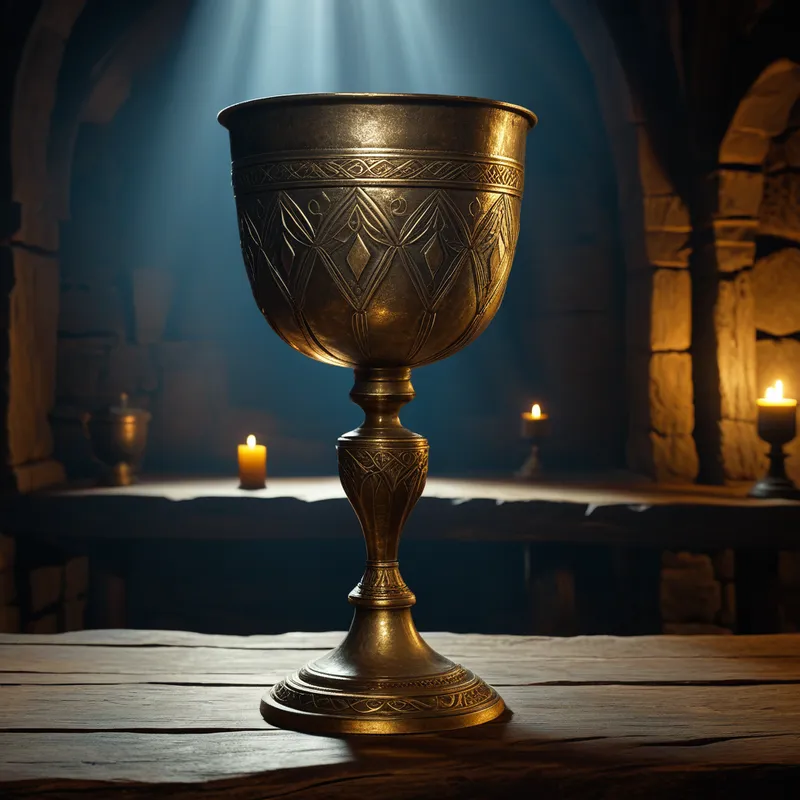
The Last Supper Chalice Myth Meaning & Symbolism
The vessel of the final covenant, holding the wine of sacrifice and the promise of eternal life, lost and sought through the ages.
The Tale of The Last Supper Chalice
The air in the upper room was thick with the scent of roasted lamb, bitter herbs, and the oil of the lamps that fought back the gathering Jerusalem night. The twelve were gathered, their voices a low murmur of unease beneath the familiar Passover prayers. At the head of the table sat Yeshua, his face a landscape of profound sorrow and a terrible, quiet resolve.
The meal progressed, but this was no ordinary Seder. A silence fell as he took the bread, blessed it, and broke it with a sound that echoed like a fate sealed. “Take, eat,” he said, his voice both a command and a lament. “This is my body, broken for you.” The words hung in the air, a mystery too vast to hold. Then he reached for the cup.
It was not a king’s goblet of gold, but a simple, shared cup of blessing—the Cup of Redemption. He held it aloft, the cheap pottery or worn wood gleaming in the lamplight. “Drink from it, all of you,” he intoned. “For this is my blood of the covenant, which is poured out for many for the forgiveness of sins.” As each disciple drank, the wine became more than wine. It was a seal, a promise, a burden. In that moment, the humble vessel was transfigured. It became the container of the ultimate sacrifice, the chalice of a new and everlasting pact between the divine and the human.
Judas slipped into the night, his shadow swallowing the coin’s silver gleam. The others remained, heavy with a truth they could not yet comprehend. Later, in the agony of the garden, Yeshua would pray, “Let this cup pass from me.” The Chalice was no longer just an object; it was the symbol of the suffering he must drink to its dregs. After the horror of the cross and the mystery of the empty tomb, the physical cup vanished from history. But its story did not end. It passed into legend as the Holy Grail, a sacred relic lost to the world, waiting in a hidden sanctuary for those pure of heart to seek it—not merely as treasure, but as the living proof of a covenant written in blood and spirit.
Cultural Origins & Context
The myth of the Chalice is woven from the threads of the Synoptic Gospels—Matthew, Mark, and Luke—and Paul’s first letter to the Corinthians, which contains the earliest written account of the Last Supper. It is fundamentally a myth of institution, establishing the central ritual of the Christian faith: the Eucharist, or Communion. For the early, often persecuted Christian communities, this story was not a distant legend but a living reality re-enacted in secret gatherings. The sharing of bread and wine was the mystical participation in that original, fateful meal.
As Christianity moved from a Jewish sect to a dominant cultural force, the story expanded in the popular imagination. By the High Middle Ages, the specific cup used by Christ became the object of intense legendary pursuit. Writers like Chrétien de Troyes and Robert de Boron fused the Biblical narrative with Celtic cauldron myths and knightly quest romances, giving birth to the full-blown Grail legend. The Chalice became the Sangreal, a vessel of miraculous power. This evolution served a societal function: it externalized the inner, spiritual quest for divine grace into a chivalric adventure, providing a mythic framework for ideals of purity, sacrifice, and sacred kingship in a turbulent age.
Symbolic Architecture
At its core, the Chalice is the archetypal vessel. It is the receptive principle, the womb, the container meant to hold something precious and transformative. In the myth, it holds the Vinum Novum, the “new wine” of a new consciousness.
The Chalice transforms the literal into the symbolic, the blood of sacrifice into the wine of eternal life. It is the crucible where death is alchemized into covenant.
Psychologically, it represents the human soul’s capacity to receive and contain the profound, often painful, insights necessary for transformation. The act of drinking from it signifies conscious acceptance and internalization of one’s fate, one’s suffering, and one’s connection to something greater. The subsequent “loss” of the Grail speaks to a profound truth: the ultimate mystery of divine communion cannot be permanently possessed as an object. It must be continually sought, remembered, and re-experienced inwardly. The quest for the Grail, therefore, is the quest for the integrated Self, for the wholeness that comes from fully incorporating the spirit (the wine) into the vessel of one’s own being.
The Dreamer's Resonance
When the Chalice appears in a modern dream, it rarely manifests as a glittering medieval goblet. More often, it is a simple, significant cup—a family heirloom, a ceramic mug, even a humble bowl—that holds immense, numinous importance. The dreamer may be seeking it, holding it, drinking from it, or watching it be taken away.
Somatically, this dream pattern often correlates with a process of deep emotional or spiritual intake. The dreamer may be in a life phase where they are being asked to “drink” a difficult truth, to accept a painful but necessary change, or to consciously receive love, grace, or a calling. The full Chalice suggests the soul is ready to receive this transformative content. An empty or lost Chalice can point to a feeling of spiritual aridity, a loss of meaning, or a covenant (in a relationship, vocation, or with oneself) that feels broken. The quest to find it in the dream mirrors the psyche’s innate movement toward healing and re-integration, urging the dreamer to reconnect with their own sacred center and the promises they have made to their deepest self.
Alchemical Translation
The myth of the Last Supper Chalice is a perfect map of psychic alchemy, the Individuation process. The initial state is the nigredo: the darkening, the betrayal in the garden, the impending death. The shared meal represents the albedo: a moment of conscious, ritualized clarity where the base materials (bread, wine) are recognized as carriers of the divine.
The transmutation occurs not in the fire of the forge, but in the quiet acceptance of the cup. To drink is to perform the ultimate alchemy: converting the lead of mortal suffering into the gold of conscious meaning.
The Chalice itself is the vas, the sacred vessel of this operation. The modern individual’s “Last Supper” is any pivotal moment of conscious choice where they must accept a painful but transformative truth about their life—the end of an era, a necessary sacrifice, the acknowledgment of a profound responsibility. Drinking from their own “chalice” means internalizing this truth, allowing it to become part of their psychic substance, and thus entering into a new “covenant” with their own destiny. The quest that follows—the feeling of having lost the Grail—is the long work of integration, of living out the implications of that choice until the sacred is no longer sought as an external object, but known as an inner, sustaining presence. The myth teaches that wholeness is found not in possessing the sacred, but in becoming the vessel that can contain it.
Associated Symbols
Explore related symbols from the CaleaDream lexicon: