The Labyrinth of Daedalus Myth Meaning & Symbolism
An architect's genius creates a prison for a monster, a cage for his own son, and the ultimate symbol of the mind's confounding, creative depths.
The Tale of The Labyrinth of Daedalus
Hear now of the Daedalus, whose hands held the cunning of [Hephaestus](/myths/hephaestus “Myth from Global/Universal culture.”/) and the pride of a king. In the court of [Minos](/myths/minos “Myth from Greek culture.”/), a shame was born—the [Minotaur](/myths/minotaur “Myth from Greek culture.”/), a creature of bestial hunger and royal disgrace. The king’s command was a whisper of steel: build a prison from which this shame could never emerge, yet never be forgotten.
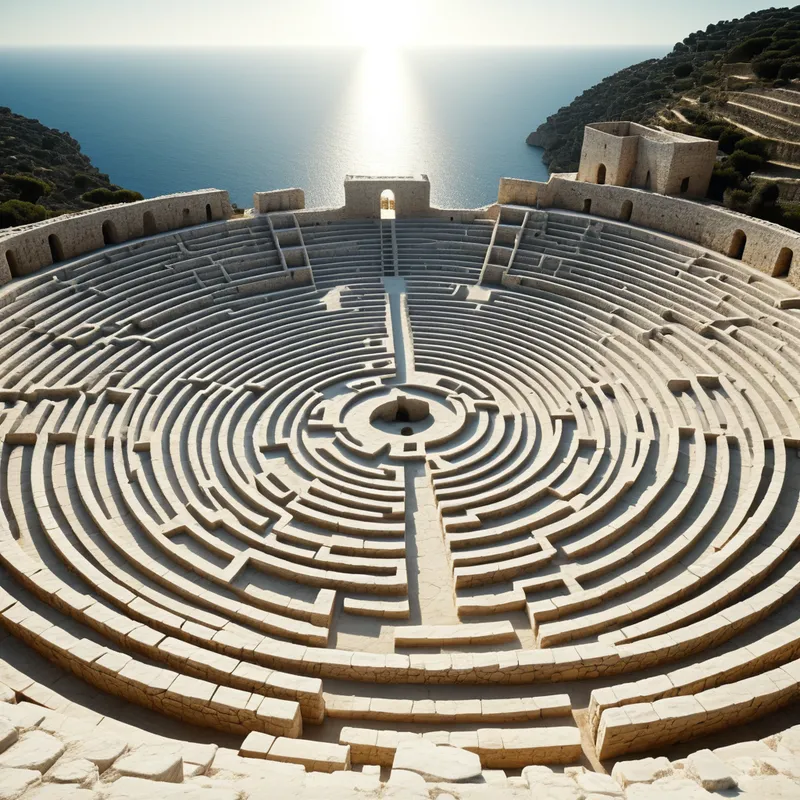
Daedalus walked the empty shores, listening to the logic of waves and the geometry of shells. He did not build walls, but a conundrum in stone. He crafted a single, winding path that turned back upon itself, a river of corridor that drank its own tail. [The Labyrinth](/myths/the-labyrinth “Myth from Greek culture.”/) was born—not a dungeon of darkness, but a prison of perfect, sunlit confusion. Its high white walls promised escape around every corner, only to deliver the seeker back to the center, to the hot, damp breath and the lowing in the dark. It was a masterpiece of containment, a mind made manifest in masonry.
But genius begets its own chains. When the hero [Theseus](/myths/theseus “Myth from Greek culture.”/) came to slay the beast, he was given a simple clew: a ball of thread from the king’s daughter, Ariadne. Daedalus, [the architect](/myths/the-architect “Myth from Various culture.”/) of the trap, could only watch as his perfect puzzle was undone by love’s simple filament. [Theseus](/myths/theseus “Myth from Greek culture.”/) entered the gleaming maze, paid the monster in bronze and blood, and followed the thread back to [the world](/myths/the-world “Myth from Tarot culture.”/) of light, leaving the [Labyrinth](/myths/labyrinth “Myth from Various culture.”/) an empty, silent monument.
And Daedalus? His fate was woven from the same pride. Confined now himself, with his beloved son [Icarus](/myths/icarus “Myth from Greek culture.”/), on the very island his creation protected, he looked not to earth or sea, but to the empty sky. From feathers and wax, he fashioned wings—another labyrinth, this one of air. He charted a precarious path between the drowning sea and the melting sun. “Follow my middle course,” he warned. But the boy, drunk on the altitude of freedom, soared upward. The wax wept, the feathers scattered, and Daedalus, the solver of all earthly puzzles, could only watch his greatest creation—his son—spiral into the uncaring sea. The man who built the ultimate cage could not build one to hold the human heart.
Cultural Origins & Context
This is a core myth of the ancient Greek world, primarily preserved in the epic cycles and later synthesized by Roman poets like Ovid. It functioned as a foundational narrative for the Athenian city-state, justifying its historical tributes to Minoan Crete and celebrating its own heroic identity through Theseus. The story was not merely entertainment; it was a societal tool. It explored the perilous contract between power (Minos) and ingenuity (Daedalus), the consequences of transgression ([the Minotaur](/myths/the-minotaur “Myth from Greek culture.”/)’s birth), and the civic virtue of the hero who confronts chaos (Theseus). Told by bards and depicted on pottery, it was a shared cultural dream about order versus monstrosity, and the price of brilliance.
Symbolic Architecture
The [Labyrinth](/symbols/labyrinth “Symbol: The labyrinth represents a complex journey, symbolizing the intricate path toward self-discovery and understanding one’s life’s direction.”/) is the myth’s central psychic [organ](/symbols/organ “Symbol: An organ symbolizes vital aspects of life and health, often representing one’s emotional or physical state.”/). It is not a [maze](/symbols/maze “Symbol: A maze represents confusion, complexity, or a search for truth, often reflecting life’s challenges or inner turmoil.”/), which offers dead ends and choices. A labyrinth, in its classical form, has a single, winding, but unbranching [path](/symbols/path “Symbol: The ‘path’ symbolizes a journey, choices, and the direction one’s life is taking, often representing individual growth and exploration.”/) to the center.
It is the inescapable circuit of our own obsessive thoughts, the convoluted path of a destiny we ourselves have engineered but cannot see beyond.
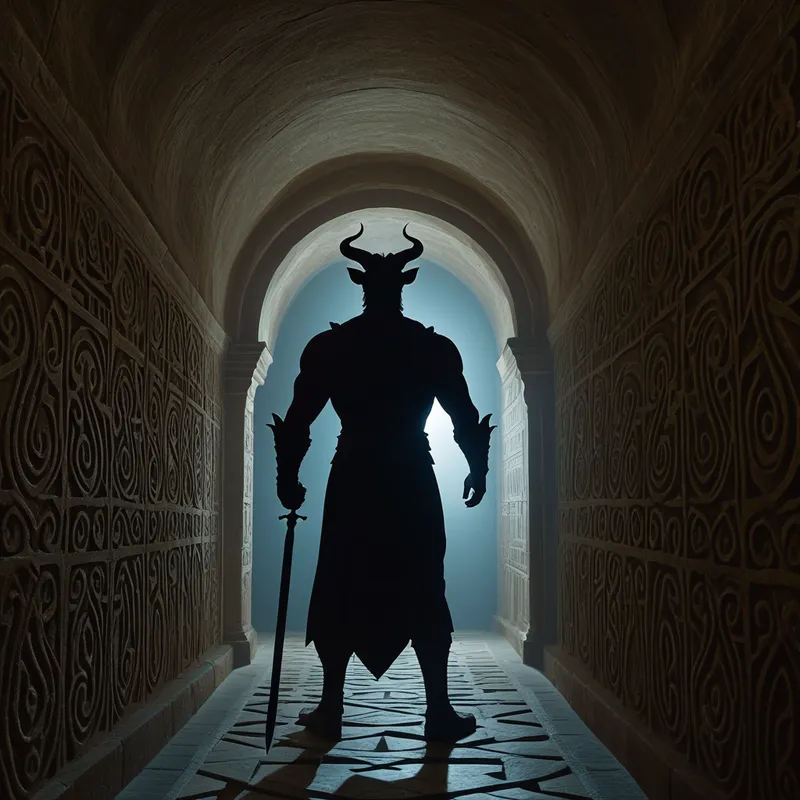
The [Minotaur](/symbols/minotaur “Symbol: The Minotaur, a creature from Greek mythology, is often interpreted as a symbol of inner turmoil and the struggle between human and beast.”/) at the center is the ultimate [Shadow](/symbols/shadow “Symbol: The ‘shadow’ embodies the unconscious, repressed aspects of the self and often represents fears or hidden emotions.”/)—the untamed, instinctual, and shameful hybrid born from a [queen](/symbols/queen “Symbol: A queen represents authority, power, nurturing, and femininity, often embodying leadership and responsibility.”/)’s unnatural desire and a [king](/symbols/king “Symbol: A symbol of ultimate authority, leadership, and societal order, often representing the dreamer’s inner power or external control figures.”/)’s arrogance. It is the psychic wound we [wall](/symbols/wall “Symbol: Walls in dreams often symbolize boundaries, protection, or obstacles in one’s life, reflecting the dreamer’s feelings of confinement or security.”/) in but must eventually face. Daedalus represents the brilliant, [problem](/symbols/problem “Symbol: Dreams featuring a ‘problem’ often symbolize internal conflicts or challenging situations that require resolution and self-reflection.”/)-solving Ego, capable of magnificent constructions, yet blind to their consequences. His creations—the Labyrinth, the wings—always become his own [prison](/symbols/prison “Symbol: Prison in dreams typically represents feelings of restriction, confinement, or a lack of freedom in one’s life or mind.”/).
Theseus is the [consciousness](/symbols/consciousness “Symbol: Consciousness represents the state of awareness and perception, encompassing thoughts, feelings, and experiences.”/) that dares the descent, armed not just with a sword (the will to confront), but with Ariadne’s thread. This thread is the lifeline of [connection](/symbols/connection “Symbol: Connection symbolizes relationships, communication, and bonds among individuals.”/)—to love, to [intuition](/symbols/intuition “Symbol: The immediate, non-rational understanding of truth or insight, often described as a ‘gut feeling’ or inner knowing that bypasses conscious reasoning.”/), to a guiding principle outside the [logic](/symbols/logic “Symbol: The principle of reasoning and rational thought, often representing order, structure, and intellectual clarity in dreams.”/) of the maze itself. It is the remembered [truth](/symbols/truth “Symbol: Truth represents authenticity, honesty, and the quest for knowledge beyond mere appearances.”/) that allows one to retreat from the [abyss](/symbols/abyss “Symbol: A profound void representing the unconscious, the unknown, or a spiritual threshold between existence and non-existence.”/) and integrate the experience.
The Dreamer’s Resonance
To dream of a labyrinth is to feel the [psyche](/myths/psyche “Myth from Greek culture.”/) constricting into a pattern of inescapable repetition. The dreamer is not lost in a forest, but in a structure. This is the architecture of a complex, a neurotic loop, or a life path that feels self-designed yet utterly confining. The somatic sensation is one of mounting frustration, dizziness, and a heart-pounding certainty that the exit is just there, yet perpetually out of reach.
Dreaming of the Minotaur signals a confrontation with a repressed, “monstrous” aspect of [the self](/myths/the-self “Myth from Jungian culture.”/)—often rage, hunger, or a primal sexuality that the dreamer’s inner “King Minos” has tried to hide. The dream is an invitation from the unconscious: the labyrinth can no longer hold its charge. The thread in the dream may appear as a literal string, a voice, a remembered phone number, or a sudden clear thought—the psychic function that can lead you back to yourself after facing the beast.

Alchemical Translation
The myth models the full individuation cycle. First, the [Nigredo](/myths/nigredo “Myth from Alchemical culture.”/): the recognition of [the shadow](/myths/the-shadow “Myth from Jungian culture.”/) (the Minotaur’s existence) and the conscious entrapment within one’s own brilliant defenses (entering the Labyrinth). Daedalus’s initial act is [the ego](/myths/the-ego “Myth from Jungian culture.”/)’s attempt to solve a problem by creating a more complex container for it, a spiritual bypass in stone.
The alchemical work begins not with building a better prison, but with consenting to be lost within the one you have already built.
The confrontation in the center is the Mortificatio—the slaying of the identification with the monstrous, instinctual self. It is not the destruction of the instinct, but the liberation of consciousness from its tyrannical, undifferentiated form. Theseus does not become the Minotaur; he ends its reign.
The escape via the thread is the Albedo, the washing clean. It is the conscious retracing of one’s steps, integrating the insight gained from the center. Finally, Daedalus’s flight is the Citrinitas, the attempt at spiritual ascent. Its tragedy—Icarus’s fall—is the crucial warning: transcendence attempted through sheer ingenuity, without embodied wisdom and humble adherence to the “middle path,” leads to dissolution. The ultimate goal, the [Rubedo](/myths/rubedo “Myth from Alchemical culture.”/), is not escape from the human condition, but the hard-won wisdom to navigate it. One becomes not the flawless architect, nor the fallen son, but the weathered survivor who understands both the design of the maze and the necessity of the thread. The true treasure is not at the center or in the sun, but in the capacity to walk [the winding path](/myths/the-winding-path “Myth from Taoist culture.”/), fully conscious, holding the end of your own story.
Associated Symbols
Explore related symbols from the CaleaDream lexicon:
- Corner
- Hallway
- Mall
- Dorm
- Structure
- Interior
- Complicated
- Teleportation Portal
- Twisted Curling Stone
- Arcade Machine
- Game Booth
- Enigmatic Line Art
- Twisted Storyline
- Nested Tables
- Trellis Screen
- Paperclip Chain
- Tack Board
- Moorish Palace
- Abandoned Warehouse
- Futuristic Bunker
- Shopping Mall
- Abandoned Cabin
- Forgotten Exits
- Grid
- Grid Pattern
- Tiled Mosaic
- Digital Matrix
- Virtual Community
- Wormhole
- Topology
- Bifurcation Points
- Helix
- Vent
- Arcade