The Labyrinth of Crete and Ari Myth Meaning & Symbolism
A hero enters a monstrous maze, guided by a thread of love, to face the beast within and find his way back to the light.
The Tale of The Labyrinth of Crete and Ari
Hear now the tale of stone, sorrow, and salvation, spun from the dark heart of the wine-dark sea. On the isle of Crete, where the sun beat down like a hammer on bronze, a king’s shame was given form. King [Minos](/myths/minos “Myth from Greek culture.”/), favored by [the sea](/myths/the-sea “Myth from Greek culture.”/)-god [Poseidon](/myths/poseidon “Myth from Greek culture.”/), was gifted a bull of purest white, a sign of divine favor. But when greed overcame piety, and [Minos](/myths/minos “Myth from Greek culture.”/) kept the bull for himself, the gods weave vengeance from mortal folly. Pasiphaë, the queen, was struck with a monstrous desire for the beast. From this unholy union, engineered by the cunning artisan Daedalus, a creature was born: part man, part bull, all fury. They named him the [Minotaur](/myths/minotaur “Myth from Greek culture.”/), the Bull of [Minos](/myths/minos “Myth from Greek culture.”/).
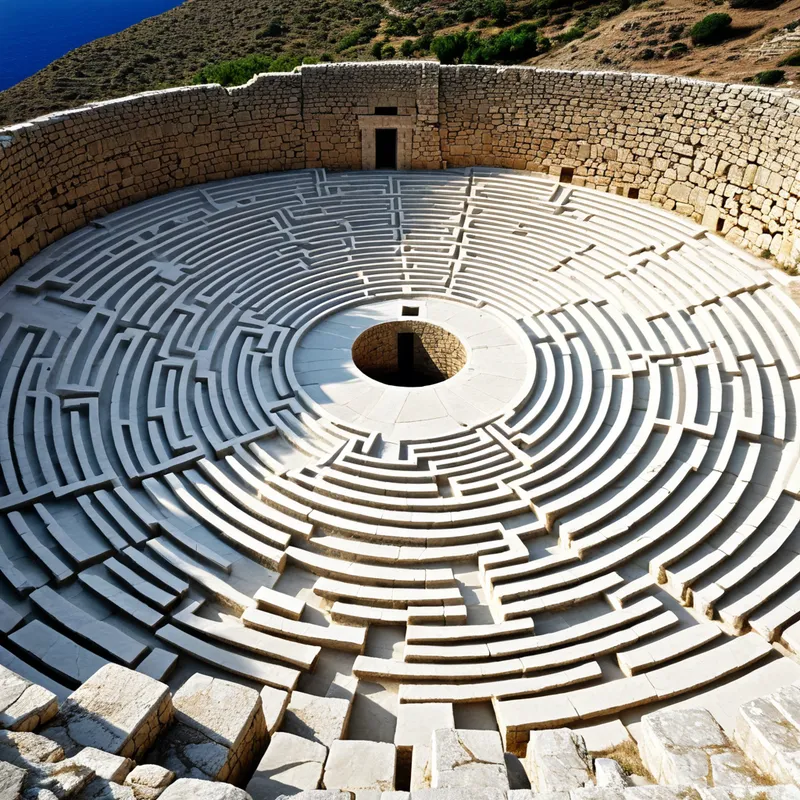
To hide his family’s disgrace, Minos commanded Daedalus to build a prison from which none could escape. And so the [Labyrinth](/myths/labyrinth “Myth from Various culture.”/) was born—a twisting, turning, stone-throated beast of corridors and dead ends, a puzzle of despair. Within its stony gut, [the Minotaur](/myths/the-minotaur “Myth from Greek culture.”/) raged, fed by a terrible tribute: every nine years, seven youths and seven maidens from conquered Athens were sent into the maze, a feast for the monster.
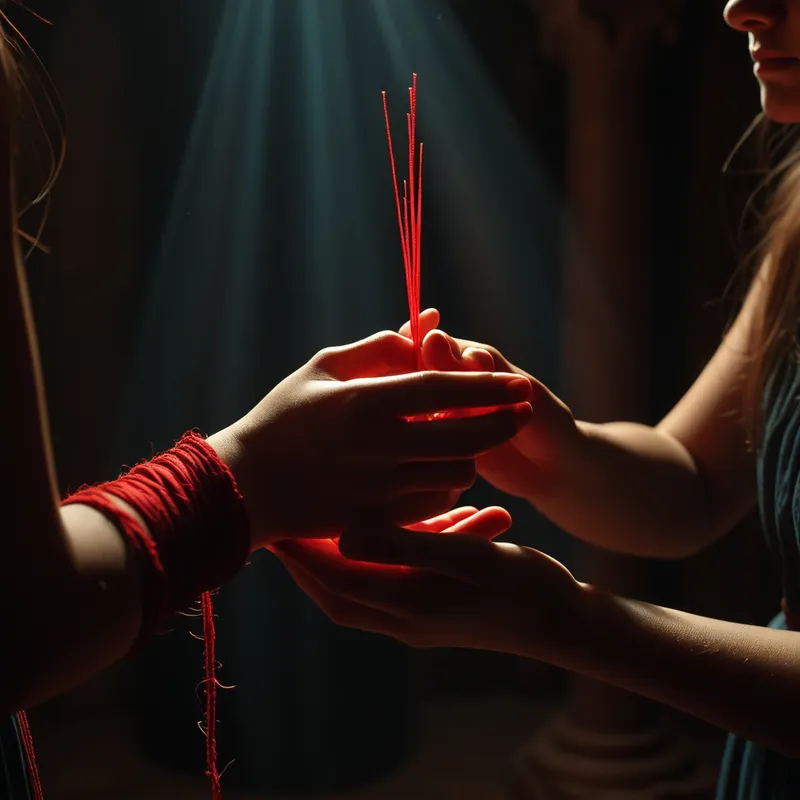
Then came the hero, [Theseus](/myths/theseus “Myth from Greek culture.”/), son of Aegeus. He volunteered as tribute, sailing on a black-sailed ship with death in his heart and destiny in his grip. In the palace of Knossos, a princess watched. Ariadne, whose name means “most holy,” saw the Athenian prince and was pierced by love and pity. Before he entered the mouth of [the Labyrinth](/myths/the-labyrinth “Myth from Greek culture.”/), she found him in secret. Her hands did not offer a sword, but a spindle of thread.
“Take this,” she whispered, the air thick with the scent of cedar and fear. “Tie one end to the entrance. Unwind it as you go. It will be your memory in stone, your path back to the light.” She also gave him a sword, but the thread was the greater gift. With a grateful heart, Theseus entered the darkness.
The air grew cold and still, the only sound the scuff of his sandals and the whisper of the thread paying out behind him. The walls pressed close, identical, mocking. He moved through the belly of the beast, guided by the faint, taut line of connection. Then came the smell—wet straw, blood, and animal musk. A heavy breathing echoed. In the central chamber, the Minotaur awaited, a mountain of muscle and rage, its eyes glowing with a trapped, lonely madness. There was no ceremony, only the primal clash of man and monster. Theseus fought, and with Ariadne’s help, he prevailed.
The monster slain, the hero was not free. He stood in the absolute dark, the center of [the world](/myths/the-world “Myth from Tarot culture.”/)’s confusion. But there, at his feet, gleamed the slender, crimson thread. He followed it, hand over hand, a pilgrim retracing his steps through his own terror, the walls now a blur as he raced toward the pinprick of daylight. He emerged, blinking, into the sun, pulling the thread of his salvation from the jaws of [the earth](/myths/the-earth “Myth from Hindu culture.”/). He took Ariadne, and they fled Crete, leaving the empty Labyrinth to the whispers of [the wind](/myths/the-wind “Myth from Various culture.”/).
Cultural Origins & Context
This myth is a cornerstone of the ancient Greek storytelling tradition, primarily preserved in the epic cycles and later works of authors like Hesiod, Herodotus, and most vividly in the Bibliotheca of Pseudo-Apollodorus. It functioned as a foundational national legend for Athens, explaining its dominance over Minoan Crete and celebrating the cunning and courage of its founding hero, Theseus. The story was not mere entertainment; it was a societal narrative about order triumphing over chaos, civilization over savagery, and the burdens of kingship. It was told in symposia, enacted in rituals, and depicted on pottery, serving to reinforce cultural identity, political authority, and the complex Greek understanding of divine [justice](/myths/justice “Myth from Tarot culture.”/) and human responsibility.
Symbolic Architecture
The [Labyrinth](/symbols/labyrinth “Symbol: The labyrinth represents a complex journey, symbolizing the intricate path toward self-discovery and understanding one’s life’s direction.”/) is not merely a [prison](/symbols/prison “Symbol: Prison in dreams typically represents feelings of restriction, confinement, or a lack of freedom in one’s life or mind.”/); it is the ultimate [symbol](/symbols/symbol “Symbol: A symbol can represent an idea, concept, or belief, serving as a powerful tool for communication and understanding.”/) of the unconscious [psyche](/myths/psyche “Myth from Greek culture.”/)—a convoluted, self-similar [structure](/symbols/structure “Symbol: Structure in dreams often symbolizes stability, organization, and the framework of one’s life, reflecting how one perceives their environment and personal life.”/) where [logic](/symbols/logic “Symbol: The principle of reasoning and rational thought, often representing order, structure, and intellectual clarity in dreams.”/) fails and the primal self resides.
The monster is not at the end of the maze; the maze is the body of the monster. To enter is to be consumed by the problem you seek to solve.
The [Minotaur](/symbols/minotaur “Symbol: The Minotaur, a creature from Greek mythology, is often interpreted as a symbol of inner turmoil and the struggle between human and beast.”/) represents the [shadow](/symbols/shadow “Symbol: The ‘shadow’ embodies the unconscious, repressed aspects of the self and often represents fears or hidden emotions.”/), the unlived [life](/symbols/life “Symbol: The symbol of ‘Life’ represents a journey of growth, interconnectedness, and existential meaning, encompassing both the joys and challenges that define human experience.”/), the bestial and shameful complex born from a “sin” of the past (Minos’s broken vow, Pasiphaë’s transgressive desire) that is hidden away but demands a bloody toll. Theseus is [the ego](/myths/the-ego “Myth from Jungian culture.”/)-[consciousness](/symbols/consciousness “Symbol: Consciousness represents the state of awareness and perception, encompassing thoughts, feelings, and experiences.”/) that voluntarily descends into this [chaos](/symbols/chaos “Symbol: In Arts & Music, chaos represents raw creative potential, uncontrolled expression, and the breakdown of order to forge new artistic forms.”/) to confront what has been repressed. But he does not go alone. Ariadne embodies the [anima](/symbols/anima “Symbol: The feminine archetype within the male unconscious, representing soul, creativity, and connection to the inner world.”/), the [soul](/symbols/soul “Symbol: The soul represents the essence of a person, encompassing their spirit, identity, and connection to the universe.”/)-guide, the connecting principle of love and relatedness that provides the crucial tool for return.
Her thread is the symbol of supreme importance: the linum, the [connection](/symbols/connection “Symbol: Connection symbolizes relationships, communication, and bonds among individuals.”/) to consciousness, to [memory](/symbols/memory “Symbol: Memory symbolizes the past, lessons learned, and the narratives we construct about our identities.”/), to the outside world. It is the slender, fragile, but unbreakable link of [intention](/symbols/intention “Symbol: Intention represents the clarity of purpose and direction in one’s life and can symbolize motivation and commitment within a dream context.”/), of love, of the guiding [idea](/symbols/idea “Symbol: An ‘Idea’ represents a spark of creativity, innovation, or realization, often emerging as a solution to a problem or a new outlook on life.”/) that allows one to navigate the inner chaos without becoming permanently lost.
The sword slays the beast, but the thread saves the soul. One is for conquest, the other for return.
The Dreamer’s Resonance
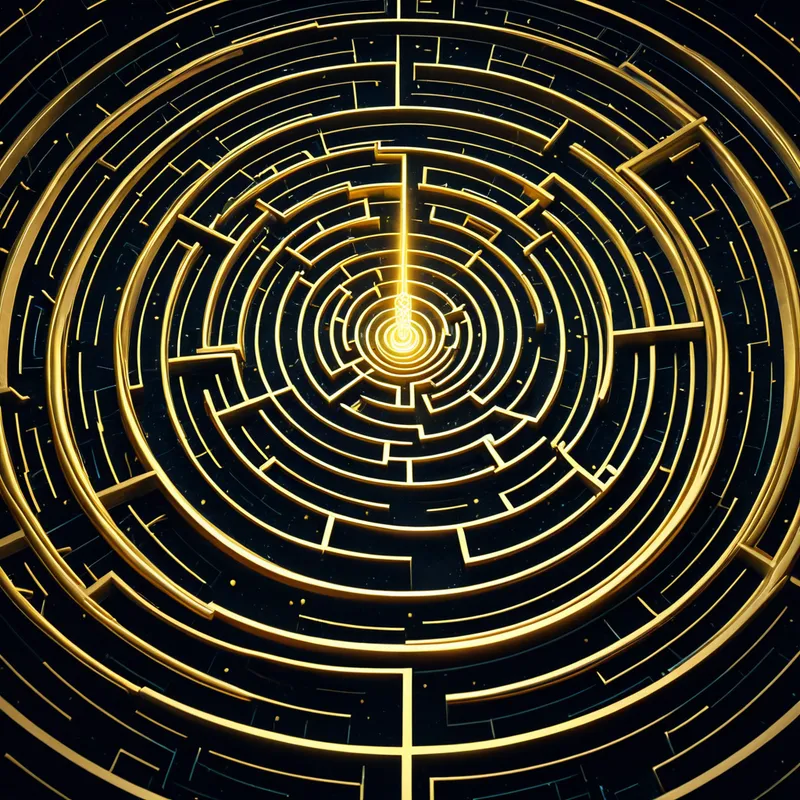
When this myth pattern stirs in the modern dreamer, it signals a profound encounter with the personal labyrinth. Dreaming of endless, identical corridors speaks to a feeling of being trapped in a repetitive psychological pattern, a career maze, or a relationship with no visible exit. The somatic experience is one of constriction, anxiety, and a racing heart—the body sensing it is in a trap.
To dream of a monster in such a place is to directly confront a shadow aspect: perhaps a rage (the bull), a shameful secret, or a consuming addiction that has been walled off. The dream may present a thread, a string of light, a voice, or a helping figure—this is the nascent appearance of the Ariadne function, the psyche’s own innate capacity to provide a guiding insight, a therapeutic connection, or a creative idea that can lead back to integration. The dream is an enactment of the psyche preparing for, or undergoing, a necessary confrontation and retrieval.
Alchemical Translation
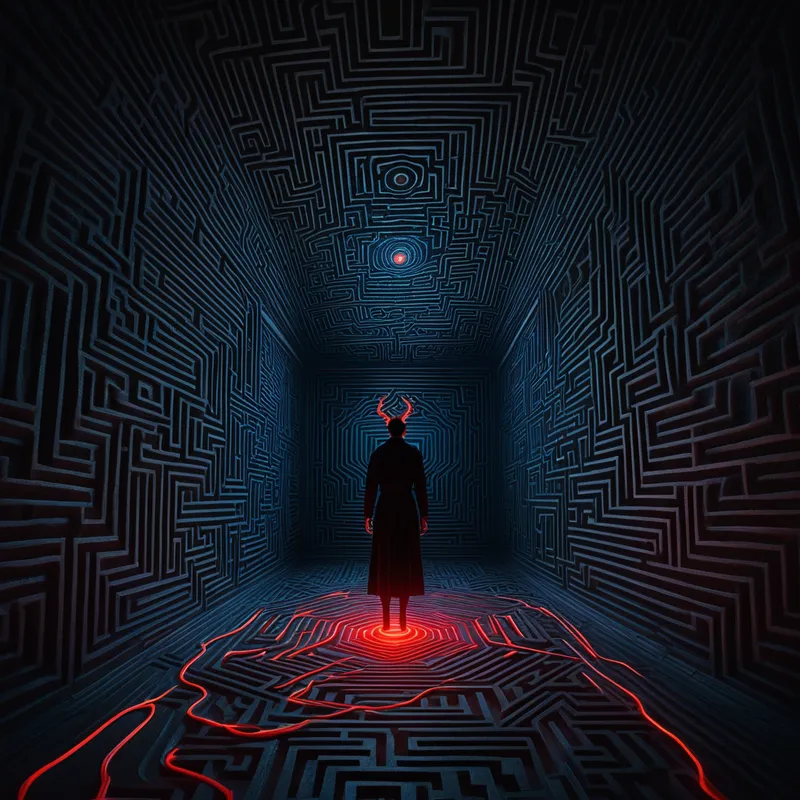
The myth models the complete arc of individuation. The [nigredo](/myths/nigredo “Myth from Alchemical culture.”/), the blackening, is the descent into the Labyrinth—the depression, confusion, or crisis that forces one inward. The confrontation with the Minotaur is the mortificatio, the killing of the old, autonomous complex that has ruled the inner kingdom from the shadows.
The alchemical gold is not found in slaying the beast, but in following the thread back out, carrying the knowledge of the center into the light of day.
Ariadne’s thread represents the conjunctio, [the sacred marriage](/myths/the-sacred-marriage “Myth from Various culture.”/) of consciousness (Theseus) and soul (Ariadne). Their union is brief in the literal myth, but eternal in the symbolic one—the hero internalizes the guiding function. The true [triumph](/myths/triumph “Myth from Roman culture.”/) is not the victory in the dark, but the successful return. The ego that enters the unconscious alone is doomed; the ego that enters tethered to a thread of meaning—be it love, art, faith, or therapy—can confront [the shadow](/myths/the-shadow “Myth from Jungian culture.”/) and re-emerge, transformed. The abandoned Labyrinth remains, but it is now a known place, a conquered territory of [the self](/myths/the-self “Myth from Jungian culture.”/). The modern individual’s journey is not to destroy their inner complexity, but to learn to navigate it, holding fast to the thread of conscious awareness that allows them to face their depths and return, whole.
Associated Symbols
Explore related symbols from the CaleaDream lexicon: