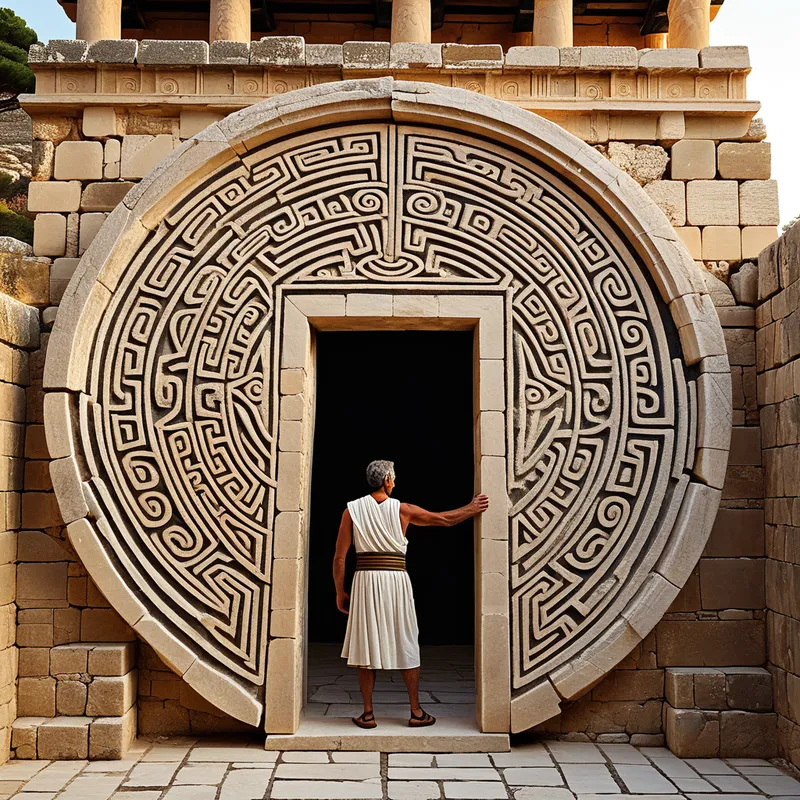
The Labyrinth Door Myth Meaning & Symbolism
A hero enters a maze to face a monstrous half-brother, guided by a thread through darkness to find the door back to his soul.
The Tale of The Labyrinth Door
Hear now of the door that was not made of wood or bronze, but of dread and royal shame. It stood on the sun-baked isle of Crete, in [the shadow](/myths/the-shadow “Myth from Jungian culture.”/) of the palace of [Minos](/myths/minos “Myth from Greek culture.”/). This was no ordinary threshold. It was the mouth of the [Labyrinth](/myths/labyrinth “Myth from Various culture.”/), a living puzzle of stone, a prison for a horror born of a broken oath.
The horror was the [Minotaur](/myths/minotaur “Myth from Greek culture.”/), Asterion. His breath was hot and rank in the endless corridors, his bellows echoing not from a beast’s throat alone, but from a place of profound, trapped anguish. He was the embodied curse of a king’s arrogance, fed on the flesh of Athenian youths and maidens, sent as tribute across the wine-dark sea.
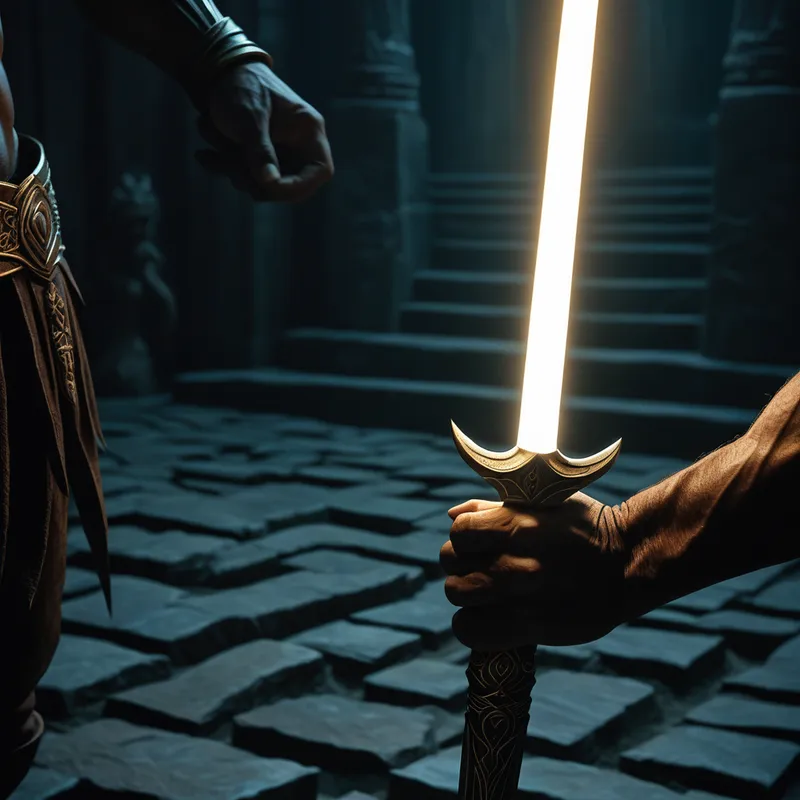
Then came the son of Aegeus. His name was [Theseus](/myths/theseus “Myth from Greek culture.”/), and in his heart burned not just the fire of a hero, but the cold resolve of one who would end a cycle of despair. He volunteered to be part of the tribute, to sail to Crete not as a victim, but as a hidden blade. In the court of Minos, his destiny was spun not by [the Fates](/myths/the-fates “Myth from Greek culture.”/) alone, but by a princess. Ariadne saw his nobility and, with a love as sudden as it was desperate, gifted him two things: a sword to slay the monster, and a skein of thread.
The door groaned open. The darkness within was not mere absence of light; it was a presence, thick and swallowing. The scent of damp stone, old blood, and animal musk washed over him. Theseus tied the thread to the lintel—a fragile tether to [the world](/myths/the-world “Myth from Tarot culture.”/) of sun and reason. Step by step, he paid out the line, his other hand clenched on the hilt of his sword. The passages turned upon themselves, a geometry of madness. The roars grew closer, vibrating in the stone beneath his feet. He followed the sound, a hunter drawn to the heart of the wound.
In the central chamber, they met. [The Minotaur](/myths/the-minotaur “Myth from Greek culture.”/) was colossal, muscle coiled under a hide of coarse hair, but in its eyes, Theseus did not see only beastly rage. He saw a confused, eternal pain. The fight was brutal, a clash of divine curse against mortal will. With a final, mighty heave, Theseus drove the blade home. The great body shuddered and fell silent. In that stillness, amidst the gore, the hero saw only a broken [thing](/myths/thing “Myth from Norse culture.”/), a symbol of a king’s sin.
Then came the true test. [The Labyrinth](/myths/the-labyrinth “Myth from Greek culture.”/), its purpose fulfilled, seemed to coil tighter, eager to make the victor its final prize. But the thread, that slender, brilliant idea of Daedalus, glimmered in the gloom. Theseus wound it back, hand over hand, following the path of his own courage out of the belly of the beast, past the whispering walls, back to the door. He stepped across [the threshold](/myths/the-threshold “Myth from Folklore culture.”/), from the stench of death into the salt-tinged air of dawn, the red thread his only bridge from nightmare back to life.
Cultural Origins & Context
This is a core myth of the Athenian identity, recorded most famously in the pseudo-historical works of later writers like Plutarch, but whose roots dig deep into the Bronze Age. It functioned as an etiological tale, explaining and justifying Athenian cultural and political submission to Minoan Crete in a distant, mythic past, transformed into a narrative of heroic liberation. The story was not static scripture but a living narrative, performed by bards and depicted on pottery, from drinking cups to monumental amphorae. It served as a powerful metaphor for [the polis](/myths/the-polis “Myth from Greek culture.”/) (city-state) of Athens itself: a heroic, intelligent force (Athena’s favored son, Theseus) overcoming the chaotic, monstrous, and tyrannical (the Minotaur and Minos). The Labyrinth was a known motif in Minoan culture—the complex palace of Knossos itself and the ritual dance of the Geranos—which the Greeks appropriated and mythologized into an architecture of terror.
Symbolic Architecture
The myth is a perfect map of the [psyche](/myths/psyche “Myth from Greek culture.”/)’s deepest [structure](/symbols/structure “Symbol: Structure in dreams often symbolizes stability, organization, and the framework of one’s life, reflecting how one perceives their environment and personal life.”/). The [Labyrinth](/symbols/labyrinth “Symbol: The labyrinth represents a complex journey, symbolizing the intricate path toward self-discovery and understanding one’s life’s direction.”/) is not a [prison](/symbols/prison “Symbol: Prison in dreams typically represents feelings of restriction, confinement, or a lack of freedom in one’s life or mind.”/) for the [monster](/symbols/monster “Symbol: Monsters in dreams often symbolize fears, anxieties, or challenges that feel overwhelming.”/); it is the monster externalized. It represents the convoluted, defensive [structure](/symbols/structure “Symbol: Structure in dreams often symbolizes stability, organization, and the framework of one’s life, reflecting how one perceives their environment and personal life.”/) of the unconscious mind, built to contain what the conscious self (Minos/[the ego](/myths/the-ego “Myth from Jungian culture.”/)) cannot integrate: the [Minotaur](/symbols/minotaur “Symbol: The Minotaur, a creature from Greek mythology, is often interpreted as a symbol of inner turmoil and the struggle between human and beast.”/), the [shadow](/symbols/shadow “Symbol: The ‘shadow’ embodies the unconscious, repressed aspects of the self and often represents fears or hidden emotions.”/).
The shadow is not what we have done, but what we have refused to become. It is the disowned self, raging in its maze.
The Minotaur, born of unnatural union, symbolizes the primal, instinctual, and “bestial” aspects of [human](/symbols/human “Symbol: The symbol of a human represents individuality, complexity of emotions, and social relationships.”/) [nature](/symbols/nature “Symbol: Nature symbolizes growth, connectivity, and the primal forces of existence.”/) that civilization (and the ego) seeks to deny and hide away. It is our raw [passion](/symbols/passion “Symbol: Intense emotional or physical desire, often linked to love, creativity, or purpose. Represents life force and deep engagement.”/), our unmediated rage, our bodily existence—not evil in itself, but monstrous only because it is imprisoned and starved, forced to feed on the vitality (the Athenian youths) of the conscious [personality](/symbols/personality “Symbol: Personality in dreams often symbolizes the traits and characteristics of the dreamer, reflecting how they perceive themselves and how they believe they are perceived by others.”/).
Theseus represents the heroic ego-[consciousness](/symbols/consciousness “Symbol: Consciousness represents the state of awareness and perception, encompassing thoughts, feelings, and experiences.”/) that dares to descend. His weapons are crucial: the sword (discrimination, focused will) and Ariadne’s thread (the [logos](/myths/logos “Myth from Christian culture.”/), the connecting principle of consciousness, often symbolized by the [anima](/symbols/anima “Symbol: The feminine archetype within the male unconscious, representing soul, creativity, and connection to the inner world.”/), the inner feminine guide). The thread is the supreme [symbol](/symbols/symbol “Symbol: A symbol can represent an idea, concept, or belief, serving as a powerful tool for communication and understanding.”/) of the myth—the intellectual or loving [connection](/symbols/connection “Symbol: Connection symbolizes relationships, communication, and bonds among individuals.”/) that allows one to venture into [chaos](/symbols/chaos “Symbol: In Arts & Music, chaos represents raw creative potential, uncontrolled expression, and the breakdown of order to forge new artistic forms.”/) and return, transformed, to order.
The door is the liminal space where one identity is shed and another is not yet born. To cross it is to consent to the ordeal of becoming.
The Dreamer’s Resonance
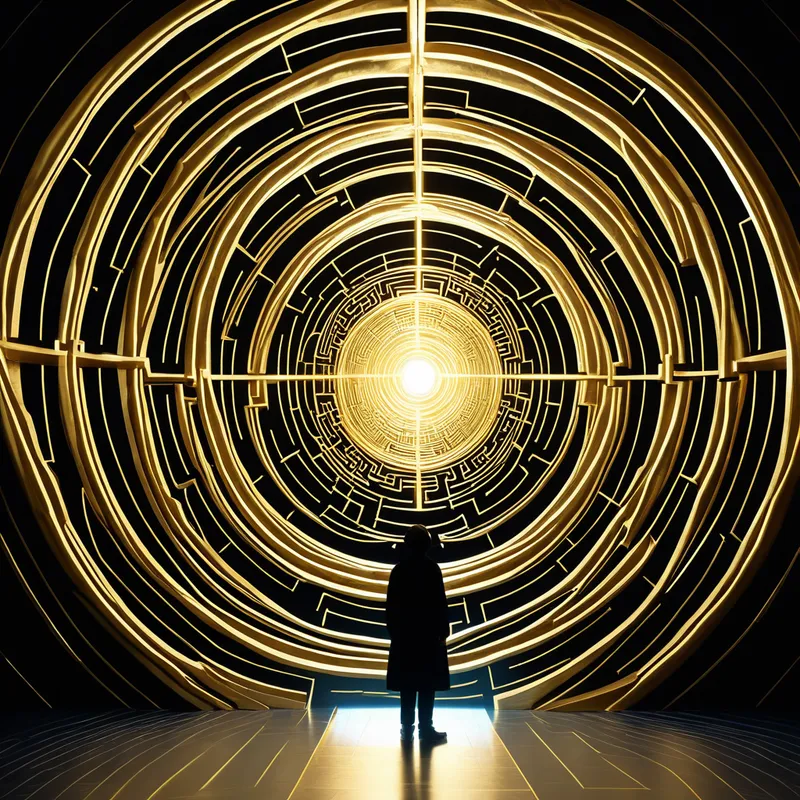
When this myth stirs in modern dreams, it signals a profound confrontation with the personal shadow. Dreaming of being lost in a maze, hearing distant roars, or clutching a thread speaks to a somatic process of navigating deep anxiety, a feeling of being trapped by one’s own psyche. The labyrinthine office, the endless school hallway, the basement that goes on forever—these are modern translations. The body may respond with a racing heart, a sense of constriction, or the chilling sweat of the hunt.
The dream-Minotaur is rarely a literal bull-man. It may be a frightening figure, a pursuing animal, or even a overwhelming emotion or memory that stalks the dreamer. The psychological process is one of recognition. The dream urges the dreamer not to flee, but to turn and face the pursuer, to see what part of themselves has been walled away and is now demanding acknowledgment. Finding a door or a thread in such a dream is a moment of immense relief, indicating the nascent emergence of a guiding insight or connection that can lead to integration.
Alchemical Translation
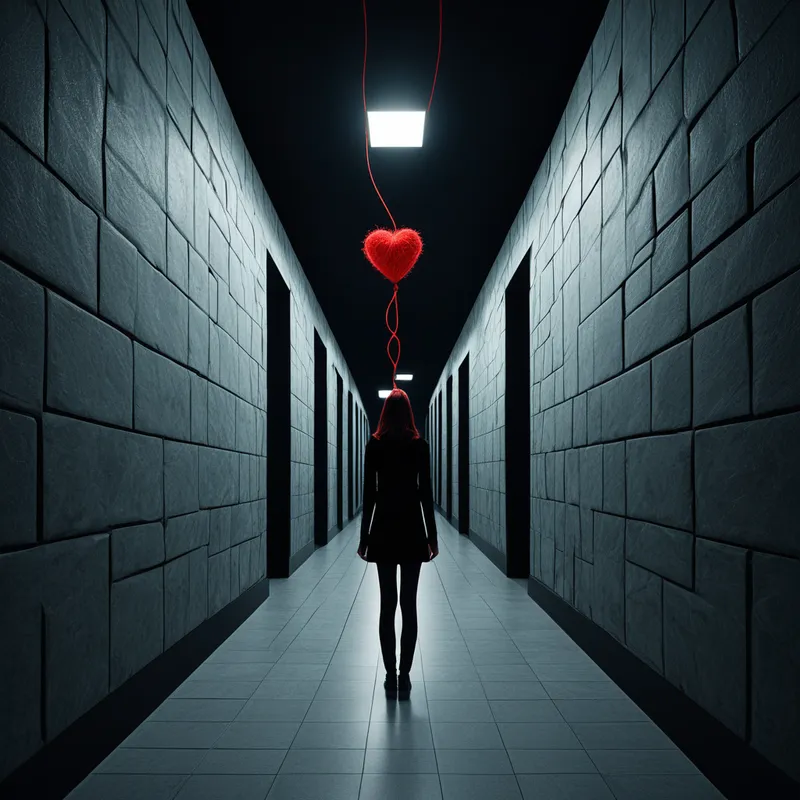
The myth models the alchemical individuation process with stunning clarity. The journey is one of psychic transmutation, where the base material of the shadow is engaged and integrated to produce the gold of the whole self.
[The first stage](/myths/the-first-stage “Myth from Alchemical culture.”/) is [nigredo](/myths/nigredo “Myth from Alchemical culture.”/), the descent into darkness: crossing the Labyrinth door, entering the depression, confusion, or crisis. The hero, our conscious attitude, must willingly enter this state. The battle with the Minotaur is the mortificatio—the killing of the old, autonomous complex. It is not a murder of part of [the self](/myths/the-self “Myth from Jungian culture.”/), but the dissolution of its monstrous, autonomous form.
The slaying is not destruction, but the breaking of a spell. The monster must die so that the energy it held captive can be freed.
Here, Ariadne’s thread is the vinculum, the connective substance without which the operation fails and the ego is lost in psychosis (madness in the maze). Winding the thread back is the albedo, the washing clean, the return with new consciousness. Theseus emerges not just a victor, but a king-in-waiting, having reclaimed the vital energy (the bull-strength) that was trapped in the shadow. The monster is transcended, and its power is made available to the larger Self. The Labyrinth Door, once a seal on a secret shame, becomes a remembered threshold of initiation, a scar that marks where the soul entered its own depths and returned, whole.
Associated Symbols
Explore related symbols from the CaleaDream lexicon: