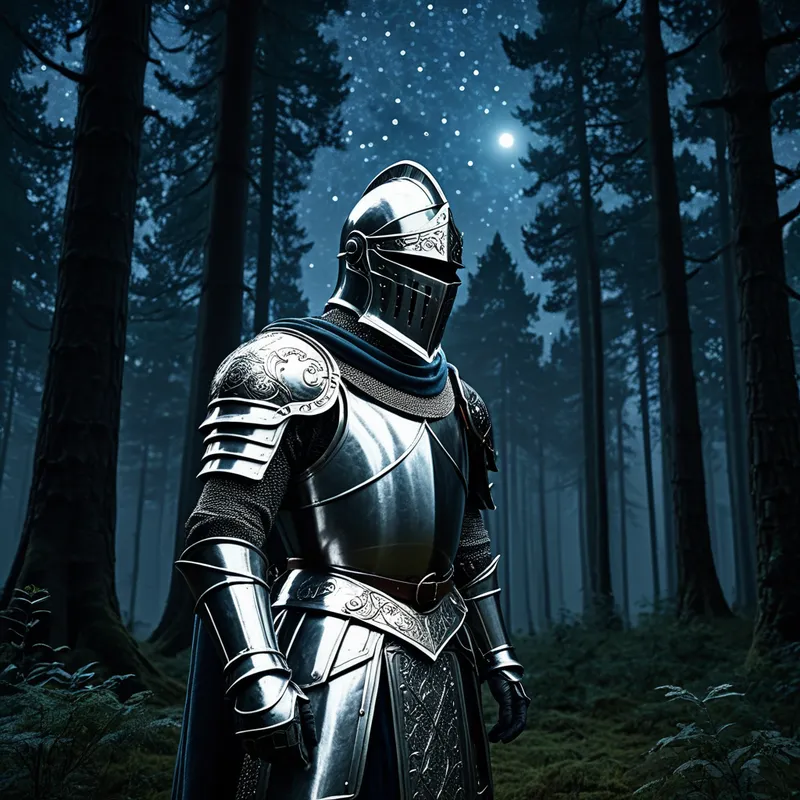
The Knight's Helmet Myth Meaning & Symbolism
A knight's enchanted helmet conceals his true face, forging a legend of identity, sacrifice, and the armor we wear between our soul and the world.
The Tale of The Knight’s Helmet
Listen, and hear a tale not of a sword pulled from stone, but of a face never seen. In the twilight years of Camelot, when the quest for the [Grail](/myths/grail “Myth from Christian culture.”/) had hollowed the halls and weary resolve hung in the air like mist, a knight arrived without a name.
He came at the dying of the day, a silhouette against the blood-red sun. His armor was not the gilded plate of [Lancelot](/myths/lancelot “Myth from Arthurian culture.”/), nor the weathered mail of Gawain. It was simple, unadorned steel, save for the helmet. That helmet was a masterpiece of the smith’s art, seamless and closed, its visor a single, smooth plate of polished silver that held [the world](/myths/the-world “Myth from Tarot culture.”/)’s reflection like a dark lake. No clasp, no hinge was visible. He spoke in a voice that seemed to rise from a deep well, resonant yet muffled, and he offered his sword to the King without ever giving his name. The court, in its hunger for new wonders, called him the Knight of [the Mirror](/myths/the-mirror “Myth from Various culture.”/)-Visor.
He performed deeds of startling, silent prowess. He defended villages with a strategic ferocity that spoke of a seasoned general. He bested champions in the lists with a grace that hinted at a noble lineage. Yet he never lifted his visor to drink, to eat, or to accept the laurels of victory. Whispers coiled around him like serpents. Some said he was a prince under a curse. Others murmured he was a spirit of the land, armoured in mortal form. Ladies sighed for the mystery; knights bristled at the secrecy. The helmet itself became his identity—an impenetrable fortress behind which a soul, unknown even to itself, resided.
The test came not in battle, but in the heart of the Perilous Forest. A sorceress of the old blood, a guardian of forgotten truths, laid a geas upon the land: a blight that withered crops and stilled the hearts of beasts. She would lift it only for a price—a truth. Not any truth, but the face of the knight who hid from the sun and moon alike. Arthur, bound by his kingly duty to his people, with a heart heavy as stone, asked the Knight of the Mirror-Visor for this sacrifice.
The knight did not refuse. He walked into the forest’s deepest grove, where the sorceress waited beside a spring as clear and deep as time. The air was thick with the scent of damp earth and magic. “Remove your helmet,” she commanded, “and show the face you have denied the world. Show the face you have perhaps denied yourself.”
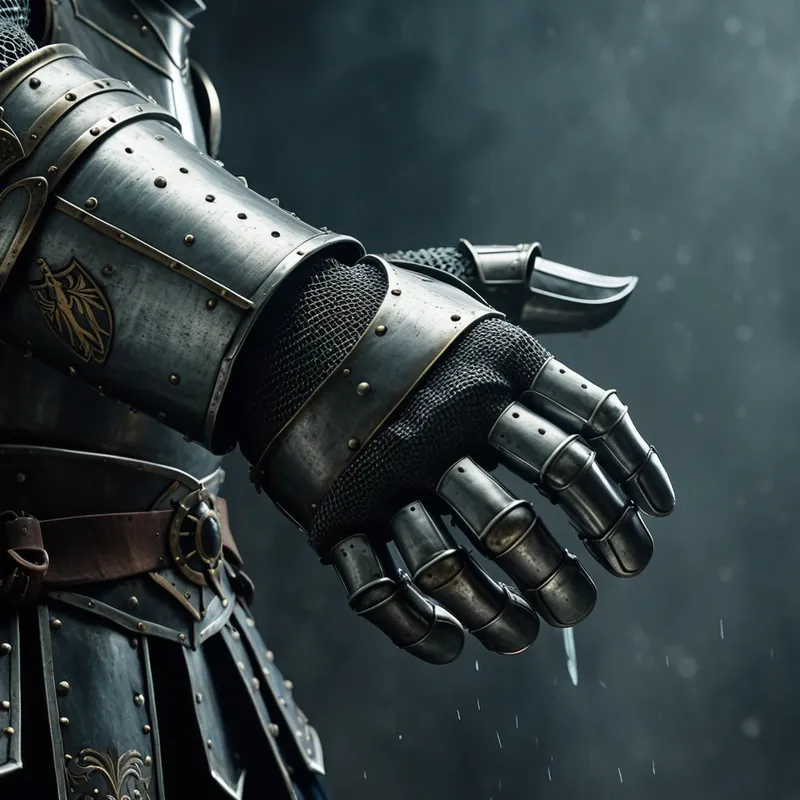
The knight stood motionless. Then, his gauntlets rose. Where there was no clasp, his fingers found purchase. Where there was no seam, a line of light appeared. With a sound like a sigh held for a lifetime, the helmet parted. He lifted it from his shoulders and let it fall to the mossy ground. There was no monstrous visage, no mark of shame. The face revealed was… ordinary. Handsome, yes, and strong, but etched with a profound, human sorrow. It was the face of a man who had carried a kingdom’s grief, a brother’s failure, a lover’s loss—burdens so personal they had become universal. He was not a cursed prince, but a man who had chosen the helmet to contain a pain too vast for a single name.
The sorceress did not smile, but her eyes softened like winter frost yielding to spring. “The truth was not the face,” she said, her voice now gentle. “The truth was the courage to be seen bearing it.” The blight lifted. The knight returned to Camelot, his face known to all. Yet, from that day, he was never quite the same man who had worn the mirror-visor. He was something more, and something less: a man finally integrated with his own story.
Cultural Origins & Context
This tale exists in the murky borderlands of the Arthurian canon, more folktale than romance. It is not found in Malory or Chrétien de Troyes, but in the local oral traditions that clung to the hills and valleys of Britain long after the dream of Camelot faded. It was a story told by firesides, not scribed in illuminated manuscripts—a “what if” tale that explored the psychological undercurrents of the chivalric ideal.
Its tellers were likely bards and village elders for whom [the Knights of the Round Table](/myths/the-knights-of-the-round-table “Myth from Arthurian culture.”/) were not distant paragons, but archetypes reflecting human dilemmas. The societal function of this myth was to question the very armor of knighthood. In a culture obsessed with heraldry, lineage, and public honor (one’s “face” in society), this story asked: What cost does that public identity demand? What must be hidden to maintain the perfect, reflective surface of honor? It served as a cautionary tale about the isolation of perfection and a validation of the healing found in vulnerable, shared humanity.
Symbolic Architecture
The [helmet](/symbols/helmet “Symbol: A helmet in dreams typically symbolizes protection, security, and the mental frameworks we use to shield ourselves from emotional pain.”/) is the central, consuming [symbol](/symbols/symbol “Symbol: A symbol can represent an idea, concept, or belief, serving as a powerful tool for communication and understanding.”/). It is not merely protection; it is a [prison](/symbols/prison “Symbol: Prison in dreams typically represents feelings of restriction, confinement, or a lack of freedom in one’s life or mind.”/) of one’s own making, a [persona](/symbols/persona “Symbol: The social mask or outward identity one presents to the world, often concealing the true self.”/) forged so completely it becomes a sarcophagus for the true self. The mirror-like [visor](/symbols/visor “Symbol: A visor symbolizes protection and focus, often related to clarity of vision and mental acuity in navigating life’s challenges.”/) is particularly potent: it reflects the world’s expectations, its desires, and its projections back upon itself, allowing the wearer to hide while giving the illusion of engagement.
The greatest armor is not forged of steel, but of the stories we believe others require of us.
The [knight](/symbols/knight “Symbol: The knight symbolizes honor, chivalry, and the pursuit of noble causes, reflecting the ideal of the noble warrior.”/) represents the [hero](/symbols/hero “Symbol: A hero embodies strength, courage, and the ability to overcome significant challenges.”/) [archetype](/symbols/archetype “Symbol: A universal, primordial pattern or prototype in the collective unconscious that shapes human experience, behavior, and creative expression.”/) in its most [interior](/symbols/interior “Symbol: The interior symbolizes one’s inner self, thoughts, and emotions, often reflecting personal growth, vulnerabilities, and secrets.”/) form. His [quest](/symbols/quest “Symbol: A quest symbolizes a journey or search for purpose, fulfillment, or knowledge, often representing life’s challenges and adventures.”/) is not to conquer a [dragon](/symbols/dragon “Symbol: Dragons are potent symbols of power, wisdom, and transformation, often embodying the duality of creation and destruction.”/), but to conquer his own need for [the dragon](/myths/the-dragon “Myth from Chinese culture.”/)—the externalized conflict that justifies his hiddenness. The act of removal is the ultimate heroic deed, requiring more courage than any physical battle. The sorceress represents the [anima](/symbols/anima “Symbol: The feminine archetype within the male unconscious, representing soul, creativity, and connection to the inner world.”/) or the deep, often feared, wisdom of the unconscious that demands authenticity as the price for healing and [fertility](/symbols/fertility “Symbol: Symbolizes creation, growth, and abundance, often representing new beginnings, potential, and life force.”/) (the lifting of the [blight](/symbols/blight “Symbol: A pervasive, destructive force that withers life, hope, or potential. Often represents decay, corruption, or systemic failure.”/)).
The Dreamer’s Resonance
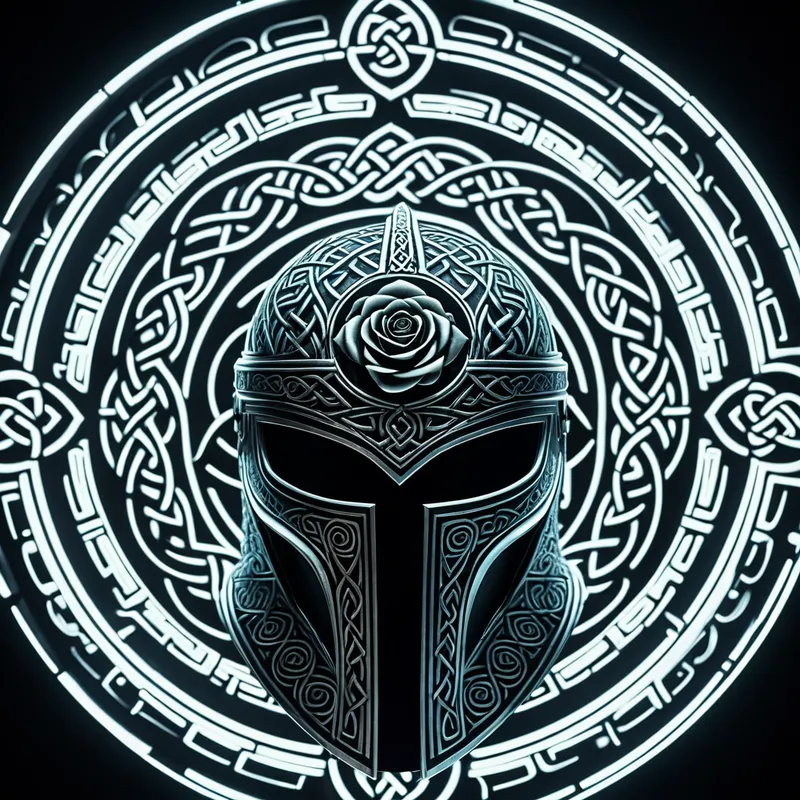
When this myth surfaces in modern dreams, the dreamer is often at a crossroads of identity. The helmet may appear as a stifling job title, a rigid role as caregiver or provider, a social media facade, or simply the exhausting effort of “keeping it together.” Dreaming of being unable to remove a helmet signals a somatic feeling of suffocation and isolation—the [psyche](/myths/psyche “Myth from Greek culture.”/) feeling trapped within its own defenses.
Dreams where one chooses to don the helmet often precede periods where we feel we must compartmentalize a vulnerable part of [the self](/myths/the-self “Myth from Jungian culture.”/) to function. The pivotal dream moment—the struggle or decision to remove it—marks the beginning of a profound psychological process: the reintegration of the disowned self. The relief or terror upon removal in the dream is a direct reflection of the dreamer’s readiness to be seen, and to see themselves, in their full, unarmored humanity.

Alchemical Translation
The myth models the alchemical process of [solutio](/myths/solutio “Myth from Alchemical culture.”/) followed by coagulatio. The knight’s life in the helmet is the [nigredo](/myths/nigredo “Myth from Alchemical culture.”/), the leaden state of isolated, hidden suffering. The king’s request and the sorceress’s demand are the catalytic fire, the forced confrontation.
The removal of the helmet is the solutio—the dissolution of the hardened, metallic [persona](/myths/persona “Myth from Greek culture.”/) in the waters of truth and exposure. This is not a destruction, but a merciful melting. The ordinary, sorrow-etched face revealed is the albedo, the whitening: the humbling, human essence laid bare, cleansed of its grandiose or hidden projections.
Individuation is not the forging of a better mask, but the sacred, terrifying act of laying all masks upon the altar of the self.
Finally, the knight’s return, integrated, to his life is the [rubedo](/myths/rubedo “Myth from Alchemical culture.”/), the reddening or gold-making. He is the same, yet fundamentally changed. His power is no longer in the mystery of his hiddenness, but through the authenticity of his revealed being. He carries his history in his face, not behind a shield. For the modern individual, the alchemy lies in identifying what “helmet” we wear, understanding the original, perhaps necessary, protection it offered, and finding [the sacred grove](/myths/the-sacred-grove “Myth from Celtic culture.”/)—the safe, contained space of therapy, art, or profound relationship—where we can perform the ritual of removal, transforming isolated armor into integrated strength.
Associated Symbols
Explore related symbols from the CaleaDream lexicon: