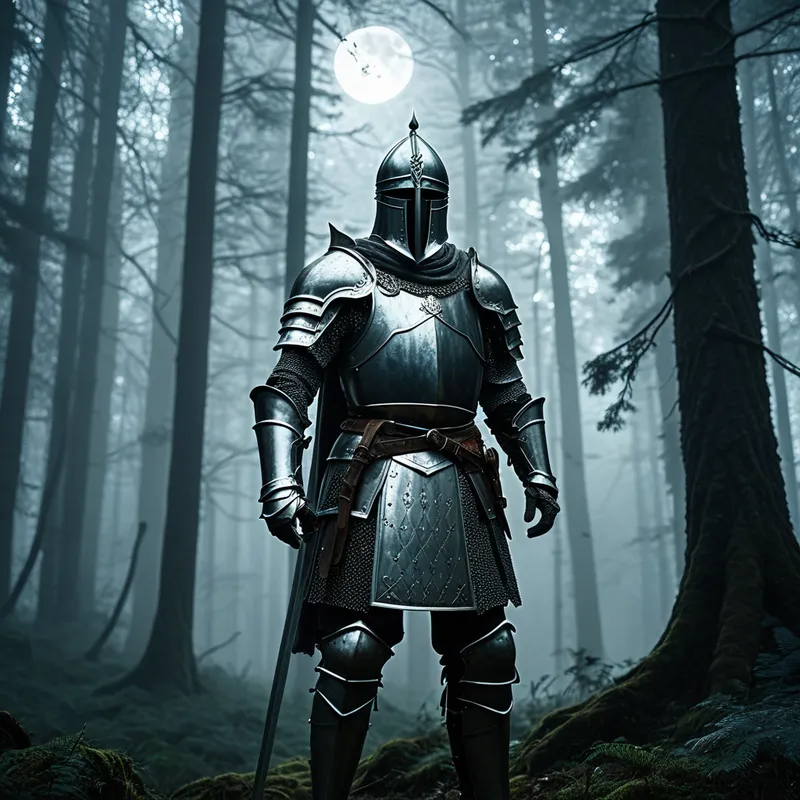
The Knight's Armor Myth Meaning & Symbolism
A knight's enchanted armor becomes his prison, forcing a confrontation with the shadow self to reclaim a soul forged in vulnerability and truth.
The Tale of The Knight’s Armor
Listen, and let the mists of Avalon part. There was a knight, not the greatest in name, but one whose heart burned with a pure, fierce light. His name is lost to us, for his story is not about a name, but a shell. He served a noble lord in the wild marches of Camelot, a land where the veil between the worlds of men and the Sidhe was thin as morning frost.
On a quest to rescue a stolen child from the tangled, whispering woods, the knight faced a creature of glamour and malice. It was not a beast of tooth and claw, but a spirit of envy, a hollow thing that coveted his unwavering purpose. Their battle was silent, a contest of wills in a moonlit clearing. The knight prevailed, driving the entity back into the roots of an ancient oak with a prayer and the sign of the cross. But as the spirit dissipated, it uttered a curse not of death, but of stasis. “You who hide behind steel,” it hissed, its voice like rustling leaves, “shall become it. Your strength shall be your cage.”
The knight felt a chill, but found no wound. He returned the child, a hero. Yet, that night, as he sought to remove his armor after the vigil, he found the clasps would not yield. The steel had fused to his skin. Panic, then desperate force, availed him nothing. The armor was now his second skin, unremovable, permanent. At first, it was a boon. He felt no fatigue, feared no blade. In tournaments, he was invincible. In battle, a terror. He was called the Iron Knight, a living statue of war.
But seasons turned. He could not feel the sun on his face, nor the grip of a friend’s hand. He could not taste wine, nor smell the rain on summer earth. The world reached him muted, through a slit of vision and the echo of sound within a metal helm. His heart, once a furnace of feeling, began to beat in time with the slow, cold rhythm of the ore. He was becoming the armor. His memories of softness—his mother’s lullaby, the touch of a lost love’s hair—began to feel like stories about another man. The armor was not protecting him; it was erasing him.
In deepest despair, he rode beyond the known maps, to the shores of a black, still lake. There, an old hermit, a man said to speak with the voices of the land, awaited him. “You sought to keep the world out,” the hermit said, his eyes seeing the man within the metal. “Now you must let it in. The curse is not in the steel, but in your agreement with it. You believed the shell was the self.” The hermit gave him not a sword, but an instruction: “Sit. Be still. Listen not to the world, but to the silence within your cage. The key is there.”
For days and nights, the Iron Knight sat at the lake’s edge, a statue in vigil. He let the panic, the rage, the profound loneliness wash through him. In that absolute internal silence, he heard it: a faint, familiar sound. The sound of his own weeping, trapped deep within the steel cavern of his form. He did not fight it. He turned his awareness toward that raw, vulnerable sound—the very thing the armor was meant to shield. He focused on it with all the will he once used to swing a sword.
And as he attended to his own hidden weeping, a warmth began in his chest. It was not the heat of a forge, but the gentle warmth of a living heart. A golden light, faint as a candle flame, glowed from within the breastplate. Where the tears of his spirit fell inside the armor, the steel began to soften, not to melt, but to become permeable. Starting at the heart, then spreading along the seams, the enchanted metal flowed like liquid moonlight and fell away, not as shattered plates, but as petals of light dissolving into the lake. He was left kneeling on the shore, naked, shivering, utterly human—and free. The first sensation was the cool night air on his skin, and it was more glorious than any victory.

Cultural Origins & Context
The motif of the binding or imprisoning armor is not a single, codified Arthurian legend from a text like Le Morte d’Arthur, but a powerful archetypal fragment that echoes through the corpus. It emerges from the Celtic substrate of the myths, where enchantment, shape-shifting, and curses that blur the line between human and object are common. This tale lives in the narrative space between the knight’s glorious ideal and his human fragility.
It would have been a story told not in the great hall, but in the barracks, by firelight, or by a traveling storyteller at a crossroads inn. Its function was deeply psychological for a warrior society. It served as a cautionary tale about the perils of the vocation: the danger that the role of the protector, the miles christi (soldier of Christ), could consume the individual. It asked the knight, and by extension any person in a rigid societal role, a terrifying question: What happens when the symbol of your power becomes the substance of your prison? It reinforced a core, often unspoken, Celtic belief that true strength was fluid, adaptable, and connected to the vulnerable heart, not just the unyielding will.
Symbolic Architecture
The Knight’s Armor is the ultimate symbol of the Persona taken to a literal, life-threatening extreme. It is the constructed identity—the warrior, the professional, the perfect son or daughter—that initially serves a necessary function but can, through trauma, fear, or enchantment (unconscious identification), become fused to the psyche.
The armor is not forged in the smithy, but in the agreement between fear and identity. Its final clasp is always fastened from the inside.
The curse represents the moment the psyche internalizes a wound and builds a permanent defense around it. The knight’s victory over the envious spirit is a classic inflation of the ego; he believes in his invulnerability, and the unconscious responds by making that belief horrifyingly literal. The lake and the hermit symbolize the Self and its wisdom, accessed only when the heroic ego’s striving ceases. The dissolution of the armor through attending to inner vulnerability is the key symbolic action.
Liberation comes not from breaking the shell, but from realizing the shell was never you. The warmth that melts it is the forgotten truth of your own feeling.
The Dreamer’s Resonance
When this myth stirs in modern dreams, it rarely appears as medieval plate mail. It manifests as dreaming of being trapped in a suit, a uniform that won’t come off, of having skin turned to plastic or stone, or of being a robot discovering a human heart. The somatic experience is one of constriction, numbness, and profound isolation. The dreamer is going through a critical psychological process: the realization that a long-held identity structure has become a prison.
This is the psyche’s alarm bell signaling that the adaptation which once served survival is now inhibiting life. The feeling of being watched from behind one’s own eyes, of actions feeling automated, of emotional flatness—these are the dream equivalents of the knight’s muted senses. The dream is an invitation to the vigil by the lake: to stop trying to fight the structure externally (which only reinforces it) and to turn inward to find the locked-away vulnerability, the “weeping within the steel,” that holds the authentic key to release.

Alchemical Translation
The myth models the alchemical process of solutio—dissolution—followed by a rebirth of the integrated self. In psychological alchemy, the first stage is often nigredo, the blackening or despair, represented by the knight’s hopeless journey to the black lake. His stillness is the mortificatio, the death of the old, armored ego.
The crucial alchemical operation here is not the fiery calcinatio (which would be trying to smash the armor), but the watery solutio. The knight dissolves his prison not with force, but with the waters of feeling—his own acknowledged tears. The armor turning to liquid light is the transmutation of a rigid, leaden complex into a fluid, conscious awareness. What was a separating shell becomes re-integrated, returning to the psychic waters (the lake) from which it was erroneously formed.
Individuation is not about adding more plates to your armor, but about developing the courage to sit by the dark water and listen for the soft, human sound you buried long ago.
The triumph is not a return to a prior, “unarmored” innocence. That is impossible. The knight is reborn with the memory of the armor. He now knows its weight and its illusion. His newfound vulnerability is not weakness, but a conscious, hard-won strength. He has performed the ultimate alchemy: turning the experience of imprisonment into the wisdom of freedom, achieving a Self that can engage the world not from behind a wall of steel, but from a centered, feeling heart. He is no longer the Iron Knight, but simply, and profoundly, a knight.
Associated Symbols
Explore related symbols from the CaleaDream lexicon: