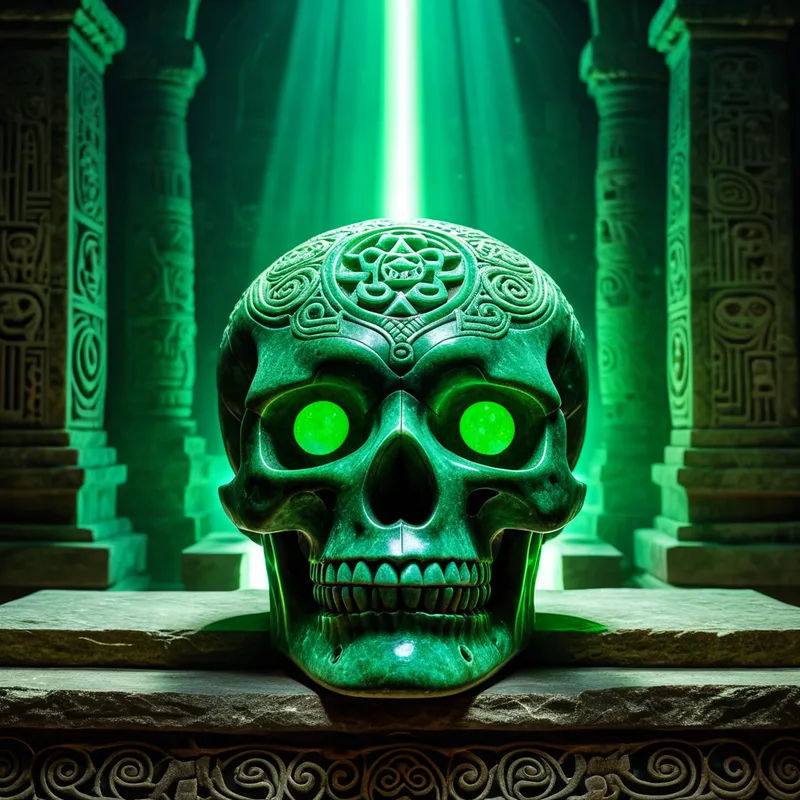
The Jade Skull Myth Meaning & Symbolism
A myth of a hero's descent into the underworld to retrieve a sacred jade skull, transforming death into a vessel for cosmic wisdom and renewal.
The Tale of The Jade Skull
Listen, and let the smoke of copal carry you back. Before the stone cities, when the world was young and soft, the sun was a capricious youth. It would blaze with fury, then hide for days, leaving the people cold and the maize stalks brittle. The wise ones consulted the stars and the flight of birds, but the answer lay not in the sky, but in the deep, silent belly of the earth.
It was said that in the heart of Xibalba, the Place of Fright, the Lords of Death guarded a great treasure. Not gold, nor silver, but a skull carved from a single, flawless piece of living jade. This was the Yax Ch’ich’ Baak, and within its polished curves slept the secret of balance—the knowledge to coax the sun from its slumber and ensure the rains returned.
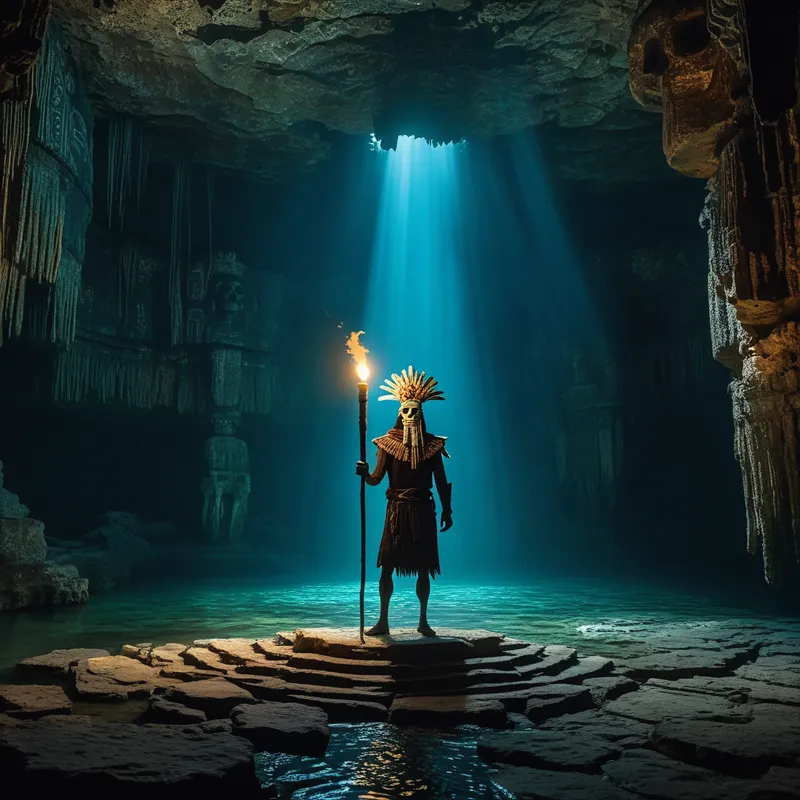
A hero was chosen, not for his strength in battle, but for the stillness in his heart. His name is lost to the ceiba trees, but we shall call him Ah K’in, the Child of the Sun. His journey began at the mouth of a cenote, a wound in the world leading down into perpetual night. The air grew thick and cool, smelling of wet stone and ancient roots. Phosphorescent fungi painted ghostly maps on the walls, and the drip of water echoed like a slow, dying heartbeat.
He passed through chambers of trial. In one, a river of scorpions flowed silently; he walked its length on faith, his bare feet untouched. In another, whispers promised him kingdoms if he would turn back; he offered them only silence. Finally, in a cavern lit by a single shaft of light from a distant sky-hole, he found them. The Lords of Death were not monstrous, but regal and terribly still, seated on thrones of obsidian and bone. Between them, on a pedestal of stalagmite, rested the Jade Skull. It drank the faint light and glowed with a deep, vegetative peace.
“You have come for the heart of the world,” spoke One Death, his voice like grinding stones. “It is ours. To take it, you must leave something of equal weight. What do you offer?”
Ah K’in had brought no jewels, no captives. He looked at the luminous skull, then into the empty sockets of the Lords. He understood. The only thing of equal weight to the secret of life was a life itself. Not through violence, but through surrender. He did not draw a blade. Instead, he lay down upon the cold stone floor, directly beneath the shaft of light. He closed his eyes, slowed his breath, and let the chill of the underworld enter him. He offered his own vitality, his warmth, his claim on the sunlit world above.
For nine days, he lay as if dead. The Lords watched, impassive. On the tenth day, as the distant sun pierced the cenote’s opening once more, the beam of light fell upon his chest. But instead of illuminating flesh, it passed through him as if through clear water and struck the Jade Skull. The skull blazed with an emerald fire. The light refracted, filling the cavern with swirling patterns of life—maize plants, flowing rivers, dancing children.
The Lords of Death inclined their heads. The balance was struck. Ah K’in’s sacrifice had not been a theft, but an exchange—mortal breath for immortal pattern. When he stirred, he was not weakened, but filled with a cool, clear knowledge. One Death gestured to the skull. “Take it. It is no longer ours alone. It is now also yours. Carry its wisdom to the living world. Remember the darkness that gives it light.”
Ah K’in ascended, the Jade Skull cradled in his arms. When he emerged, the people saw that his eyes held the deep, green stillness of the cenote’s pool. He placed the skull in the temple, and that very evening, the sun set in a blaze of glory, promising a sure return. The rains came. And the people learned that life does not fear death, but is in constant, sacred conversation with it.
Cultural Origins & Context
The myth of the Jade Skull is a composite narrative, drawing from the deep well of Mesoamerican cosmovision, particularly Mayan and Aztec traditions. It is not a single, codified text, but a story pattern that emerges from the interpretation of artifacts, colonial-era chronicles like the Popol Vuh, and the enduring oral histories of indigenous communities. The story would have been told by priests (Ah Kinob) and elder storytellers during ceremonies or community gatherings, often alongside the ritual use of the actual, revered objects: jade beads, plaques, and rare carvings.
Jade (yax) was more valuable than gold to these cultures. It symbolized water, vegetation, life-force, and the soul. A skull fashioned from jade was the ultimate alchemical symbol: the fusion of the enduring vessel of consciousness (the skull) with the essence of eternal, fertile life (jade). This myth served a crucial societal function, providing a metaphysical framework for understanding the necessity of sacrifice, the agricultural cycle, and the journey of the soul. It justified ritual practices, from bloodletting by nobles to the symbolic “death” of kings during accession rites, framing them not as acts of despair, but as sacred exchanges that maintained cosmic order.
Symbolic Architecture
At its core, the myth is a map of the psyche’s relationship with the ultimate Other: mortality. The Jade Skull itself is the central symbol of this reconciliation.
The most precious wisdom is not found in the light of day, but forged in the respectful confrontation with the night.
The hero’s journey into Xibalba represents the ego’s necessary descent into the unconscious—the realm of forgotten memories, instincts, and the psychic substrate we often fear. The Lords of Death are not mere villains; they are the guardians of this profound, often terrifying, knowledge. They demand a price because wisdom of this depth cannot be taken; it must be earned through the surrender of a naïve attitude. Ah K’in’s offering of his own living warmth is the pivotal act. It symbolizes the sacrifice of the ego’s illusion of separateness and control. He does not fight the darkness; he merges with it temporarily, allowing his individual identity to be dissolved in service of a greater understanding.
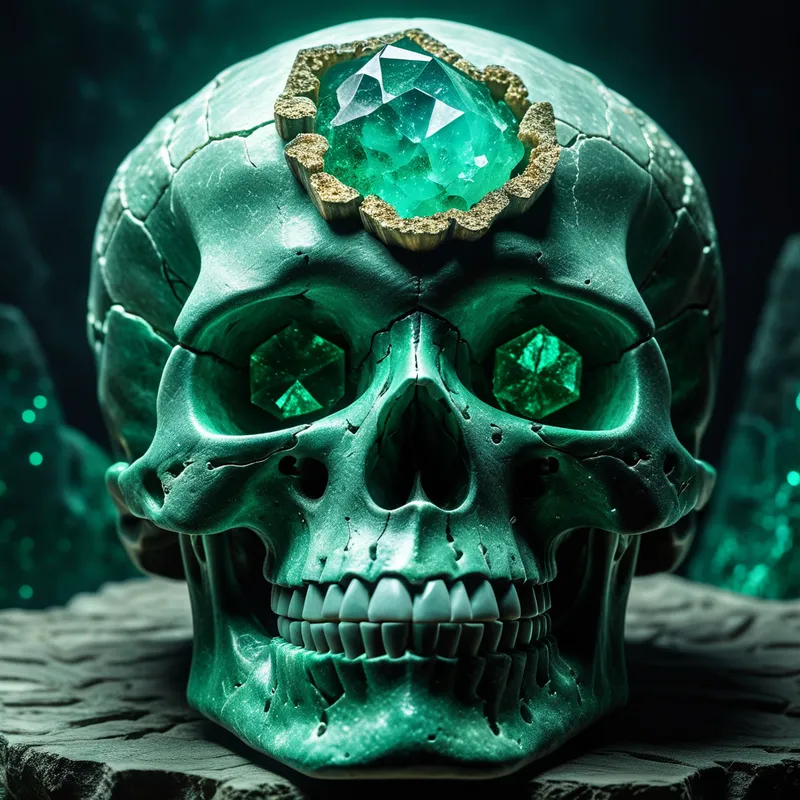
The skull, made of jade, represents the transformative outcome. The bone (death, structure, the past) is transmuted into jade (life, fluidity, the future). It is the lapis philosophorum of this tradition—the stone of wisdom born from the confrontation of opposites. It signifies a consciousness that has integrated the reality of death, and in doing so, has become a vessel for a more vibrant, resilient, and connected form of life.
The Dreamer's Resonance
When this myth pattern stirs in the modern dreamer, it often manifests as dreams of descending into basements, caves, or submerged cities. One might dream of finding a strange, glowing object in a dark place, or of facing a council of silent, authoritative figures who demand something intangible. The somatic experience can be one of chilling cold, weightlessness, or a paradoxical feeling of fear mixed with profound peace.
Psychologically, this dream signals a process of psychic excavation. The dreamer is being called to retrieve something vital that has been lost, repressed, or left in the “underworld” of their personal history. This could be a forgotten talent, a buried trauma, or an unacknowledged aspect of their personality. The “price” demanded in the dream reflects the resistance of the conscious mind—the need to let go of an old self-image, a comfortable narrative, or a defensive pride. The emergence of the jade-like object in the dream signifies the nascent formation of a new, more authentic perspective, hard-won from the depths of inner conflict. It is the psyche’s way of initiating its own alchemy.
Alchemical Translation
The myth of the Jade Skull is a perfect allegory for the Jungian process of individuation—the journey toward psychological wholeness. The modern individual, like Ah K’in, often feels a “drought” in their life: a lack of meaning, vitality, or connection. The prescription is not to seek more light, but to have the courage to descend into one’s personal Xibalba.
Individuation is not about becoming perfect, but about becoming complete; it requires the sacred inclusion of one’s own shadows.
The first alchemical stage, nigredo (the blackening), is the descent itself—the confrontation with depression, loss, fear, or the rubble of failed plans. The Lords of Death represent the internal voices of judgment, shame, and nihilism that guard the gates to deeper self-knowledge. The sacrifice demanded is the mortificatio—the “killing” of the ego’s attachment to how things “should be.” This is not self-destruction, but a disciplined surrender, a lying still in the darkness of uncertainty.
The hero’s passive endurance is the albedo (the whitening), a purification through patience. When the external “sun” (insight, grace, or a new understanding) finally strikes, it interacts with the surrendered self to ignite the citrinitas (the yellowing) and finally the rubedo (the reddening). The Jade Skull is the resultant caelum (the heavenly vessel)—the integrated Self. The individual who completes this cycle carries the “skull” within. They possess a wisdom that is both sober (acknowledging limits and mortality) and incredibly fertile (capable of creativity and renewal). They understand that their life force is not diminished by engaging with darkness, but is, in fact, refined and given its true, enduring color. They become, in their own way, a keeper of balance.
Associated Symbols
Explore related symbols from the CaleaDream lexicon: