The Iron Shaman Myth Meaning & Symbolism
A shaman, shattered by a cosmic battle, must journey to the underworld to forge his soul anew from iron, becoming a vessel for both spirit and steel.
The Tale of The Iron Shaman
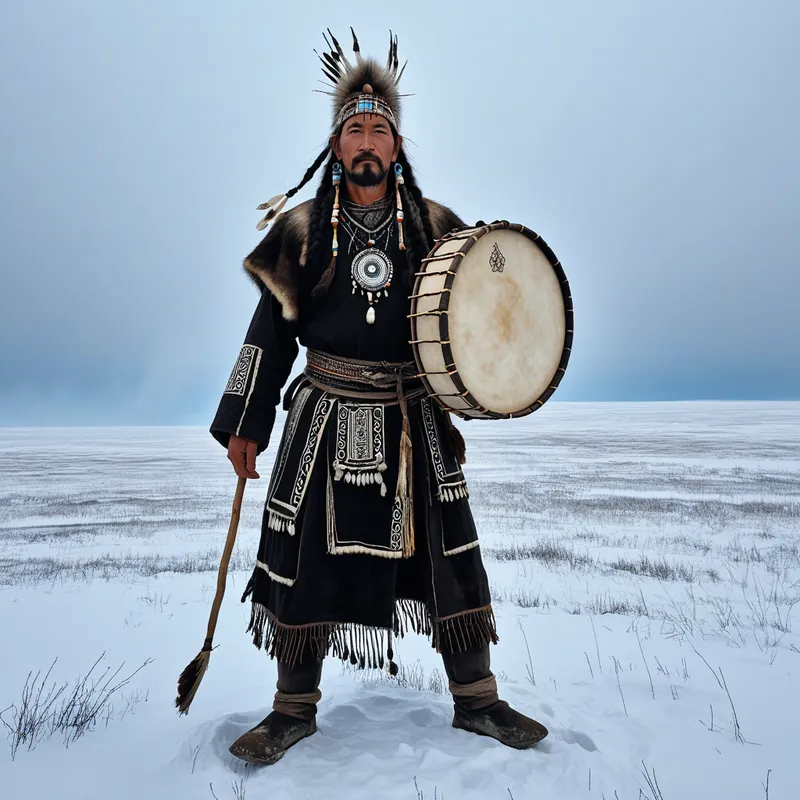
Listen. In the time when the world was younger and the cold had teeth, there lived a shaman of great power. His name was Ulan, and his drum was the heartbeat of the taiga. He could ride the wind to the upper world, where the Tengri dwelled, and dive deep into the lower world, where the spirits of the dead whispered secrets. His people thrived, for he kept the balance.
But a shadow grew. A sickness of the soul began to spread, a cold despair that no herb could cure, no chant could warm. It was the work of Abasy, a spirit of emptiness that fed on fractured will. Ulan, in his pride, confronted it directly. He journeyed not to negotiate or trick, but to wage war in the spirit realms.
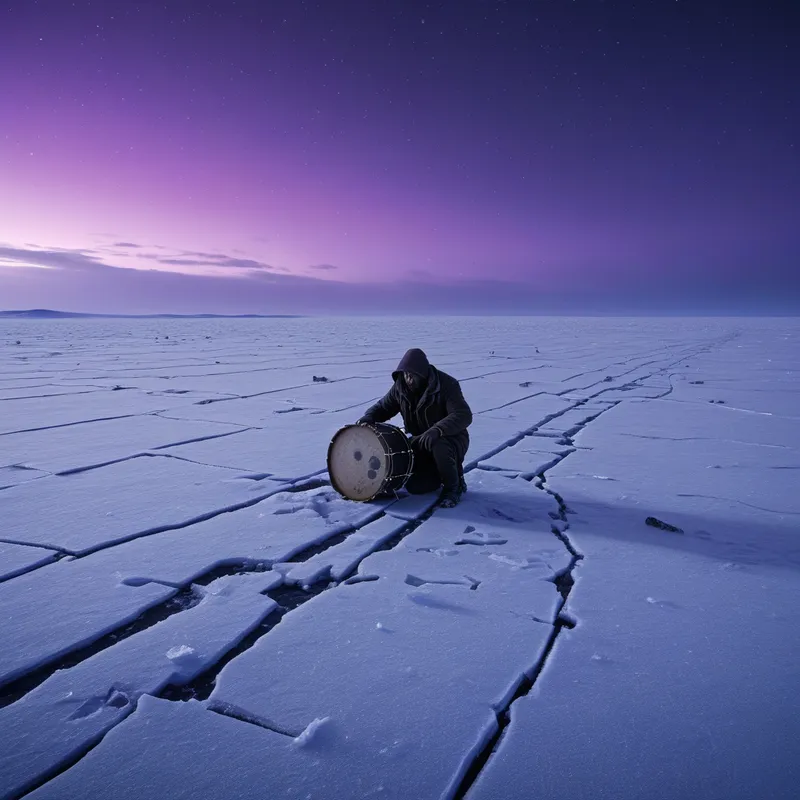
The battle was not of claw and tooth, but of essence. The Abasy did not strike him; it un-made him. It sang a silence that unraveled the songs in his bones. It showed him a void that reflected no soul. Ulan’s drum-skin split with a sound like a dying gasp. His helping spirits scattered like smoke in a gale. His very self—the accumulated power, memory, and connection—shattered. He fell from the spirit flight, a broken thing, landing on the frozen earth as mere flesh and bone, empty of purpose.
For nine days and nights, he lay in the snow, a hollow vessel. The cold seeped into where his soul had been. In his despair, a vision came. Not from above, but from below. The iron of the earth, the deep, sleeping metal in the mountain’s heart, called to him. It spoke without words: What is broken can be remade. But not as it was. To hold the spirit now, you must become harder than bone, colder than the void, yet capable of resonance.
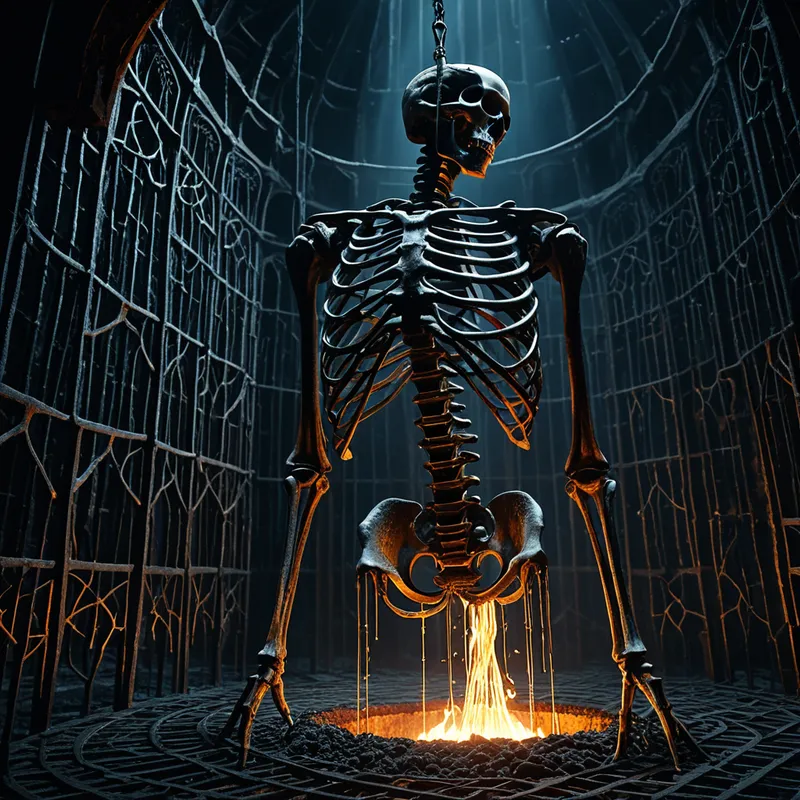
With the last flicker of his will, Ulan began to crawl. He crawled away from his people, towards the smoking mountains. He dragged his broken body over stone and ice, following the pull of ore. He descended into a cavern where the air tasted of metal and the walls shimmered with raw iron. In the center glowed a pit of eternal coals, a forge not made by human hands.
There, guided by the spirit of the mountain itself, he began the terrible work. He did not repair his old self. He fed the fragments—his pride, his shattered drum, his pain—into the fire. Then, he took the raw, dark iron ore and began to forge a new self. He hammered resilience into his spine, tempered flexibility into his joints, and shaped a new drum-frame from ribs of black iron. He quenched his new form not in water, but in the tears of his own grief, which sizzled and steamed on the hot metal, etching the story of his breaking into its surface.
When he emerged, he was no longer Ulan the Pure-Souled. He was the Iron Shaman. His gaze was steady and unyielding. His drum, when struck, rang with a clear, cold tone that could cut through spiritual sickness, a sound that mirrored the resilience of the earth itself. He returned, and where he walked, the shadow of Abasy retreated, for it could find no purchase on a soul forged in fire and failure.
Cultural Origins & Context
The myth of the Iron Shaman finds its roots in the vast, animistic worldviews of the Indigenous peoples of Siberia, particularly among Turkic and Mongolian groups like the Yakuts, Altaians, and Buryats. In these cultures, the shaman is not merely a priest or healer but a crucial psychopomp and balance-keeper, whose personal integrity directly influences the community’s fortune. This myth was likely told during long winter nights, passed down by elder shamans to their initiates. Its function was multifaceted: it served as a cautionary tale about the dangers of spiritual hubris, a map for navigating profound psychological crisis, and, most importantly, a narrative of hope that defined the source of ultimate shamanic power not as innate purity, but as hard-won resilience born from catastrophic failure. It legitimized the “wounded healer” archetype, suggesting that the most powerful guide is one who has been utterly dismantled and consciously reassembled.
Symbolic Architecture
At its core, the myth is a profound [allegory](/symbols/allegory “Symbol: A narrative device where characters, events, or settings represent abstract ideas or moral qualities, conveying deeper meanings through symbolic storytelling.”/) for the [death](/symbols/death “Symbol: Symbolizes transformation, endings, and new beginnings; often associated with fear of the unknown.”/) and [rebirth](/symbols/rebirth “Symbol: A profound transformation where old aspects of self or life die, making way for new beginnings, growth, and renewal.”/) of the ego, or the conscious [personality](/symbols/personality “Symbol: Personality in dreams often symbolizes the traits and characteristics of the dreamer, reflecting how they perceive themselves and how they believe they are perceived by others.”/), in service of a greater totality.
The most resilient vessel for the spirit is not the untouched one, but the one that has been shattered and consciously reforged with the iron of will.
The shattering represents a total psychological [breakdown](/symbols/breakdown “Symbol: A sudden failure or collapse of a system, structure, or mental state, often signaling a need for fundamental change or repair.”/), where old identities, coping mechanisms, and belief systems completely fail. The Abasy symbolizes the impersonal, annihilating force of the unconscious—or of [trauma](/symbols/trauma “Symbol: A deeply distressing or disturbing experience that overwhelms the psyche, often manifesting in dreams as unresolved emotional wounds or psychological injury.”/)—that can dismantle the unprepared ego. The crawl across the frozen plain is the humiliating, somatic [reality](/symbols/reality “Symbol: Reality signifies the state of existence and perception, often reflecting one’s understanding of truth and life experiences.”/) of depression or severe [crisis](/symbols/crisis “Symbol: A crisis symbolizes turmoil, urgent challenges, and the need for immediate resolution or change.”/), where one is reduced to the most basic [movement](/symbols/movement “Symbol: Movement symbolizes change, progress, and the dynamics of personal growth, reflecting an individual’s desire or need to transform their circumstances.”/) toward an unknown [source](/symbols/source “Symbol: The origin point of something, often representing beginnings, nourishment, or the fundamental cause behind phenomena.”/) of salvation.
The iron is the key [symbol](/symbols/symbol “Symbol: A symbol can represent an idea, concept, or belief, serving as a powerful tool for communication and understanding.”/). Unlike organic materials, iron must be violently extracted from the [earth](/symbols/earth “Symbol: The symbol of Earth often represents grounding, stability, and the physical realm, embodying a connection to nature and the innate support it provides.”/), purified in extreme heat, and shaped by repeated blows. It represents the qualities of the integrated psyche: [strength](/symbols/strength “Symbol: ‘Strength’ symbolizes resilience, courage, and the ability to overcome challenges.”/), endurance, and the [ability](/symbols/ability “Symbol: In dreams, ‘ability’ often denotes a recognition of skills or potential that one possesses, whether acknowledged or suppressed.”/) to hold a form (a conscious [attitude](/symbols/attitude “Symbol: Attitude symbolizes one’s mental state, perception, and posture towards life, influencing emotions and actions significantly.”/)) under pressure. The forge in the [mountain](/symbols/mountain “Symbol: Mountains often symbolize challenges, aspirations, and the journey toward self-discovery and enlightenment.”/) is the [crucible](/symbols/crucible “Symbol: A vessel for intense transformation through heat and pressure, symbolizing spiritual purification, testing, and alchemical change.”/) of the deep unconscious, where this alchemical [transmutation](/symbols/transmutation “Symbol: A profound, alchemical process of fundamental change where one substance or state transforms into another, often representing spiritual evolution or personal metamorphosis.”/) occurs away from the eyes of the world. The new drum of iron signifies a new mode of being—one’s “tool” or interface with reality is now forged from the very substance of one’s ordeal, capable of resonating with a different, more durable [truth](/symbols/truth “Symbol: Truth represents authenticity, honesty, and the quest for knowledge beyond mere appearances.”/).

The Dreamer’s Resonance
When this myth stirs in modern dreams, it often signals a profound initiation crisis in the dreamer’s psyche. You may dream of mechanical parts integrating with your body (iron limbs, gears for joints), feeling both alien and strangely right. You may dream of being shattered or disassembled and watching yourself be put back together by an impersonal, cosmic force. Dreams of descending into industrial or metallic landscapes—sub-basements, factories, mines—point to this journey into the “forge” of the unconscious.
Somatically, this process can feel like a deep, bone-level fatigue coupled with a strange, hard certainty. Psychologically, it is the experience of hitting absolute rock bottom, where the only choice is to surrender the project of rebuilding the old self. The dreamer is in the process of retrieving a lost or fragmented part of the soul, but the retrieval method is not gentle recollection; it is a forging. The new self that emerges feels less “natural” but more reliable, less emotional but more present—a container strong enough to finally hold one’s full history and spirit.
Alchemical Translation
For the modern individual, the Iron Shaman’s journey models the stage of individuation known as the nigredo—the blackening, the descent, and the putrefaction—followed by a transmutation that bypasses a simple return to the albedo (whiteness/purity).
Individuation is not about restoring a lost innocence, but about constructing a conscious adulthood from the raw ore of experience, including the ore of failure and shadow.
The first step is the honest confrontation with one’s personal Abasy: the trauma, complex, or shadow aspect that has the power to dismantle our carefully constructed persona. This defeat is necessary. The ego must be humbled, its tools broken, to create the vacuum that draws up a more profound resource from the psychic earth.
The “crawl to the mountain” is the commitment to the deep, often solitary, inner work—therapy, meditation, artistic expression, or any disciplined practice that serves as our “forge.” The “iron” we must find is our core will, our stubborn, non-negotiable commitment to exist and find meaning, even when feeling empty. We must take the shattered pieces of our old identity—our broken dreams, our shame, our pride—and willingly place them in the fire, not to destroy them, but to use them as fuel for the transformation.
The final act is quenching in grief. The new, forged self cannot be hardened into brittle dogma. It must be tempered by the honest, fluid acknowledgment of all that was lost—the old self, the innocence, the easy joy. This emotional honesty makes the iron resilient, not just hard. The result is not a superhero, but an Iron Shaman: a person whose authority comes from having been broken and who now carries a resonant, durable strength that can hold space for both the human and the divine, the fragile and the eternal.
Associated Symbols
Explore related symbols from the CaleaDream lexicon:
- Iron — The core substance of transformation, representing resilience, will, and the strength forged through ordeal, forming the new structure of the self.
- Shaman — The archetype of the wounded healer and mediator between worlds, whose ultimate power is born from a journey through personal disintegration.
- Drum — The vehicle for journeying and the resonant voice of the soul, which in this myth must be remade from a new, more durable material to sound a new frequency.
- Mountain — The symbolic location of the deep unconscious and the forge of transformation, representing the arduous ascent and descent required for profound change.
- Cave — The womb of rebirth and the crucible where the alchemical work occurs in darkness and isolation, away from the collective.
- Fire — The purifying and transmuting agent that burns away the old form and provides the heat necessary to shape the raw ore of potential.
- Journey — The essential process of moving from a state of brokenness, through a liminal wilderness, to a place of remaking, representing the psychic quest.
- Death — The necessary dissolution of the old identity and ego structure, without which no true rebirth or forging of a new self is possible.
- Rebirth — The emergence of a new, conscious personality forged from the elements of the old, but fundamentally altered in substance and strength.
- Shadow — The personified Abasy, representing the unconscious, annihilating force that must be encountered and integrated to initiate the transformative crisis.
- Spirit — The intangible essence that the new iron vessel is designed to carry, highlighting that the goal of hardening is to better contain and channel softness and power.