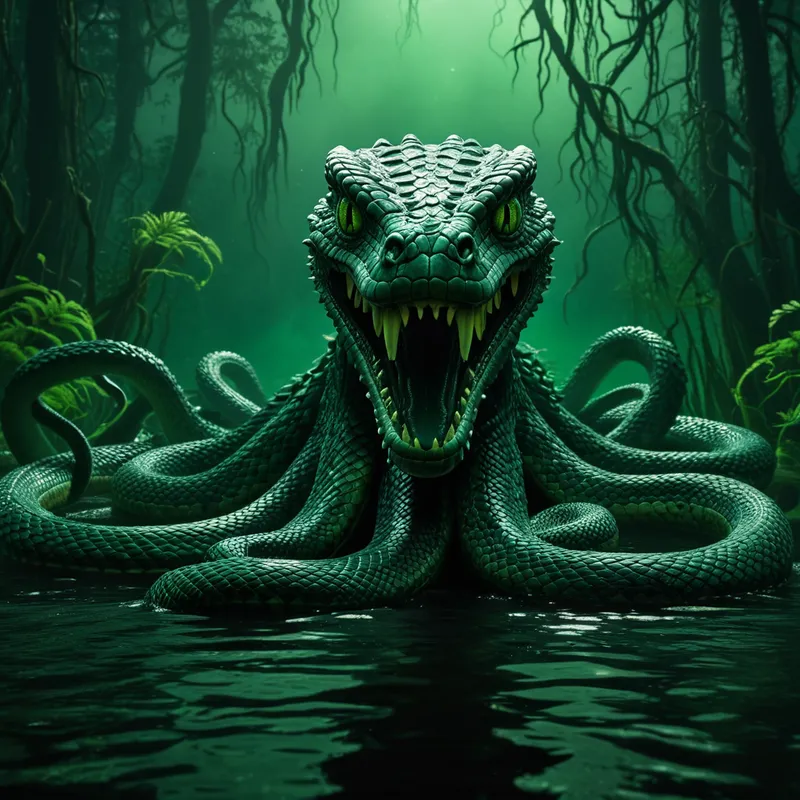
The Hydra's Breath Myth Meaning & Symbolism
Heracles battles the Lernaean Hydra, whose breath is a deadly miasma. Victory requires cauterizing each neck, transforming the monster's venom into a potent weapon.
The Tale of The Hydra’s Breath
Hear now of the second labor, a task not of strength alone, but of wit against venom, of fire against foul breath. The air in the Argolid was thick and sweet with decay, for the traveler was drawn to the dreaded Lernaean springs. Here, beneath waters that bubbled with hidden currents, the beast made its lair.
It was the [Hydra](/myths/hydra “Myth from Greek culture.”/) of Lerna, child of monstrous lineage, raised by the goddess Hera herself for a single purpose: to be the doom of [Heracles](/myths/heracles “Myth from Greek culture.”/). He approached the swamp’s edge, the mud sucking at his sandals. The stench hit him first—not merely the rot of the marsh, but something sharper, metallic, and corrupt. It was [the Hydra](/myths/the-hydra “Myth from Greek culture.”/)’s breath, a visible miasma that clung to the reeds and withered the leaves.
From the murk it rose. Not one head, but nine, each a serpentine nightmare, eyes like polished jet. The central head was immortal, a fact whispered in dread. As Heracles lunged, his club a blur, he learned the horror’s true nature. With a sickening thud, he crushed one skull. But before the head could hit the [water](/myths/water “Myth from Chinese culture.”/), two more sprouted from the bleeding stump, hissing, their mouths dripping with the same poisonous vapor that now clouded the air. He fought in a choking fog. Each labored breath seared his lungs; each victory doubled his foes.
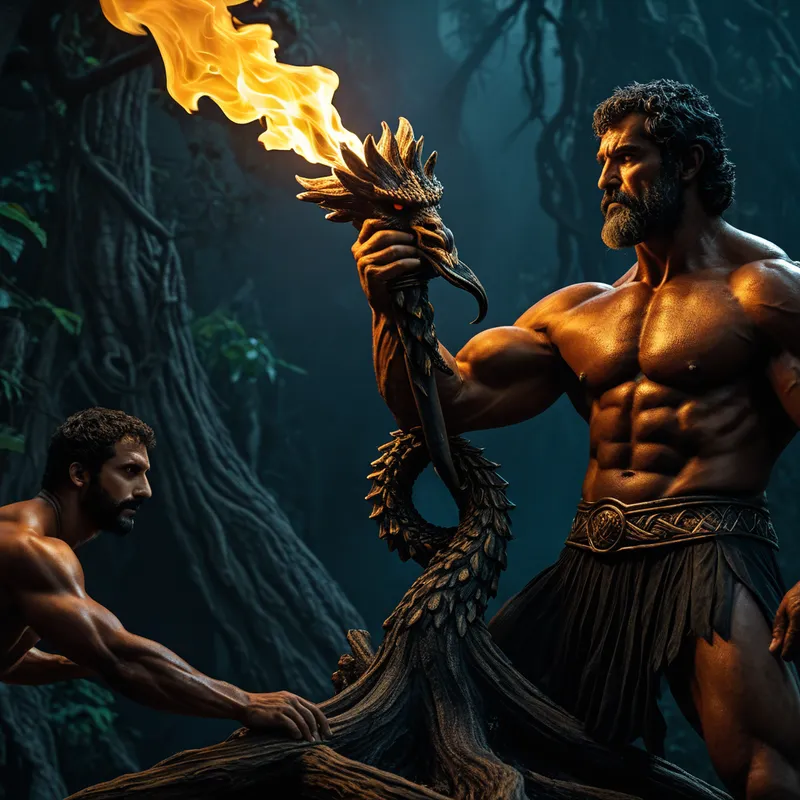
Despair, that old enemy, crept in with the poison. Then came [the flash of insight](/myths/the-flash-of-insight “Myth from Alchemical culture.”/), a gift from his divine father or his own desperate cunning. He called to his nephew, Iolaus. “Bring fire!” As Heracles hewed a head from its neck, Iolaus was there, searing brand in hand, pressing the white-hot flame to the raw wound. The sizzle was a terrible sound, the smell of burnt venom and flesh overwhelming. The regeneration was stopped.
Head after head, they repeated this grim ballet: the severing, the cautery. The swamp air grew thick with smoke and the acrid perfume of the Hydra’s own essence being turned against it. Finally, only [the immortal](/myths/the-immortal “Myth from Taoist culture.”/) head remained. Heracles buried it beneath a heavy stone at [the crossroads](/myths/the-crossroads “Myth from Celtic culture.”/), where its breath would poison [the earth](/myths/the-earth “Myth from Hindu culture.”/) for eternity. But in a final act of alchemy, the hero dipped his arrows into the Hydra’s own venomous blood. The very source of the monster’s power was now his weapon. The breath that sought to kill him had been transformed.
Cultural Origins & Context
This myth was not a fireside fancy but a foundational pillar of the Greek cosmogony. It was codified in texts like the Bibliotheca of Pseudo-Apollodorus and echoed in the art that adorned temples and pottery. The labor was set by Eurystheus, a proxy for the will of Hera, representing the oppressive, seemingly impossible demands of fate and societal obligation.
Functionally, the myth served multiple purposes. It explained the noxious, marshy realities of the Lerna region—a place of actual miasmas—as the lasting breath of a vanquished monster. It also established Heracles not just as strong, but as ingeniously resilient, a model for overcoming proliferating crises. The story was a tool for navigating a world full of hidden, regrowing dangers, from political strife to personal misfortune, teaching that raw force must be wedded to strategic, transformative action.
Symbolic Architecture
The [Hydra](/symbols/hydra “Symbol: A multi-headed serpent from Greek mythology that regenerates two heads when one is cut off, symbolizing persistent, multiplying challenges.”/) is the ultimate [symbol](/symbols/symbol “Symbol: A symbol can represent an idea, concept, or belief, serving as a powerful tool for communication and understanding.”/) of the proliferating [problem](/symbols/problem “Symbol: Dreams featuring a ‘problem’ often symbolize internal conflicts or challenging situations that require resolution and self-reflection.”/), the psychological [shadow](/symbols/shadow “Symbol: The ‘shadow’ embodies the unconscious, repressed aspects of the self and often represents fears or hidden emotions.”/) that grows when attacked directly with unconscious aggression. Each head is a facet of a complex issue—a [resentment](/symbols/resentment “Symbol: A deep-seated emotional bitterness from perceived unfairness or injury, often festering silently and poisoning relationships.”/), a fear, a compulsion. To strike at one without addressing the root cause is to invite two more to take its place.
The Hydra’s breath is the atmosphere of the problem itself—the toxic emotional environment, the pervasive anxiety, the “bad air” of a situation that weakens us before we even engage the beast.
The immortal head represents the core, irreducible wound or complex, often buried (under the [stone](/symbols/stone “Symbol: In dreams, a stone often symbolizes strength, stability, and permanence, but it may also represent emotional burdens or obstacles that need to be acknowledged and processed.”/) at the [crossroads](/symbols/crossroads “Symbol: A powerful spiritual symbol representing a critical decision point where paths diverge, often associated with fate, transformation, and life-altering choices.”/)) but never truly destroyed. Its poison persists in the [psyche](/myths/psyche “Myth from Greek culture.”/). Heracles’s [solution](/symbols/solution “Symbol: A solution symbolizes resolution, clarity, and the overcoming of obstacles, often representing a sense of accomplishment.”/)—the fiery cautery—is the symbol of conscious, transformative intervention. Fire here is not destruction, but sealing; it is the [application](/symbols/application “Symbol: An application symbolizes engagement, integration of knowledge, or the pursuit of goals, often representing self-improvement and personal development.”/) of intense [awareness](/symbols/awareness “Symbol: Conscious perception of self, surroundings, or internal states. Often signifies awakening, insight, or heightened sensitivity.”/), painful [truth](/symbols/truth “Symbol: Truth represents authenticity, honesty, and the quest for knowledge beyond mere appearances.”/), or deliberate change to prevent [regression](/symbols/regression “Symbol: A psychological or spiritual return to earlier states of being, often involving revisiting past patterns, memories, or developmental stages for insight or healing.”/). The most profound [alchemy](/symbols/alchemy “Symbol: A transformative process of purification and creation, often symbolizing personal or spiritual evolution through difficult stages.”/), however, is the poisoned arrows. The [hero](/symbols/hero “Symbol: A hero embodies strength, courage, and the ability to overcome significant challenges.”/) does not merely defeat the [monster](/symbols/monster “Symbol: Monsters in dreams often symbolize fears, anxieties, or challenges that feel overwhelming.”/); he metabolizes its essence.
The Dreamer’s Resonance
When this myth stirs in the modern unconscious, it often manifests as dreams of being overwhelmed by multiplying tasks, facing a many-voiced critic, or breathing in a suffocating, polluted atmosphere. The dreamer may be in a swamp or a maze, unable to find clean air.
Somatically, this can mirror experiences of anxiety attacks—the feeling of a problem expanding, of being poisoned by one’s own stress hormones. Psychologically, it signals engagement with a “hydra-headed” complex: perhaps a pattern of relationship failures where ending one bad connection seems to create two more, or a work project where solving one bug generates others. The dream is the psyche’s dramatic rendering of the exhausting, cyclical nature of fighting symptoms instead of the source. The presence of a helper (Iolaus) or the discovery of fire in the dream points to the emerging capacity for the transformative, cauterizing insight needed.
Alchemical Translation
The journey of Heracles at Lerna is a precise map for the process of individuation. The initial confrontation is [the ego](/myths/the-ego “Myth from Jungian culture.”/)’s recognition of a shadow complex. The first, futile blows with the club are the ego’s attempts at suppression, denial, or forceful control—which only inflate the complex’s power.
The turning point is the acceptance of the “fiery” function—often related to thinking or intense feeling that burns away self-deception. This is the painful, deliberate work of therapy, journaling, or honest confrontation that “seals” a behavioral pattern so it cannot regrow in the same form.
The ultimate goal is not to live in a sterile field free of poison, but to learn the art of the poisoned arrow—to take the transformed essence of one’s greatest struggle and make it the source of one’s unique strength and discernment.
The immortal head buried at the crossroads signifies the acceptance that some core wounds or dynamics remain as part of our structure. We do not erase them; we learn to contain them at a sacred crossroads of choice, where their presence can warn us and inform our direction. The labor thus transmutes the victim of a poisonous environment into the sovereign who holds a measured, potent power, forged in the very breath of the beast he faced.
Associated Symbols
Explore related symbols from the CaleaDream lexicon: