The Hydra Myth Meaning & Symbolism
A many-headed serpent of the swamp, slain by Heracles, whose heads multiply when struck, symbolizing the self-regenerating nature of unresolved trauma and shadow.
The Tale of The Hydra
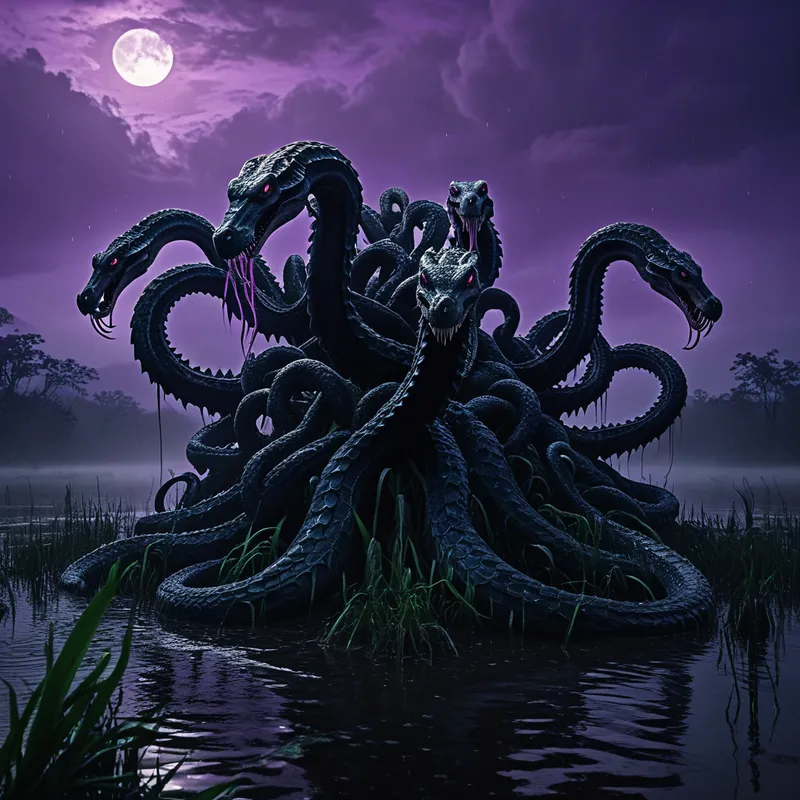
Hear now of a terror born from [the womb](/myths/the-womb “Myth from Various culture.”/) of [the earth](/myths/the-earth “Myth from Hindu culture.”/), a child of monsters, a blight upon the sunlit world. In the time when gods walked with men and heroes carved their names into fate, there festered in the marshes of Lerna a horror that choked the land. The air there was thick with the stench of decay, a miasma that turned brave men’s blood to [water](/myths/water “Myth from Chinese culture.”/). This was the domain of the [Hydra](/myths/hydra “Myth from Greek culture.”/).
It was no ordinary beast. From the murky waters it rose, a colossal serpent with a body like a coiled mountain and not one, but nine heads that danced upon sinuous necks. Eight were mortal, their eyes burning with a venomous hunger. The ninth, immortal and central, shone with a cruel, unearthly intelligence. Its breath was poison, its very blood a corrosive plague. The land around its lair withered; travelers vanished. The Hydra was a knot of pure, undiluted dread.
The task of cleansing this blight fell to [Heracles](/myths/heracles “Myth from Greek culture.”/), the son of Zeus, bound to serve a lesser king. His second labor: slay [the Lernaean Hydra](/myths/the-lernaean-hydra “Myth from Greek culture.”/). With his nephew Iolaus as his steadfast companion, the hero approached the dreaded spring of Amymone. He flushed the monster from its reeking den with flaming arrows. The Hydra emerged, a symphony of hisses, its heads weaving like stalks in a foul wind.
Heracles charged, his club a blur. He smashed one head to pulp. But as the [ichor](/myths/ichor “Myth from Greek culture.”/) spilled, two more sprouted from the bleeding stump, fiercer and more terrible. He severed another; two more grew. For every wound he inflicted, the horror redoubled. The very ground seemed to aid the beast, as a giant crab sent by Hera scuttled forth to nip at the hero’s heels. The swamp itself was against him, the rules of battle broken. This was not a fight of strength, but a nightmare of proliferation.
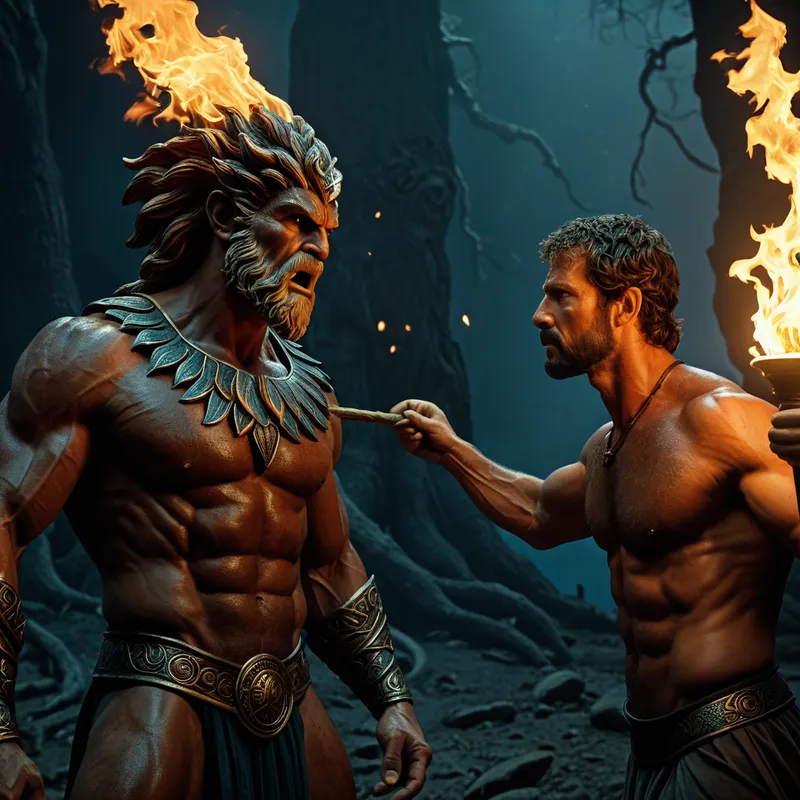
In the cloying stench, with the monster’s coils threatening to ensnare him and its immortal head watching with cold malice, Heracles saw the truth. He could not win this fight alone. He called to Iolaus. “Bring fire!” The young man seized a torch. As Heracles, muscles corded and sweat mingling with swamp-filth, lopped off a head, Iolaus was there, searing the raw neck-stump with flame, cauterizing the wound before new life could burst forth. Head by head, they worked in desperate harmony—the severing and the sealing. The swamp air filled with the smell of burnt flesh and victory.
Finally, only [the immortal](/myths/the-immortal “Myth from Taoist culture.”/) head remained, thrashing and undying. Heracles cast aside his club. He drew a golden sword, or in some tellings, took up the very sickle that once felled [Uranus](/myths/uranus “Myth from Greek culture.”/). With a final, god-driven blow, he severed it. But this head could not die. So he buried it deep beneath a massive rock, a weight upon the eternal. He then dipped his arrows into the Hydra’s venomous blood, forging weapons of fateful potency. The marsh fell silent. The terror was contained, but not erased, forever buried under a stone of resolve.
Cultural Origins & Context
The myth of the Hydra is woven into the grand tapestry of the Heraclean Labors, a cycle of stories that served as foundational national epics for the ancient Greeks. Primarily transmitted through the oral tradition of bards and later codified by poets like Hesiod in his Theogony and the playwrights, the Hydra’s tale was not mere entertainment. It functioned as a charter myth, explaining the heroic character of Heracles as one who confronts and overcomes primordial chaos. The setting of Lerna was significant—a known prehistoric site with springs and a deep lake (Alcyonian Lake) believed to be an entrance to [the Underworld](/myths/the-underworld “Myth from Greek culture.”/). Thus, the Hydra was more than a monster; it was a guardian of a chthonic threshold, a piece of the wild, untamed world that civilization (represented by the hero) must subdue to establish order. The story reinforced cultural values of ingenuity, partnership (Heracles and Iolaus), and the necessity of using more than brute force to solve a problem that regenerates.
Symbolic Architecture
At its core, the [Hydra](/symbols/hydra “Symbol: A multi-headed serpent from Greek mythology that regenerates two heads when one is cut off, symbolizing persistent, multiplying challenges.”/) is the archetypal [symbol](/symbols/symbol “Symbol: A symbol can represent an idea, concept, or belief, serving as a powerful tool for communication and understanding.”/) of [the self](/myths/the-self “Myth from Jungian culture.”/)-regenerating [problem](/symbols/problem “Symbol: Dreams featuring a ‘problem’ often symbolize internal conflicts or challenging situations that require resolution and self-reflection.”/), the psychic [knot](/symbols/knot “Symbol: A knot symbolizes connections, commitments, complications, and the binding or untying of relationships and situations.”/) that grows stronger when attacked directly. It represents the [shadow](/symbols/shadow “Symbol: The ‘shadow’ embodies the unconscious, repressed aspects of the self and often represents fears or hidden emotions.”/) aspects of the [psyche](/myths/psyche “Myth from Greek culture.”/)—repressed [trauma](/symbols/trauma “Symbol: A deeply distressing or disturbing experience that overwhelms the psyche, often manifesting in dreams as unresolved emotional wounds or psychological injury.”/), addictive patterns, chronic [anxiety](/symbols/anxiety “Symbol: Anxiety in dreams reflects internal conflicts, fears of the unknown, or stress from waking life, often demonstrating the subconscious mind’s struggle for peace.”/), or entrenched [resentment](/symbols/resentment “Symbol: A deep-seated emotional bitterness from perceived unfairness or injury, often festering silently and poisoning relationships.”/).
To confront the Hydra with the same weapon that created it is to be doomed to its multiplication. The monster thrives on linear, forceful opposition.
Each head is a [symptom](/symbols/symptom “Symbol: A physical or emotional sign indicating an underlying imbalance, distress, or message from the unconscious mind.”/), and cutting one off only gives [energy](/symbols/energy “Symbol: Energy symbolizes vitality, motivation, and the drive that fuels actions and ambitions.”/) to two more underlying causes. The immortal central head is the core complex, the root wound that feels eternal and unkillable. The [swamp](/symbols/swamp “Symbol: Represents the subconscious mind, emotions, and the complexities of personal issues.”/) is the murky, emotional unconscious where such complexes fester. The crab sent by Hera signifies the unexpected, sideways attacks from our own psyche or [life](/symbols/life “Symbol: The symbol of ‘Life’ represents a journey of growth, interconnectedness, and existential meaning, encompassing both the joys and challenges that define human experience.”/) circumstances when we engage in deep work—the ancillary anxieties that surface. Heracles’s initial failure and subsequent [adaptation](/symbols/adaptation “Symbol: The process of adjusting to new conditions, often involving psychological or physical change to survive or thrive.”/) model the necessary shift in [consciousness](/symbols/consciousness “Symbol: Consciousness represents the state of awareness and perception, encompassing thoughts, feelings, and experiences.”/): from heroic ego-force to strategic, transformative [action](/symbols/action “Symbol: Action in dreams represents the drive for agency, motivation, and the ability to take control of situations in waking life.”/) aided by the “other” (Iolaus as the supportive function, the witnessing consciousness).
The Dreamer’s Resonance
When the Hydra pattern emerges in modern dreams, it rarely appears as a classical monster. Instead, the dreamer may be in a familiar yet oppressive environment—a childhood home filling with water, an office overgrown with vines. They face a problem that multiplies: for every email deleted, two more appear; for one argument resolved with a partner, two new grievances sprout. The somatic feeling is one of claustrophobic frustration, breathlessness, and sticky entrapment. This is the psyche signaling a state of being “hydra-locked.” The dreamer is likely engaged in a surface-level battle with a symptom (a habit, a recurring conflict) using old, ineffective methods of “cutting it off”—suppression, blame, or sheer willpower—only to feel the issue redouble. The dream calls for a cessation of the fruitless battle and the recruitment of a new resource: the “Iolaus” function. This could be seeking therapy, adopting a new perspective, applying compassionate curiosity instead of judgment, or literally asking for help. The fire is the transformative element that cauterizes, that changes the very nature of the engagement from removal to integration.

Alchemical Translation
The labor against the Hydra is a precise map for the alchemical process of individuation—the forging of a more complete Self. [The first stage](/myths/the-first-stage “Myth from Alchemical culture.”/), [nigredo](/myths/nigredo “Myth from Alchemical culture.”/), is the blackening, represented by the hero’s descent into the foul swamp of his own unconscious shadow. His initial, failed attacks with the club (pure ego strength) lead to despair and the multiplication of the problem, a necessary humiliation of the heroic attitude.
The immortal head cannot be destroyed, only buried under a great weight. The core complex is not eliminated; it is contained and its energy transmuted.
The arrival of Iolaus with fire marks the albedo, the whitening. Fire is spirit, consciousness, the illuminating insight. The collaborative act—severing and searing—is the coniunctio, [the sacred marriage](/myths/the-sacred-marriage “Myth from Various culture.”/) of opposing forces: the active, confronting principle (Heracles) and the receptive, transformative principle (Iolaus with fire). This partnership symbolizes [the ego](/myths/the-ego “Myth from Jungian culture.”/) aligning with the Self’s guidance. The final act is the [rubedo](/myths/rubedo “Myth from Alchemical culture.”/), the reddening or completion. The immortal head, the root complex, is not slain but buried under a rock—a conscious, lasting structure of understanding and acceptance. Its venomous blood, once a source of death, is then used to tip Heracles’s arrows. This is the ultimate alchemy: the poison of the wound is transmuted into the power of the weapon. The hero’s future struggles will be informed by this conquered shadow; his arrows carry the wisdom of the Hydra’s defeat. Thus, the labor teaches that our deepest wounds, when confronted with the right combination of courage, insight, and supportive consciousness, become the source of our most potent strengths.
Associated Symbols
Explore related symbols from the CaleaDream lexicon: