The Hunter-God Myth Meaning & Symbolism
A myth of a divine hunter who, through a great sacrifice, becomes the eternal guardian of the forest, binding human fate to the fate of the wild.
The Tale of The Hunter-God
Listen. The story begins not with a birth, but with a silence. A silence so deep it was the forest holding its breath. In the time before time, when the rivers were veins of silver and the canopy was a second sky, there lived a hunter named Kuarachi. He was not the first man, but he was the first to truly see. His eyes did not just look at the green wall of [the world](/myths/the-world “Myth from Tarot culture.”/); they saw the shimmering soul-light within each leaf, the ancient song in the tapir’s footfall, the fiery dream burning in the jaguar’s gaze.
Kuarachi hunted, but his hunt was a prayer. His spear, carved from the heartwood of the Wacapú tree, never struck without necessity. He took only what the forest gave freely, whispering thanks to the spirit of the fallen, promising his breath would honor theirs. For a time, there was balance. But a shadow grew in the hearts of the people. They saw Kuarachi’s skill and coveted it. They began to hunt not for need, but for greed. They took the young before they could grow, they felled trees to see them fall, and their laughter drowned out the forest’s song.
The great spirits of the jungle wept. The animals hid their faces. The rivers grew cloudy with sorrow. In his despair, Kuarachi climbed to the highest branch of the Wacapú, where [the sky](/myths/the-sky “Myth from Persian culture.”/) touches [the earth](/myths/the-earth “Myth from Hindu culture.”/). He called out to the Anaconda-Mother, the great serpent who coils around the roots of the world. “What must be done?” he cried, his voice raw with the pain of the breaking covenant.
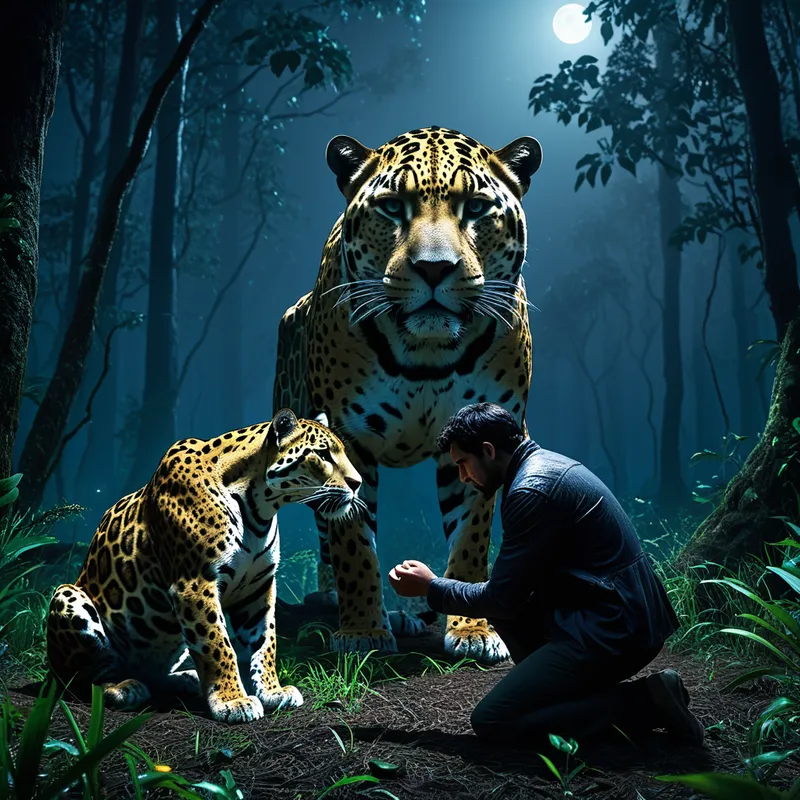
From [the mist](/myths/the-mist “Myth from Celtic culture.”/), a form emerged. It was Jaguar-Lord, his coat a tapestry of night and fire, his eyes twin pools of liquid obsidian. “The pact is broken,” the Jaguar-Lord growled, the sound shaking the very leaves. “My children are slain without honor. The people have forgotten they are part of the hunt, not its masters. For the forest to live, the one who remembers must pay the price of those who forgot.”
Kuarachi understood. There, on that high branch, under the watch of a thousand stars, he laid down his spear. He did not raise it in defense. He offered his own life, his own form, as a bridge. The Jaguar-Lord, embodying the fury and grief of the wild, leapt. But this was not an attack of malice; it was a terrible, sacred embrace. Claws of shadow and light pierced Kuarachi, not to destroy, but to unravel and re-weave.
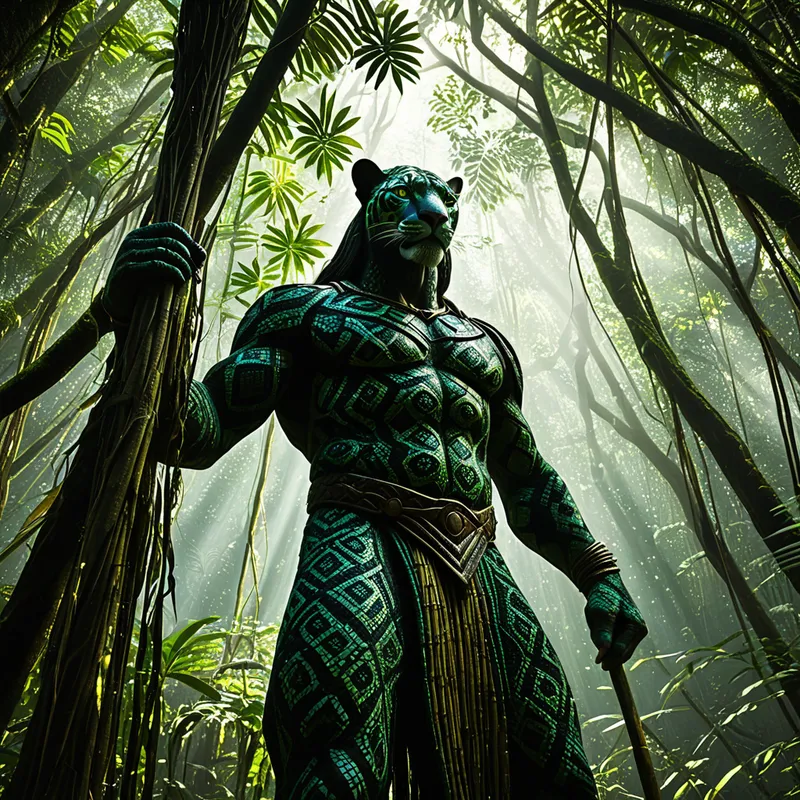
When the dawn came, Kuarachi was gone. In his place stood a new being. His skin was dappled like sunlight through leaves, his hair was woven of liana vines, and his eyes held the patient, timeless watchfulness of the stone and [the star](/myths/the-star “Myth from Tarot culture.”/). He was both man and forest, hunter and guardian. He became [The Hunter](/myths/the-hunter “Myth from African culture.”/)-God. His new law echoed through every clearing and riverbank: to hunt is to be hunted by the consequences of your own soul. He walks forever at the edge of vision, the boundary between the village firelight and the deep, breathing dark, ensuring the taking is never without a giving, and the hunger of humanity is forever tempered by the memory of its sacred debt.
Cultural Origins & Context
This myth, in its myriad local variations, is the bedrock of ethical ecology for numerous Indigenous peoples across the Amazon basin. It is not a story of the distant past, but a living map of present relationship. Traditionally told by elders and shamans (payés) during rites of passage or before communal hunts, its function is profoundly pedagogical and regulatory.
It encodes the principle of manejo—the careful, spiritual stewardship of the forest. The myth establishes that skill alone is not legitimacy; legitimacy comes from respect, reciprocity, and the conscious bearing of spiritual responsibility. The Hunter-God is not a remote deity to be worshipped from afar, but an immanent presence in every hunt, a psychological checkpoint. His transformation serves as the foundational social contract: human survival is inextricably and sacredly linked to the well-being of the more-than-human world. To break this contract is not just impractical; it is a cosmological crime that demands a cosmic rebalancing.
Symbolic Architecture
At its core, this is a myth about the evolution of [consciousness](/symbols/consciousness “Symbol: Consciousness represents the state of awareness and perception, encompassing thoughts, feelings, and experiences.”/) from a state of unconscious participation with [nature](/symbols/nature “Symbol: Nature symbolizes growth, connectivity, and the primal forces of existence.”/) to a conscious, responsible partnership with it. Kuarachi begins as the archetypal [Hero](/symbols/hero “Symbol: A hero embodies strength, courage, and the ability to overcome significant challenges.”/), mastering the outer world. His [crisis](/symbols/crisis “Symbol: A crisis symbolizes turmoil, urgent challenges, and the need for immediate resolution or change.”/) is the realization that this mastery, if left unchecked by wisdom, becomes a cancer.
The true hunter does not conquer the wild; he allows the wild to conquer his ignorance.
The [Jaguar](/symbols/jaguar “Symbol: The jaguar symbolizes strength, power, and stealth, often associated with transformation and the spiritual journey.”/)-[Lord](/symbols/lord “Symbol: The symbol of ‘Lord’ represents authority, mastery, and control, along with associated power dynamics in relationships.”/) represents the autonomous, instinctual [psyche](/myths/psyche “Myth from Greek culture.”/)—the raw, untamed power of nature both without and within. It is the [fury](/symbols/fury “Symbol: An intense, overwhelming rage that consumes the dreamer, often representing suppressed anger or a primal emotional eruption.”/) of the repressed instinct, the revenge of the ignored [shadow](/symbols/shadow “Symbol: The ‘shadow’ embodies the unconscious, repressed aspects of the self and often represents fears or hidden emotions.”/). Kuarachi’s offering is the ultimate act of ego-sacrifice. He does not fight [the shadow](/myths/the-shadow “Myth from Jungian culture.”/) (the [Jaguar](/symbols/jaguar “Symbol: The jaguar symbolizes strength, power, and stealth, often associated with transformation and the spiritual journey.”/)); he surrenders to its transformative power. The resulting Hunter-God is the [symbol](/symbols/symbol “Symbol: A symbol can represent an idea, concept, or belief, serving as a powerful tool for communication and understanding.”/) of the Self in Jungian terms—a transcendent third [thing](/myths/thing “Myth from Norse culture.”/) that is neither purely [human](/symbols/human “Symbol: The symbol of a human represents individuality, complexity of emotions, and social relationships.”/) ego nor pure animal instinct, but a synthesized [guardian](/symbols/guardian “Symbol: A protector figure representing safety, authority, and guidance, often embodying parental, societal, or spiritual oversight.”/) of the totality.
The [spear](/symbols/spear “Symbol: The spear often symbolizes power, aggression, and the drive to protect or conquer.”/) laid down is the [weapon](/symbols/weapon “Symbol: A weapon in dreams often symbolizes power, aggression, and the need for protection or defense.”/) of simple [dominance](/symbols/dominance “Symbol: A state of power, control, or influence over others, often reflecting hierarchical structures, authority, or social positioning.”/). The new form—part plant, part animal, part human—is the living [emblem](/symbols/emblem “Symbol: A symbolic design representing identity, authority, or ideals, often used in heraldry, logos, or artistic expression.”/) of interconnectedness. He is the embodied [boundary](/symbols/boundary “Symbol: A conceptual or physical limit defining separation, protection, or identity between entities, spaces, or states of being.”/), the psychological “[skin](/symbols/skin “Symbol: Skin symbolizes the boundary between the self and the world, representing identity, protection, and vulnerability.”/)” where exchange happens, where [life](/symbols/life “Symbol: The symbol of ‘Life’ represents a journey of growth, interconnectedness, and existential meaning, encompassing both the joys and challenges that define human experience.”/) is given and taken in a conscious, sacred cycle.

The Dreamer’s Resonance
When this myth stirs in the modern dreamer, it often signals a profound confrontation with the “wild” within—the untamed instincts, passions, or creative forces that have been neglected or exploited for personal gain. Dreaming of being pursued by a jaguar may reflect a sense of being “hunted” by the consequences of one’s own actions, or by a repressed fury (one’s inner Jaguar-Lord) now demanding attention.
Conversely, dreaming of being the hunter, especially one who is lost or whose weapons fail, can point to a feeling of spiritual ineffectiveness, a disconnect from one’s primal power and purpose. The somatic feeling is often one of being at a threshold—in a dense forest, at the edge of a clearing—paralyzed by a choice: to continue exploiting one’s own inner resources (or outer relationships) mindlessly, or to stop and make a sacred offering. The dream invites a ritual of acknowledgment: What within me have I taken without thanks? What instinct have I slain without honor?
Alchemical Translation
The alchemical journey mirrored here is the [nigredo](/myths/nigredo “Myth from Alchemical culture.”/) of confrontation followed by the albedo of synthesis. The modern individual’s “forest” is the complex ecosystem of their own psyche and their relational world. The initial “hunting skill” represents any talent or power—intellectual, emotional, social—that we learn to wield.
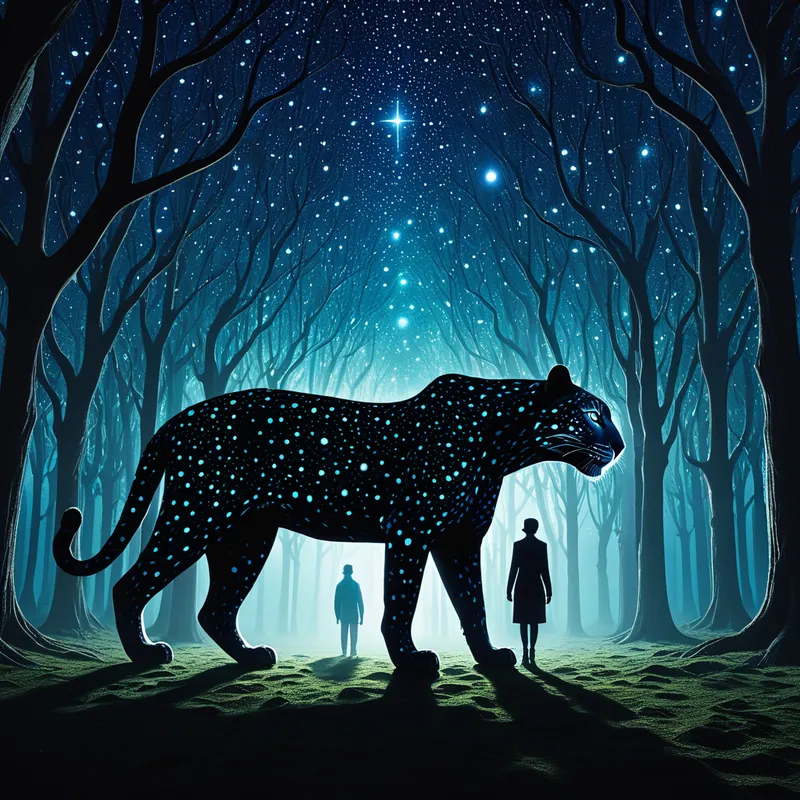
The crisis arrives when we realize we are using this power in a way that depletes our own soul or harms our connections. We are taking life (energy, time, love) without true reciprocity. The alchemical sacrifice is the voluntary surrender of this old, ego-driven mode of operation. It is the terrifying but necessary step of allowing our inner “Jaguar-Lord”—our anger, our grief, our wild intuition—to tear apart our self-image.
Individuation is not about building a better hunter, but about becoming the forest that sustains the hunt.
The transmutation yields the “Hunter-God” state of consciousness: no longer a consumer of life, but a conscious participant in its cycles. Psychically, this means our talents become stewarded by a deeper wisdom. Our actions are tempered by an awareness of their cost and their gift. We become guardians at the boundary of our own being, ensuring that what we take from the world (attention, resources, love) and what we give back (creativity, care, respect) exist in a sacred, sustainable balance. We are no longer simply in the world; we are responsible for the small piece of it that we are.
Associated Symbols
Explore related symbols from the CaleaDream lexicon: