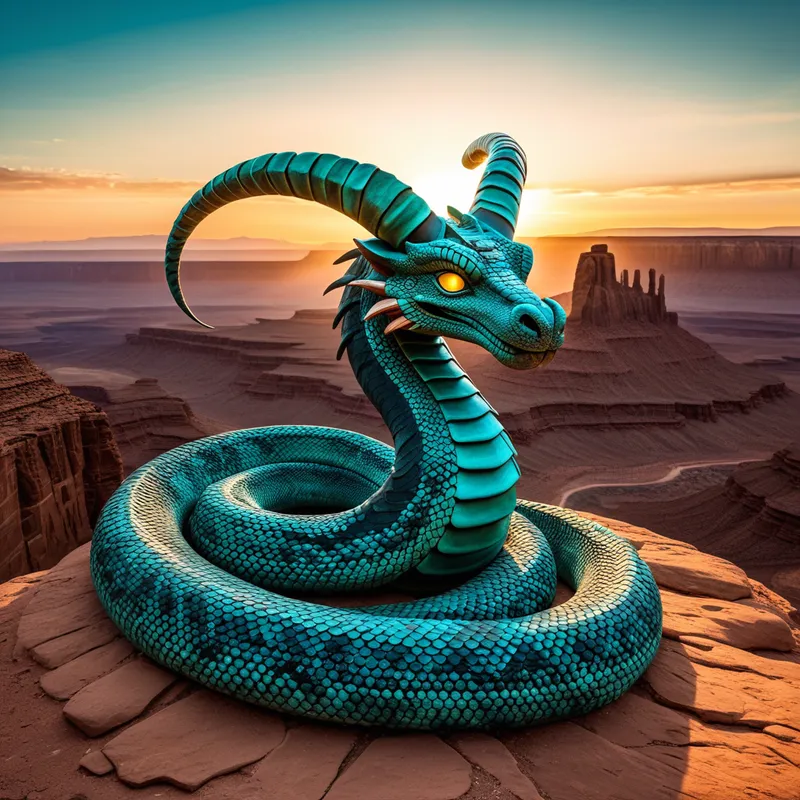
The Horned Serpent Myth Meaning & Symbolism
A Hopi myth where the warrior twins confront the Horned Serpent, establishing the sacred covenant between humanity and the elemental forces of the world.
The Tale of The Horned Serpent
In the time before time, when [the world](/myths/the-world “Myth from Tarot culture.”/) was still soft from its making, the people lived in the Fourth World. The sun was a fierce eye, and the rain a rare blessing. From the deep places, from the hidden springs and the thunderheads that gathered over the sacred mesas, it came. It was not born; it simply was—a power older than the stones. The Horned Serpent.
Its body was the length of a canyon, scales like chips of turquoise and polished copper catching the light. Upon its head grew great, curling horns, like those of [the desert](/myths/the-desert “Myth from Biblical culture.”/) bighorn, but wrought from storm-cloud and obsidian. Where it traveled, [the earth](/myths/the-earth “Myth from Hindu culture.”/) trembled. It drank rivers dry. It summoned floods from cloudless skies. It was chaos given form, the untamed spirit of [water](/myths/water “Myth from Chinese culture.”/) and lightning, and it demanded reverence through fear.
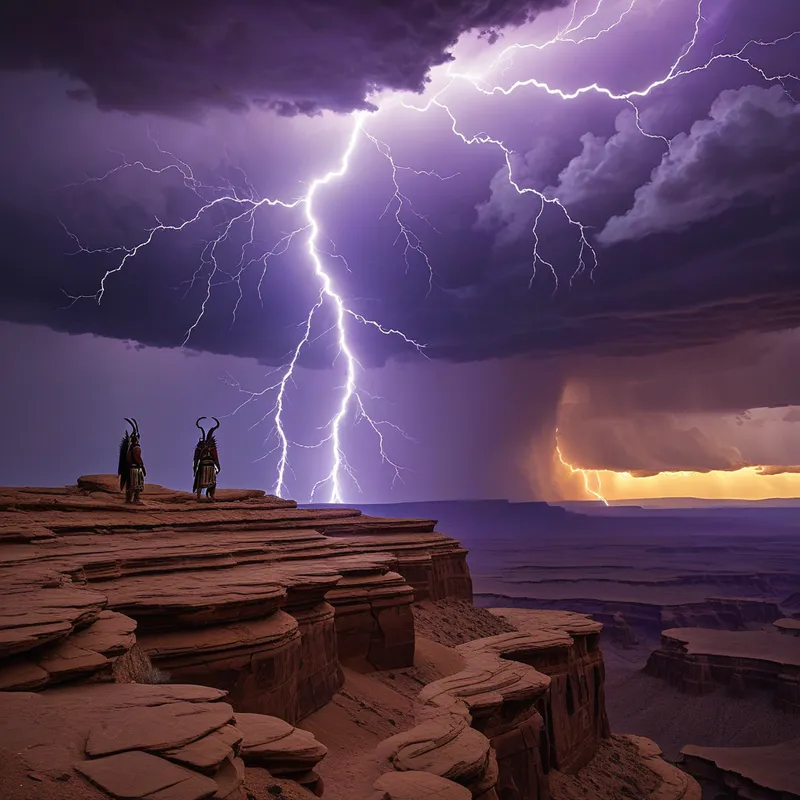
The people were in despair. Their crops withered. Their springs ran muddy or vanished overnight. They prayed to the Kachinas, and the answer came not in a whisper, but in a charge of duty laid upon two brothers, the warrior twins. They were given gifts: feathers of the eagle for sight, prayers planted in their hearts like seeds, and a mandate from the Taiowa himself. They must confront the Serpent. Not to slay it, but to speak with it. To remind it of the covenant.
The twins journeyed to the place of emergence, a crack in the world where the Serpent was known to dwell. The air smelled of ozone and wet stone. They did not hide. They stood upon the high rock, and as the massive head broke from the pool below, casting a shadow that swallowed the sun, they held their ground. Lightning danced in the Serpent’s eyes. Its breath was the monsoon wind.
“Great One,” one twin called, his voice steady against the roar. “You are power. You are the life of the water and the voice of [the sky](/myths/the-sky “Myth from Persian culture.”/). But your power is wild. It drowns the fields it should nourish. It steals the water it should give.”
The Serpent hissed, a sound like a river tearing through a cliff. “I am ancient. I take what I will. Who are you to speak to me?”
The second twin stepped forward, holding up the sacred feather. “We are the people of the covenant. We were placed here to care for this world, and in return, its spirits would sustain us. You have forgotten your part. We have come to remember it for you.”
A struggle ensued—not of claws and spears, but of wills. The Serpent tested them with visions of deluge and drought, with promises of dominion if they would only worship its chaos. The twins stood firm, rooted not in defiance, but in respect. They spoke of balance. They spoke of the corn that needed steady rain, of the children who needed to drink. They spoke of the sacred exchange: reverence for sustenance, stewardship for blessing.
And then, a change. The lightning in the Serpent’s eyes softened to a glow. The coiled tension in its immense body relaxed. It had been alone in its power for eons, a force without a purpose. In the twins’ courage and their clear speech, it saw not an enemy, but a partner. A keeper of the other half of the bargain.
The Horned Serpent bowed its great head. From its mouth, it did not spew flood, but issued a deep, resonant tone that shook the very bones of the earth—a new law. It promised the seasonal rains. It promised to guard the underground waters. In return, the people would honor it through ceremony, through prayer, through living in right relationship with all its kin—the rivers, the clouds, the stones.
It retreated into its sacred spring, not as a menace banished, but as a sovereign placated. The first drops of a gentle, life-giving rain began to fall. The covenant was restored.
Cultural Origins & Context
This myth is a cornerstone of Hopi oral tradition, belonging to the rich tapestry of Puebloan cosmology. It was not merely a story for entertainment, but a vital narrative transmitted across generations by elders and ceremonial leaders, particularly within the context of religious societies like the Snake Clan or Flute Clan. Its telling was—and is—a sacred act, reinforcing the Hopi worldview of reciprocal responsibility.
The myth functions as a societal charter. It explains the origin of the crucial summer rains and establishes the proper, respectful relationship between humanity and the potentially destructive, yet utterly essential, forces of nature. The Horned Serpent, or Palulukon, is not a villain to be destroyed, but a powerful, capricious deity who must be acknowledged and integrated into the community’s spiritual practice. The story validates the complex cycle of Hopi ceremonies, many of which are dedicated to petitioning for rain and fertility, acting as the ongoing fulfillment of the twins’ brave negotiation.
Symbolic Architecture
Psychologically, the myth presents a masterful [drama](/symbols/drama “Symbol: Drama signifies narratives, emotional expression, and the exploration of human experiences.”/) of confronting the unruly, overwhelming aspects of [the Self](/myths/the-self “Myth from Jungian culture.”/) and the world. The Horned [Serpent](/symbols/serpent “Symbol: A powerful symbol of transformation, wisdom, and primal energy, often representing hidden knowledge, healing, or temptation.”/) symbolizes the raw, untamed power of the unconscious—the psychic forces of creativity, [emotion](/symbols/emotion “Symbol: Emotion symbolizes our inner feelings and responses to experiences, often guiding our actions and choices.”/), and instinct that, left unaddressed, can flood the conscious mind (the [village](/symbols/village “Symbol: Symbolizes community, connection, and a reflection of one’s roots or origins.”/), the fields) with [chaos](/symbols/chaos “Symbol: In Arts & Music, chaos represents raw creative potential, uncontrolled expression, and the breakdown of order to forge new artistic forms.”/). It is the archetypal [Shadow](/symbols/shadow “Symbol: The ‘shadow’ embodies the unconscious, repressed aspects of the self and often represents fears or hidden emotions.”/), not of evil, but of immense, amoral potency.
The hero’s task is not to kill the dragon, but to tame it; not to repress the unconscious, but to enter into a sacred dialogue with it.
The [warrior](/symbols/warrior “Symbol: A spiritual archetype representing inner strength, discipline, and the struggle for higher purpose or self-mastery.”/) twins represent the conscious ego’s [capacity](/symbols/capacity “Symbol: A measure of one’s potential, limits, or ability to contain, process, or achieve something, often reflecting self-assessment or external demands.”/) for courageous engagement. They do not go to war; they go to parley. Their weapons are [clarity](/symbols/clarity “Symbol: A state of mental transparency and sharp focus, often representing resolution of confusion or attainment of insight.”/), respect, and [the authority](/symbols/the-authority “Symbol: A figure representing power, control, and societal structure, often embodying rules, leadership, or external judgment.”/) of a higher principle ([the covenant](/symbols/the-covenant “Symbol: A sacred, binding agreement between parties, often with divine or societal significance, representing commitment, obligation, and mutual responsibility.”/) from Taiowa). This symbolizes the necessary step in individuation where [the ego](/myths/the-ego “Myth from Jungian culture.”/) must consciously face the contents of the unconscious, not with brute force, but with the intent to understand and negotiate a working [relationship](/symbols/relationship “Symbol: A representation of connections we have with others in our lives, often reflecting our emotional state.”/). The resulting “[covenant](/symbols/covenant “Symbol: A binding agreement or sacred promise between parties, often carrying deep moral, spiritual, or social obligations and consequences.”/)” is the hard-won [integration](/symbols/integration “Symbol: The process of unifying disparate parts of the self or experience into a cohesive whole, often representing psychological wholeness or resolution of internal conflict.”/) of these powerful forces into a balanced [psyche](/myths/psyche “Myth from Greek culture.”/), where instinct serves [life](/symbols/life “Symbol: The symbol of ‘Life’ represents a journey of growth, interconnectedness, and existential meaning, encompassing both the joys and challenges that define human experience.”/) rather than disrupts it.

The Dreamer’s Resonance
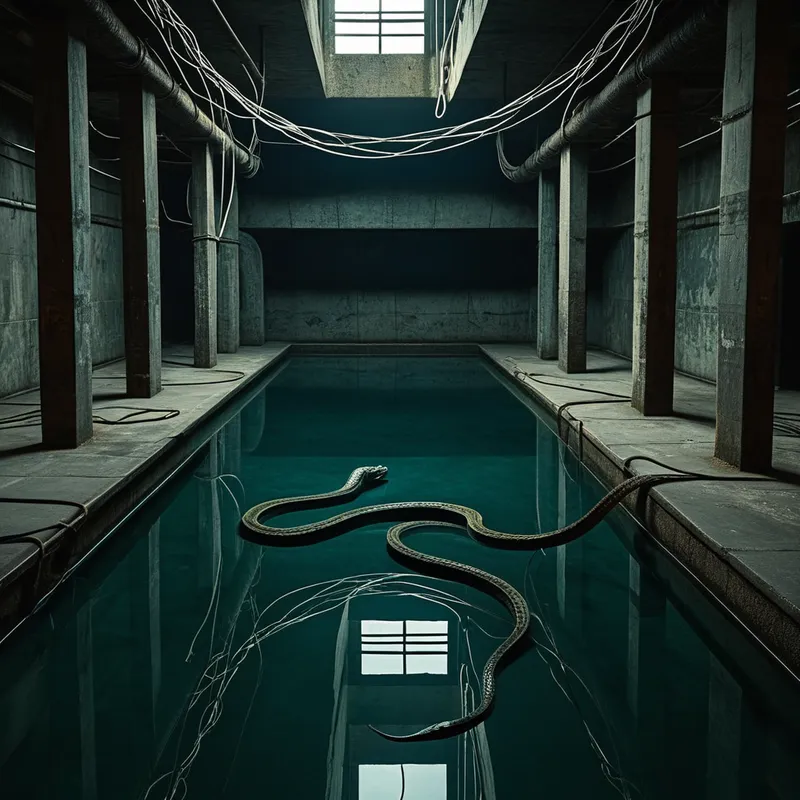
When this myth stirs in the modern dreamer, it often manifests as an encounter with a vast, primal, and intimidating force. One might dream of a colossal serpent in the city sewers, a rising flood in one’s childhood home, or a terrifying yet majestic animal that blocks one’s path. The somatic feeling is one of awe and dread—a tightening in the chest, a sense of being profoundly small.
Psychologically, this signals that a long-ignored or repressed aspect of the dreamer’s own power is demanding recognition. This could be a surge of creative energy that feels disruptive, a deep well of grief or anger that threatens to overflow, or an instinctual drive (for change, for passion, for sovereignty) that can no longer be contained by the “dry fields” of a controlled, orderly life. The dream is the summons. The rising Serpent is the unconscious issuing an ultimatum: engage with me, or I will lay waste to your fragile order.
Alchemical Translation
The alchemy of this myth maps directly onto the process of psychic transmutation. The initial state is one of [nigredo](/myths/nigredo “Myth from Alchemical culture.”/)—the drought, the paralysis, the chaotic flooding caused by a disconnect between conscious life and unconscious power.
The twins’ journey is the albedo, the whitening, which requires courage (facing [the shadow](/myths/the-shadow “Myth from Jungian culture.”/)) and clarity (stating the terms of the covenant). This is the conscious work of analysis, of sitting with one’s inner turmoil without fleeing, and speaking to it honestly: “I see your power. It frightens me. But I also need what you hold. How can we work together?”
The pact with the serpent is the rubedo, the reddening, where the raw material of the psyche is transmuted into gold—not by elimination, but by sacred agreement.
The resolution—the gentle rain—symbolizes the [rubedo](/myths/rubedo “Myth from Alchemical culture.”/), the final stage of integration. The once-chaotic force is now a source of nourishment and vitality. The unconscious is no longer an enemy; it is a respected, allied source of depth, creativity, and life-force. For the modern individual, this translates to finding a way to honor one’s deepest, most powerful instincts and emotions—not by letting them run rampant, but by giving them a sacred, structured place in one’s life through ritual, creative expression, or conscious practice. One becomes, like the Hopi people, a steward of an inner covenant, where the horned serpent of the soul provides the rain, and the conscious self tends the garden.
Associated Symbols
Explore related symbols from the CaleaDream lexicon: