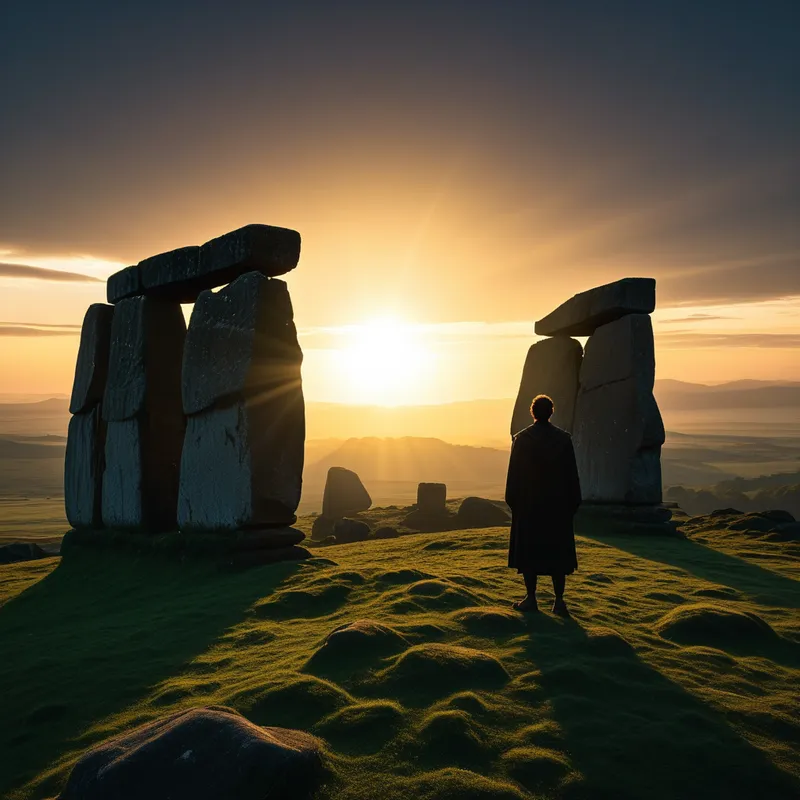
The Horizon Myth Meaning & Symbolism
A universal myth of the ever-receding line where sky meets earth, embodying the soul's longing for the infinite and the boundary of the known self.
The Tale of The Horizon
In the time before time, when [the world](/myths/the-world “Myth from Tarot culture.”/) was still soft and [the sky](/myths/the-sky “Myth from Persian culture.”/) was close enough to touch, there was no division. [The earth](/myths/the-earth “Myth from Hindu culture.”/) breathed into the heavens, and the heavens wept onto the earth in a gentle, ceaseless embrace. All was one, and in that oneness, there was a deep, unspoken rest. But within the heart of [the world](/myths/the-world “Myth from Tarot culture.”/)-spirit, a curious stirring began—a longing not for union, but for sight. It wished to see itself.
And so, the spirit took a breath so vast it stretched the very fabric of being. It pushed the sky upward with a sigh that became [the wind](/myths/the-wind “Myth from Various culture.”/), and it pressed the earth downward with a weight that became stone. Between them, a line was born. Not a wall, but a seam. A breathless, perfect line where the two met and did not merge. They called this line The Horizon.
At first, all creatures trembled. The great eagles, who once nested in the clouds, now had to climb to reach them. The deep-rooted trees felt the sky recede from their highest leaves. A great mourning rose up for the lost unity. But then, a single human, skin etched by sun and wind, stood on a high place and looked. They did not see a separation, but a promise. They saw the place where the fire of the sun was born each morning and where it was swallowed each night. They saw the destination of every river, the end of every path, and the beginning of every sky.
This first watcher began to walk. They walked towards the line, but with every step, it retreated, cool and untouchable. They walked until their feet bled and their throat was dust, yet the Horizon remained, eternally ahead. In despair, they fell to their knees as the sun died in a blaze of ochre and violet. In that darkness, they heard not a voice, but a knowing in their blood: You cannot reach me, for I am not a place. I am the looking itself. I am the space between your breath and your yearning.
The watcher did not return home. They became the walker, the one who follows. And it is said that in their endless walking, they weave the two worlds together with their gaze. Their journey is the thread that stitches the earth to the sky, making the separation sacred. The Horizon did not create distance; it created the journey. And in every human eye that lifts to that line, the original longing of the world-spirit to see itself is born again.

Cultural Origins & Context
The myth of the Horizon is not the property of a single tribe or scroll; it is a foundational layer of human consciousness, etched into our oldest stories and most instinctive gestures. We find its echoes in the Akhet of the Egyptians, the sacred boundary where the sun god Ra was reborn daily. We hear it in the songs of Polynesian navigators for whom the horizon was not a limit but a star-path, a “road of the sun” to be read and trusted. It lives in the rituals of the Plains tribes, where the horizon’s circle defined [the sacred hoop](/myths/the-sacred-hoop “Myth from Various Indigenous Traditions culture.”/) of the world.
It was a story told not around a single fire, but by every fire—by sailors pointing towards an empty line of sea, by desert nomads tracing the mirage on the heat-shimmered plain, by mountain dwellers watching storms gather on the distant edge of the world. Its societal function was profound yet simple: to sanctify the act of seeking. It transformed the anxiety of the unknown into the sacred duty of the quest. It provided a cosmic rationale for restlessness, making the explorer, [the pilgrim](/myths/the-pilgrim “Myth from Christian culture.”/), and the philosopher central to the community’s spiritual health. The Horizon was the ultimate teacher of humility and wonder, a daily reminder that the known world is cradled by a vast, beautiful mystery.
Symbolic Architecture
Psychologically, the [Horizon](/symbols/horizon “Symbol: The horizon can symbolize the boundary between the known and the unknown, representing future possibilities and the journey ahead.”/) is the ultimate [symbol](/symbols/symbol “Symbol: A symbol can represent an idea, concept, or belief, serving as a powerful tool for communication and understanding.”/) of the liminal. It is the visible representation of the [boundary](/symbols/boundary “Symbol: A conceptual or physical limit defining separation, protection, or identity between entities, spaces, or states of being.”/) of [the ego](/myths/the-ego “Myth from Jungian culture.”/), the edge of the known self. It is where the “I” that we have constructed meets the unfathomable “Not-I” of the unconscious and the external world.
The Horizon is the eye’s question mark made permanent against the sky. It is the visible shape of longing, proving that the soul is always oriented towards something just beyond its grasp.
The myth’s central [paradox](/symbols/paradox “Symbol: A contradictory yet true concept that challenges logic and perception, often representing unresolved tensions or profound truths.”/)—that the goal recedes with [pursuit](/symbols/pursuit “Symbol: A chase or being chased in dreams often reflects unresolved anxieties, unfulfilled desires, or internal conflicts demanding attention.”/)—is its deepest [truth](/symbols/truth “Symbol: Truth represents authenticity, honesty, and the quest for knowledge beyond mere appearances.”/). The Horizon represents an objective that is not meant to be possessed, but to provide [direction](/symbols/direction “Symbol: Direction in dreams often relates to life choices, guidance, and the path one is following, emphasizing the importance of navigation in personal journeys.”/). It symbolizes the transcendent function, the psychic process that urges us beyond our current state of being. The walker who never arrives is not a failure; they are the embodiment of the individuating [psyche](/myths/psyche “Myth from Greek culture.”/), forever in [dialogue](/symbols/dialogue “Symbol: Conversation or exchange between characters, representing communication, relationships, and narrative flow in games and leisure activities.”/) with its own [depths](/symbols/depths “Symbol: Represents the subconscious, hidden emotions, or foundational aspects of the self, often linked to primal fears or profound truths.”/). The Horizon is not a failure of reach, but the necessity of reach. It is the line that separates the literal from the symbolic, the profane from the sacred, compelling us to assign meaning to the [journey](/symbols/journey “Symbol: A journey in dreams typically signifies adventure, growth, or a significant life transition.”/) itself.
The Dreamer’s Resonance
When the Horizon appears in modern dreams, it rarely manifests as a simple landscape. It is a felt experience, a somatic truth. One may dream of walking towards a distant city on a plain, only to watch its lights perpetually retreat. Or of standing on a shore, watching a beloved sail towards a line of light they can never cross. The dreamer often wakes with a profound ache in the chest—a mixture of yearning, frustration, and awe.
This dream pattern signals a critical psychological process: the confrontation with a personal or spiritual limit. The somatic ache is the feeling of the psyche straining against its own container. It is the pain of growth, of recognizing that a current identity, relationship, or understanding is too small. The receding Horizon in the dream mirrors the elusive nature of wholeness; just as we integrate one complex, another reveals itself in the distance. This dream is an invitation from the unconscious to stop seeking a final destination in the outer world, and to instead understand that the true journey is an inward orientation towards depth. The Horizon in the dream is not mocking the dreamer’s progress; it is confirming that the path itself is the destination.

Alchemical Translation
The alchemical process mirrored in the Horizon myth is that of [Solutio](/myths/solutio “Myth from Alchemical culture.”/) and Coagulatio—dissolution and reformation. The initial, undivided unity of earth and sky represents the unconscious, primary state of the psyche. The creation of the Horizon is the [separatio](/myths/separatio “Myth from Alchemical culture.”/), the necessary, painful emergence of consciousness that creates duality: self and other, known and unknown.
The alchemical gold is not found at the horizon’s edge, but is forged in the heat of the endless walk. The self is not a trophy to be found, but a path to be worn into being through perpetual seeking.
For the modern individual, the myth models the core of individuation. Our instinct is to “reach the horizon”—to achieve enlightenment, perfect healing, or a final, static state of “success.” The myth corrects this: the goal is not to arrive, but to orient. The psychic transmutation occurs in the daily commitment to walk towards the limit, to engage with the mystery. Each step of conscious engagement with our inner and outer boundaries (our fears, our projections, our untapped potentials) is the “walking” that weaves a new, more expansive consciousness. The Horizon, by forever receding, forces the coagulation of a different kind of self—a pilgrim self, resilient, humble, and sustained not by possession, but by profound, active relationship with the unknown. We do not become whole by capturing the horizon; we become whole by acknowledging it as our true and eternal companion.
Associated Symbols
Explore related symbols from the CaleaDream lexicon: