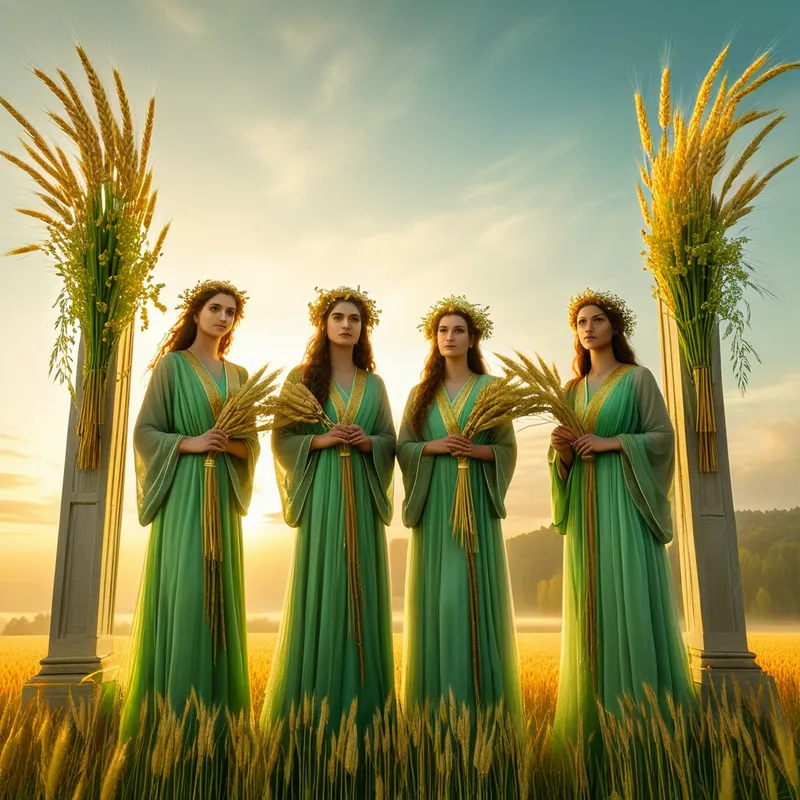
The Horae (Greek goddesses of Myth Meaning & Symbolism
Three goddesses who personify the seasons and the divine order of time, dancing at the threshold of Olympus to orchestrate the cycles of nature and human life.
The Tale of The Horae
Listen, and hear the whisper of the turning world. Before the first mortal drew breath, the great wheel was set in motion. Its keepers were three sisters, born of Themis and the sky-father Zeus. They were the Horae: Eunomia, Dike, and Eirene.
Their realm was the liminal space, the shimmering threshold where the immutable halls of Olympus met the ever-changing face of the earth. You would find them at the very gates of cloud, not as stern sentinels, but as a living, breathing hinge of the cosmos. Their footsteps were not heard as marches, but felt as the gentle, inexorable press of one season into the next.
In the tender blush of dawn, Eunomia—Good Order—would stir. With hands that could coax law from chaos, she would begin the dance. She did not command the buds to open; she was the opening, the first green shoot breaking the hard winter soil, the precise angle of the sun’s ascent. Her presence was the template, the divine blueprint from which life could safely unfold.
As the sun climbed, Dike—Justice—took her turn. Her gaze was the high, clear light of midday, leaving no shadow unturned. She measured the growth, ensured the stalk grew straight, the vine bore true. Her dance was one of balance, weighing the bloom against the root, the rain against the thirst. She was the fullness of summer, the moment of perfect ripeness that contains, within itself, the seed of its own passing.
Then, as the light gilded and softened, Eirene—Peace—would glide forward. Hers was the dance of completion, of gracious yielding. She gathered the ripe grain not with a sickle, but with an open palm. She was the fruitful autumn, the gentle decline into rest, the harmony of a task well-finished. She led the world not into death, but into a deep, quiet slumber, a necessary pause in the great rhythm.
Together, in their endless, graceful rotation, they wove the very fabric of time for the mortal world below. They adorned Aphrodite with the first blossoms of spring. They welcomed Dionysus to Olympus, their cycles a promise for his vines. Their dance was the resolution to the cosmic tension between eternity and decay, a resolution that played out in the scent of rain on dry earth, the weight of a peach in the hand, the crackle of frost on a silent morning.
Cultural Origins & Context
The worship of the Horae is ancient, rooted in the pre-Olympian understanding of the world as a sacred, ordered system. They were originally agrarian deities, their names and numbers varying across regions of Greece, reflecting local seasonal patterns—sometimes two, sometimes three, sometimes four. By the classical era, solidified in the works of Hesiod and later poets, they were most commonly triadic, embodying the fundamental conditions for a flourishing society: Order, Justice, and Peace.
They had no grand temples of their own. Instead, their cult was woven into the daily and annual rhythms of life. Farmers made offerings to them at planting and harvest. City-states invoked them, especially Dike, as the divine foundation of civil law and social harmony. They were the psychological and spiritual infrastructure, the invisible principles that made community and agriculture—the bedrock of Greek civilization—possible. Their myth was passed down not as a saga of adventure, but as a poetic explanation for the most reliable yet mysterious truth of human existence: the cycle.
Symbolic Architecture
The Horae represent the archetypal principle of dynamic order. They are not static law, but law in motion; not a frozen ideal, but the process of idealization itself. They symbolize the necessary stages through which any living system—a day, a year, a project, a relationship, a life—must progress to be whole and healthy.
They are the triple pulse of the cosmos: the impulse to begin (Order), the process of sustaining (Justice), and the grace of completion (Peace).
Psychologically, they map the structure of consciousness. Eunomia is the ego’s function of creating coherent structure from the chaos of the unconscious, setting intentions, and establishing personal boundaries. Dike is the evaluative function, the inner moral and ethical compass that weighs actions against consequences, demanding accountability and growth. Eirene is the integrative function, the capacity for acceptance, rest, and inner reconciliation that follows struggle or achievement. A psyche that ignores one of the Horae becomes disordered: chaotic without Eunomia, harsh and rigid without Dike, stagnant and unresolved without Eirene.
The Dreamer’s Resonance
To dream of the Horae, or of their symbols—a triple spiral, a circle of dancing figures, a door that opens onto three different landscapes—is to dream of life’s intrinsic timing. It often surfaces when the dreamer is out of sync, either rushing a natural process or stubbornly resisting a necessary ending.
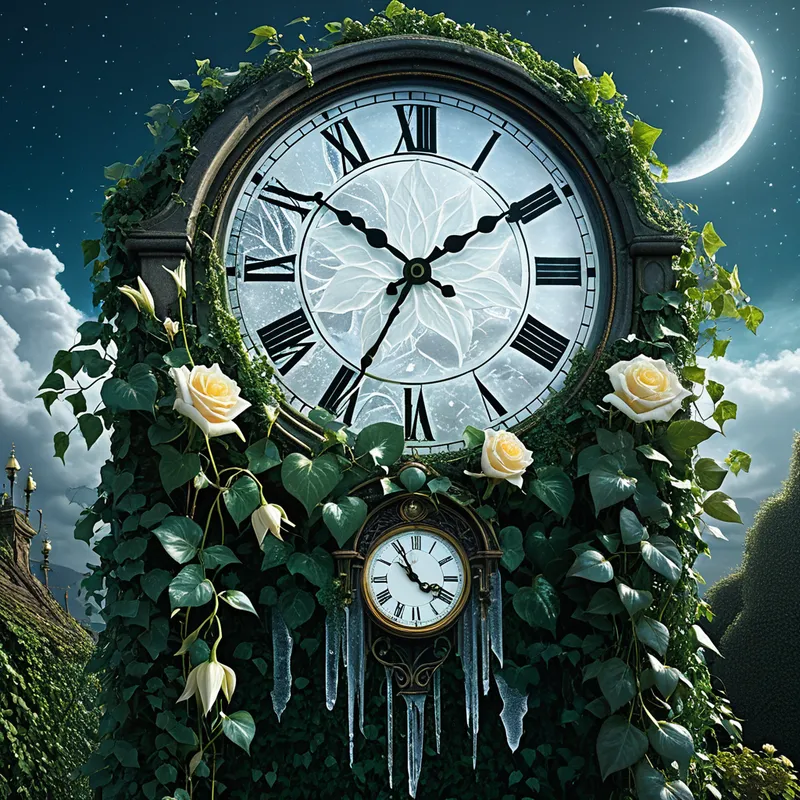
Somatically, this might manifest as dreams of being too early or too late, of missing a step in a dance, or of a garden where all the seasons are confused—snow falling on roses. Psychologically, it indicates a confrontation with one’s personal rhythm. The dream may present an unfinished task (Eirene calling for closure), a chaotic life circumstance (Eunomia offering a new structure), or a feeling of injustice or imbalance (Dike demanding re-assessment). The Horae in dreams are seldom dramatic; they are subtle, patient regulators, reminding the dreamer that health is a verb, a process of continual, graceful adjustment.
Alchemical Translation
The individuation process, the alchemical journey toward psychic wholeness, is not a linear conquest but a cyclical refinement. The Horae provide the model for this sacred rotation. The modern seeker must become their own gatekeeper, learning to dance their own threefold measure.
The work begins with Eunomia’s Alchemy: the opus of establishing order. This is the difficult, conscious work of sorting the inner chaos—naming the complexes, setting boundaries, choosing a direction. It is the winter planning for the spring garden.
It proceeds to Dike’s Alchemy: the opus of the crucible. Here, the chosen structure is tested by life and by the unconscious. Shadow material rises, old patterns rebel, and the justice of the psyche demands that every aspect of the self be acknowledged and weighed. This is the summer’s growth, which requires both nourishment and pruning.
The final, and often most elusive, stage is Eirene’s Alchemy: the opus of letting the gold be gold. This is the transmutation of struggle into wisdom, of effort into being. It is the conscious surrender to an ending, the gratitude for a cycle completed, which creates the fertile peace from which a new, more integrated order can naturally emerge.
To live in harmony with the Horae is to stop fighting time and to become time—to embody one’s own seasons with grace. It is to understand that peace is not the absence of conflict, but the fruit of an order justly maintained; that justice is not mere punishment, but the law that allows for growth; and that order is not rigid control, but the loving structure that makes life possible. They teach that our deepest liberation is found not in escaping the cycle, but in mastering its divine, dancing steps.
Associated Symbols
Explore related symbols from the CaleaDream lexicon: