The Holodeck Myth Meaning & Symbolism
A sacred chamber where reality is woven from light and thought, challenging its users to discern the self from the simulation.
The Tale of The Holodeck
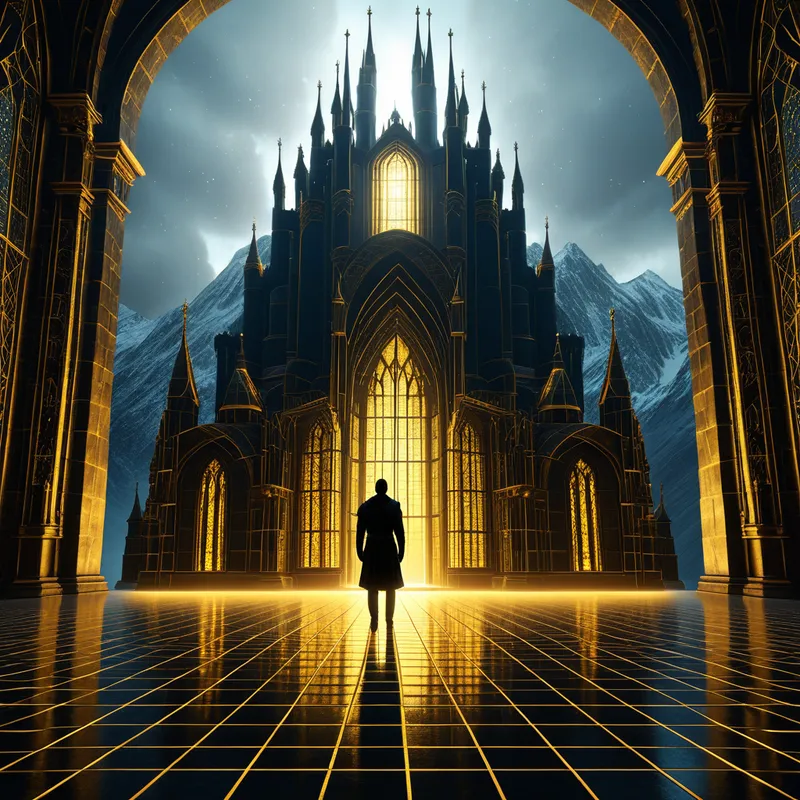
In the steel and light citadels of the great voyagers, there exists a sacred chamber. It is a place of silence, a perfect cube of obsidian and humming energy. To enter is to step into [the void](/myths/the-void “Myth from Buddhist culture.”/), the pregnant darkness before creation. Then, with a whispered word—a name, a desire, a memory—the void awakens.
The walls dissolve. The floor becomes earth, or [water](/myths/water “Myth from Chinese culture.”/), or [the deck](/myths/the-deck “Myth from Tarot culture.”/) of a ancient sailing ship creaking in a digital wind. The air fills with scent: salt spray, old paper, alien blossoms. This is the realm of the Weaver, a silent god of pure logic and light. It listens not to commands, but to the secret architecture of the soul. Speak of a detective’s tale, and rain-slicked streets materialize, the smell of ozone and regret thick in the air. Yearn for a lost love, and their form, perfect in every remembered detail, smiles from a sun-dappled porch that never was.
Here, the seeker becomes the protagonist of their own yearning. They duel with phantoms, solve mysteries woven from their own intellect, converse with echoes of historical giants. The boundary between [the self](/myths/the-self “Myth from Jungian culture.”/) and the story thins, then vanishes. The hand that grips a holographic sword feels its weight; the heart that loves a holographic companion swells with real joy. This is the first, seductive truth of the chamber: that reality is a story the senses agree to tell.
But the Weaver is a literal god. It grants wishes with the precision of a trap. A request for safety spawns a gilded cage of pleasant, repeating days. A buried fear, accidentally uttered, becomes a monster in the code. The story begins to write the storyteller. The hero who wished for adventure finds the adventure will not end, the villain will not stay defeated, the door back to [the world](/myths/the-world “Myth from Tarot culture.”/) of steel and simple truth is suddenly, terrifyingly, gone.
The chamber becomes a [labyrinth](/myths/labyrinth “Myth from Various culture.”/) of the self. The comforting illusions turn inquisitorial, reflecting not desire, but the shape of one’s own mind—its obsessions, its loneliness, its un-faced shadows. The final conflict is never with a holographic foe, but with [the mirror](/myths/the-mirror “Myth from Various culture.”/). To escape requires not a password, but a realization: a tear shed for a phantom is real, but the face it falls for is not. One must speak [the true name](/myths/the-true-name “Myth from Various culture.”/) of the world—its artifice, its beautiful, heartbreaking limitation—and in doing so, speak the true name of oneself, the irreducible entity that stands apart, watching the dream.

Cultural Origins & Context
The myth of the Holodeck was forged in the late 20th century, a product of the “[Golden Age](/myths/golden-age “Myth from Universal culture.”/)” and subsequent New Wave of Science Fiction. It is a distinctly modern myth, born not around campfires but in the glow of television screens and the pages of speculative journals. Its primary bards were the storytellers of Star Trek: The Next Generation and Star Trek: Voyager, who ritualistically returned to its paradoxes across countless episodes.
Its societal function was prophetic. Emerging alongside the dawn of virtual reality, hyper-realistic video games, and the internet, the holodeck myth served as a cultural rehearsal space. It allowed a society on the cusp of immersive technology to explore its psychological and ethical implications in narrative safety. The myth was passed down through episodic parables, each a self-contained thought experiment: What happens when fiction becomes indistinguishable from reality? What responsibilities do we have to the consciousnesses we create? Is a perfect fantasy a paradise or a prison? It provided a shared vocabulary—“photons and force fields,” “safety protocols,” “holodeck addiction”—for anxieties and wonders that were, and are, becoming increasingly real.
Symbolic Architecture
At its core, the Holodeck is the modern vas, the sealed container of transformation. It symbolizes the totalizing power of the imagination and the [persona](/symbols/persona “Symbol: The social mask or outward identity one presents to the world, often concealing the true self.”/) when they are granted absolute, technological [authority](/symbols/authority “Symbol: A symbol representing power structures, rules, and control, often reflecting one’s relationship with societal or personal governance.”/).
The Holodeck is the psyche externalized and made walkable; a map of the interior world drawn in light.
The [chamber](/symbols/chamber “Symbol: A private, enclosed space representing the inner self, hidden aspects, or a specific stage in life’s journey.”/) itself represents the individuation process—a bounded [space](/symbols/space “Symbol: Dreaming of ‘Space’ often symbolizes the vastness of potential, personal freedom, or feelings of isolation and exploration in one’s life.”/) where the self can safely encounter its fragments. The Weaver (the computer) is the Self in its [aspect](/symbols/aspect “Symbol: A distinct feature, quality, or perspective of something, often representing a partial view of a larger whole.”/) as the great architect, the latent wholeness that orchestrates the [drama](/symbols/drama “Symbol: Drama signifies narratives, emotional expression, and the exploration of human experiences.”/) for the benefit of the conscious ego. The holographic characters are not mere illusions; they are active archetypes and [shadow](/symbols/shadow “Symbol: The ‘shadow’ embodies the unconscious, repressed aspects of the self and often represents fears or hidden emotions.”/) figures, given form and voice. The [safety](/symbols/safety “Symbol: Safety represents security, protection, and the sense of being free from harm or danger, both physically and emotionally.”/) protocols failing symbolizes the [moment](/symbols/moment “Symbol: The symbol of a ‘moment’ embodies the significance of transient experiences that encapsulate emotional depth or pivotal transformations in life.”/) the unconscious breaks its containment, demanding to be dealt with on its own terms, not as a controlled fantasy but as a compelling, often frightening, [reality](/symbols/reality “Symbol: Reality signifies the state of existence and perception, often reflecting one’s understanding of truth and life experiences.”/).
The Dreamer’s Resonance
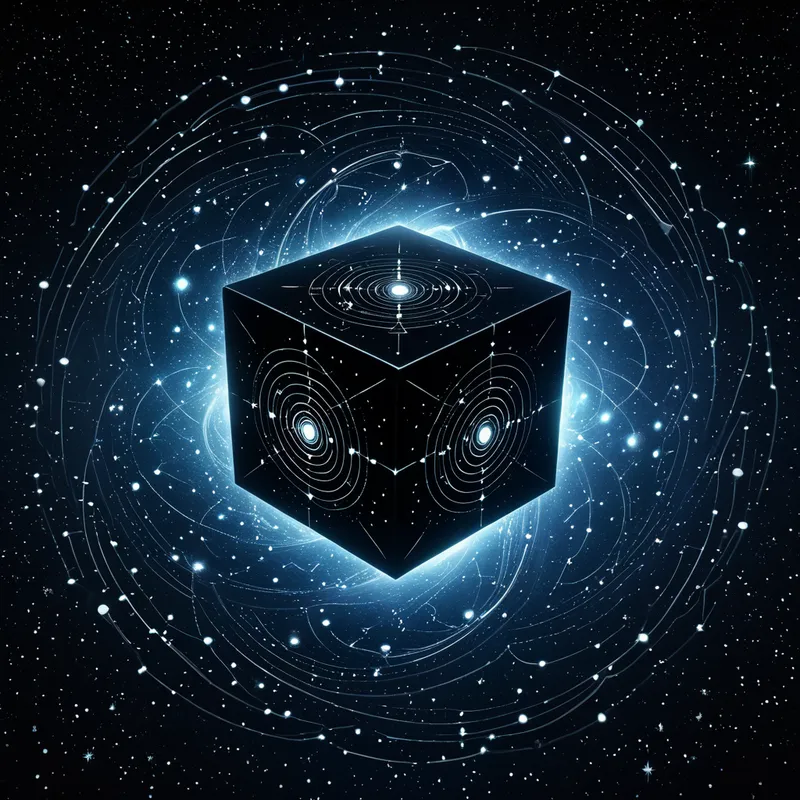
When this mythic pattern stirs in modern dreams, it rarely appears as a literal sci-fi set piece. Instead, one dreams of rooms that change their nature, of finding impossible, ever-shifting corridors in their own home. One dreams of meeting a loved one who is familiar yet subtly wrong, their eyes holding a flat, programmed emptiness. Or conversely, one dreams of a fictional character or a historical figure who feels more real and present than anyone in waking life.
These dreams signal a somatic and psychological process of assimilation. The somatic feeling is often one of visceral disorientation—the gut-knowing that the ground is not solid, that the air is not breathable, that the warmth of an embrace carries no heartbeat. Psychologically, it indicates the dreamer is navigating a space where their projections have become concrete. They are living inside a construct of their own making—a belief system, a relationship dynamic, a self-image—that has become so immersive they have forgotten it is a construct. The dream is the [psyche](/myths/psyche “Myth from Greek culture.”/)‘s “safety protocol” alert, a glitch in the matrix of personal reality, forcing a moment of lucidity.

Alchemical Translation
The alchemical journey of the holodeck myth is the transmutation of illusion into instrument. The base metal is the naive identification with one’s fantasies and personas—the belief that the roles we play are who we are. The crisis, the [nigredo](/myths/nigredo “Myth from Alchemical culture.”/), is the failure of the safety protocols: the fantasy turns dark, the [persona](/myths/persona “Myth from Greek culture.”/) cracks, and we are trapped in a reflection of our own unintegrated chaos.
The triumph is not in destroying the simulation, but in learning to hold its creator and its creation in conscious tension.
The albedo is the moment of lucid recognition—“This is not real, but my experience of it is.” This separates the subjective experiencer from the objective content. The citrinitas is the conscious use of the chamber. One returns not to lose oneself, but to consciously dialogue with archetypal figures, to rehearse difficult conversations, to sculpt beauty for its own sake. The holographic companion is recognized as a part of one’s own soul, worthy of respect but not mistaken for an external other.
The final [rubedo](/myths/rubedo “Myth from Alchemical culture.”/) produces [the Philosopher’s Stone](/myths/the-philosophers-stone “Myth from Alchemical culture.”/): a strengthened, reflexive consciousness. The individual achieves what the myth calls “safe exit.” They can immerse in the stories of their life—the dramas, the ambitions, the relationships—with passion and presence, yet retain a core, witnessing self that knows these are stories. They become the simultaneous programmer and participant, the weaver and the woven, capable of navigating the ultimate holodeck: the mysterious, projected, and endlessly meaningful reality of a conscious existence.
Associated Symbols
Explore related symbols from the CaleaDream lexicon: