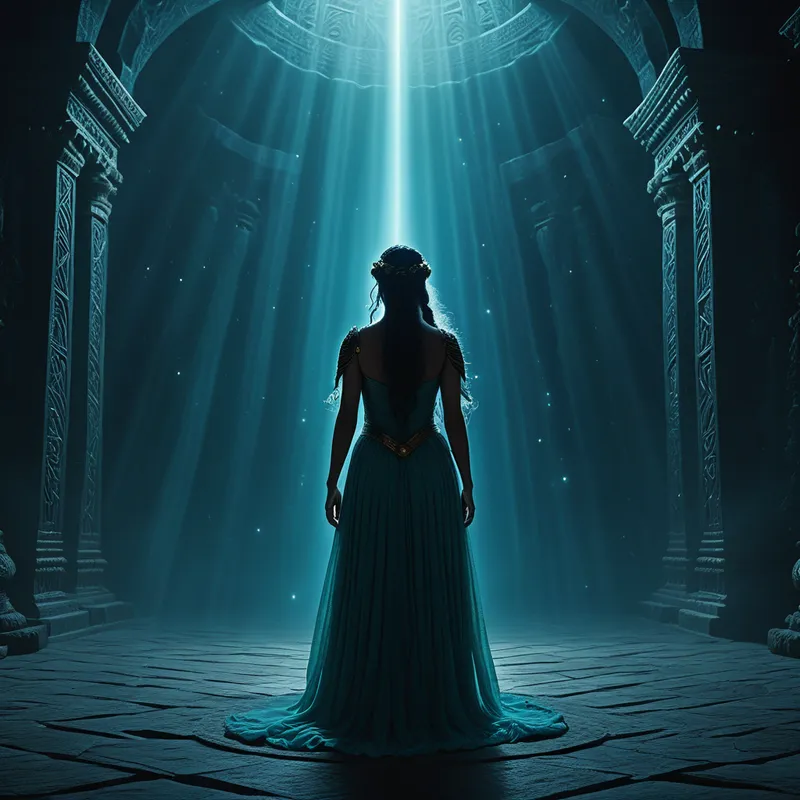
The Hero Twins in Xibalba
The Maya Hero Twins descend into Xibalba, the underworld, to avenge their father and outwit the death gods through cleverness and trickery.
The Tale of The Hero Twins in Xibalba
Before [the world](/myths/the-world “Myth from Tarot culture.”/) was as we know it, when [the sky](/myths/the-sky “Myth from Persian culture.”/) was lower and the gods more present, there lived the sons of One [Hunahpu](/myths/hunahpu “Myth from Mayan culture.”/). Their father and uncle, the original Hero Twins, had been lured to the foul realm of Xibalba and tricked into a ballgame, where they were sacrificed and buried beneath the court. From the grave of their father, a [calabash](/myths/calabash “Myth from African Diaspora culture.”/) tree grew, and from its fruit, born of the spittle of a passing goddess, came [Hunahpu and Xbalanque](/myths/hunahpu-and-xbalanque “Myth from Mesoamerican culture.”/).
They grew not as ordinary boys but as beings of destiny, skilled hunters and ballplayers, their hearts burning with the unspoken knowledge of their father’s fate. When [the lords of Xibalba](/myths/the-lords-of-xibalba “Myth from Mesoamerican culture.”/)—One [Death](/myths/death “Myth from Tarot culture.”/) and Seven Death, and their host of affliction gods like Pus Master and Jaundice Master—sent a summons, the twins did not hesitate. They knew the path led to vengeance.
Their descent was a journey into the very architecture of fear. The [road to Xibalba](/myths/road-to-xibalba “Myth from Mesoamerican culture.”/) was steep and treacherous, but the first true tests were the silent, sentient rivers: [the River](/myths/the-river “Myth from Buddhist culture.”/) of Scorpions, the River of Blood, and the River of Pus. The twins did not falter; they crossed without drinking, seeing the illusions for what they were. At the dark council, they faced the lords seated as effigies, and when commanded to greet them, they addressed the manikins. The lords roared with laughter, revealing themselves. The twins had failed the first test of perception, and were given the House of Gloom for the night.
This was but the first of the deadly houses—the House of Cold, the House of Jaguars, the House of Fire, the House of Knives. Each was a chamber of pure, elemental terror designed to annihilate body and spirit. In the House of Gloom, they were given a single torch and two cigars, ordered to keep them lit until dawn on pain of death. With cunning, they placed fireflies at the tips of the cigars and tied the tail feathers of a macaw to the torch, making the lords believe they burned all night. They survived through trickery, the first turning of the tables.
Yet Xibalba was relentless. The next day, they were challenged to [the ballgame](/myths/the-ballgame “Myth from Mesoamerican culture.”/). The lords used a ball of solid, sharp obsidian. The twins, however, had brought a hidden ally—a blade of obsidian within their own ball. During the game, they let the obsidian ball strike a rabbit they had conjured; the creature dashed away, distracting the Xibalbans long enough for the twins to switch the lethal ball for their own. They lost the game strategically, accepting the “defeat” that led to their next trial: the House of Bats.
Here, in a cavern swarming with razor-beaked bats, Hunahpu made a fatal miscalculation. Peeking from his hiding place at dawn, he was instantly decapitated by the great bat god, [Camazotz](/myths/camazotz “Myth from Mesoamerican culture.”/). His head was taken to the [ballcourt](/myths/ballcourt “Myth from Mesoamerican culture.”/) as a trophy. But Xbalanque did not despair. He summoned the animals of [the earth](/myths/the-earth “Myth from Hindu culture.”/), and with the help of a turtle, fashioned a new head for his brother. Restored, they returned to the game.
Now began the final, glorious deception. Appearing as ragged vagabonds, they performed miracles for the lords of Xibalba. They burned a house and restored it, killed a dog and brought it back to life. Entranced, the death gods demanded a new spectacle: “Sacrifice a person, then bring him back to life!” The twins obliged. They “sacrificed” a Xibalban volunteer, then truly revived him. Drunk on this power over life and death, One Death and Seven Death then made the ultimate demand: “Do it to us! Sacrifice us!”
This was the moment of reckoning. The twins performed the ritual, but when they sacrificed the two supreme lords, they did not bring them back. They broke the cycle. They stripped the lords of their power and dominion, humiliating the remaining gods and binding them to a new, lesser order. The twins then revealed their true identities as the avenging sons of One Hunahpu. Their work done, they did not stay to rule [the underworld](/myths/the-underworld “Myth from Greek culture.”/). Instead, they ascended to the sky, becoming the sun and [the moon](/myths/the-moon “Myth from Tarot culture.”/), eternal witnesses to the world they helped secure for humanity.
Cultural Origins & Context
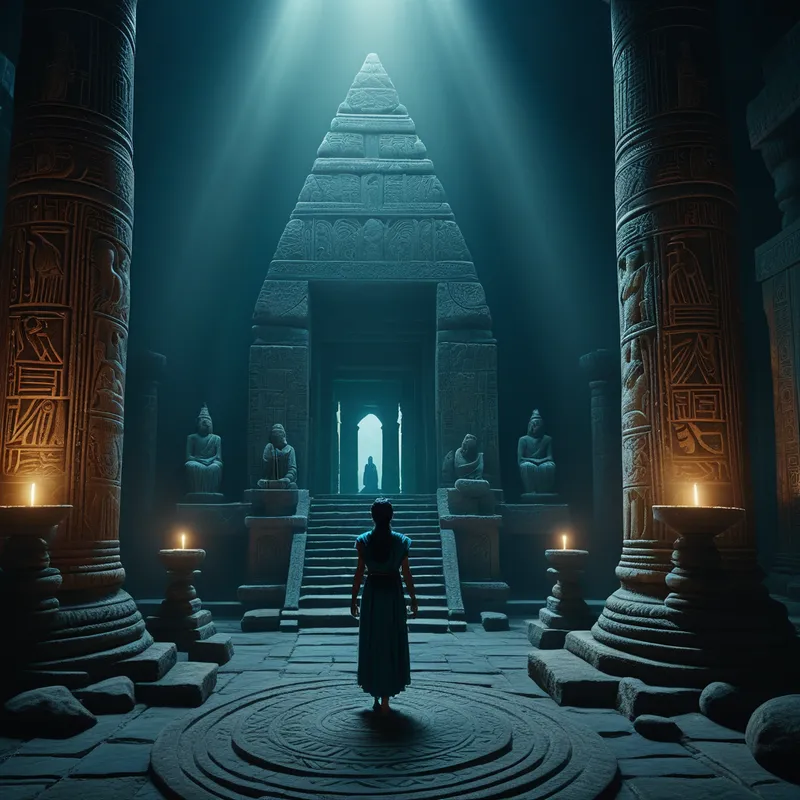
This myth is the central narrative of the Popol Vuh, the sacred book of the Kʼicheʼ Maya. It is not merely a story of adventure but a foundational charter that explains the nature of the cosmos, the relationship between gods and humans, and the proper order of the world. The Hero Twins’ journey is the pivotal event between the failures of the earlier generations of gods and the final creation of true humans from maize.
Xibalba (meaning “Place of Fright”) is not a hell of eternal punishment, but a bureaucratic, diseased reflection of the upper world—a realm of decay, fear, and false appearances. The lords are not demons of evil, but personifications of sickness, misfortune, and death itself. The twins’ victory does not annihilate death; they subdue and regulate it, establishing the conditions under which life can flourish. Their story is deeply intertwined with the Maya ballgame, a ritual sport that reenacted cosmic battles and often culminated in sacrifice, seen as a necessary offering for the renewal of life and the movement of celestial bodies.
Symbolic Architecture
The myth is a masterclass in symbolic [initiation](/symbols/initiation “Symbol: A symbolic beginning or transition into a new phase, status, or awareness, often involving tests, rituals, or profound personal change.”/). Each element is a [layer](/symbols/layer “Symbol: Layers often symbolize complexity, depth, and protection in dreams, representing the various aspects of the self or situations.”/) of psychological and spiritual [truth](/symbols/truth “Symbol: Truth represents authenticity, honesty, and the quest for knowledge beyond mere appearances.”/).
The Houses of Xibalba are not physical locations but states of consciousness—the House of Cold is despair, the House of Knives is self-doubt, the House of Gloom is depression. To pass through them is not to avoid the feeling, but to outwit its claim to ultimate reality.
The twins’ primary weapons are not [strength](/symbols/strength “Symbol: ‘Strength’ symbolizes resilience, courage, and the ability to overcome challenges.”/), but [perception](/symbols/perception “Symbol: The process of becoming aware of something through the senses. In dreams, it often represents how one interprets reality or internal states.”/) and improvisation. They fail the first test of perception (the effigies) but learn instantly, mastering illusion thereafter. Their tricks are acts of psychological warfare, using the expectations of the lords against them. The beheading and replacement of Hunahpu’s head is a profound alchemical [image](/symbols/image “Symbol: An image represents perception, memories, and the visual narratives we create in our minds.”/): the [loss](/symbols/loss “Symbol: Loss often symbolizes change, grief, and transformation in dreams, representing the emotional or psychological detachment from something or someone significant.”/) of the rational, directing mind (the head) and its replacement with an earthy, enduring [consciousness](/symbols/consciousness “Symbol: Consciousness represents the state of awareness and perception, encompassing thoughts, feelings, and experiences.”/) (the [turtle](/symbols/turtle “Symbol: The turtle symbolizes wisdom, longevity, and the importance of taking one’s time.”/)), enabling a resurrection of the whole self with new wisdom.
Their final act—the false miracles leading to the true, irreversible sacrifice of the [death](/symbols/death “Symbol: Symbolizes transformation, endings, and new beginnings; often associated with fear of the unknown.”/) gods—represents the ultimate trick: using the [enemy](/symbols/enemy “Symbol: An enemy in dreams often symbolizes an internal conflict, self-doubt, or an aspect of oneself that one struggles to accept.”/)’s deepest desire (for power over [life](/symbols/life “Symbol: The symbol of ‘Life’ represents a journey of growth, interconnectedness, and existential meaning, encompassing both the joys and challenges that define human experience.”/) and death) as the trap that annihilates them. It is the [paradox](/symbols/paradox “Symbol: A contradictory yet true concept that challenges logic and perception, often representing unresolved tensions or profound truths.”/) of defeating [death](/symbols/death “Symbol: Symbolizes transformation, endings, and new beginnings; often associated with fear of the unknown.”/) by inviting it in, then refusing to play by its cyclical rules.
The Dreamer’s Resonance
To dream of this myth is to dream of the descent. Psychologically, it speaks to the necessary journey into one’s personal Xibalba—the shadowlands of grief, shame, trauma, or depression where our personal “lords of death” (addictions, fears, complexes) hold court. The twins model a path not of brute conquest, but of cunning engagement. They teach that to face the monstrous is not to fight it on its own terms, but to change the terms of the game.
The avenging of the father is a powerful motif of psychological integration. The twins are not destroying their father’s legacy; they are completing it, facing the fate he could not overcome and transforming it. This is the move from being a victim of ancestral pain to becoming its redeemer. Their ascent as celestial bodies suggests that the integration of such a profound journey does not simply return one to the old self, but elevates consciousness to a guiding, illuminating role.
Alchemical Translation
The myth is a complete alchemical opus. The descent is the [nigredo](/myths/nigredo “Myth from Alchemical culture.”/)—the blackening, the confrontation with primal matter and decay in the [underworld](/myths/underworld “Myth from Greek culture.”/). The series of tricks and survivals is the [albedo](/myths/albedo “Myth from Alchemical culture.”/)—the whitening, the purification through cunning and the application of intellect ([mercury](/myths/mercury “Myth from Roman culture.”/)). The beheading and restoration is a critical citrinitas—the yellowing, a death and rebirth that grants a new, more resilient form of consciousness.
The final, triumphant sacrifice of the death lords is the rubedo—the reddening, the achievement of the philosopher’s stone. Here, the stone is not a physical object, but the achieved state of being that can “sacrifice” (confront and dissolve) the very principles of annihilation within the self, thereby gaining true sovereignty.
Their apotheosis as sun and moon is the final fixation: the stabilized, eternal expression of the reconciled opposites (the twins themselves, day and night, life and death) now placed in ordered, life-giving motion in the heavens.
Associated Symbols
Explore related symbols from the CaleaDream lexicon:
- Hero — The archetypal figure who ventures into the unknown to confront a profound challenge, often achieving a victory that transforms [the self](/myths/the-self “Myth from Jungian culture.”/) and the world.
- Trickster — A boundary-crossing agent of change who uses wit, deception, and subversion to disrupt stagnant orders and expose hidden truths.
- Ballgame — A ritual contest representing cosmic struggle, fate, and the cyclical nature of sacrifice and renewal.
- Death — Not merely an end, but a transformative threshold, a lord to be confronted, outwitted, and forced into a new, life-affirming order.
- Rebirth — The essential promise emerging from [the underworld journey](/myths/the-underworld-journey “Myth from Various culture.”/), exemplified by the restored head, the revived dog, and the twins’ celestial ascent.
- Sacrifice — The central, ambiguous act; a tool of the death gods turned against them, representing the necessary surrender of one state of being to achieve a higher one.
- Father — The ancestral figure whose unresolved fate sets the quest in motion, representing legacy, burden, and the need for completion by the next generation.
- Journey — The structured descent and return, mapping the necessary passage through darkness to achieve enlightenment or victory.
- Shadow — The repressed, feared aspects of existence given form and dominion in the labyrinthine realm of Xibalba.
- Twins — The embodiment of duality and complementary partnership, where two distinct beings act as one united consciousness to navigate [chaos](/myths/chaos “Myth from Greek culture.”/).
- Deception — The strategic weapon of the weak against the powerful, a means of survival and subversion that exposes the illusions of tyranny.
- Underworld — The psychological and mythological realm of the dead, the unconscious, and all that is hidden, feared, and awaiting integration.