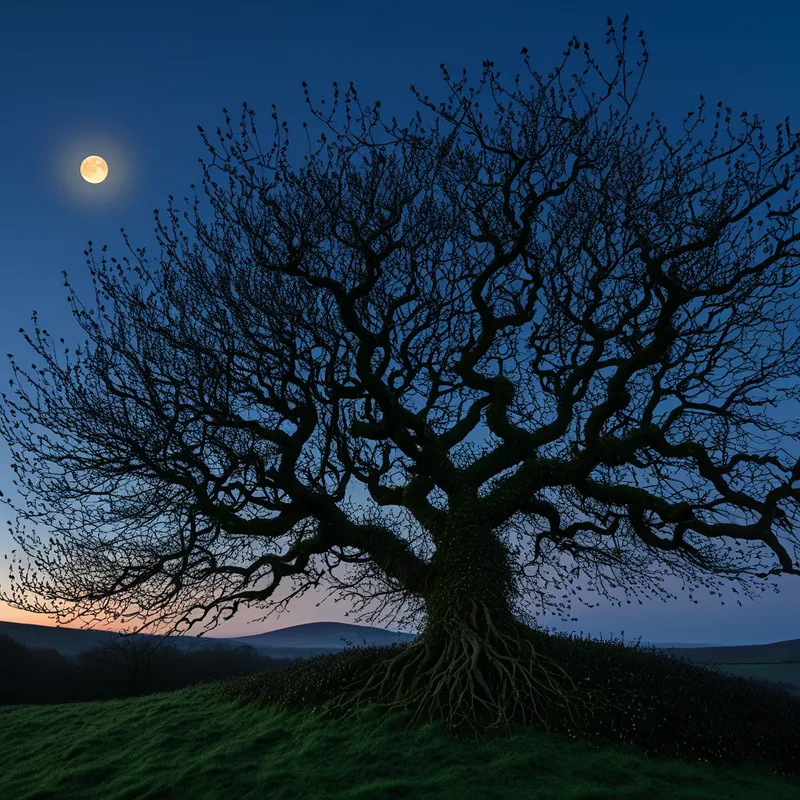
The Hedge Myth Meaning & Symbolism
An ancient tale of a living boundary, woven from sacrifice, that separates the mortal world from the unseen, demanding respect and offering passage only to the worthy.
The Tale of The Hedge
Listen. Before the roads were straight and the fields were square, when the world was soft at the edges and the wind carried whispers from places without names, there was the making of The Hedge.
It did not grow; it was woven. In the time when the First Clay still breathed with the memory of chaos, the worlds bled into one another. The laughter of the Green Kin would startle a mortal heart to stillness. The grief of a dying man could sour a spring in the Otherlands. There was no separation, only a terrible, beautiful intimacy that was driving both realms mad.
The Elder Council met at the Crossroads of Maybe. The earth rumbled with their debate. Finally, the Weaver, whose fingers were roots and whose thoughts were seasons, spoke. “A boundary must be made. Not of stone, for stone is deaf. Not of fire, for fire consumes. It must be alive. It must feel the cost.”
And so the call went out. From the mortal realm came a woman, Anya, whose sorrow was a well with no bottom. Her child had strayed into a mist and not returned, taken by the glimmering confusion of the un-separated worlds. From the Otherlands came a being known as Kaelen, whose purpose was eroding, its essence diluted by the endless spill of mortal dreams.
They met at the appointed place, a raw seam in reality. The Weaver gave them the seed: a single, hard pit from the first Blackthorn. “This will be the spine,” the Weaver said. “But for flesh, it requires yours. For spirit, it requires yours.”
Anya, without hesitation, pressed her palm against the cold soil. From her hand grew not a root, but a memory—the memory of her child’s laugh, now a bittersweet scent of hawthorn blossom. Kaelen placed its shimmering hand over hers. From its touch grew not a branch, but a law—the law of here and there, now a sharp, protective thorn.
They wove. Anya gave her grief, her love, her longing for a clear, safe path. Each memory became a whipping branch, a tender leaf. Kaelen gave its clarity, its ancient patience, its duty to maintain order. Each principle became a cruel thorn, a guiding glimmer in the bark. They wove until their individual forms were indistinguishable from the growing wall. Their sacrifice was not a death, but a transformation into a new kind of life—a living, feeling boundary.
Where Anya’s mortal tears fell, gateways formed—places where, with proper respect and need, one might pass. Where Kaelen’s resolve hardened, the Hedge became impenetrable, a bastion against chaos. It stretched across the world, a living tapestry of sacrifice, separating yet connecting the realms. It was not a wall of hate, but a membrane of love so profound it had to say “thus far, and no further.” The Hedge was born, and the worlds could breathe again, each in its own sacred space.
Cultural Origins & Context
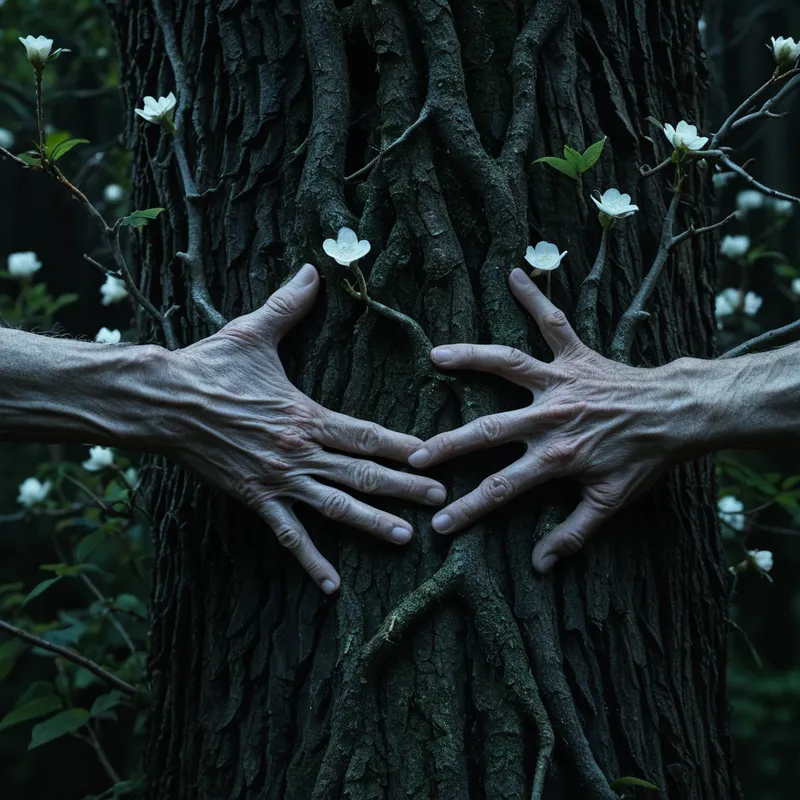
The myth of The Hedge is foundational to what scholars term the “Folklore” culture—a composite tapestry of agrarian, pre-modern European folk traditions, oral histories, and localized spirit beliefs. It was not the property of priests in temples, but of grandmothers by hearths, of shepherds on lonely hills, of midwives and woodcutters. It was told during the Between-Times, when the veil was considered thin: at Samhain, at dusk, at the birth of a child or the vigil for the dying.
Its societal function was multifaceted. Practically, it explained and enforced the real, physical boundaries of the community—the hedgerows that marked fields, the edges of the village, the border of the wild forest. These were not mere property lines but sacred demarcations, echoes of the primal Hedge. Psychologically, it provided a cosmology of order. It answered the profound human need for a world that makes sense, where there is a here for the living and a there for the ancestors and spirits, with a defined, though negotiable, relationship between them. The myth taught that boundaries are not born of violence, but of sacred sacrifice, and thus deserve reverence.
Symbolic Architecture
At its core, The Hedge is the archetypal symbol of the Liminal Membrane. It represents the necessary separation that allows for relationship. Without a skin, an organism dissolves into its environment; without an ego-boundary, a psyche is flooded by the unconscious.
The Hedge is not a wall that denies connection, but a skin that makes conscious relationship possible.
Anya symbolizes the mortal soul—its profound capacity for love, which inherently creates the pain of loss and the need for protection. Her sacrifice represents the necessary “giving up” of naive omnipresence, the childish dream of having everything without cost, to create a safe container for life to grow. Kaelen represents the transpersonal spirit of law, structure, and differentiation—the principle that gives form to formless love. Its sacrifice is the relinquishment of pure, abstract principle to be grounded in the messy, emotional reality of embodied existence.
The thorns are not punishments, but the necessary consequences of form—the pains of individuation, the sting of self-awareness, the defenses required for integrity. The blossoms are the gifts that emerge from this sacred constraint: identity, culture, love that knows its object, and the possibility of a meaningful journey, for a path requires edges to define it.
The Dreamer’s Resonance
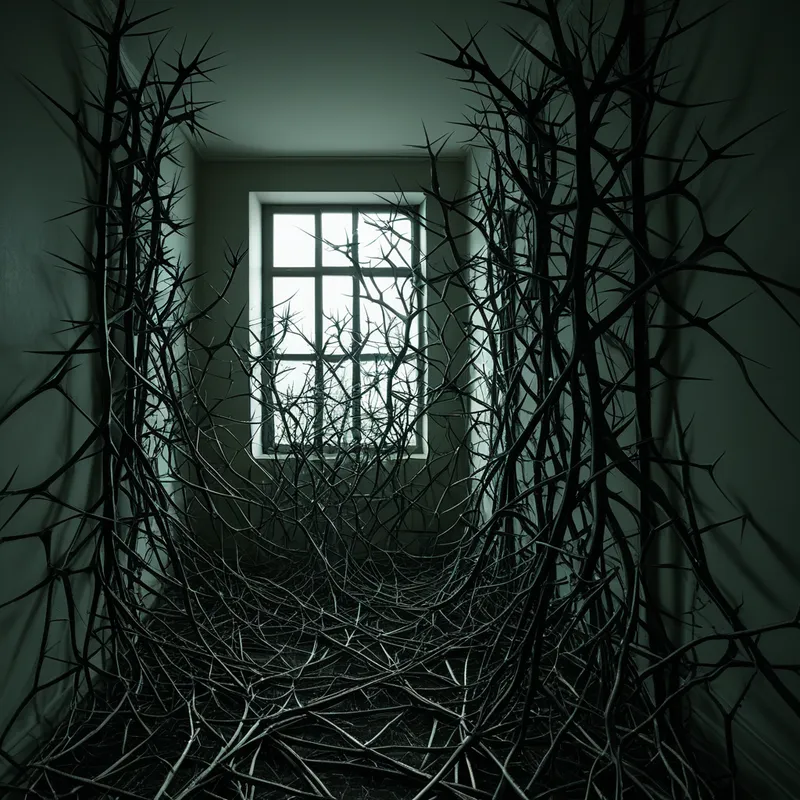
When The Hedge appears in modern dreams, it rarely manifests as a quaint countryside barrier. It appears as a dense, overwhelming thickness—a wall of bureaucratic red tape made of brambles, a social anxiety that physically constricts into thorny vines, a psychological barrier built from the tangled memories of past hurts. It is the dream-image of the dreamer’s own psychic boundaries, either crumbling, being violated, or becoming pathologically rigid.
To dream of being lost outside The Hedge is to feel exiled from one’s own sense of order or safety, adrift in the unconscious. To dream of being trapped inside an overgrown, suffocating hedge is to experience the claustrophobia of an overly defended ego, cut off from the vitality of the outer world or the inner instinctual self. The somatic experience is often one of constriction in the chest, a prickling on the skin, or a profound sense of being “stuck.” The dream is presenting the current state of the psyche’s defining membrane, asking for conscious attention to where we are too porous or too fortified.
Alchemical Translation
The alchemical process modeled by the myth is that of the Coniunctio Liminalis—the sacred marriage that creates a threshold. For the modern individual, this is the heart of individuation. It is the internal work of weaving together our inner Anya and inner Kaelen.
Our “Anya” is our vulnerable, feeling, connecting self—our capacity for empathy, love, and merger. Our “Kaelen” is our structuring, discerning, differentiating self—our capacity for analysis, principle, and self-definition. Psychic illness occurs when these are split: the feeling self runs wild without boundaries (leading to enmeshment, burnout, hysteria), or the structuring self becomes a tyrannical fortress (leading to isolation, rigidity, obsession).
Individuation is the conscious weaving of one’s own Hedge. The thorns are the wise defenses we choose; the blossoms are the authentic relationships we cultivate.
The alchemical work is to bring these opposites to the Crossroads of Maybe within us—the point of tension and potential. We must allow our vulnerable love to inform our principles, and we must allow our principles to give wise form to our love. The sacrifice is the relinquishment of each in their pure, extreme state. We sacrifice the fantasy of boundless, undifferentiated connection (Anya’s initial loss) and the fantasy of perfect, impersonal order (Kaelen’s initial erosion). In their place, we weave a living boundary—a resilient, responsive ego that can both protect and connect, that knows where it ends and another begins. This is the creation of a true Self, a sacred space where the inner and outer worlds can meet in conscious, respectful relationship. We become, ourselves, a passage point.
Associated Symbols
Explore related symbols from the CaleaDream lexicon: