The Hearth of Frigg Myth Meaning & Symbolism
A myth of the goddess Frigg, who weaves fate and guards a sacred hearth of silent wisdom, the hidden center of all homes and hearts.
The Tale of The Hearth of Frigg
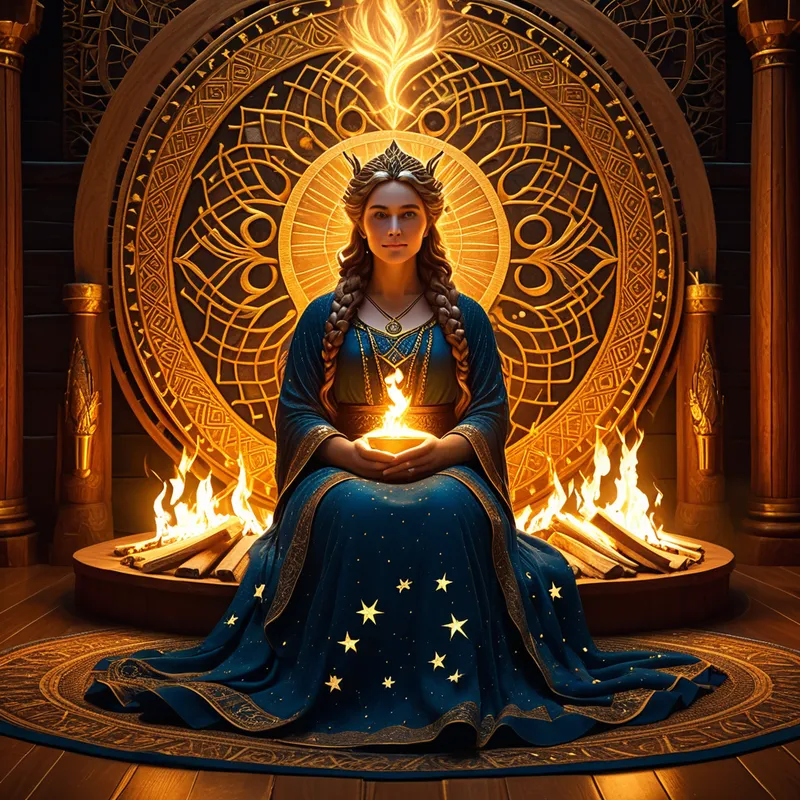
Listen. In the high halls of Ásgarðr, where [the wind](/myths/the-wind “Myth from Various culture.”/) carries the whispers of the Nornir from the roots of the [Yggdrasil](/myths/yggdrasil “Myth from Global/Universal culture.”/), there sits a queen whose silence holds the weight of worlds. Her name is [Frigg](/myths/frigg “Myth from Norse culture.”/). While Óðinn rides forth to seek wisdom from the dead, and Þórr shakes [the sky](/myths/the-sky “Myth from Persian culture.”/) with his rage, [Frigg](/myths/frigg “Myth from Norse culture.”/) remains. Her throne is not of silver or gold, but of ash-wood, worn smooth by time, and it faces not the great doors of the hall, but the heart of it: [the Hearth](/myths/the-hearth “Myth from Norse culture.”/).
This is no simple fire of birch logs. This is the First Fire, kindled from the spark that leapt from Múspell at the dawn of time. Its flames are the colour of remembered sunlight on honey, and they do not crackle, but hum—a low, deep song that resonates in the marrow. Around it, the hall of [Fensalir](/myths/fensalir “Myth from Norse culture.”/) is built: walls of woven reeds that hold the scent of meadow and mist, rafters hung with linens drying, their fibres holding the memory of flax fields.
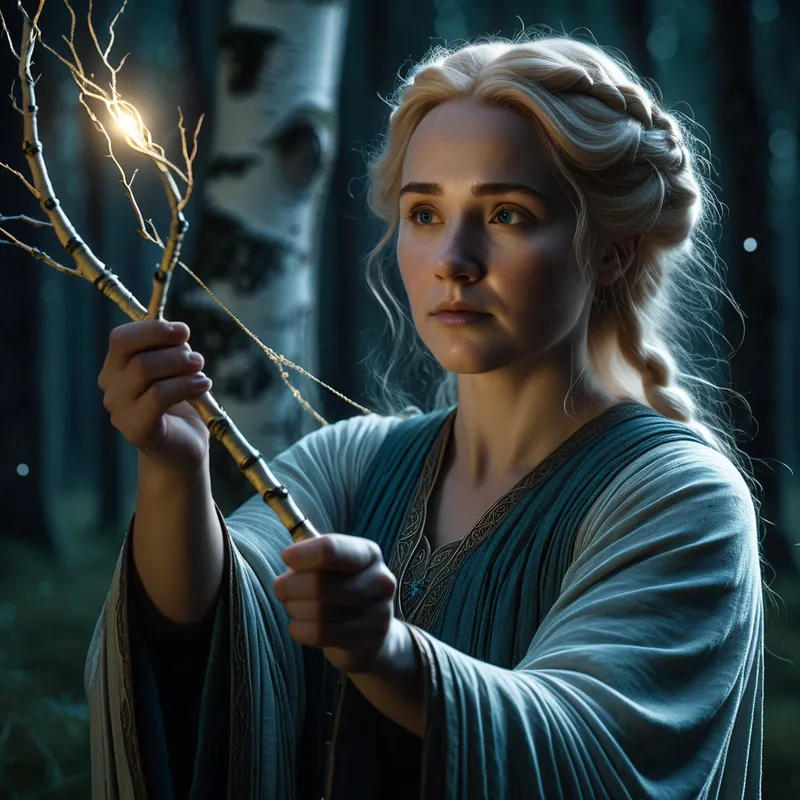
Here, Frigg works. In her lap rests a distaff of pale birch, and from it, she spins. But she does not spin wool or linen. She spins cloud-stuff and starlight, the breath of newborns and the last sigh of the dying. With fingers that know the texture of fate, she draws out threads of glimmering white and threads of profound black, weaving them upon a loom only she can see. Each thread is a life, a choice, a turning point in the great tapestry of ørlög. She sees the patterns forming—the glorious victories and the terrible falls. She sees the thread of her own son, Baldr, shining with a terrible, fragile light, and she knows its end.
And so, she acts. Not with a shout, but with a whispered plea to every being in creation—to stone and metal, to fire and [water](/myths/water “Myth from Chinese culture.”/), to beast and bird—to swear an oath not to harm her son. All swear it, all but one: the mistletoe, young and unregarded, growing at the edge of [the world](/myths/the-world “Myth from Tarot culture.”/). This secret, this one un-sworn thread, she holds close to her heart, a cold dread amidst the Hearth’s warmth.
When the terrible game is played, and the blind god Höðr is guided to cast the mistletoe shaft, it is not in the field that Frigg hears the news. It is by her Hearth. The hum of the fire stutters. The threads on her invisible loom go suddenly, violently slack. The warmth that sustained the very walls of Ásgarðr dims, not to darkness, but to a grey, enduring ember-glow. She does not wail. She gathers the silence around her like a cloak, and the Hearth’s light becomes the light of vigil, of memory, of a love that persists beyond the breaking of the world. It is the light that waits at the end of all things, ready to be kindled again.
Cultural Origins & Context
The figure of Frigg and the sanctity of the hearth are not the subjects of a single, codified myth like the tales of Thor’s fishing trip or the death of Baldr. Instead, they are woven into the very fabric of Norrœn daily life and cosmological understanding. Our sources are fragments: tantalizing mentions in the Poetic Edda, implications in the Prose Edda, and the enduring archaeological record of the longhouse.
The hearth was the absolute center of the Norse home—the source of heat, light, and cooked food, the gathering place for family and [thing](/myths/thing “Myth from Norse culture.”/). It was a microcosm of the world, its fire a domesticated echo of the sun and of [Surtr](/myths/surtr “Myth from Norse culture.”/)’s flame. To tend it was a sacred duty, often falling to the woman of the house, who thus became the priestess of this inner sanctum. Frigg, as the divine matron of marriage, the household, and foresight, was the mythic [projection](/myths/projection “Myth from Alchemical culture.”/) of this role. Stories of her would have been told not by skalds in grand [feasting halls](/myths/feasting-halls “Myth from Celtic culture.”/) alone, but by mothers and grandmothers by the home-fire, teaching the profound magic and responsibility of creating and holding safe space. Her knowledge of fate, and her inability to ultimately alter it, mirrors the Norse worldview: one prepares the hearth, one weaves the cloth, one faces the winter with courage, knowing that ørlög is fixed, but dignity is not.
Symbolic Architecture
The Hearth of Frigg is far more than a [household](/symbols/household “Symbol: Represents the self, family dynamics, and personal psychological structure. It’s a container for identity and relationships.”/) fixture; it is the symbolic center of conscious, caring existence within the chaotic [flux](/symbols/flux “Symbol: A state of continuous change, instability, or flow, often representing the impermanent nature of existence and experience.”/) of [destiny](/symbols/destiny “Symbol: A predetermined course of events or ultimate purpose, often linked to spiritual forces or cosmic order, representing life’s inherent direction.”/).
The hearth is the altar where the raw, chaotic element of fire is domesticated into a source of sustenance and vision. It represents the conscious ego’s task: to contain and focus the blazing, undifferentiated energies of the unconscious into a stable, life-giving center.
Frigg herself embodies the [archetype](/symbols/archetype “Symbol: A universal, primordial pattern or prototype in the collective unconscious that shapes human experience, behavior, and creative expression.”/) of the knowing [caregiver](/symbols/caregiver “Symbol: A spiritual or mythical figure representing nurturing, protection, and unconditional support, often embodying divine or archetypal parental energy.”/). Her wisdom is not the wandering, acquisitive [knowledge](/symbols/knowledge “Symbol: Knowledge symbolizes learning, understanding, and wisdom, embodying the acquisition of information and enlightenment.”/) of Odin, but an intuitive, embodied knowing that comes from deep [attention](/symbols/attention “Symbol: Attention in dreams signifies focus, awareness, and the priorities in one’s life, often indicating where the dreamer’s energy is invested.”/) and [relationship](/symbols/relationship “Symbol: A representation of connections we have with others in our lives, often reflecting our emotional state.”/). She sees [fate](/symbols/fate “Symbol: Fate represents the belief in predetermined outcomes, suggesting that some aspects of life are beyond human control.”/) because she sits at the center of the web of [life](/symbols/life “Symbol: The symbol of ‘Life’ represents a journey of growth, interconnectedness, and existential meaning, encompassing both the joys and challenges that define human experience.”/), feeling the [tension](/symbols/tension “Symbol: A state of mental or emotional strain, often manifesting physically as tightness, pressure, or unease, signaling unresolved conflict or anticipation.”/) and release of every thread connected to her home and [heart](/symbols/heart “Symbol: The heart symbolizes love, emotion, and the core of one’s existence, representing deep connections with others and self.”/). The distaff and [spindle](/symbols/spindle “Symbol: A spindle is a tool used for spinning thread, symbolizing creativity, the act of weaving, and the intertwining of life’s stories.”/) are extensions of this [symbolism](/symbols/symbolism “Symbol: The use of symbols to represent ideas or qualities, often conveying deeper meanings beyond literal interpretation. In dreams, it’s the language of the unconscious.”/): from the formless [mass](/symbols/mass “Symbol: Mass often symbolizes a gathering or collective experience, representing shared beliefs, burdens, or the weight of emotions within a community.”/) (the [wool](/symbols/wool “Symbol: A natural fiber representing warmth, protection, and connection to tradition. Often symbolizes comfort, labor, or spiritual purity.”/) on the distaff, the unmanifest potential), she draws out a continuous thread (individual [life](/symbols/life “Symbol: The symbol of ‘Life’ represents a journey of growth, interconnectedness, and existential meaning, encompassing both the joys and challenges that define human experience.”/), conscious continuity) and gives it purposeful [direction](/symbols/direction “Symbol: Direction in dreams often relates to life choices, guidance, and the path one is following, emphasizing the importance of navigation in personal journeys.”/).
The tragedy of Baldr, and Frigg’s foreknowledge of it, introduces the hearth’s [shadow](/symbols/shadow “Symbol: The ‘shadow’ embodies the unconscious, repressed aspects of the self and often represents fears or hidden emotions.”/) [aspect](/symbols/aspect “Symbol: A distinct feature, quality, or perspective of something, often representing a partial view of a larger whole.”/): the burden of foresight. To hold the warm, life-sustaining center is also to hold the certainty of its eventual cooling. The one un-sworn [oath](/symbols/oath “Symbol: A solemn promise or vow, often invoking a higher power or sacred principle, binding individuals to specific actions or loyalties.”/), the [mistletoe](/symbols/mistletoe “Symbol: Mistletoe symbolizes love, peace, and friendship, traditionally used as a decoration during Christmas with the famous practice of kissing underneath it.”/), symbolizes the inevitable flaw in any [system](/symbols/system “Symbol: A system represents structure, organization, and interrelated components functioning together, often reflecting personal or social order.”/) of total protection, the unconscious blind spot that exists in even the most vigilant [psyche](/myths/psyche “Myth from Greek culture.”/). The hearth, after Baldr’s [death](/symbols/death “Symbol: Symbolizes transformation, endings, and new beginnings; often associated with fear of the unknown.”/), does not go out; it becomes a memorial flame. This is its most profound teaching: the center holds not by preventing pain, but by transforming it into enduring warmth and [memory](/symbols/memory “Symbol: Memory symbolizes the past, lessons learned, and the narratives we construct about our identities.”/).

The Dreamer’s Resonance
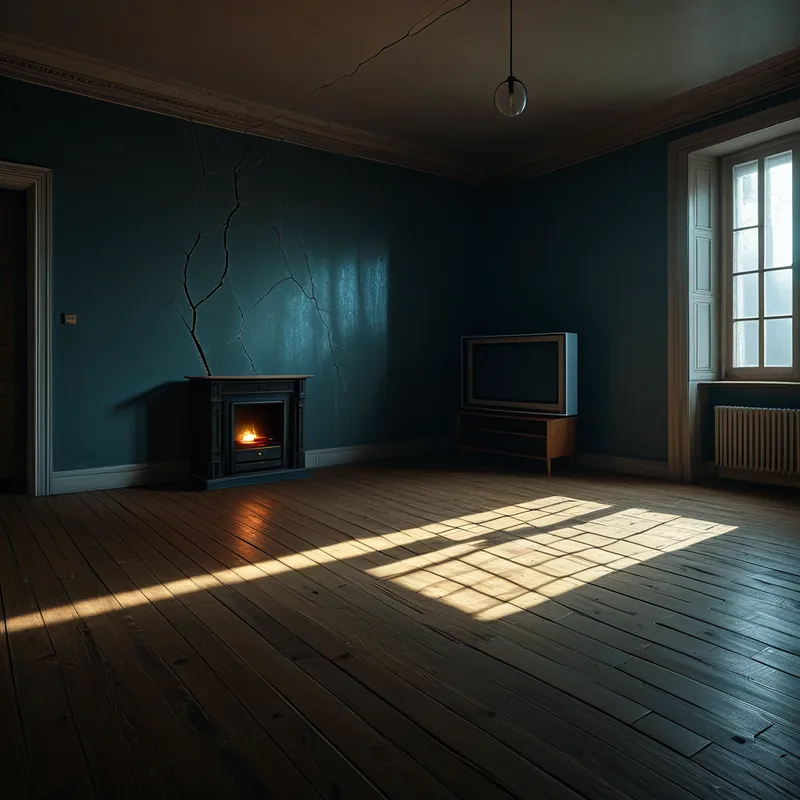
When this myth stirs in the modern unconscious, it rarely appears as a Viking hall. Instead, one might dream of the only lit room in a vast, dark house. The dreamer is compelled to tend this fire, feeling acutely that if it goes out, something essential will be lost. This is the somatic signal of the psyche attempting to establish or defend its inner sanctum—a core sense of self, safety, and values amidst internal or external chaos.
Alternatively, one might dream of spinning or weaving with a material that is impossibly delicate—light, water, or sand—and feeling a terrible anxiety about dropping or breaking the thread. This mirrors Frigg’s burden: the anxiety of the caregiver, the parent, the creator, or anyone responsible for holding a fragile process together. The dream signals a psychological process of integration, where [the ego](/myths/the-ego “Myth from Jungian culture.”/) is attempting to consciously “spin” the disparate threads of experience, relationship, and responsibility into a coherent narrative of a life. The fear is the fear of fate, of losing control over what one has lovingly created.
Alchemical Translation
The alchemical journey modeled by the Hearth of Frigg is not one of heroic conquest, but of sacred containment. In Jungian terms, it is a central process of individuation: the creation of a stable, nurturing [temenos](/myths/temenos “Myth from Greek culture.”/) (a sacred precinct) within the psyche where transformation can safely occur.
The first fire, the prima materia, is our raw, undirected psychic energy—our passions, our anxieties, our creative drives. The initial spiritual work is to build the “hearth” of consciousness to contain it.
The modern individual begins this opus by identifying what constitutes their “hearth”—the practices, relationships, and values that provide consistent warmth and light to their inner world. This is the caregiver archetype turned inward. Frigg’s spinning is the patient work of introspection and meaning-making, drawing the thread of one’s own life story from the mass of unconscious material.
The crisis—Baldr’s death—is the inevitable confrontation with the limits of this carefully built sanctuary. We cannot oath-bind every potential source of pain. The alchemical translation here is the mortificatio or darkening, where the bright, conscious attitude is pierced by loss, failure, or the intrusion of the ignored “mistletoe” (often a repressed aspect of [the shadow](/myths/the-shadow “Myth from Jungian culture.”/)). The true test is not preventing this but, as Frigg demonstrates, changing the nature of the fire. The flame of naive protection must be transmuted into the flame of compassionate witness and resilient memory.
The final stage is the hearth as a vessel for the athanor, the enduring furnace of the alchemical work. It no longer burns with the bright, consuming flame of perfect security, but with the steady, deep ember-glow of acquired wisdom. It knows winter will come, but it has banked the coals of experience. The individual who has integrated this myth carries an inner warmth that is not dependent on external circumstances—a centered, nurturing consciousness that can hold both joy and grief, creation and loss, because it sits at the still point of its own spinning world.
Associated Symbols
Explore related symbols from the CaleaDream lexicon: