The Hearth Myth Meaning & Symbolism
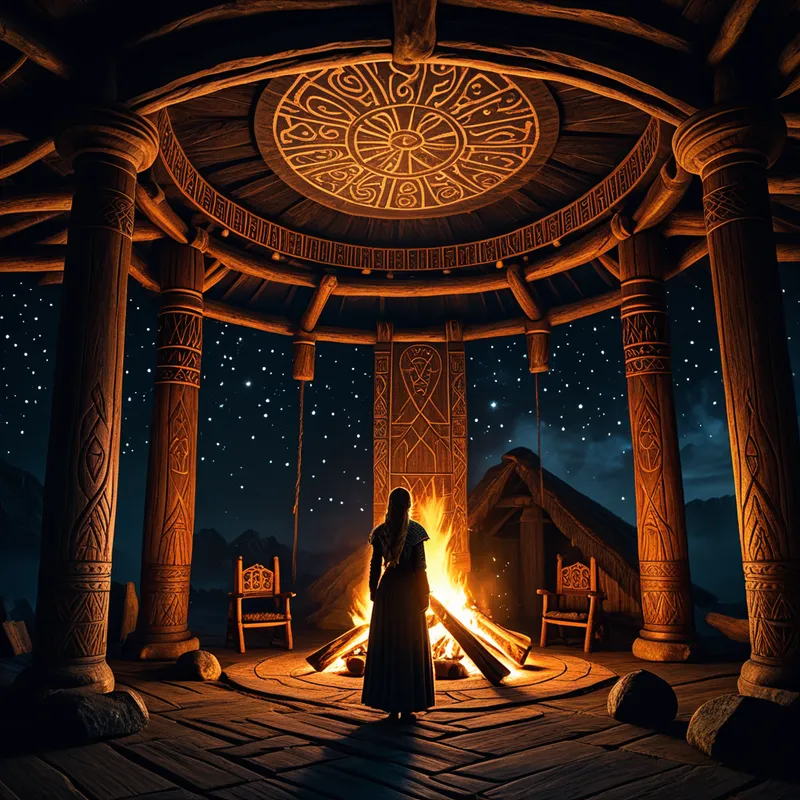
A myth of the sacred fire, guarded by the goddess Frigg, representing the soul's sanctuary, the warmth of belonging, and the eternal covenant between home and cosmos.
The Tale of The Hearth
Listen. In the long, dark of the northern winter, when the wind howls like wolves at the edge of the world and the sun is a memory buried beneath the ice, there is a light that does not die. It is not the flash of lightning from Thor’s hammer, nor the cold gleam from Odin’s spear. It is a quieter light, a deeper warmth. It is the light of the Hearth.
In the heart of every hall, from the humblest croft to the golden halls of Asgard itself, this fire was sovereign. But it was not born of mere flint and tinder. In the beginning, when the worlds were still young and raw from the giant Ymir’s flesh, the fire was a wild, consuming thing, a spark from the southern realm of Muspelheim. It was chaos, potential, and destruction all at once.
Then came Frigg, Allmother, she who sees all fates yet speaks none. She walked among the fledgling homes of gods and humans. She saw the people huddled in the dark, their breath fogging the air, their spirits shrinking with the cold. She saw not just bodies freezing, but souls growing dim. So she knelt. Not on a throne, but on the hard-packed earth of a dwelling. With her own hands, she gathered stones—not magical stones, but common, heavy things—and ringed a space in the very center of the home.
She did not summon the wild fire. Instead, she called to the spirit of the home itself, to the landvættir of the place, and to the memories of those who lived and died there. She whispered to the wood—oak, for endurance; birch, for new beginnings—and laid it with intention. Then, from the smallest spark, struck not in anger but in need, she nurtured the flame. She fed it not with haste, but with ritual. A log for the ancestors, so their wisdom might linger in the smoke. A log for the family, for health and fortitude. A log for the guests yet unknown, for the bonds of community.
She taught the first woman and the first man the covenant: This fire is never to go out. You must tend it as you tend your own life. Its flame is the soul of this place; its ashes are the memory of all that has been consumed to keep you warm. Guard it with your vigilance, and it will guard you with its light. It is the eye of the home, watching through the night. It is the beating heart, pulsing warmth into the farthest corners. Let its smoke carry your oaths to the gods. Let its light be a beacon that says, Here, you may lay down your sword. Here, you are known.
And so it was. The wild, world-burning fire was tamed, not broken, but invited. It became the Hearth. Its light pushed back the outer dark. Its warmth thawed frozen hands and hearts alike. In its flickering glow, stories were woven, laws were spoken, children were born, and the dead were remembered. It became the axis around which all life within the walls turned, a tiny, perfect echo of the great world-tree, Yggdrasil, itself rooted in this sacred, smoky ground.
Cultural Origins & Context
The hearth was not merely a mythological concept but the absolute center of daily reality in the Norse world. This myth was not a single story recited by skalds but a living, performed narrative embedded in the most mundane of acts: feeding the fire, sweeping the ashes, gathering around its light. It was passed down not through epic poetry alone, but through the hands of mothers and fathers, through the enforced watch of the youngest child told to “mind the fire.”
Its societal function was profound and multifaceted. Legally, the hearth defined a household—to be “hearth-less” was to be an outlaw, stripped of all social identity and protection. Spiritually, it was a direct conduit. The smoke from the hearth fire was believed to carry prayers and offerings to the gods, and the fire itself was a threshold where one could commune with the dísir, the protective female ancestral spirits. The hearth was also the seat of the landvættir, the local wights of the land, and to neglect it was to risk offending these crucial, unseen neighbors.
The myth, as encapsulated in the lore of Frigg’s establishment of the domestic order, served as the sacred charter for this entire system. It transformed a practical necessity—heat and light—into a holy duty. It encoded the values of hospitality (the hearth must welcome), continuity (the fire must not die), and sanctuary (the hearth defines safe space) into the very infrastructure of life.
Symbolic Architecture
Psychologically, the Hearth represents the temenos—the sacred, protected inner sanctum of the Self. It is the core of psychic warmth and identity from which we can safely engage with a cold and chaotic outer world.
The hearth is not where the fire is contained, but where the soul is kindled. It is the alchemical crucible where raw experience (the wild fire of Muspelheim) is transformed into sustaining warmth and illuminating wisdom.
The stones that ring it symbolize the necessary boundaries of the ego—the structure that allows a stable identity to form without being consumed by unconscious impulses or external demands. The ever-burning flame is the vital spark of consciousness itself, which requires constant tending through attention, reflection, and care. The goddess Frigg, as its establisher, embodies the archetypal principle of containment: the loving, foresightful force that creates a safe vessel for growth and relationship. The ashes beneath represent the accumulated past—all the spent joys, sorrows, and trials—which form the fertile ground from which new understanding can grow.
The Dreamer’s Resonance
When the Hearth appears in modern dreams, it often signals a profound somatic and psychological process related to belonging and inner sanctuary. To dream of a dying hearth fire speaks to a soul-coldness, a depletion of vital energy and personal meaning, often after prolonged stress or alienation. The dreamer may feel “unplugged” from their own core warmth.
Conversely, to dream of kindling a new hearth in a barren place—a concrete room, a vast empty field—marks the beginning of a powerful individuation process: the conscious establishment of a psychic home. The most potent dreams involve tending: carefully feeding a weak flame, or clearing old, suffocating ashes. These are dreams of self-care at the deepest level, of committing to the daily rituals (psychological practices, boundaries, self-compassion) that keep the inner light alive. The somatic sensation is often one of deep, radiating warmth in the chest or gut—a literal feeling of “coming home to oneself,” countering the disembodied anxiety of modern life.
Alchemical Translation
The myth of the Hearth models the individuation process as the sacred internalization of the caregiver archetype. The journey is not one of heroic conquest, but of devoted cultivation.
The alchemical work is not to steal fire from the gods, but to become the goddess who builds the hearth and keeps the covenant with the flame within.
First, we must gather our stones—establish the non-negotiable boundaries that protect our time, energy, and emotional space (the circumscriptio). Then, we must confront our own “wild fire”—the raw, often chaotic energies of passion, creativity, anger, or desire (the nigredo). The task is not to extinguish this fire, but, like Frigg, to invite it into the sanctified space of conscious awareness. We learn to “feed” it appropriately—channeling anger into assertiveness, passion into committed action, creativity into form.
The perpetual tending is the heart of the work. It is the daily practice of introspection, the “feeding” of the soul with what truly nourishes it, and the careful removal of the “ashes”—the spent narratives, grudges, and identities that smother new growth. This process transmutes the base lead of scattered, reactive existence into the gold of a centered, resilient Self. The final stage is not a grand revelation, but a quiet, enduring state: the ability to be a source of steady warmth and light for oneself, thereby naturally creating a sanctuary that welcomes the authentic other. The inner hearth becomes the unshakable center from which we meet the world.
Associated Symbols
Explore related symbols from the CaleaDream lexicon: