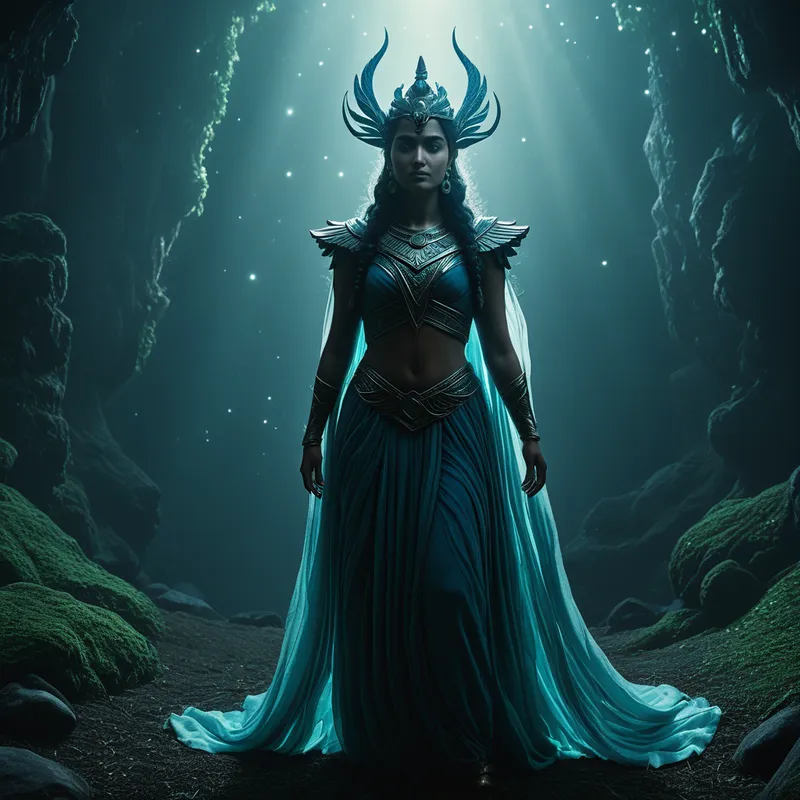
The Heart as the Throne of God
A Sufi mystical teaching that envisions the human heart as the throne of God, symbolizing divine presence within and the path to spiritual union.
The Tale of The Heart as the Throne of God
In the beginning, before time was measured, the Beloved, the Unseen King, sought a place to rest His gaze. He looked upon the heavens, vast and star-strewn, and found them beautiful but distant. He considered [the earth](/myths/the-earth “Myth from Hindu culture.”/), solid and teeming, and found it rich but transient. The angels offered their luminous courts, but their light was a reflection, not a dwelling. A deep solitude echoed within the Divine, a longing for a chamber of intimacy, a place where His secret could be whispered and heard.
Then, from the clay of the earth and the breath of His own essence, He fashioned a human being. And within the center of this fragile, walking earth, He placed a vessel—not of muscle and blood alone, but of a subtler substance, a polished mirror, a receptive cup. This, He declared, would be His throne. Not a seat of power displayed for subjects, but a seat of love unveiled for the lover. He placed within this throne a yearning that mirrored His own—a homing instinct for the source from which it came.
Thus, every human child is born a monarch in exile, carrying a forgotten sovereignty within their chest. [The world](/myths/the-world “Myth from Tarot culture.”/) clamors with distractions—the glitter of possessions, the clamor of status, the dense weight of [the ego](/myths/the-ego “Myth from Jungian culture.”/)—and layer by layer, dust settles upon the throne. It becomes obscured, a neglected chamber in the castle of [the self](/myths/the-self “Myth from Jungian culture.”/). The seeker, the salik, is one who hears a faint, echoing heartbeat beneath the noise of existence. It is a sound that pulls not at the ears, but at the very core of being.
Their journey is the great return, a pilgrimage inward. Through the dhikr, the rhythmic repetition of the Beloved’s name, they begin to polish [the mirror of the heart](/myths/the-mirror-of-the-heart “Myth from Taoist culture.”/). Through prayer that transcends petition and becomes communion, they clear the debris. Through love that turns from attachment to surrender, they sweep the chamber. It is a work of lifetimes, often felt as a burning, a breaking, a profound ache—for the throne feels its own emptiness until the King arrives.
And then, in a moment of grace beyond all striving, the dust clears. The seeker falls silent. In that stillness, the King ascends His throne. The heart does not swell with pride; it dissolves in recognition. The individual self, the nafs, kneels and vanishes. What remains is not a person on a throne, but the Throne itself, radiant with the presence of the One who sits upon it. The secret is out: the worshipper and the Worshipped, [the lover and the Beloved](/myths/the-lover-and-the-beloved “Myth from Sufi culture.”/), the heart and its God, were never two. The throne was always occupied; the journey was to remember.
Cultural Origins & Context
This profound metaphor is woven into the very fabric of Sufism, the mystical dimension of Islam. Its roots tap directly into the Qur’an, where it is stated, “The heavens and the earth contain Me not, but the heart of My believing servant contains Me.” (a sacred hadith qudsi). Another pivotal verse declares, “Have they not traveled through the land so that they may have hearts by which to reason?” (Qur’an 22:46), establishing the heart (qalb) as the organ of true perception, not mere emotion.
Early Sufi masters like Al-Ghazali (1058-1111) systematized the heart’s psychology in works like “The Revival of the Religious Sciences,” detailing its purification. The concept blossomed fully in the poetic and philosophical traditions of later [saints](/myths/saints “Myth from Christian culture.”/). Jalaluddin Rumi (1207-1273) speaks endlessly of the heart as the site of divine encounter: “The heart is a mirror, polish it clean so the Sun of Truth may be reflected.” For Ibn ‘Arabi (1165-1240), the great theoretician of wahdat al-wujud, the human heart is the microcosmic point where all divine attributes and names are integrated and realized; it is the ‘ayn al-thabita, the fixed entity, where God knows Himself.
This teaching was never mere philosophy; it was the engine of spiritual practice. The tariqa, under the guidance of a shaykh, existed to facilitate this inner unveiling. Practices of dhikr, meditation (muraqaba), music (sama), and poetry were all tools to attune the heart, to quiet the ego’s chatter, and to prepare the throne for its royal occupant. It democratized divinity, placing the ultimate spiritual reality not in a distant heaven, but within the immediate, intimate space of the human being.
Symbolic Architecture
The [heart](/symbols/heart “Symbol: The heart symbolizes love, emotion, and the core of one’s existence, representing deep connections with others and self.”/)-as-[throne](/symbols/throne “Symbol: A seat of authority, power, and sovereignty, representing leadership, divine right, or social hierarchy.”/) is a [symbol](/symbols/symbol “Symbol: A symbol can represent an idea, concept, or belief, serving as a powerful tool for communication and understanding.”/) of immense architectural complexity. It inverts worldly [hierarchy](/symbols/hierarchy “Symbol: A structured system of ranking or authority, often representing social order, power dynamics, and one’s position within groups or institutions.”/): the most sacred [space](/symbols/space “Symbol: Dreaming of ‘Space’ often symbolizes the vastness of potential, personal freedom, or feelings of isolation and exploration in one’s life.”/) is not a grand [mosque](/symbols/mosque “Symbol: A sacred Islamic place of worship representing spiritual connection, community, and divine guidance.”/)’s [dome](/symbols/dome “Symbol: A dome symbolizes shelter, protection, and the boundaries we place around our personal lives, as well as aspirations toward the divine or higher consciousness.”/) but the hidden [chamber](/symbols/chamber “Symbol: A private, enclosed space representing the inner self, hidden aspects, or a specific stage in life’s journey.”/) within a perishable [body](/symbols/body “Symbol: The body in dreams often symbolizes the dreamer’s self-identity, personal health, and the relationship they have with their physical existence.”/). The [throne](/symbols/throne “Symbol: A seat of authority, power, and sovereignty, representing leadership, divine right, or social hierarchy.”/) (‘arsh) in Islamic cosmology is the outermost limit of creation, the seat of divine sovereignty. To place it within the [heart](/symbols/heart “Symbol: The heart symbolizes love, emotion, and the core of one’s existence, representing deep connections with others and self.”/) collapses the cosmic into the personal, suggesting that the [human](/symbols/human “Symbol: The symbol of a human represents individuality, complexity of emotions, and social relationships.”/) being is not a speck in the [universe](/symbols/universe “Symbol: The universe symbolizes vastness, interconnectedness, and the mysteries of existence beyond the individual self.”/), but a universe in a speck.
The polished heart is not a container that holds God, but a transparency through which God manifests. The throne is not a piece of furniture; it is a state of perfect receptivity and submission (islam), where the human will becomes a flawless instrument of the divine will.
This heart is dynamic, its very name in Arabic, qalb, meaning “that which turns over.” It is not a [static](/symbols/static “Symbol: Static represents interference, disruption, and the breakdown of clear communication or signal, often evoking feelings of frustration and disconnection.”/) seat but a revolving [door](/symbols/door “Symbol: A door symbolizes transition, opportunity, and choices, representing thresholds between different states of being or experiences.”/) between realms, constantly fluctuating between states of [contraction](/symbols/contraction “Symbol: A symbolic process of compression, reduction, or inward movement, often representing preparation, transition, or the tension between opposing forces.”/) (qabd) and [expansion](/symbols/expansion “Symbol: A symbol of growth, increase, or extension beyond current boundaries, often representing personal development, opportunity, or overwhelming change.”/) (bast), between the awe of divine majesty and the intimacy of divine [beauty](/symbols/beauty “Symbol: This symbol embodies aesthetics, harmony, and the appreciation of life’s finer qualities.”/). To be the throne is to be in perpetual, loving [motion](/symbols/motion “Symbol: Represents change, progress, or the flow of life energy. Often signifies transition, personal growth, or the passage of time.”/) around the [axis](/symbols/axis “Symbol: A central line or principle around which things revolve, representing stability, orientation, and the fundamental structure of reality or consciousness.”/) of the Eternal.
The Dreamer’s Resonance
For the modern [psyche](/myths/psyche “Myth from Greek culture.”/), estranged from sacred cosmology, this myth speaks directly to the experience of inner authority and authentic self. The ego’s tyranny—its incessant demands, fears, and narratives—is the dust covering the throne. The feeling of existential emptiness, the “God-shaped hole,” is the throne’s aching vacancy. Psychological healing, then, is not just about adjusting the ego, but about dethroning it, clearing the central space for a deeper, transpersonal authority to emerge.
The journey of therapy or self-inquiry mirrors the Sufi path: identifying the debris (traumas, complexes, false identities), polishing [the mirror](/myths/the-mirror “Myth from Various culture.”/) (through awareness, integration, and acceptance), and ultimately surrendering the illusion of a separate, managing self. The moment of “breakthrough” or self-realization in depth psychology—where one moves from being the content of consciousness to being the aware space for the content—resonates deeply with the mystical ascent of the King to the throne. The heart, in this sense, becomes the seat of the true Self, the Jungian Self, which is both the center and the circumference of our being.
Alchemical Translation
The alchemical process here is one of inversion and refinement. The base matter is the nafs al-ammarah—the commanding, passionate ego, identified solely with the physical and social self. Through the fire of spiritual practice and the waters of divine grace, it is purified into the nafs al-lawwamah—the self-accusing soul, aware of its flaws, and finally into the nafs al-mutma’innah—the soul at peace, which is the throne itself.
The alchemical gold is not a transformed ego, but the revealed essence that was always there. The work is not to create something new, but to remove everything that is not the King. The heart’s burning is not destruction, but the fire that reveals the gold beneath the dross.
This is the ultimate integration: the divine attributes (sifat) of Compassion, Majesty, Beauty, and Severity are no longer abstract concepts but lived realities emanating from the heart-throne. The individual becomes a clear locus for the divine presence to act in the world, not as a puppet, but as a conscious, willing throne. Action flows from stillness; speech emanates from silence; the individual life becomes a perfect symbol of the universal reality.
Associated Symbols
Explore related symbols from the CaleaDream lexicon:
- Heart — The central chamber, the polished mirror and receptive throne where the divine presence is seated and known.
- Throne — The seat of ultimate sovereignty and authority, symbolizing the center of consciousness where the true Self reigns.
- Mirror — The essential nature of the purified heart, which must be cleansed of egoic distortion to perfectly reflect divine reality.
- Fire — The transformative agent of spiritual practice and divine love that burns away impurities to reveal the heart’s true, golden nature.
- Crown — The emblem of divine authority and kingship, which is not worn on the head but realized within the heart of the sincere seeker.
- Key — The practices of remembrance, love, and surrender that unlock the hidden chamber of the heart, allowing access to the throne within.
- Temple — The human body and psyche as the sacred architecture built to house the inner sanctum, the heart-throne of God.
- Light — The divine essence that illuminates the heart once the throne is occupied, transforming the individual into a beacon of spiritual truth.
- Journey — The inward path of return (tawba), the long and often arduous pilgrimage through the self to discover the divine sovereign at its core.
- Door — [The threshold](/myths/the-threshold “Myth from Folklore culture.”/) of the heart, which separates the realm of ego and world from the inner chamber where divine intimacy resides.
- Cup — The heart as a vessel, empty and receptive, waiting to be filled with the wine of divine knowledge and unconditional love.