
The Hawthorn Hedge Myth Meaning & Symbolism
A tale of a king who erects an impenetrable hawthorn hedge to protect his daughter, creating a sacred boundary that tests love and destiny.
The Tale of The Hawthorn Hedge
Listen, and hear a tale woven from [the mist](/myths/the-mist “Myth from Celtic culture.”/) of the old world, when kings were gods in mortal flesh and the land itself breathed with intention. There was a king, Labraid Loingsech, whose heart held two treasures: his kingdom, vast and green, and his daughter, Cráeb, whose beauty was said to rival the dawn. Her laughter was a charm that could make the oldest oak bud anew, and her gaze held the quiet depth of a forest pool. Yet, with such a treasure comes a deep and gnawing fear—the fear of loss, of a future where her light might be taken to illuminate another’s hall.
This fear took root in the king’s soul and grew, twisted and strong as ancient ivy. He consulted his Druí, a man whose eyes held the grey of winter storms. “How,” asked the king, his voice a low rumble, “can I keep her safe? Not just from raiders or rival kings, but from fate itself? From the call of her own heart that may lead her away?”
The Druí walked the boundaries of the royal fort, his fingers brushing [the earth](/myths/the-earth “Myth from Hindu culture.”/). He listened to the whisper of [the wind](/myths/the-wind “Myth from Various culture.”/) in the trees. Finally, he stood before a solitary sceach gheal, its branches laden with the promise of white blossoms. “The answer is here,” he said. “Not in stone, which can be shattered, nor in [water](/myths/water “Myth from Chinese culture.”/), which can be crossed. But in life. In a boundary that lives, breathes, and chooses.”
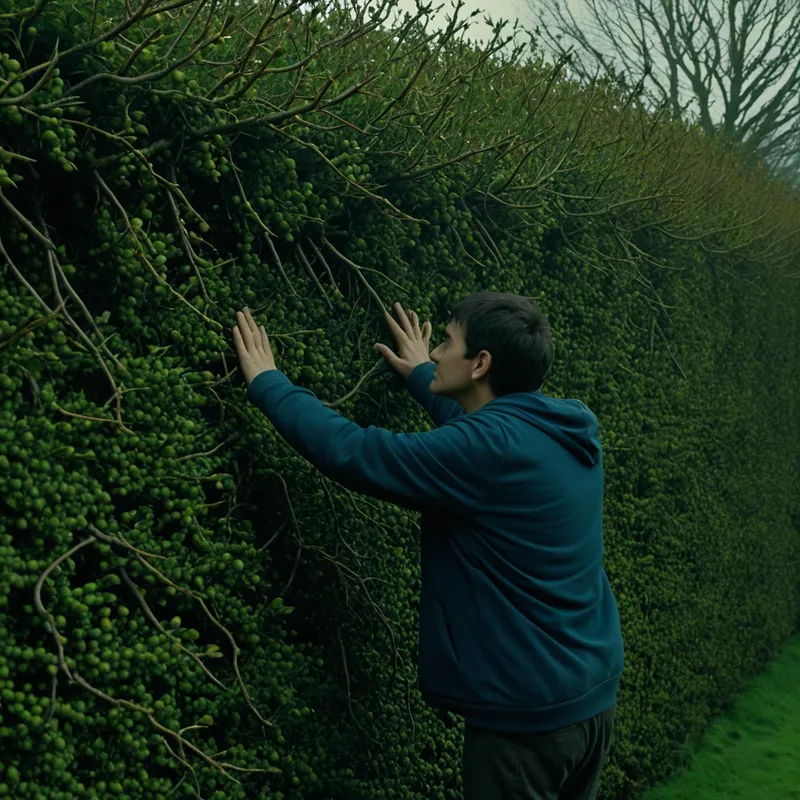
And so the great working began. On the night of the new moon, when [the world](/myths/the-world “Myth from Tarot culture.”/) was held in a breath of darkness, the king and the Druí walked the perimeter of Cráeb’s quarters. The Druí chanted words older than the hills, words that spoke to the spirit of the thorn, to the genius loci of the place. He did not plant seeds; he sang a covenant into the very soil. By dawn, a hedge had risen. Not a common hedge, but a living rampart of [hawthorn](/myths/hawthorn “Myth from Celtic culture.”/), dense and impenetrable, its branches woven tighter than any wicker, its thorns long and sharp as bronze needles. It stood taller than two men, and a strange, shimmering light clung to its white blossoms, a light that hummed with a singular law: None shall pass but he who is her destined love.
Cráeb lived within her verdant prison. She could hear the world beyond—the songs of the hunters, the chatter of the court—but she could not see it. [The hedge](/myths/the-hedge “Myth from Folklore culture.”/) was her entire horizon. Seasons turned. The hawthorn bloomed, rained its petals, bore its blood-red haws, and stood skeletal in the frost, but its law never wavered. Suitors came, princes and champions adorned in gold and confidence. They approached the living wall, declared their love, and reached out. The hedge remained still, a silent judge. Then, as their fingers touched the first branch, the thorns would writhe like serpents, the branches would knit themselves tighter, and a force like a gale would push the unworthy back, hearts bruised and pride in tatters.
Years folded into years. The king watched, his protective love curdling into a quiet despair. His daughter, the treasure he sought to keep safe, was becoming a story, a ghost in a bower of thorns. Then came a man named Cú. He was no prince, bore no famous sword. He had heard the tale, not of a prize to be won, but of a soul to be met. He came to the hedge with empty hands. He did not shout promises or show his strength. He simply stood before it, and spoke not to the princess, but to the hedge itself.
“I do not come to conquer you,” he said, his voice steady. “I come to honor [the law](/myths/the-law “Myth from Biblical culture.”/) you guard. If my destiny lies on the other side, then it is not I who must break through, but you who must let me pass.”
He placed his palm flat against a knot of wood, not grasping, but open. A thorn pierced his skin, and a single drop of blood welled, dark against the grey bark. The hedge shuddered. From root to topmost blossom, a ripple passed through it. The branches did not part so much as they unwove, threads of a great tapestry loosening. A path opened, not torn, but offered. The shimmering light on the blossoms softened, warming to a gentle gold. Cú walked through, the thorns bending away from his form. And on the other side, Cráeb stood, not as a captive, but as a woman stepping into her own dawn. The hedge, its purpose fulfilled, did not die. It remained, but now it was simply a hedge, its terrible magic spent, its sacred boundary transformed into a garden gate.
Cultural Origins & Context
The myth of the Hawthorn Hedge finds its roots in the rich, oral tradition of early Irish literature, particularly within the Historical Cycle. It is a story less about epic battles and more about Fír—the deep, often paradoxical right order of things. It would have been told by fili at royal gatherings, serving multiple societal functions.
It was a narrative about sacred kingship. A true king must be a protector, but the myth warns of the peril when protection becomes possession, isolating the very vitality (his daughter, the future) it seeks to guard. The hedge itself reflects the Celtic reverence for liminal spaces. The sceach was never to be cut down lightly, as it was a favorite tree of the Aos Sí. It marked boundaries between town and wild, between the human world and [the Otherworld](/myths/the-otherworld “Myth from Celtic culture.”/). The hedge in the myth is the ultimate liminal entity: a boundary that is alive, sentient, and endowed with the authority to judge the intangible quality of destiny. The story validates the idea that some laws—those of the heart and fate—are beyond even a king’s decree, residing in the older magic of the land itself.
Symbolic Architecture
At its core, the myth is a profound exploration of the [psychology](/symbols/psychology “Symbol: Psychology in dreams often represents the exploration of the self, the subconscious mind, and emotional conflicts.”/) of boundaries. The Hawthorn Hedge is not merely an [obstacle](/symbols/obstacle “Symbol: Obstacles in dreams often represent challenges or hindrances in waking life that intercept personal progress and growth. They can symbolize fears, doubts, or external pressures.”/); it is a psychic [structure](/symbols/structure “Symbol: Structure in dreams often symbolizes stability, organization, and the framework of one’s life, reflecting how one perceives their environment and personal life.”/).
The true boundary is not a wall that keeps the world out, but a membrane that discerns what may enter the soul.
The [king](/symbols/king “Symbol: A symbol of ultimate authority, leadership, and societal order, often representing the dreamer’s inner power or external control figures.”/) represents the ego in its protective, paternalistic mode. His love is genuine, but it is fear-based. He attempts to control [destiny](/symbols/destiny “Symbol: A predetermined course of events or ultimate purpose, often linked to spiritual forces or cosmic order, representing life’s inherent direction.”/) to avoid [loss](/symbols/loss “Symbol: Loss often symbolizes change, grief, and transformation in dreams, representing the emotional or psychological detachment from something or someone significant.”/), creating a complex (the hedge) that ultimately imprisons the [anima](/symbols/anima “Symbol: The feminine archetype within the male unconscious, representing soul, creativity, and connection to the inner world.”/)—the inner feminine principle symbolizing [connection](/symbols/connection “Symbol: Connection symbolizes relationships, communication, and bonds among individuals.”/), [life](/symbols/life “Symbol: The symbol of ‘Life’ represents a journey of growth, interconnectedness, and existential meaning, encompassing both the joys and challenges that define human experience.”/), and the future (Cráeb). The hedge is the manifestation of this neurosis: a [defense](/symbols/defense “Symbol: A protective mechanism or barrier against perceived threats, representing boundaries, security, and resistance to external or internal challenges.”/) [mechanism](/symbols/mechanism “Symbol: Represents the body’s internal systems, emotional regulation, or psychological processes working together like a machine.”/) so potent it becomes a self-created [prison](/symbols/prison “Symbol: Prison in dreams typically represents feelings of restriction, confinement, or a lack of freedom in one’s life or mind.”/), isolating the [psyche](/myths/psyche “Myth from Greek culture.”/) from the nourishing flow of [life](/symbols/life “Symbol: The symbol of ‘Life’ represents a journey of growth, interconnectedness, and existential meaning, encompassing both the joys and challenges that define human experience.”/) and new experience.
Cú, the destined [lover](/symbols/lover “Symbol: A lover in dreams often represents intimacy, connection, and the emotional aspects of relationships.”/), symbolizes the authentic Self. He does not fight the [boundary](/symbols/boundary “Symbol: A conceptual or physical limit defining separation, protection, or identity between entities, spaces, or states of being.”/) on its own terms (with force or cleverness). He approaches with respect and integrity, acknowledging its [purpose](/symbols/purpose “Symbol: Purpose signifies direction, meaning, and intention in life, often reflecting personal ambitions and core values.”/). His [blood](/symbols/blood “Symbol: Blood often symbolizes life force, vitality, and deep emotional connections, but it can also evoke themes of sacrifice, trauma, and mortality.”/) sacrifice—the willing [vulnerability](/symbols/vulnerability “Symbol: A state of emotional or physical exposure, often involving risk of harm, that reveals authentic self beneath protective layers.”/)—is the key. It represents [the ego](/myths/the-ego “Myth from Jungian culture.”/)‘s surrender of its rigid control, allowing a deeper, more authentic [pattern](/symbols/pattern “Symbol: A ‘Pattern’ in dreams often signifies the underlying structure of experiences and thoughts, representing both order and the repetitiveness of life’s situations.”/) (the destiny guarded by the hedge) to emerge. The hedge’s [dissolution](/symbols/dissolution “Symbol: The process of breaking down, dispersing, or losing form, often representing transformation, release, or the end of a state of being.”/) is not a defeat but a recognition. The [boundary](/symbols/boundary “Symbol: A conceptual or physical limit defining separation, protection, or identity between entities, spaces, or states of being.”/), having served its sacred [purpose](/symbols/purpose “Symbol: Purpose signifies direction, meaning, and intention in life, often reflecting personal ambitions and core values.”/) of warding off the unaligned, gracefully steps aside for wholeness.

The Dreamer’s Resonance
When this myth pattern arises in modern dreams, the dreamer is often grappling with a self-created limitation that has outlived its usefulness. Dreaming of an impassable, living wall of thorns around a house, garden, or a cherished part of oneself points to a potent psychological process.
Somatically, it may correlate with a feeling of constriction in the chest, a tightness of breath—the physical echo of a heart or a life path that feels fenced in. The dream hedge often appears after periods of prolonged self-protection, perhaps following betrayal or hurt. The psyche is announcing that the defensive structure, once necessary, has now become the primary problem. It is cutting off vitality. The figure trying to penetrate the hedge in the dream—whether it is the dreamer, a stranger, or a known person—represents the new energy, relationship, or aspect of [the Self](/myths/the-self “Myth from Jungian culture.”/) that is seeking integration. The terror or frustration of being blocked by the hedge mirrors the dreamer’s waking conflict between a deep desire for connection/ growth and an equally deep, automated habit of self-protection.
Alchemical Translation
The myth models the alchemical process of [separatio](/myths/separatio “Myth from Alchemical culture.”/) followed by a sacred coniunctio. The king’s act is the [separatio](/myths/separatio “Myth from Alchemical culture.”/): he consciously (if misguidedly) delineates a sacred space, isolating the anima from the chaotic world. This is a necessary first step in individuation—one must define the Self before one can relate authentically.
Individuation begins not with expansion, but with a sacred definition. The hedge is the circle drawn in the soil of the soul.
The long stasis within the hedge is the [putrefactio](/myths/putrefactio “Myth from Alchemical culture.”/), a necessary incubation. It is a time of inward turning, where what is protected is also forced to confront its own nature without external distraction. Cráeb’s patience is not passive; it is the anima awaiting its proper counterpart, refusing all false solutions.
Cú’s arrival and the hedge’s response embody the coniunctio. This is not a violent merging, but a recognition and a graceful yielding. The key is that the transformation happens to the boundary itself. The hardened, defensive complex (the hedge) is transmuted into a permeable membrane. The alchemical gold produced is not the princess “won,” but the new, integrated state of being: a Self that can maintain healthy boundaries without isolation, that can be protected yet open, defined yet capable of profound connection. The modern individual undergoing this process learns to differentiate between walls built from fear and boundaries informed by Self-knowledge. The [triumph](/myths/triumph “Myth from Roman culture.”/) is the moment the old defense, seen in the light of conscious, vulnerable honesty, simply ceases to be necessary, and the path forward unveils itself.
Associated Symbols
Explore related symbols from the CaleaDream lexicon: