The Haitian Revolution and Bois Caiman Myth Meaning & Symbolism
A sacred ritual in a storm-lashed forest where enslaved Africans swore an oath, forging a pact with ancestral spirits to shatter their chains and birth a nation.
The Tale of The Haitian Revolution and Bois Caiman
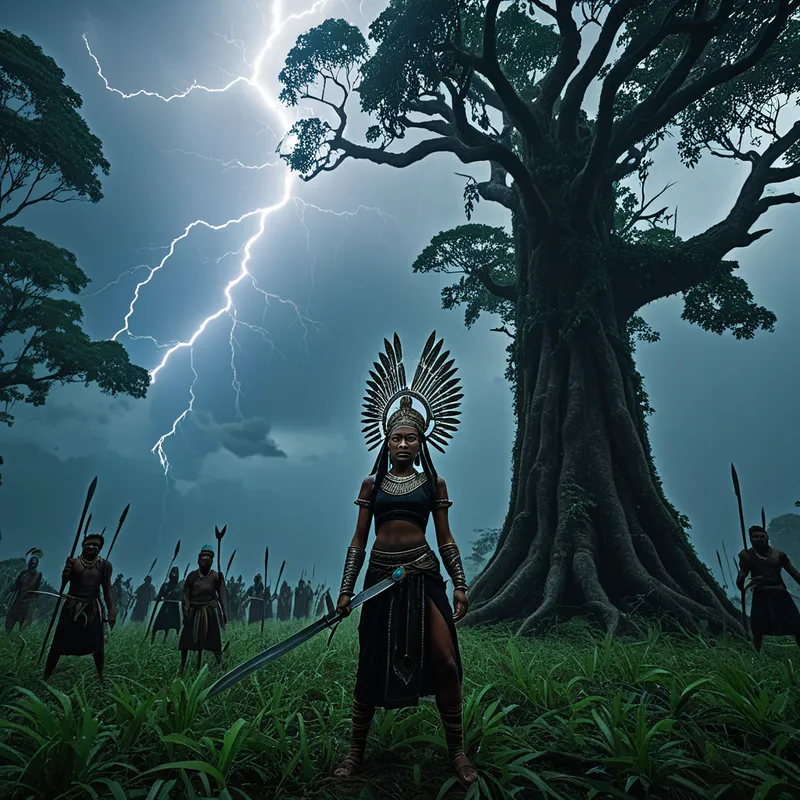
Listen. The air on the northern plain of Saint-Domingue was thick, not just with the Caribbean heat, but with the weight of a thousand suns of unwept grief. It was the night of August 14, 1791. The sky, a bruised purple, growled with the promise of a storm. The sugarcane, that cruel and profitable green sea, whispered of blood in its rustling.
Into this charged darkness, they came. Not as the broken bodies the plantation ledgers recorded, but as lwa, as warriors, as children of forgotten kings. They slipped from the lakous and the canefields, their feet finding a path known only to the desperate and the destined. Their guide was the sky itself, ripped open by jagged bolts of Sogbo’s fury.
They gathered in a hidden clearing near the Morne Rouge, a place called Bois Caïman. At its heart stood a mighty mapou, its roots deep in the belly of the earth, its branches clawing at the storm. The rain began, not as a sprinkle, but as a torrent, washing the sweat from their brows, mingling with the salt of their memories.
From the shadows emerged the figures of power. There was Dutty Boukman, a man of immense stature, his eyes holding the fire of the Coromantee coast. And beside him, a mambo, her body a vessel for a force greater than any master. Her name is lost to the storm, but her presence was the axis upon which the world turned.
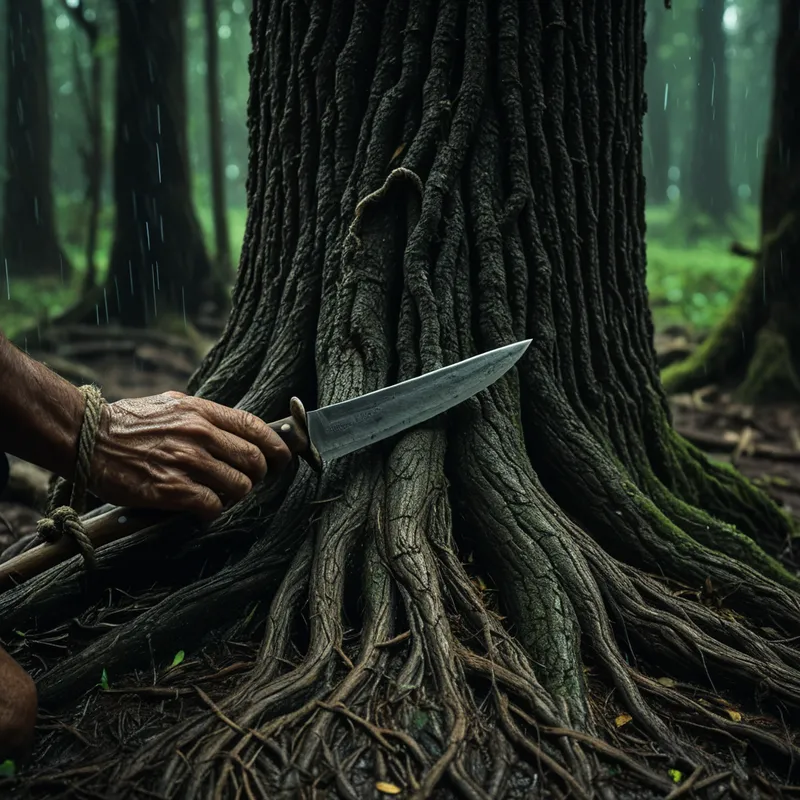
A black pig was brought forth. Its squeal was the sound of the old world protesting. The mambo’s blade flashed, a silver tongue in the lightning. The blood, hot and dark, was caught. This was no mere sacrifice; it was ink for a new covenant. It was offered to the lwa, to Damballa Wedo who moves through all things, and to Ogou, the iron-willed general.
Boukman’s voice rose above the thunder, a drumbeat of destiny. He spoke of the God of the free, who demanded liberty. He spoke of the white man’s god, who preached patience to the enslaved. “Throw away the image of the god of the whites,” he thundered, “who thirsts for our tears. Listen to the voice of liberty that speaks in the hearts of us all!”
The cup of blood and gunpowder, mixed with bitter herbs, was passed. Each man and woman drank. The oath was sworn not on parchment, but on their very souls: Liberty or death. The pact was sealed. The serpent of wisdom had witnessed. The spirit of the forest had granted its cover. The fire of vengeance was lit.
Eight days later, the plains erupted. The oath of Bois Caïman became a hurricane of machetes and torches, sweeping across the plantations. It was the beginning of a thirteen-year journey through blood and flame, a war against empires, that would end with the birth of Haiti—the first black republic, born from a sacred promise made under a sacred tree, in the heart of a sacred storm.
Cultural Origins & Context
The story of Bois Caïman is the foundational myth of the Haitian nation. It exists in the liminal space between documented history and powerful oral tradition. Emerging from the crucible of the transatlantic slave trade, it is a quintessential African Diaspora narrative, woven from the threads of West and Central African spiritual systems—primarily Vodou—and the brutal reality of the plantation.
It was not written down by its participants but was carried in the collective memory, told in hushed tones, and later recorded by historians, often through the antagonistic accounts of colonists who feared its power. The myth served multiple vital functions: as a sacred charter for the revolution, providing divine sanction for the insurrection; as a unifying cultural touchstone for a people drawn from diverse African nations; and as a psychological weapon, transforming a scene of profound oppression into one of immense spiritual agency. It answered the “how” of the unthinkable—how could the enslaved succeed?—with a spiritual and communal truth: through a pact with the ancestral world and with each other.
Symbolic Architecture
At its core, Bois Caïman is a myth of radical sacrifice and catalytic fire. The [ritual](/symbols/ritual “Symbol: Rituals signify structured, meaningful actions carried out regularly, reflecting cultural beliefs and emotional needs.”/) is an alchemical [operation](/symbols/operation “Symbol: An operation signifies a process of change or transformation that often requires deliberate effort and planning.”/) performed on the [soul](/symbols/soul “Symbol: The soul represents the essence of a person, encompassing their spirit, identity, and connection to the universe.”/) of a people.
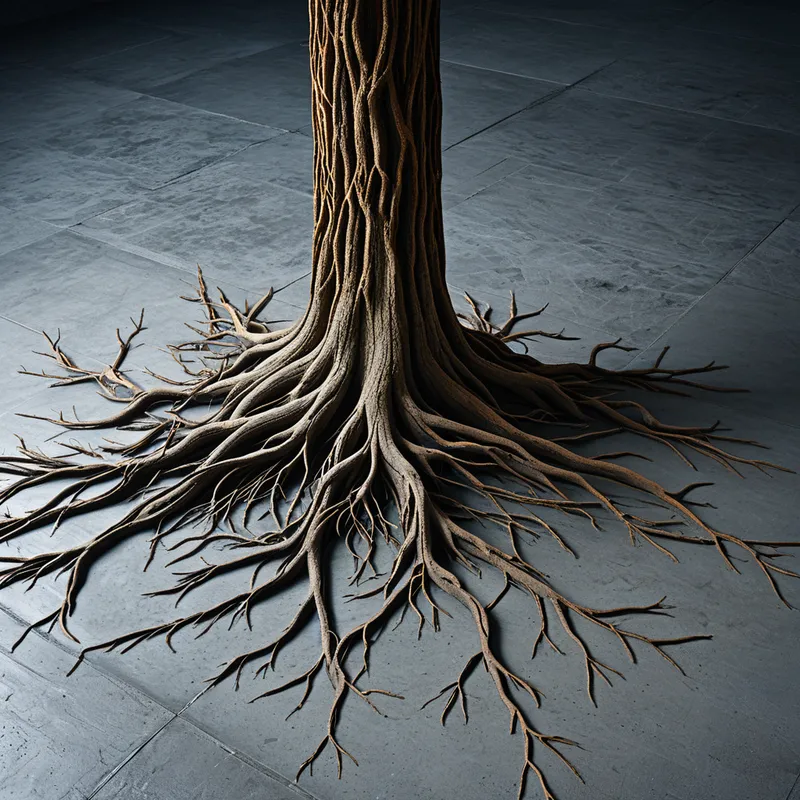
The mapou tree is the axis mundi—the connecting pillar between the world of the living (the enslaved), the world of the ancestors (lwa), and the world of the divine (the African gods). The oath sworn at its roots is a promise not just to men, but to the cosmos itself.
The black pig represents the consumption of the [condition](/symbols/condition “Symbol: Condition reflects the state of being, often focusing on physical, emotional, or situational aspects of life.”/) of bondage. Its [blood](/symbols/blood “Symbol: Blood often symbolizes life force, vitality, and deep emotional connections, but it can also evoke themes of sacrifice, trauma, and mortality.”/), mixed with [gunpowder](/symbols/gunpowder “Symbol: Gunpowder in dreams symbolizes explosive potential, transformation, and volatile energy, often representing repressed emotions or sudden change.”/), is the literal and symbolic [fusion](/symbols/fusion “Symbol: The merging of separate elements into a unified whole, often representing integration of self, relationships, or conflicting aspects of identity.”/) of the spiritual and the martial, the sacred [oath](/symbols/oath “Symbol: A solemn promise or vow, often invoking a higher power or sacred principle, binding individuals to specific actions or loyalties.”/) and the practical war. Drinking this potion is an act of profound internalization; the [revolution](/symbols/revolution “Symbol: A fundamental, often violent transformation of social, political, or personal structures, representing upheaval, liberation, and the overthrow of established order.”/) is no longer an external [idea](/symbols/idea “Symbol: An ‘Idea’ represents a spark of creativity, innovation, or realization, often emerging as a solution to a problem or a new outlook on life.”/) but a chemical [truth](/symbols/truth “Symbol: Truth represents authenticity, honesty, and the quest for knowledge beyond mere appearances.”/) in their veins.
The mambo and Boukman represent the necessary union of the feminine and masculine principles of power: the intuitive, channeling force of the invisibles and the commanding, organizing force of the [leader](/symbols/leader “Symbol: A leader signifies authority, responsibility, and guidance; representing aspirations for achievement or fear of following.”/). The storm is the chaotic, fecund [womb](/symbols/womb “Symbol: A symbol of origin, potential, and profound transformation, representing the beginning of life’s journey and the unconscious source of creation.”/) of the new world, the [chaos](/symbols/chaos “Symbol: In Arts & Music, chaos represents raw creative potential, uncontrolled expression, and the breakdown of order to forge new artistic forms.”/) from which a new order must be born.
The Dreamer’s Resonance
To dream of this myth is to be at the precipice of a profound psychic insurrection. It often manifests when the dreamer’s life has become a “plantation”—a structure of internalized oppression, whether through a toxic relationship, a soul-crushing job, or a lifelong pattern of self-abnegation.
The somatic experience is key: the dream may carry the feeling of a gathering storm, of electrical tension in the body. One might dream of drinking a strange, potent liquid (the oath), of cutting bonds (the sacrifice), or of standing in a circle under a great tree (the communal pact). This is the psyche’s ritual, preparing the dreamer for the necessary, terrifying act of self-liberation. The shadow here is not a personal demon, but the internalized master—the voice that says you are not entitled to your freedom, your joy, your wholeness. The dream of Bois Caïman is the unconscious mustering its allies—your ancestral resilience, your buried courage, your spiritual will—to stage a revolt against that inner tyranny.
Alchemical Translation
For the modern individual, the myth maps the process of individuation as revolution. It is not a gentle awakening, but a violent, necessary secession from the colonial powers of the psyche—the complexes, familial mandates, and cultural conditioning that hold the authentic self in bondage.
The first stage is the Call to the Forest: withdrawing from the “plantation” of consensus reality to a secret, interior space (the forest) where true feeling and spirit can speak. This is often a period of depression, agitation, or intense introspection—the gathering storm.
The oath is the moment of irrevocable commitment to the Self. It is the decision, sworn on the soul, to pursue wholeness at any cost, even if it means the “death” of the old, adapted personality.
The Sacrifice of the Black Pig is the killing of what nourishes the oppressive system. This could be a cherished illusion (“If I am perfect, I will be loved”), a toxic loyalty, or the comfort of victimhood. This sacrifice fuels the transformation.
The Drinking of the Potion is the integration of this commitment into the very fiber of one’s being. It moves the revolution from an idea to a somatic, cellular truth. From this point, there is no turning back. The ensuing conflict (the 13-year war) is the long, arduous work of integrating this change, battling residual internal and external forces, until a new, sovereign psychic nation—the individuated Self—is declared.
Associated Symbols
Explore related symbols from the CaleaDream lexicon:
- Sacrifice — The offering of the black pig represents the conscious surrender of something of value (comfort, the old identity) to achieve a transcendent, liberating goal, forging a covenant with a higher power.
- Fire — Symbolizes the destructive and purifying force of revolution, the burning away of the old oppressive structures, and the fierce, transformative energy of the warrior spirit Ogou.
- Forest — Represents the secret, sacred space outside the control of the “plantation,” a place of refuge, spiritual power, and clandestine planning where the true self can gather and conspire.
- Oath — The sacred vow sworn on blood and spirit embodies an irrevocable commitment to a cause greater than the individual, binding a community to a single, fateful purpose.
- Serpent — As Damballa Wedo, it is the primal, wise, and cosmic force witnessing the pact, symbolizing the connection to ancestral wisdom, life energy, and the cyclical nature of death and rebirth.
- Blood — Represents life force, kinship, and the solemn seal of the covenant; it is the tangible essence of the sacrifice that binds the spiritual promise to material action.
- Revolution — The ultimate outcome of the myth, representing the total, irreversible overthrow of an oppressive external or internal order to establish a new foundation of sovereignty.
- Chaos — The storm-lashed night of the ritual embodies the fertile, terrifying, and necessary state of dissolution and potential from which a new world must be born.
- Tree — The sacred mapou is the axis mundi, a living conduit between the earthly, ancestral, and divine realms, providing a stable center for the universe-shattering ritual.
- Dance — The ritual movements and possession by the lwa at Bois Caiman represent the ecstatic surrender to a power greater than the self, a physical enactment of the spiritual pact.
- Liberty — The ultimate goal and divine mandate of the myth, representing the inalienable right to self-determination, both as a political reality and as a state of psychic wholeness.
- Shadow — The internalized master, the voice of oppression and limitation within the psyche, which must be confronted and overthrown in the personal revolution mirrored by the myth.