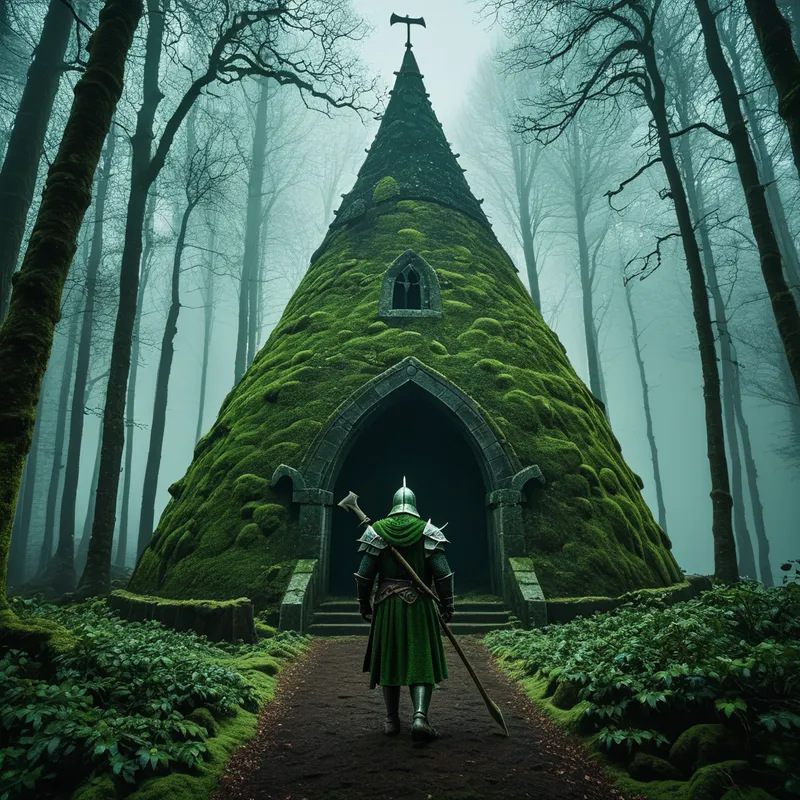
The Green Knight's Chapel Myth Meaning & Symbolism
Sir Gawain faces a supernatural test of honor at the Green Chapel, confronting mortality and the wild, untamed forces of nature and the self.
The Tale of The Green Knight’s Chapel
Listen, and hear a tale not of bright conquest, but of a covenant struck in firelight and fear. In the high hall of Camelot, during the Yuletide feast, a winter’s silence was shattered. The great doors burst open not with wind, but with a being. He was a mountain of a man, his flesh and form the fierce green of deep forest shadows and summer holly. This was the [Green Knight](/myths/green-knight “Myth from Arthurian culture.”/), and in his hand he held not a weapon of war, but a great axe of green steel, and a holly bob.
His voice was the rumble of stone in a riverbed. He proposed a game, a Christmas jest. Let any brave knight strike him one blow with this axe. In return, in one year and a day, that knight must seek him out at the Green Chapel and receive a blow in kind.
The court was frozen, a tapestry of shock. Then, to defend the honor of [the Round Table](/myths/the-round-table “Myth from Arthurian culture.”/), [Sir Gawain](/myths/sir-gawain “Myth from Arthurian culture.”/) stepped forward. With a single, swift stroke, he cleaved [the Green Knight](/myths/the-green-knight “Myth from Arthurian culture.”/)’s head from his shoulders. The head rolled on the rushes, a grim [Yule log](/myths/yule-log “Myth from Folklore culture.”/). But the green body did not fall. It strode forward, gathered its own head by the hair, and mounted its steed. The head’s eyes opened, its lips moved, repeating the covenant: Find me at [the Green Chapel](/myths/the-green-chapel “Myth from Arthurian culture.”/) when the year turns.
The seasons wheeled. Autumn’s gold faded to winter’s bone-white truth. Gawain, bound by his oath, rode north through a dying world. He crossed frozen rivers and mountains like broken teeth, through forests where the sun was a forgotten memory. He found shelter in a strange castle, where the lord, Bertilak, offered a game: each day, the lord would hunt, and Gawain would rest, and they would exchange their daily winnings.
For three days, as Bertilak hunted stag, boar, and fox, Gawain was tested in the castle by a different quarry: the lady of the castle, whose kisses she won from him. True to his bargain with the lord, Gawain passed on the kisses, but on the third day, he kept a secret gift: a green silk girdle, said to protect the wearer from death. Fear, that cold serpent, had coiled around his heart.
On the morning of doom, a guide led him to a forsaken valley. “Turn back,” the guide pleaded, “none return from that place.” But Gawain went on. He found no chapel of stone and spire, but a raw, grassy mound, an old barrow by a boiling stream—a place older than Christ, older than Rome. This was the Green Chapel. The air smelled of damp earth and iron.
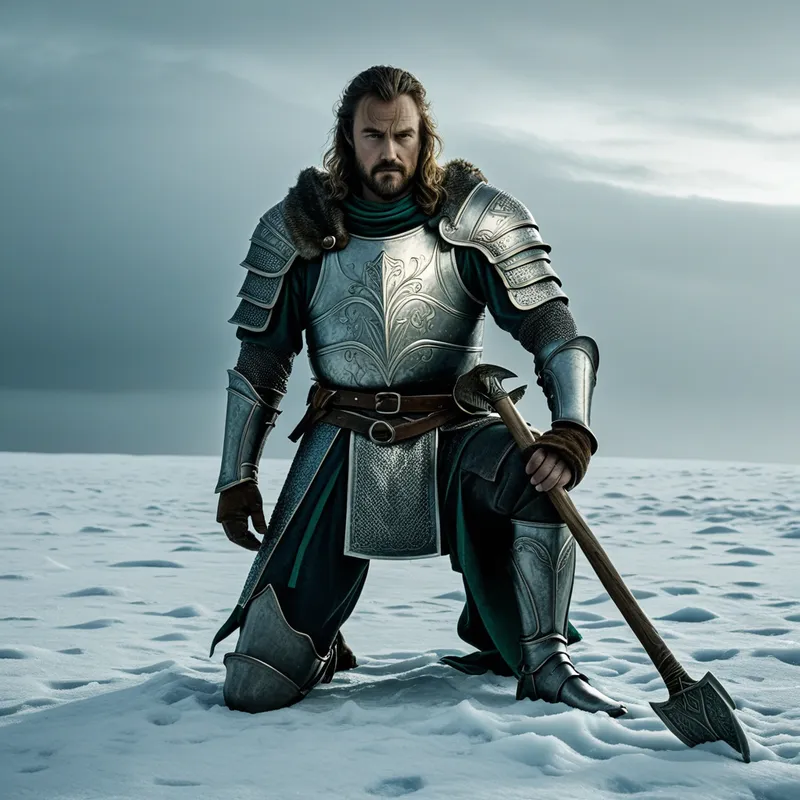
From a crevice in the mound, the Green Knight emerged, whole and terrible, a living axe in his hand. Gawain knelt, baring his neck. The axe rose, a green flash against the grey sky. It fell once, twice, but only tapped the skin. On the third swing, it bit, but only enough to draw a thin line of blood. The Green Knight laughed, a sound like rocks tumbling, and revealed himself: he was Bertilak, transformed by the magic of [Morgan le Fay](/myths/morgan-le-fay “Myth from Celtic culture.”/). The three blows were for the three days of their game; the nick was for Gawain’s one hidden fault—the kept girdle, a small betrayal of perfect honesty for the sake of his life.
Shame flooded Gawain, but the Green Knight called it not failure, but human nature. He gave Gawain the girdle to keep, a green badge not of victory, but of humility. Gawain returned to Camelot, not as a flawless hero, but as a man who had faced the axe and his own fear, and had been cut down to his true size.
Cultural Origins & Context
This myth, known as Sir Gawain and the Green Knight, survives in a single, exquisite manuscript from the late 14th century, a product of the rich, complex Alliterative Revival in England. It exists at a cultural crossroads: the high chivalric ideals of the French-influenced Arthurian court are brought into direct, shocking contact with the older, wilder, and deeply pagan substrata of the British landscape. The poet is unknown, but his work suggests a cleric or courtier deeply familiar with both Christian morality and pre-Christian Celtic lore.
The tale functioned as more than entertainment. In an age where chivalry was as much a social performance as a moral code, the poem served as a profound interrogation of that very code. It asked: What happens when the polished rituals of the court—the games, the vows, the courtly love—are tested not by a human adversary, but by the raw, amoral, cyclical force of nature itself, embodied in the Green Knight? It was a story told to knights and nobles to probe the gap between ideal honor and mortal fear, reminding them that true integrity is forged in the lonely encounter with one’s own limitations.
Symbolic Architecture
The Chapel is no chapel. It is a tumulus, a [door](/symbols/door “Symbol: A door symbolizes transition, opportunity, and choices, representing thresholds between different states of being or experiences.”/) to the [underworld](/symbols/underworld “Symbol: A symbolic journey into the unconscious, representing exploration of hidden aspects of self, transformation, or confronting repressed material.”/). It represents not a sanctuary of God, but the [altar](/symbols/altar “Symbol: An altar represents a sacred space for rituals, offering, and connection to the divine, embodying spirituality and devotion.”/) of the [Green Man](/myths/green-man “Myth from Celtic culture.”/), the archetypal [spirit](/symbols/spirit “Symbol: Spirit symbolizes the essence of life, vitality, and the spiritual journey of the individual.”/) of untamed [nature](/symbols/nature “Symbol: Nature symbolizes growth, connectivity, and the primal forces of existence.”/), [death](/symbols/death “Symbol: Symbolizes transformation, endings, and new beginnings; often associated with fear of the unknown.”/), and [regeneration](/symbols/regeneration “Symbol: The process of renewal, restoration, and growth following damage or depletion, often representing emotional healing, transformation, or a fresh start.”/). The Green [Knight](/symbols/knight “Symbol: The knight symbolizes honor, chivalry, and the pursuit of noble causes, reflecting the ideal of the noble warrior.”/) himself is this force personified—immortal, cyclical (beheaded yet living), and utterly indifferent to [human](/symbols/human “Symbol: The symbol of a human represents individuality, complexity of emotions, and social relationships.”/) laws. He is the [condition](/symbols/condition “Symbol: Condition reflects the state of being, often focusing on physical, emotional, or situational aspects of life.”/) of [the world](/myths/the-world “Myth from Tarot culture.”/) to which all [life](/symbols/life “Symbol: The symbol of ‘Life’ represents a journey of growth, interconnectedness, and existential meaning, encompassing both the joys and challenges that define human experience.”/), even knightly honor, must submit.
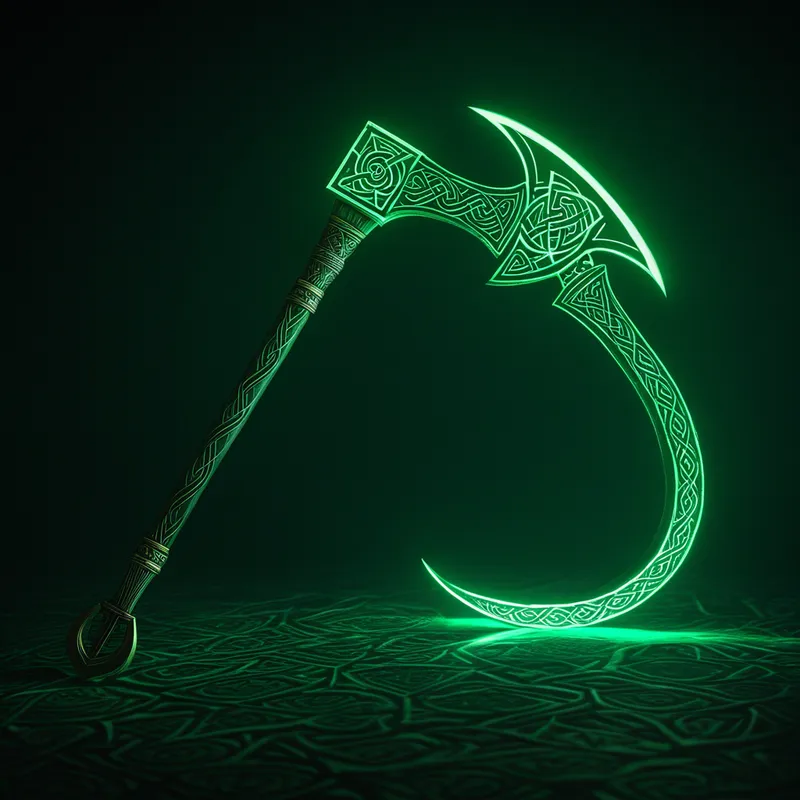
The axe is not merely a weapon; it is the sharp edge of consequence, the inevitable price of every covenant made with life.
Gawain’s [journey](/symbols/journey “Symbol: A journey in dreams typically signifies adventure, growth, or a significant life transition.”/) is the [night](/symbols/night “Symbol: Night often symbolizes the unconscious, mystery, and the unknown, representing the realm of dreams and intuition.”/) sea [journey](/symbols/journey “Symbol: A journey in dreams typically signifies adventure, growth, or a significant life transition.”/) of the [hero](/symbols/hero “Symbol: A hero embodies strength, courage, and the ability to overcome significant challenges.”/). His [armor](/symbols/armor “Symbol: Armor represents psychological protection, emotional defense, and the persona presented to the world. It symbolizes both safety and the barriers that separate us from vulnerability.”/), the [symbol](/symbols/symbol “Symbol: A symbol can represent an idea, concept, or belief, serving as a powerful tool for communication and understanding.”/) of his knightly [identity](/symbols/identity “Symbol: Identity represents the sense of self, encompassing personal beliefs, cultural background, and social roles.”/), becomes useless against a test not of [strength](/symbols/strength “Symbol: ‘Strength’ symbolizes resilience, courage, and the ability to overcome challenges.”/), but of integrity. The green girdle he accepts and hides is the [symbol](/symbols/symbol “Symbol: A symbol can represent an idea, concept, or belief, serving as a powerful tool for communication and understanding.”/) of his mortal flaw—not sin, but the very human instinct for self-preservation that conflicts with absolute [truth](/symbols/truth “Symbol: Truth represents authenticity, honesty, and the quest for knowledge beyond mere appearances.”/). His “failure” is his [initiation](/symbols/initiation “Symbol: A symbolic beginning or transition into a new phase, status, or awareness, often involving tests, rituals, or profound personal change.”/) into a deeper, more authentic humanity.
The Dreamer’s Resonance
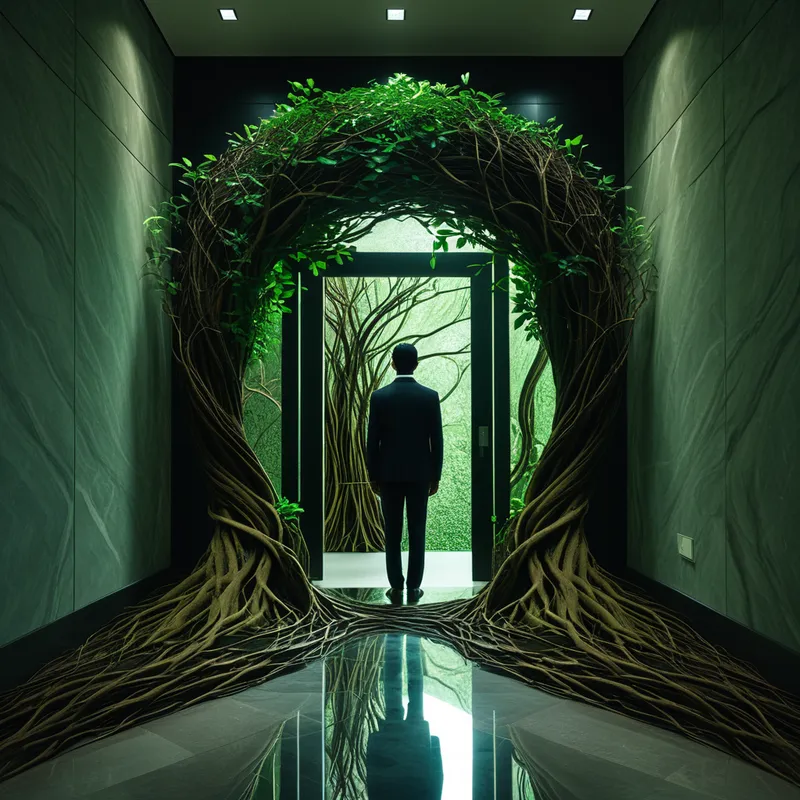
When this myth stirs in the modern dreamscape, it often manifests as a profound confrontation with a personal “Green Chapel.” The dreamer may find themselves in a stark, liminal space—a featureless room with one ominous door, a clearing at the end of a familiar path that feels utterly alien, or an elevator descending to a primal, earthy level. The feeling is one of dread mixed with solemn obligation.
The figure awaiting them is rarely a literal knight. It may be a towering, silent presence of nature (a vast tree, a rock formation), an imposing but familiar authority figure, or a shadowy version of the dreamer themselves, exuding a calm, formidable power. The “axe-blow” is the moment of terrifying, clarifying truth—a revelation of a hidden compromise, the exposure of a secret fear, or the unavoidable consequence of a past choice. The somatic experience is key: a flinch, the baring of the neck, the chilling sensation of cold metal, followed not by annihilation, but by a shocking, precise cut that draws blood but does not kill. The dreamer awakes not with trauma, but with a humbling, sobering clarity. They have been “nicked” by reality, their egoic self-image punctured, leaving them raw but paradoxically more whole.
Alchemical Translation
Psychologically, the myth charts the alchemical process of individuation. The initial state is the [nigredo](/myths/nigredo “Myth from Alchemical culture.”/): the darkening, the shock of the Green Knight’s challenge that shatters the naive, golden world of Camelot (the conscious [persona](/myths/persona “Myth from Greek culture.”/)). Gawain’s journey through the winter wasteland is the mortificatio, a dying to his old, untested self.
His stay at Bertilak’s castle represents the complex [separatio](/myths/separatio “Myth from Alchemical culture.”/) and coniunctio—the sorting and combining of opposites. The lord hunts (active, masculine, conscious pursuit) while the lady tempts (receptive, feminine, unconscious allure). Gawain must hold the tension, attempting to integrate these forces through the game of exchange. His failure with the girdle is crucial; it is the [prima materia](/myths/prima-materia “Myth from Alchemical culture.”/) of his transformation—the recognition of [the shadow](/myths/the-shadow “Myth from Jungian culture.”/), the part of himself that chooses life over perfect honor.
The final meeting at the Chapel is the rubedo, the reddening, not with the blush of shame alone, but with the blood of conscious sacrifice. The cut is the incision that allows the psychic poison (the illusion of perfection) to drain.
Gawain returns with the girdle, now transformed from a hidden [talisman](/myths/talisman “Myth from Global culture.”/) of fear into a worn symbol of integrated fallibility. For the modern individual, this is the model: we are not called to be perfect, stainless heroes. We are called to keep our covenants with life, to journey into our own wilds, to accept the testing games of our inner Bertilaks and ladies, and to finally kneel and receive the humbling, necessary cut from our own Green Knight—the part of our [psyche](/myths/psyche “Myth from Greek culture.”/) that demands truth over comfort. The [triumph](/myths/triumph “Myth from Roman culture.”/) is not in avoiding the blow, but in surviving it with enough consciousness to wear our imperfections not as secret shame, but as the green badge of our hard-won, authentic humanity.
Associated Symbols
Explore related symbols from the CaleaDream lexicon: