The Green Knight Myth Meaning & Symbolism
A mysterious, verdant giant challenges Camelot's pride. Sir Gawain accepts a deadly game, embarking on a year-long quest to face his own mortality and find true honor.
The Tale of The Green Knight
Hear now a tale of a hall hung with holly, where the breath of men and the smoke of the feast hung thick in the air. It was the high tide of Camelot, a New Year’s Day, and King Arthur presided over a court glittering with youth and certainty. The wine was red, the laughter loud, a fortress of human order against the winter’s white silence beyond the walls.
Then came the sound. Not a herald’s trumpet, but a thunderous hoof-fall that shook the very stones. The great doors groaned open, and the festive clamor died, choked by a sudden, verdant chill.
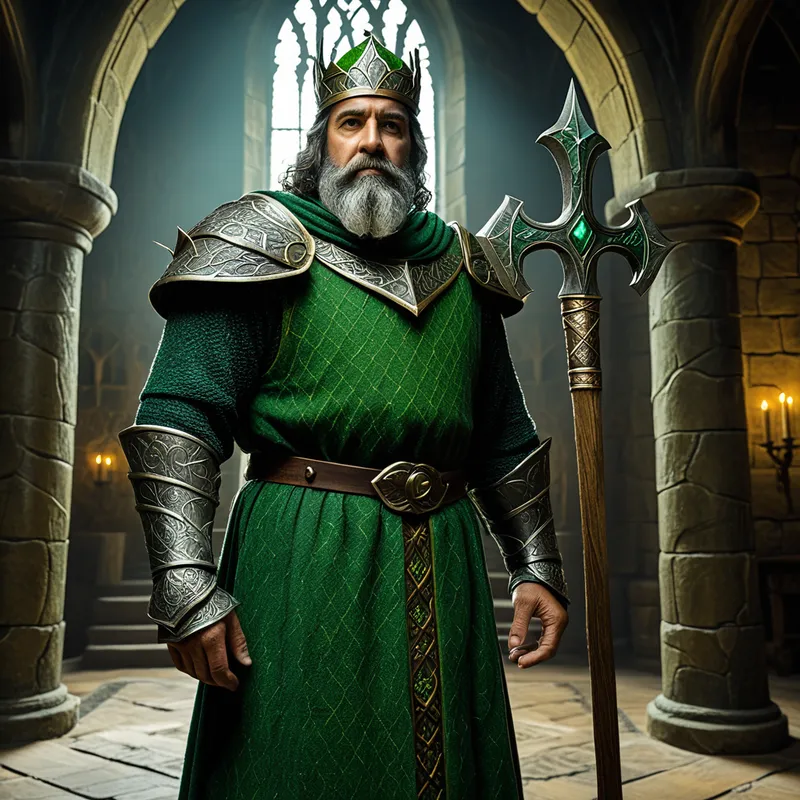
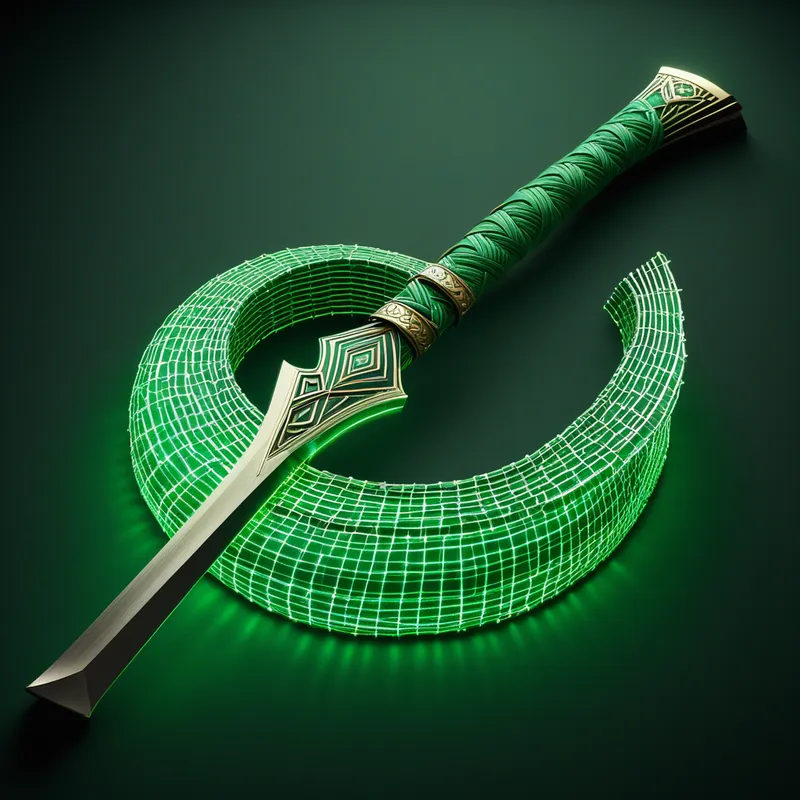
He rode in on a horse as green as jade, a giant of a man. His flesh was not flesh, but the hue of weathered moss and deep forest shadow; his hair and great beard fell like cascading ivy. His garments were green, his saddle was green, and in one massive hand he carried not a lance, but a branch of holly, its berries bright as blood-drops. In the other, an axe, its haft as thick as a man’s thigh, its blade a crescent of cold, green-tinged iron. This was the Green Knight, and his eyes held the ancient, unblinking stare of the oldest wood.
“A game!” he boomed, his voice the creak of great boughs in a storm. “I seek a knight brave enough to strike me one blow with this axe. But mark the covenant: in a year and a day, he must seek me out at my home, the Green Chapel, and receive a blow in return.”
A stunned silence held the court. Then, to defend the honor of the Round Table, the king himself stepped forward. But a younger voice spoke first. “My lord, let this folly be mine.” It was Sir Gawain, Arthur’s nephew, his face pale but resolute.
The Green Knight dismounted, knelt, and bared his neck, the green column of it like an ancient tree trunk. Gawain hefted the monstrous axe. With a shout, he swung. The blade sheared clean through. The knight’s head tumbled across the rushes, rolling to a stop at the feet of the queen. A gasp rose, then turned to a cry of horror. For the body did not fall. It stood, walked calmly to its head, and plucked it from the floor. The head’s eyes opened, its lips moved. “Remember your oath, Gawain. Seek me at the Green Chapel when the year turns. I am the Knight of the Green Chapel.” Then, mounting his steed, head tucked under his arm, he rode out, his laughter echoing long after the doors slammed shut.
The year passed in a shadow for Gawain. When the next winter’s frost gripped the land, he set out, his shield bearing the pentangle of perfect virtue. He journeyed through a dying world, through forests that whispered and over mountains that groaned, until he found a castle, fair and strange. Its lord, a jovial, red-faced man, welcomed him. “The Green Chapel is but two miles hence,” he said. “Rest until the appointed day.”
To pass the time, the lord proposed a game: each day he would hunt, and Gawain would rest in the castle. At day’s end, they would exchange what they had won. For three days, the lord hunted the deer, the boar, and the fox. And for three days, the lord’s beautiful, cunning wife visited Gawain in his chamber, offering kisses—one, then two, then three—which Gawain, bound by courtesy, accepted and later dutifully passed to the lord in their exchange.
But on the third day, the lady offered a gift: a green silk girdle, embroidered with gold. “It possesses a charm,” she whispered. “No man wearing it can be harmed by any blade on earth.” Thinking of the axe to fall, Gawain, in a moment of mortal fear, accepted it. That evening, he exchanged the three kisses, but he kept the girdle secret, a hidden talisman against death.
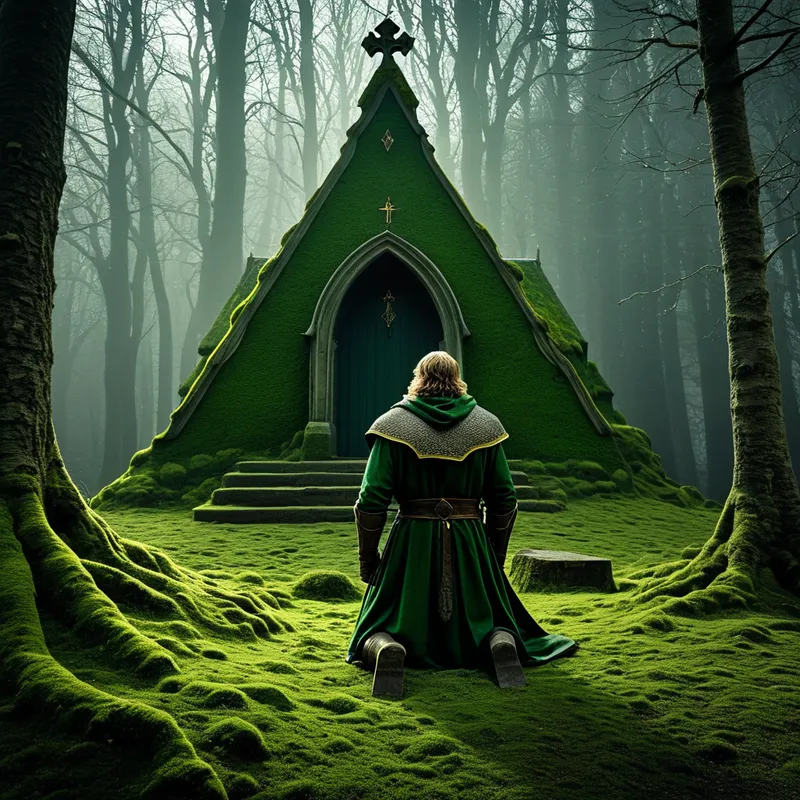
The fateful dawn arrived, iron-grey and cold. Gawain, the green girdle bound tight beneath his armor, came to the Green Chapel—a mere grassy mound by a bubbling stream. “Stay!” came the familiar, booming voice. The Green Knight emerged, whole and terrible, a fresh axe in his hand.
Gawain knelt, baring his neck. The axe rose high, whistling down. Gawain flinched. The Green Knight paused, chiding him for cowardice. The second swing feigned, stopping just at his skin. The third swing bit, but only nicking Gawain’s neck, drawing a single bead of blood.
Then the giant laughed, not with menace, but with a deep, earthy warmth. He straightened, and his form seemed to shift, revealing the face of the castle lord. “I am Bertilak de Hautdesert,” he said. “The three swings were for our three days’ exchange. You were true with the kisses, so the first two swings harmed you not. But you concealed the girdle, for love of your life. Thus, the third drew blood—a small price for a small fault. You are, Sir Gawain, the most faultless knight in all the land.”
Shame flooded Gawain, hot and bitter. He had clung to a magic lace when he should have clung to his faith. He swore to wear the green girdle forever as a badge of his failing. He returned to Camelot, not in triumph, but in humility, his perfect pentangle forever marked by the green thread of human frailty. And the court, hearing his tale, adopted the green belt as a symbol, not of shame, but of the hard-won honor found not in perfection, but in the honest reckoning with the self.
Cultural Origins & Context
The tale of Sir Gawain and the Green Knight survives in a single, exquisite manuscript from the late 14th century, written in a dialect of Middle English from the Northwest Midlands. It is the work of an anonymous poet, now called the “Pearl Poet,” whose sophistication suggests a courtly writer deeply familiar with both French romance tradition and older, native Celtic lore.
The myth functions as a hinge between two worlds. On one side is the high medieval world of chivalry and Christian virtue, represented by Camelot’s order and Gawain’s pentangle. On the other is a far older, pre-Christian stratum of British mythology, where the land itself is alive and sovereign. The Green Knight is a direct descendant of figures like the Cernunnos or the Wild Man of the woods—an embodiment of the untamed, cyclical, and morally ambiguous force of Nature. His challenge is not merely to a knight, but to the entire project of civilization: can human order withstand the raw, testing power of the natural world?
The story was likely recited in noble halls, serving as both thrilling entertainment and profound moral instruction. It tested the audience’s ideals, asking if the polished veneer of chivalry could survive a confrontation with something as primal as death, symbolized by the axe, and as seductive as life, symbolized by the fertile, ever-returning green.
Symbolic Architecture
The myth is a perfectly constructed symbolic engine. The Green Knight is not a villain, but an agent of the Self—the totality of the psyche in Jungian terms. He represents the irreducible, often terrifying, fact of Nature and Fate that exists beyond human control and social contract. His color is the color of life, decay, and regeneration—a cycle in which death is not an end, but a necessary phase.
The Green Knight is the psyche’s own immune response to the inflation of the ego; he arrives when the conscious self believes it has conquered all challenges and sits in perfect, sterile order.
Camelot, in its New Year’s pride, represents the conscious ego in a state of inflation. Gawain’s acceptance of the “beheading game” is the ego’s initial, often brash, agreement to engage with the unconscious. The long year of waiting is the necessary period of incubation, where the conscious mind lives with the knowledge of its impending rendezvous with the shadow. The journey through the winter wasteland is the nigredo of the alchemists, a stripping away of comforts and certainties.
The castle and its tests are the core of the individuation process. The lord, Bertilak, is the Green Knight in his “tamed” or socialized form—the helpful guide who nonetheless administers the test. His wife represents the anima, the feminine aspect of the male psyche, who tempts not with mere lust, but with a more complex offer: a secret, magical solution (the girdle) that would allow the ego to bypass the necessary suffering of integration. Gawain’s failure is his most human moment—choosing a hidden trick over transparent virtue. The nick on his neck is the wound of consciousness, the permanent scar of self-knowledge that proves one has truly faced the axe.
The Dreamer’s Resonance
When this myth stirs in the modern dreamer, it often manifests as an encounter with an implacable, natural force within the psyche. One may dream of a towering figure made of stone, wood, or storm; of receiving a terrifying, non-negotiable invitation or contract; or of preparing for a dreaded appointment that cannot be missed.
Somatically, this can feel like a tightening in the gut or throat—the body anticipating the blow. Psychologically, it signals that the conscious attitude has become too rigid, too prideful in its own righteousness or control. The Green Knight emerges from the dream-world to issue a challenge to this inflation. The process underway is one of initiation by ordeal. The ego is being compelled to submit to a law larger than its own desires or fears. The dream is not punishing the dreamer, but insisting on a necessary humiliation—a grounding in a reality more profound than self-image. It asks: Where are you being dishonest with yourself? What fateful appointment with your own truth are you avoiding? What green, growing, wild part of your nature have you walled out of your personal Camelot?
Alchemical Translation
The myth of Gawain is a precise map of psychic alchemy. The initial state is the prima materia of Camelot’s immature pride. The Green Knight’s arrival is the additio, the shocking catalyst that begins the work.
The true alchemical gold forged in this tale is not perfection, but integrity—the wholeness that comes when the shining ideal is fused with the shadow of its own failure.
The year-long journey is the nigredo, a descent into the cold, lonely landscape of the soul where old identities dissolve. The castle represents the albedo, a place of reflection and subtle testing, where the elements of the psyche (the hunting lord/action, the seductive lady/desire, the cautious guest/ego) interact. The exchange game is the circulatio, a back-and-forth between conscious and unconscious contents.
The final confrontation at the Green Chapel is the rubedo. The axe’s blow is the coniunctio—not a destruction, but a sacred marriage of the ego with the Self. The ego (Gawain) must kneel and offer its neck—its willful control—to be symbolically “killed” and reborn. The resulting wound is small but permanent: the scar of individuation. The green girdle, transformed from a hidden charm into a public badge of humility, becomes the lapis philosophorum, the Philosopher’s Stone. It is no longer a magic that denies death, but a symbol that integrates the knowledge of mortality and frailty into the fabric of one’s being.
For the modern individual, the alchemy is this: we are all summoned by our own Green Knight—the call from the depths to live not a flawless life, but an authentic one. The quest is to journey through the winter of our doubts, to face the seductive shortcuts of our fears, and to finally kneel at the chapel of our own truth, not to be destroyed, but to be nicked into wholeness. We return not as perfect heroes, but as humans wearing the green thread of our hard-earned, imperfect honor.
Associated Symbols
Explore related symbols from the CaleaDream lexicon: