The Greek polis or the Native Myth Meaning & Symbolism
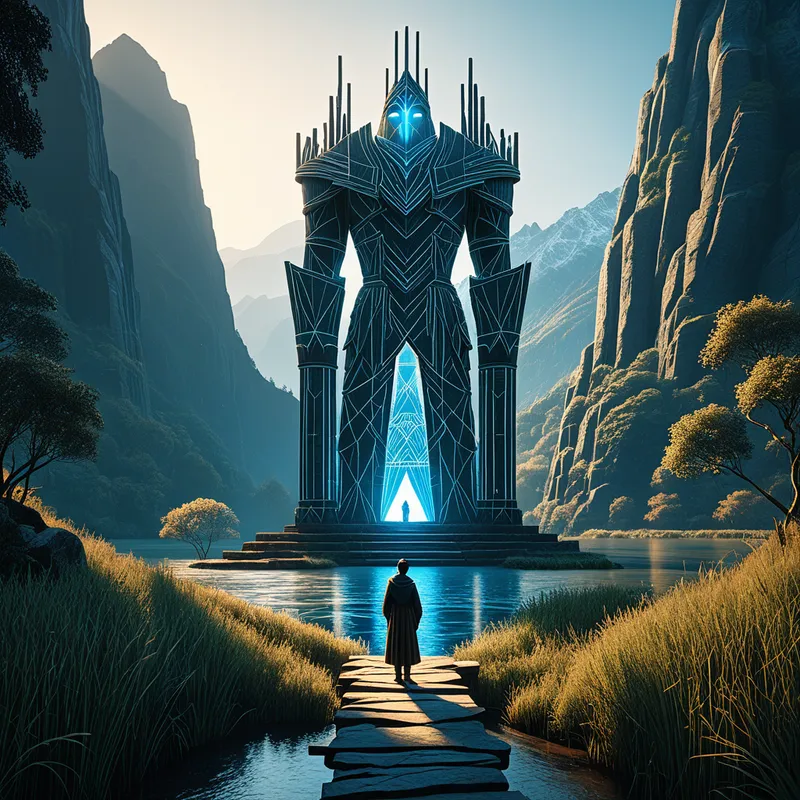
A primal spirit of the land confronts the geometric dream of a city, forging a sacred covenant between wild nature and human order.
The Tale of The Greek polis or the Native
Listen. Before the first stone was set upon stone, the land dreamed. It dreamed in the slow pulse of roots, in the chitter of insects under bark, in the patient flow of rivers carving their own stories. The land was not empty; it was full—a whispering, sentient presence we might call the Genius Loci. It was the Native, the one who belongs utterly, whose body is the hill and whose breath is the mist.
Then came the Dreamer with a different dream. He walked the same hills, but he saw not just trees, but timber; not just a river, but a boundary and a source; not just a defensible rock, but the heart of something yet unborn. In his mind’s eye, geometric forms arose: the straight line of a wall, the perfect curve of a theatre, the right angle where a street meets the agora. This was the dream of the Polis. He carried the sacred tools: the plumb bob for vertical truth, the measuring rod for proportion, the chisel to shape chaos into form.
He found the place—a sloping plain between the wild mountain and the forgiving sea. As he drove the first surveyor’s stake into the earth, the air grew still. The birds fell silent. From the oldest oak at the boundary stepped a form that was both man and not-man. Its skin was dappled bark, its hair trailing vines, its eyes the deep, still pools of a forest spring. This was the Native.
“You cut my skin with your lines,” the Native spoke, and its voice was the rustle of ten thousand leaves. “You divide what is whole. Your dream is a cage of angles.”
The Dreamer, though afraid, held up his tools. “My dream is a vessel for meaning,” he replied, his voice human and trembling with conviction. “Without the wall, there is no safety to foster art. Without the street, no meeting of minds. Without the temple, no place to honor the very mysteries you embody.”
“Your vessel will be empty,” the Native warned. “You will build a tomb of order, and your people will forget the taste of wild water and the counsel of the wind.”
A great conflict ensued, but not of claw and sword. It was a war of visions. Where the Dreamer traced his lines, thorns would erupt overnight, twisting his geometry. Where the Native let the forest creep, the Dreamer would light a fire of purpose, not to destroy, but to clear a space for his hearth. They were locked in a stalemate of creation, each rendering the other’s work incomplete.
Exhaustion finally came, not in defeat, but in mutual recognition. The Dreamer sat upon his unlaid cornerstone, his blueprints smudged with soil. The Native leaned against its oak, the vitality of its form seeming dimmed. In the silence, a third thing was born: not a thought, but a feeling. A longing for resolution.
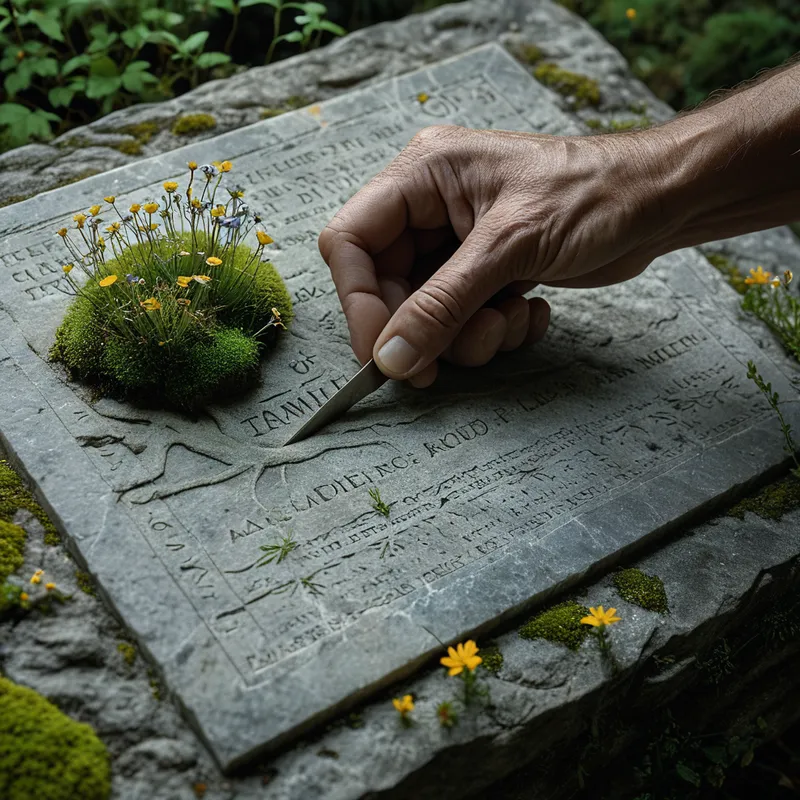
The Dreamer did a shocking thing. He lifted his chisel and marble tablet, but did not carve his own law. Instead, he offered the tools to the Native. “Show me,” he said, “how the law of the land is written.”
And the Native, in an act of equal shock, took the tools. Not to break them, but to use them. With a touch like growing moss, it guided the chisel. It did not carve words, but shapes: the sinuous path of a stream, the branching pattern of a deer’s antler, the spiral of a fern. It inscribed the land’s own logic onto the stone.
In that moment, the covenant was forged. The Polis would be built, but its walls would have gates where the wild could be invited in. Its sacred grove would not be a trimmed garden, but a preserved patch of the Native’s own body. The city’s laws would echo the deeper laws of season and cycle. The Dreamer built his vessel; the Native filled it with spirit.
Cultural Origins & Context
This is not a myth from a single scroll or epic, but a foundational pattern etched into the collective psyche of human settlement. It is the universal story of Neolithization, told and retold in the rituals of countless cultures. We hear it in the Roman rites of the Lupercalia, where the wild god Faunus was invoked within the city itself. We see it in the Mesoamerican practice of building temples atop sacred caves, acknowledging the living earth. We find it in the countless global traditions of asking permission from the local spirits before cutting a tree or digging a foundation.
The myth was passed down not by bards alone, but by farmers, masons, and priests. Its societal function was critical: to mediate the profound psychological trauma of transitioning from a life within nature to a life alongside it, within a human-made order. It served as a psychic anchor, a narrative that prevented the new city from becoming a place of alienation by ritually embedding the memory of the wild into its very charter. It was a story to ward off the haunting fear that civilization was, itself, a form of sacrilege.
Symbolic Architecture
At its core, this myth maps the birth of consciousness from the unconscious. The Polis represents the emerging ego—the part of the psyche that seeks order, identity, boundaries, and conscious structure. It is the principle of differentiation: “I am here, and the world is there.” The Native symbolizes the unconscious itself—the vast, undifferentiated, animistic matrix from which the ego arises. It is the source of life, creativity, and instinct, but also of chaos and the unknown.
The city is the psyche’s attempt to build a permanent home for itself, while the native is the land that reminds it it is always, and forever, a guest.
Their conflict is the essential human conflict: the conscious mind’s need to control and understand, versus the soul’s need to belong to something larger and more mysterious. The chisel and the growing vine are perfect opposites: one imposes form from without, the other unfolds form from within. The myth’s genius lies in its resolution: neither side wins. Instead, they engage in a sacred marriage, a hieros gamos. The ego (Polis) must offer its tools of consciousness—its capacity for language, law, and art—to the unconscious (Native). In return, the unconscious imbues those structures with vitality, meaning, and a connection to the primordial source. The resulting covenant is the foundation of a living culture and a whole psyche.
The Dreamer’s Resonance
When this myth stirs in the modern dreamer, it often manifests as dreams of profound architectural conflict or negotiation. You may dream of building a house, only to find a ancient, sacred tree growing through the floorboards. You may be trying to navigate a rigid, bureaucratic city (the over-developed ego) that is simultaneously being reclaimed by jungle or flood (the rising unconscious). The somatic feeling is one of deep tension, a pull between the need for control and a powerful, often frightening, urge to let go.
Psychologically, this dream pattern signals a critical moment in the individuation process. The dreamer’s conscious attitude—perhaps an over-reliance on order, planning, and intellectual control (the inner Polis)—has become sterile or oppressive. The Native appears as the repressed wildness: untamed emotions, neglected creativity, bodily instincts, or a spiritual longing that cannot be satisfied by logic alone. The dream is the psyche’s attempt to re-negotiate the covenant, to force a dialogue between the CEO of the self and its feral, artistic child.
Alchemical Translation
The alchemical process modeled here is that of Coagulatio—the making solid—but with a crucial caveat. In bad alchemy, Coagulatio creates a dead, rigid thing: the petrified ego, the heart turned to stone. The myth teaches the art of the Living Stone. The modern individual’s task of psychic transmutation is not to destroy the ego-structure (the city we have built of our personality, career, habits) but to ensoul it.
Individuation is not about fleeing to the wilderness of the unconscious, but about building a city of the self where the wild gods are given temples and a vote in the council.
The first step is to recognize the “Native” within—the parts of ourselves we have exiled as too messy, too emotional, too irrational, too creative. The second, and more difficult step, is the Dreamer’s courageous act: to offer our modern “tools” (our rationality, our skills, our capacity for discipline) not to suppress this wildness, but to give it form. This is the artist inviting the muse to guide the brush. This is the executive allowing intuition a seat at the board meeting. This is the planner leaving blank spaces in the schedule for spontaneity.
The covenant is the integrated Self. The Polis becomes a living system, adaptable, irrigated by deep springs of instinct and inspiration. The Native finds a voice and a home within consciousness, its chaotic energy directed into creation rather than sabotage. We become neither purely civilized nor purely wild, but something third: a human being whose order has roots, and whose wildness has a hearth. We inhabit our own lives not as conquerors of an inner landscape, but as faithful stewards of a sacred, co-created ground.
Associated Symbols
Explore related symbols from the CaleaDream lexicon: