The Greek myth of Theseus and Myth Meaning & Symbolism
A prince enters a monstrous labyrinth to face a bull-headed shadow, guided by a thread of love, in a myth of identity, sacrifice, and the dark within.
The Tale of The Greek myth of Theseus and
Hear now the tale of [the labyrinth](/myths/the-labyrinth “Myth from Greek culture.”/), the beast within, and the thread that binds fate to love. In the age when gods still walked in the whispers of men, the great city of Athens lay under a curse of sorrow. Every nine years, its harbors grew heavy not with trade, but with the groaning of a ship bearing black sails. This was the blood-tithe to mighty King [Minos](/myths/minos “Myth from Greek culture.”/) of Crete, payment for a son slain on Athenian soil. Seven youths and seven maidens, the flower of the city, were sent across the wine-dark sea to be fed to the horror that dwelled in the heart of the [Labyrinth](/myths/labyrinth “Myth from Various culture.”/).
But in one such season of mourning, a young prince raised his head. His name was [Theseus](/myths/theseus “Myth from Greek culture.”/), son of Aegeus, though some said his true father was [the sea](/myths/the-sea “Myth from Greek culture.”/)-lord [Poseidon](/myths/poseidon “Myth from Greek culture.”/). He felt the weight of his city’s grief not as a burden, but as a call. “I will go,” he declared, his voice cutting through the despair in the palace halls. “I will go as one of the seven, and I will end this terror.” His father, the king, pleaded, but [Theseus](/myths/theseus “Myth from Greek culture.”/)’s resolve was like iron. They made a pact: if Theseus triumphed, he would return under sails of white; if he failed, the black would tell the tale.
The voyage to Crete was a silent hymn of dread. In the court of Knossos, amidst its towering, painted columns and the scent of saffron and oil, the victims were paraded before the throne. There, the princess Ariadne watched. Her eyes, dark as the deep earth, met Those of the foreign prince, and in that glance, a fate was spun. She saw not just a victim, but the instrument of her own liberation from the monstrous secret that choked her home.
In the dead of night, she came to him. In her hands she held two gifts: a gleaming sword to slay the beast, and a skein of crimson thread. “Tie this to the gate,” she whispered, her voice a tremor in the torchlight. “Unwind it as you go. It is your only path back from the darkness.” Her love was the first knot in the guide-line out of hell.
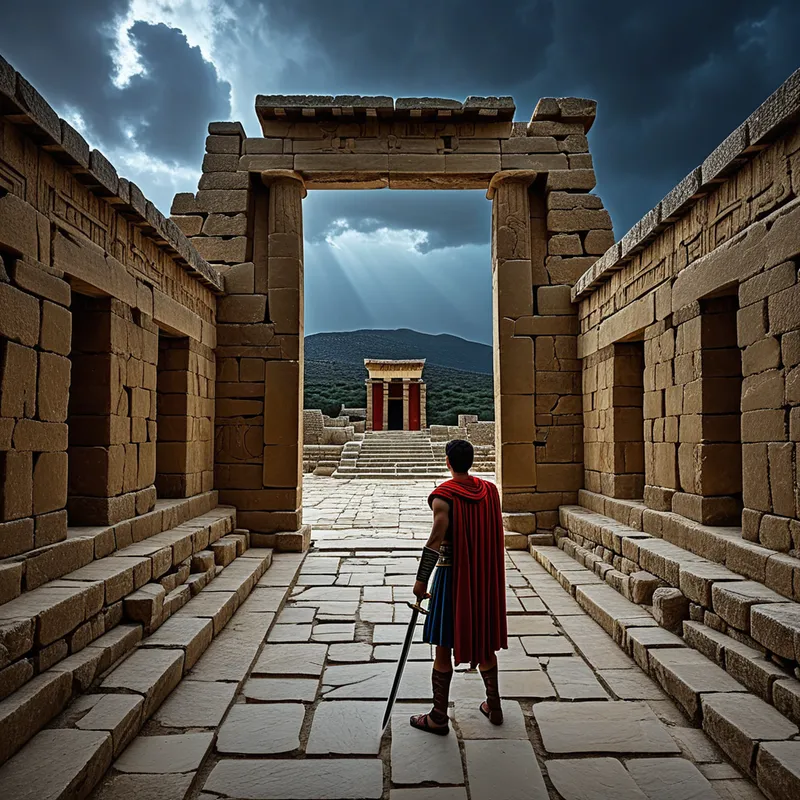
At dawn, the great bronze doors of the Labyrinth groaned open. Theseus stepped into the throat of stone. The air was cold, smelling of damp earth and something older, metallic—the scent of fear and primal rage. The passages coiled upon themselves, a stone intestine designed to devour hope. Left, right, dead end, circle. The only sound was his breath, the scuff of his sandals, and the whisper of the thread paying out behind him, a slender artery of connection to [the world](/myths/the-world “Myth from Tarot culture.”/) of light.
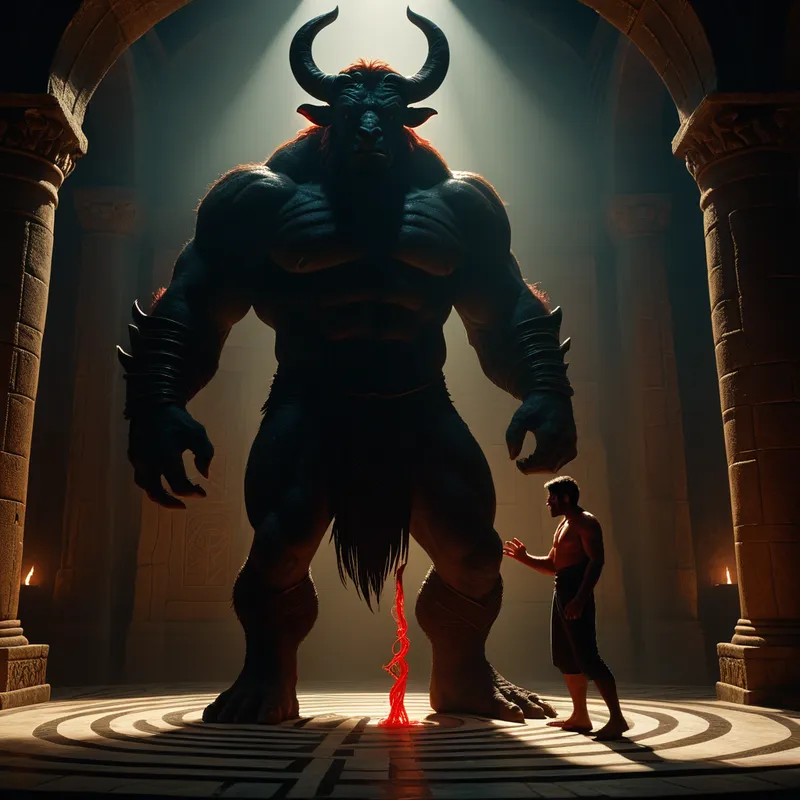
Then, he heard it. A low, guttural snort. The scrape of a hoof on stone. He turned a final corner, and there, in a chamber lit by a single shaft of dusty light from some unseen vent, stood the [Minotaur](/myths/minotaur “Myth from Greek culture.”/). It was not merely a monster; it was a tragedy made flesh—a powerful, muscular torso rising from a bull’s body, a head crowned with cruel horns, but in its eyes flickered a trapped, anguished consciousness. It charged with the mindless fury of a beast and the terrible strength of a man.
The fight was short, brutal, and echoing. Theseus, fueled by the will of a people and the love of a princess, drove the sword home. The creature fell with a sigh that seemed to shake the very foundations of the maze. Silence rushed in, deeper than before. Then, with hands stained but steady, Theseus took up the crimson thread. He followed it back, through the winding stone intestines, the thread his only tether to sanity and salvation, until he saw the blessed crack of daylight and stumbled out, blinking, into the arms of Ariadne.
Their escape was swift, a flight across the sea toward freedom and a new life. But myths are woven with threads of both [triumph](/myths/triumph “Myth from Roman culture.”/) and flaw. In the exultation of victory, or perhaps in a fog of divine forgetfulness, Theseus neglected to change the black sails for white. From the cliffs of Athens, his father Aegeus saw the dark-shrouded ship on [the horizon](/myths/the-horizon “Myth from Various culture.”/) and, believing his son dead, cast himself into the sea that bears his name to this day. Theseus returned a king, crowned with a victory forever bittersweet, the slayer of monsters now haunted by a grief of his own making.
Cultural Origins & Context
This is a foundational myth of Athenian identity, emerging from the rich oral traditions of the Bronze Age Aegean and crystallized in the works of later poets like Bacchylides and the tragedians. It functioned as a national origin story, explaining Athenian supremacy and its complex relationship with the earlier, powerful Minoan civilization of Crete (which historically did possess vast, palace complexes that could be described as labyrinthine). The myth was performed, not just read; it was a public narrative reinforcing civic values of courage, cunning ([metis](/myths/metis “Myth from Greek culture.”/)), and self-sacrifice for [the polis](/myths/the-polis “Myth from Greek culture.”/). Theseus himself evolved into the archetypal Athenian hero-king, a unifier and civilizer, with his journey into the Labyrinth serving as the ultimate initiation rite—a symbolic death and rebirth that legitimized his rule and Athens’s place in the world.
Symbolic Architecture
The [Labyrinth](/symbols/labyrinth “Symbol: The labyrinth represents a complex journey, symbolizing the intricate path toward self-discovery and understanding one’s life’s direction.”/) is not merely a [maze](/symbols/maze “Symbol: A maze represents confusion, complexity, or a search for truth, often reflecting life’s challenges or inner turmoil.”/). It is the ultimate [symbol](/symbols/symbol “Symbol: A symbol can represent an idea, concept, or belief, serving as a powerful tool for communication and understanding.”/) of the unconscious mind, a convoluted, defensive [structure](/symbols/structure “Symbol: Structure in dreams often symbolizes stability, organization, and the framework of one’s life, reflecting how one perceives their environment and personal life.”/) built to contain what the conscious self ([King](/symbols/king “Symbol: A symbol of ultimate authority, leadership, and societal order, often representing the dreamer’s inner power or external control figures.”/) Minos) cannot integrate. It is the complex, [winding path](/symbols/winding-path “Symbol: A winding path embodies life’s journey, embodying the complexities and unpredictability of experiences along the way.”/) of a psychological complex, a [trauma](/symbols/trauma “Symbol: A deeply distressing or disturbing experience that overwhelms the psyche, often manifesting in dreams as unresolved emotional wounds or psychological injury.”/), or a buried [aspect](/symbols/aspect “Symbol: A distinct feature, quality, or perspective of something, often representing a partial view of a larger whole.”/) of [the self](/myths/the-self “Myth from Jungian culture.”/).
The [Minotaur](/symbols/minotaur “Symbol: The Minotaur, a creature from Greek mythology, is often interpreted as a symbol of inner turmoil and the struggle between human and beast.”/), born of a [queen](/symbols/queen “Symbol: A queen represents authority, power, nurturing, and femininity, often embodying leadership and responsibility.”/)’s transgressive desire and hidden away, is the [Shadow](/symbols/shadow “Symbol: The ‘shadow’ embodies the unconscious, repressed aspects of the self and often represents fears or hidden emotions.”/) in its most potent form. It is the bestial, instinctual, and “unacceptable” part of the [psyche](/myths/psyche “Myth from Greek culture.”/) that is fed by repression (the Athenian tributes). It is not pure evil, but a deformed [child](/symbols/child “Symbol: The child symbolizes innocence, vulnerability, and potential growth, often representing the dreamer’s inner child or unresolved issues from childhood.”/) of denied [nature](/symbols/nature “Symbol: Nature symbolizes growth, connectivity, and the primal forces of existence.”/), a part of the [family](/symbols/family “Symbol: The symbol of ‘family’ represents foundational relationships and emotional connections that shape an individual’s identity and personal development.”/) hidden in the [basement](/symbols/basement “Symbol: The basement in dreams often symbolizes the unconscious mind, where hidden fears, repressed memories, and unacknowledged aspects of the self reside.”/) of the [soul](/symbols/soul “Symbol: The soul represents the essence of a person, encompassing their spirit, identity, and connection to the universe.”/).
The hero is not the one who never enters the labyrinth, but the one who agrees to descend into the winding darkness of their own nature, armed with nothing but a thread of consciousness.
Ariadne’s thread represents the syntropy of the psyche—the connecting principle, often embodied by love, [intuition](/symbols/intuition “Symbol: The immediate, non-rational understanding of truth or insight, often described as a ‘gut feeling’ or inner knowing that bypasses conscious reasoning.”/), or [insight](/symbols/insight “Symbol: A sudden, deep understanding of a complex situation or truth, often arriving unexpectedly and illuminating hidden connections.”/) (Athena’s [guidance](/symbols/guidance “Symbol: The act of receiving or seeking direction, advice, or leadership in a dream, often representing a need for clarity, support, or a higher purpose on one’s life path.”/) is also sometimes present). It is the fragile but unbreakable link to the conscious world ([the ego](/myths/the-ego “Myth from Jungian culture.”/)) that makes the [journey](/symbols/journey “Symbol: A journey in dreams typically signifies adventure, growth, or a significant life transition.”/) into the [depths](/symbols/depths “Symbol: Represents the subconscious, hidden emotions, or foundational aspects of the self, often linked to primal fears or profound truths.”/) possible without psychosis. It is the guiding narrative, the therapy [session](/symbols/session “Symbol: A session often represents a gathering or meeting designed for a specific purpose, reflecting your readiness to confront challenges or learn from experiences.”/), the remembered love that allows one to go into the [heart](/symbols/heart “Symbol: The heart symbolizes love, emotion, and the core of one’s existence, representing deep connections with others and self.”/) of darkness and return.
The tragic failure with the sails reveals the [hero](/symbols/hero “Symbol: A hero embodies strength, courage, and the ability to overcome significant challenges.”/)’s fatal flaw: the [inflation](/symbols/inflation “Symbol: A dream symbol representing feelings of diminishing value, loss of control, or expansion beyond sustainable limits in one’s life or psyche.”/) of success. Having conquered the ultimate [monster](/symbols/monster “Symbol: Monsters in dreams often symbolize fears, anxieties, or challenges that feel overwhelming.”/), Theseus forgets the [human](/symbols/human “Symbol: The symbol of a human represents individuality, complexity of emotions, and social relationships.”/) contract, the [connection](/symbols/connection “Symbol: Connection symbolizes relationships, communication, and bonds among individuals.”/) to his [father](/symbols/father “Symbol: The father figure in dreams often symbolizes authority, protection, guidance, and the quest for approval or validation.”/) (his [origin](/symbols/origin “Symbol: The starting point of a journey, often representing one’s roots, source, or initial state before transformation.”/), his past). The victory over [the shadow](/myths/the-shadow “Myth from Jungian culture.”/) is meaningless if it severs us from our humanity.
The Dreamer’s Resonance
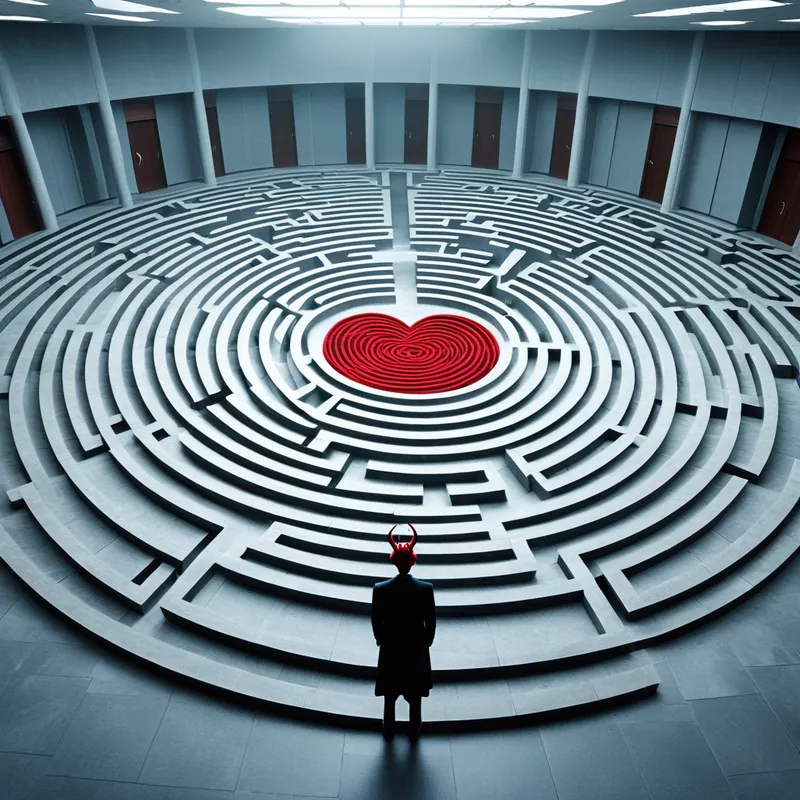
When this myth stirs in the modern dreamer, it signals a profound encounter with the personal labyrinth. You may dream of being lost in endless, repeating hallways (an office, a school, a subway), feeling a looming, unseen presence. This is the somatic experience of a complex—a knot of emotion, memory, and perception that the ego cannot navigate logically.
[The Minotaur](/myths/the-minotaur “Myth from Greek culture.”/) in a dream is rarely a literal bull-man. It may be a threatening figure, a wild animal, a overwhelming wave of rage or shame, or even a repressed talent or desire that feels “monstrous” in its power. The dream-ego’s task is not necessarily to “slay” it, but to face it. The act of turning the final corner in the dream and witnessing the form of your shadow is the beginning of integration.
The thread is the dream’s symbol of hope and connection. It might appear as a phone line, a trail of light, a remembered song, or the face of a loved one. Its presence means the psyche believes re-integration is possible. To dream of losing the thread is to experience the terror of dissociation; to find it again is to reclaim the process of self-discovery.
Alchemical Translation
The myth of Theseus models the alchemical [nigredo](/myths/nigredo “Myth from Alchemical culture.”/), the descent into blackness for the purpose of transmutation. The conscious ego (Theseus) must voluntarily descend (descensus ad inferos) into the chaotic, mineral state of the unconscious (the Labyrinth) to retrieve and redeem the hidden, golden value trapped within the base material (the libido/energy bound in the Shadow/Minotaur).
Individuation is not about becoming a perfect, monster-free hero. It is about changing the relationship with the monster from one of terror and tribute to one of acknowledgment, struggle, and ultimately, transformed kinship.
The slaying is a necessary but brutal image for the dissolution of the complex’s autonomous, destructive power. The energy bound within it—the raw life force, passion, and instinct represented by the bull—is not destroyed, but liberated. This is the [separatio](/myths/separatio “Myth from Alchemical culture.”/), where a previously fused and pathological element is broken apart. The hero integrates its strength but leaves its autonomous, tormenting consciousness behind.
The return, guided by the thread, is the albedo, the washing clean. But the myth wisely includes the failure of the sails—the citrinitas that is not fully achieved. It reminds us that the work is never done. Integrating the shadow brings new power and consciousness, but it also brings new responsibilities and the potential for tragic inflation. The fully realized Self would have remembered the white sails. The myth shows us the heroic human, not the perfected god, forever caught between the triumph over inner darkness and the enduring, human cost of the journey.
Associated Symbols
Explore related symbols from the CaleaDream lexicon: