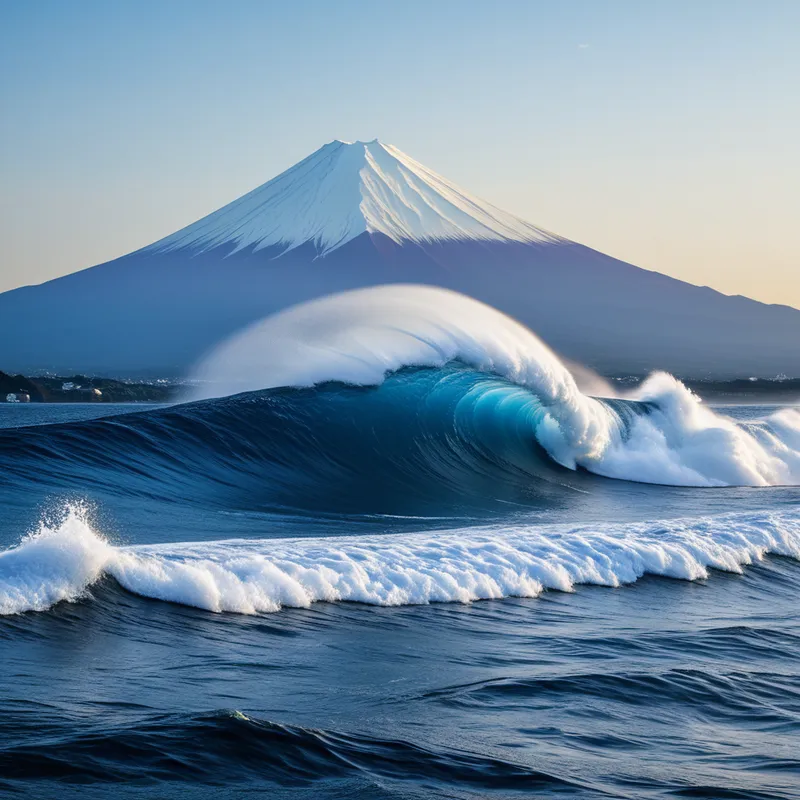
The Great Wave of Kanagawa Myth Meaning & Symbolism
A colossal wave, born of divine discontent, challenges the world's order, revealing the profound power of nature and the resilience of the human spirit.
The Tale of The Great Wave of Kanagawa
Listen, and let the salt air fill your lungs. Let the chill of the deep Pacific settle in your bones. This is not a story of a single wave, but of the Wave—the one that sleeps in the abyssal trenches, dreaming of the sky.
In the time when the world was a conversation between rock and water, the sea grew restless. It was not anger, but a deep, rhythmic sorrow, a feeling that it was forever chained to the shore, its vastness unappreciated. Its sighs became swells, its laments became currents, and its deepest yearning gathered in the cold dark off the coast of Edo. There, it coalesced into a singular consciousness, a being of pure aquatic force. They did not call it a monster, for it was not evil. They called it Ōnamazu, the great catfish of the deep, whose stirrings shake the earth, but here it took a different form: the Form of the Wave.
To the west, immutable and silent, stood Fujisan. It was the anchor of the world, a cone of perfect peace painted in eternal snows. The Wave, in its turbulent becoming, saw this stillness as a challenge, a silent rival. “Why do you get to touch the heavens while I am forever cast down?” the Wave seemed to roar, though its voice was the crash of a million tons of water.
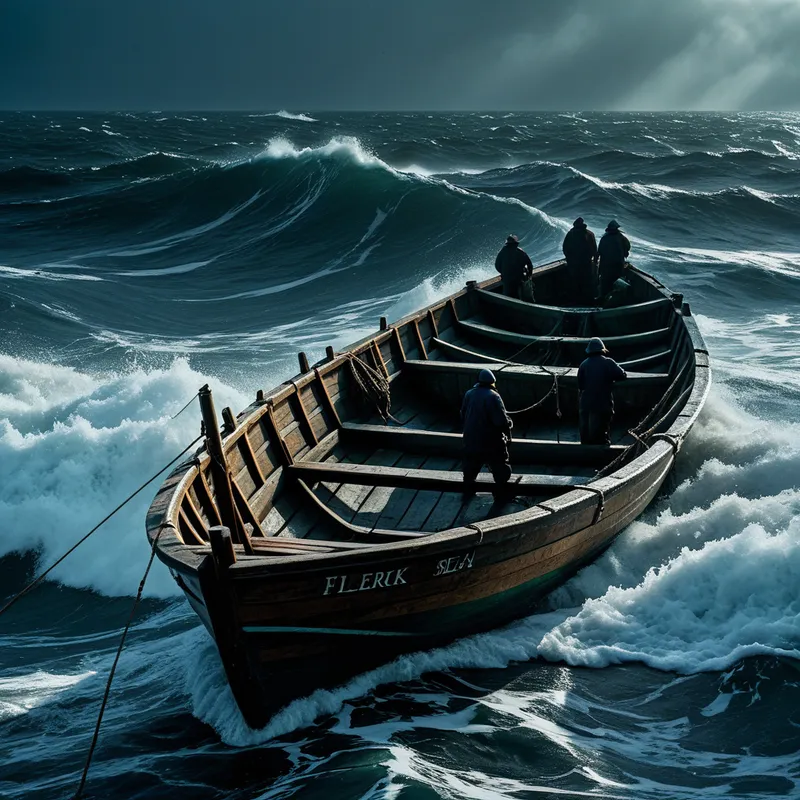
On a day when the dawn was the color of a ripe persimmon, three small boats, mere shells of wood and the courage of men, ventured out from the village of Kanagawa. The fishermen, their hands calloused from nets and ropes, were children of the sea but strangers to its soul. They sought the silver flicker of the bonito, the day’s humble bounty.
Then, the water beneath them fell away. The world tilted. A wall of water, taller than any temple, darker than a storm cloud at midnight, rose from the deep. It was not mere water; it was a claw, a fist, a devouring maw of foam. Its crest was a lace of furious white, each droplet a screaming spirit of the storm. It blotted out the dawn, casting the boats into a chilling twilight. The men did not cry out to gods; their throats were sealed by awe. They became not fishermen, but witnesses to the argument between the moving and the still, the formless and the formed.
The Wave curled, a perfect, terrible arc. It did not seek to destroy the boats, but to envelop them, to show them the view from its height—a glimpse of sacred Fuji, small and distant from this liquid summit. For a heartbeat that lasted an eternity, the men hung in the spray, between the deep and the sky, between life and oblivion. They saw the world inverted: the mountain was below them, the sea was the sky.
And then, with a sigh that shook the very foundations of the islands, the Wave began its descent. Not in a smash of annihilation, but in a cascading curtain of blue and white. It spent its fury not on the fragile wood, but on the empty air, on the act of expression itself. The boats were plunged into the roaring trough, spun, and then… released. The sea settled into a simmering calm. The Wave was gone, returned to the body of the ocean from which it came. Only the memory of its shape remained in the trembling water and the widened eyes of the men, who rowed home with a story that was not just theirs, but the sea’s.
Cultural Origins & Context
This powerful visual myth finds its origin not in ancient scrolls, but in a single, seminal woodblock print from the 1830s by the master Katsushika Hokusai. Part of his series Thirty-six Views of Mount Fuji, The Great Wave off Kanagawa was a product of the Edo period, a time when a burgeoning merchant class craved art depicting the drama of the natural world and the vibrancy of travel. While not a narrative myth from the Kojiki, it instantly became a myth. It was reproduced endlessly, traveling to Europe to influence the Impressionists, and embedding itself in the global psyche.
Its societal function was dual. For the common people, it was a sublime reminder of the power of nature—kami in its rawest form—and the precariousness of human endeavor against it. For the artist and the viewer, it was a meditation on perspective and permanence. The wave, for all its terrifying dynamism, is framed and frozen. The tiny, enduring Fuji provides the stable reference point. The myth was passed down not by bards, but by printers and collectors, its story told through composition and color, speaking directly to the soul about scale, terror, and beauty.
Symbolic Architecture
The myth is a perfect symbolic engine. The Great Wave represents the overwhelming force of the unconscious, a sudden upwelling of emotion, trauma, or transformative power that threatens to obliterate the conscious ego (the fishermen). It is not evil; it is a natural, cyclical force of psyche and world.
The wave does not seek to drown you, but to show you the view from a height you dared not climb.
Mount Fuji symbolizes the transcendent function, the enduring Self at the center of the psyche that remains unmoved by emotional tempests. The boats are the vulnerable vessel of the ego, navigating these forces. The crucial symbolism is in their relationship: the wave is in the foreground, immediate and terrifying, while Fuji is small, distant, but unshakeable. The ego, in crisis, often loses sight of the enduring Self, seeing only the crashing chaos.
The “claw” of the wave, about to grasp, symbolizes the psyche’s terrifying yet necessary engulfment by something larger than itself—a creative idea, a bout of depression, a spiritual awakening—that feels like annihilation but is ultimately a restructuring.
The Dreamer’s Resonance
When this myth appears in modern dreams, the dreamer is often at the precipice of a profound emotional or psychological inundation. To dream of the Wave is to feel the somatic dread of a rising tide within—anxiety, grief, or repressed rage gathering force. The dreamer may be one of the fishermen, helpless, or may be the wave itself, experiencing the terrifying power of their own unleashed potential or anger.
The frozen moment of the wave’s curl represents suspension in a crisis. The dreamer is in the “eye” of the psychological storm, forced to witness the magnitude of what they are facing. There is no action possible, only awe-filled witnessing. This dream pattern signals that the conscious mind is being confronted with material from the deep unconscious that is too large to integrate through analysis alone. It must be experienced. The body may respond with sensations of falling, vertigo, or pressure. The resolution in the dream—whether the wave crashes or recedes—often mirrors the dreamer’s unconscious assessment of their capacity to integrate this force.
Alchemical Translation
The alchemical process modeled here is solutio—dissolution. The rigid structures of the ego (the boat, the daily life of the fisherman) are plunged into the aqua permanens, the corrosive and creative waters of the unconscious. This is not a gentle baptism, but a violent drowning of the old self.
Individuation requires the ego to be shipwrecked, so that the Self can be discovered as the only solid ground.
The triumph is not in “defeating” the wave, which is impossible, but in surviving the immersion and gaining a new perspective. The fishermen return to shore, but they are changed. They have seen the world from the wave’s peak—they have glimpsed the Self (Fuji) from within the chaos. The alchemical gold produced is resilience forged through awe. One learns that the psyche contains both the catastrophic wave and the eternal mountain. The process of individuation involves holding this terrifying contradiction: we are both the fragile boat and the devouring sea, the transient emotion and the enduring witness. The Great Wave myth teaches that to become whole, we must consent to be momentarily shattered by the forces within us, trusting that, like Fuji, the core of our being will remain, silent and waiting, when the waters finally recede.
Associated Symbols
Explore related symbols from the CaleaDream lexicon: