The Great Serpent Boiuna Myth Meaning & Symbolism
A myth of the primordial river serpent, embodying the terrifying and fertile depths from which life, death, and profound transformation emerge.
The Tale of The Great Serpent Boiuna
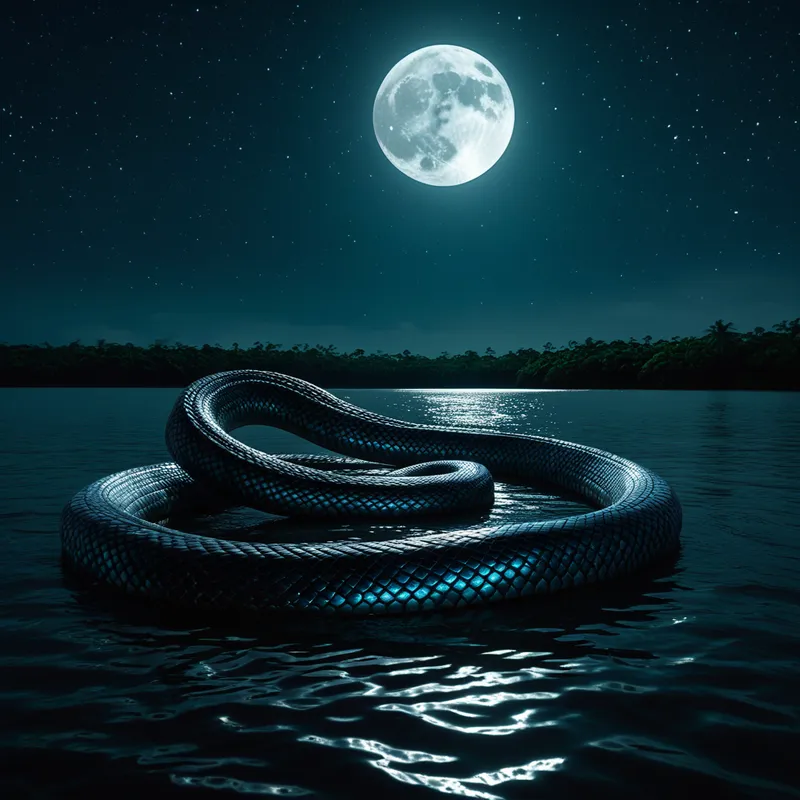
Listen. The river does not sleep. In the deep, black channels where the moonlight cannot reach, in the silent pools beneath the hanging roots of the samaúma, something ancient stirs. Its name is whispered only at dusk, when the world holds its breath between day and night: Boiuna. The Mother of Waters. The Black Serpent.
She is the river itself given form—a creature of scales dark as polished obsidian, longer than the longest canoe-path, with eyes that hold the cold phosphorescence of drowned stars. She does not hunt as the jaguar hunts; she becomes. She is the sudden whirlpool where the water was calm, the log that is not a log, the deepening shadow in a familiar channel that swallows light and sound. To see her is to know the river’s true, indifferent soul.
There was a man, a skilled fisherman who knew every eddy and sandbank. He prided himself on his courage, fishing the deepest pools where others dared not go. One evening, as the sky bled into violet, he paddled to the heart of the river, to a place of profound stillness. The water was like black glass. Casting his net, he felt a tug of impossible weight. He pulled, muscles straining against the abyss. The water did not churn; it opened. From the perfect mirror-surface, an eye emerged, vast and luminous, fixing him in a gaze older than the forest.
The river erupted. Not with froth and spray, but with a silent, yawning vortex. His canoe was not capsized; it was drawn down, swallowed into the serpent’s throat as if into a cave. Down he plunged, into a darkness that was not empty but thick, warm, and alive. He felt the pressure of the deep, the slide of immense muscle around him. This was not a belly of digestion, but a womb of transformation. Time dissolved. He saw visions in the dark: the birth of rivers, the fall of great trees, the endless cycle of decay becoming life.
When consciousness returned, he was not in water, but in a cavern glittering with crystals deep within the earth, lit by a soft, internal glow. The Boiuna was there, not as a monster, but as a presence—a coiled mountain of shadow and light. A voice, not heard but felt in the marrow of his bones, spoke: “You sought the depths. Now you know them. You carry my sight.”
The man found himself on the riverbank at dawn, his canoe beside him, whole and dry. But he was changed. His eyes held the same dark, knowing luminescence. He could see the spirits in the trees, hear the whispers of the water, understand the language of animals. He had become a pajé, a bridge between the world of the village and the primordial world of the Boiuna. He had been swallowed by the shadow and returned, not as prey, but as an initiate of the deep.

Cultural Origins & Context
The myth of the Boiuna is woven into the very fabric of life for numerous Indigenous peoples of the Amazon Basin, including the Tupi-Guarani and other cultural groups. It is not a singular, fixed story but a living narrative constellation, passed down orally through generations by elders and shamans. Its primary function is pedagogical and ecological. The Boiuna personifies the river’s immense, ambivalent power—the source of life, food, and transportation, yet also of sudden death, drowning, and unseen dangers.
Telling the story serves as a vital warning, especially to the young, about respecting the limits of human knowledge and venturing into unknown waters. It encodes a profound environmental ethic: the river is not a resource to be dominated, but a conscious, sovereign entity to be approached with caution, ritual, and respect. Furthermore, the myth is deeply tied to shamanic initiation. The journey of being swallowed and reborn with new sight mirrors the transformative, often terrifying, psychic journeys undertaken by apprentices to become pajés. The Boiuna is the ultimate master of these hidden, psychic waters.
Symbolic Architecture
The Boiuna is the quintessential [symbol](/symbols/symbol “Symbol: A symbol can represent an idea, concept, or belief, serving as a powerful tool for communication and understanding.”/) of the unconscious in its raw, primordial state. It is not the personal unconscious of repressed memories, but the collective, transpersonal, and instinctual [depths](/symbols/depths “Symbol: Represents the subconscious, hidden emotions, or foundational aspects of the self, often linked to primal fears or profound truths.”/)—what Jung termed the psychoid [realm](/symbols/realm “Symbol: The symbol of ‘Realm’ often signifies the boundaries of one’s consciousness, experiences, or emotional states, suggesting aspects of reality that are either explored or ignored.”/) where psyche and matter are one.
The serpent does not dwell in the forest; it is the forest of the soul. It is the dark, flowing intelligence of nature itself, within and without.
The [River](/symbols/river “Symbol: A river often symbolizes the flow of emotions, the passage of time, and life’s journey, reflecting transitions and movement in one’s life.”/) is the myth’s central [landscape](/symbols/landscape “Symbol: Landscapes in dreams are powerful symbols representing the dreamer’s emotional state, personal journey, and the broader context of life situations.”/), representing the flow of [life](/symbols/life “Symbol: The symbol of ‘Life’ represents a journey of growth, interconnectedness, and existential meaning, encompassing both the joys and challenges that define human experience.”/), time, and [consciousness](/symbols/consciousness “Symbol: Consciousness represents the state of awareness and perception, encompassing thoughts, feelings, and experiences.”/). The Boiuna is the [river](/symbols/river “Symbol: A river often symbolizes the flow of emotions, the passage of time, and life’s journey, reflecting transitions and movement in one’s life.”/)’s [depth](/symbols/depth “Symbol: Represents profound layers of consciousness, hidden truths, or the unknown aspects of existence, often symbolizing introspection and existential exploration.”/) and hidden current. The act of Fishing symbolizes the ego’s attempt to extract sustenance or [knowledge](/symbols/knowledge “Symbol: Knowledge symbolizes learning, understanding, and wisdom, embodying the acquisition of information and enlightenment.”/) from the unconscious. The [fisherman](/symbols/fisherman “Symbol: Represents exploration of emotional depths and the pursuit of desires, often reflecting patience and skill.”/)’s pride is his conscious [attitude](/symbols/attitude “Symbol: Attitude symbolizes one’s mental state, perception, and posture towards life, influencing emotions and actions significantly.”/), which is inevitably overwhelmed when he hooks something far greater than he intended. The [Whirlpool](/symbols/whirlpool “Symbol: The whirlpool symbolizes turmoil and the chaotic aspects of one’s life, signaling ongoing struggles and the need for resolution.”/) is the vortex of a psychic complex, a spontaneous [eruption](/symbols/eruption “Symbol: A sudden, violent release of pent-up energy or emotion from beneath the surface, often representing transformation or crisis.”/) of the unconscious that engulfs the conscious mind.
The Cave of [rebirth](/symbols/rebirth “Symbol: A profound transformation where old aspects of self or life die, making way for new beginnings, growth, and renewal.”/) is the temenos, the sacred protective [space](/symbols/space “Symbol: Dreaming of ‘Space’ often symbolizes the vastness of potential, personal freedom, or feelings of isolation and exploration in one’s life.”/) within the terrifying encounter. It signifies that being swallowed by a content of the unconscious (a depression, a rage, a profound [grief](/symbols/grief “Symbol: A profound emotional response to loss, often manifesting as deep sorrow, yearning, and a sense of emptiness.”/)) is not merely destruction; it can be the beginning of a necessary [incubation](/symbols/incubation “Symbol: A period of internal development, rest, or hidden growth before emergence, often associated with healing, creativity, or transformation.”/). The transformation of the man into a pajé represents the [birth](/symbols/birth “Symbol: Birth symbolizes new beginnings, transformation, and the potential for growth and development.”/) of the ego-Self [axis](/symbols/axis “Symbol: A central line or principle around which things revolve, representing stability, orientation, and the fundamental structure of reality or consciousness.”/)—the conscious [personality](/symbols/personality “Symbol: Personality in dreams often symbolizes the traits and characteristics of the dreamer, reflecting how they perceive themselves and how they believe they are perceived by others.”/) now in [dialogue](/symbols/dialogue “Symbol: Conversation or exchange between characters, representing communication, relationships, and narrative flow in games and leisure activities.”/) with, and guided by, the deep Self.
The Dreamer’s Resonance
When the pattern of the Boiuna surfaces in modern dreams, it signals a profound encounter with the shadow or the deep Self. This is not a trivial nightmare.
To dream of a serpent in deep, dark water often accompanies life transitions where old structures of identity are dissolving: the end of a career, a seismic shift in a relationship, a spiritual crisis, or the onset of a deep depression. The somatic feeling is one of being pulled under, of suffocating pressure, or of eerie, paralyzing stillness. Psychologically, this is the ego’s experience of being “swallowed” by a psychic content too large to integrate through ordinary means.
The dreamer may feel they are in the belly of the beast, a state of limbo and incubation. This corresponds to a necessary period of withdrawal, introspection, and “falling apart.” The crucial question the dream poses is: Can you endure the darkness without fleeing? Can you allow the dissolution? The resolution—the return with “new sight”—may not appear in the initial dreams. It is the promise held in the pattern itself: if one can consciously endure the descent, a recalibration of the personality, a new kind of perception or wisdom, becomes possible.

Alchemical Translation
The myth of the Boiuna is a perfect map for the alchemical nigredo, the blackening, the descent into the prime matter of the soul. The modern individuation process requires this descent. We cannot cherry-pick only the light, heroic aspects of ourselves. We must, like the fisherman, voluntarily (or be forced to) journey to the deepest, darkest pool of our own nature.
Individuation is not an ascent to a sunlit peak, but a dive into the black river of the soul, to retrieve the pearl of consciousness from the serpent’s keep.
The first step is the Encounter. This is when a complex—a knot of emotion, memory, and instinct—hooks us and pulls us into a psychological whirlpool (a bout of irrational anger, a paralyzing shame, a consuming grief). The ego’s task is not to fight the pull, but to consciously submit to the process of being taken down. This is the act of “making the unconscious conscious” by allowing it to overwhelm us in a contained, symbolic space (therapy, active imagination, art).
The second step is the Incubation in the cave. This is the often-isolating period of working through the material. It feels like being in limbo, disoriented, and stripped of old identities. Here, the ego must learn to “see in the dark,” to listen for the voice of the Self (Boiuna) in the midst of chaos.
The final step is Return and Integration. The fisherman does not kill the serpent; he is transformed by it. The goal is not to slay our darkness but to be altered by our relationship with it. The “new sight” is the function of the transcendent—the ability to hold the tension of opposites (light/dark, conscious/unconscious, life/death) and perceive the deeper, unifying pattern. One becomes a “pajé” to one’s own life, capable of navigating both the village of daily reality and the mystical depths of the inner river with respect and wisdom.
Associated Symbols
Explore related symbols from the CaleaDream lexicon:
- Serpent — The primordial form of the Boiuna, representing the instinctual, chthonic wisdom of the unconscious, the cycle of death and rebirth, and the transformative power of the deep psyche.
- Water — The medium of the Boiuna’s domain, symbolizing the flow of the unconscious, emotion, intuition, and the source of all potential life and dissolution.
- River — The specific, flowing manifestation of Water in this myth, representing the journey of life, the passage of time, and the ever-present, powerful current of the unconscious beneath surface consciousness.
- Cave — The womb-like space of incubation within the Boiuna, symbolizing the protective, transformative darkness where the old self is dissolved and the new vision is forged.
- Shadow — The psychological aspect embodied by the Boiuna: the repressed, feared, and unknown parts of the self that must be encountered for wholeness.
- Journey — The fisherman’s fateful trip into the deep pool, mapping the essential psychic journey of descent, ordeal, and return that defines the process of individuation.
- Rebirth — The core promise of the myth: that being swallowed by the depths is not an end, but a necessary prelude to emerging with a new, more integrated consciousness.
- Transformation — The alchemical process enacted by the Boiuna, where the base metal of the naive ego is transmuted into the gold of the awakened seer (pajé).
- Fear — The primary emotion evoked by the Boiuna, representing the instinctual terror of ego-dissolution, which must be faced and moved through to access deeper power.
- Vision — The gift bestowed by the Boiuna, symbolizing the new perceptual capacity—the “sight”—that comes from integrating unconscious contents and seeing the world with symbolic eyes.