The Great Khan's Golden Whip Myth Meaning & Symbolism
A myth where a lost golden whip, symbol of divine right and order, must be retrieved from the underworld to restore balance to the steppe.
The Tale of The Great Khan’s Golden Whip
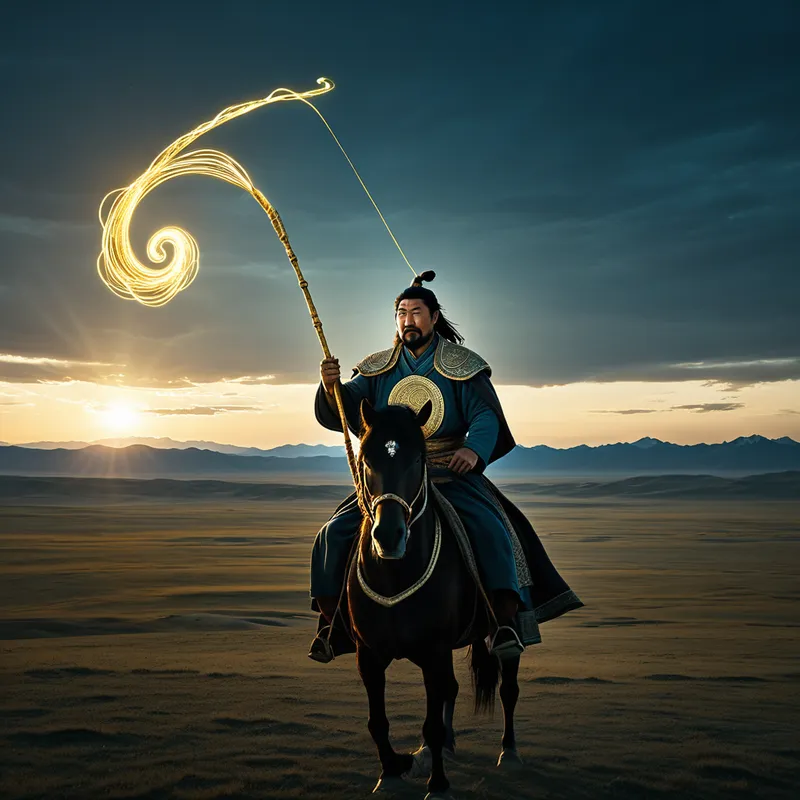
Listen. The wind does not just blow across the steppe; it carries the whispers of the ancestors and the thunder of ten thousand hooves. In the time when the sky was a closer dome of deepest blue and the earth breathed with the spirits of mountain and river, there ruled a Great Khan. His authority was not merely of men, but of Tengri himself. The symbol of this sacred covenant was his Golden Whip.
It was no mere tool of command. Forged in the heart of a fallen star and blessed by the shamans, it crackled with the energy of the storm. With a flick, it could guide the herds to fresh pasture; with a crack, it could summon the loyalty of the fiercest warrior. It was the axis around which the world of the people turned—the visible sign of the invisible order that held chaos at bay. The Khan carried it always, a sliver of the sun’s discipline against his thigh.
But order is a fragile vessel on the ocean of chaos. One evening, as the Khan prayed at an ovoo atop a windswept pass, a shadow deeper than night detached itself from the rocks. It was no beast of flesh, but a spirit of lack, of envy—a chotgor born from the forgotten grievances of the earth. With a shriek that froze the blood, it did not attack the Khan, but snatched the Golden Whip from his belt and vanished into a crack in the ground, a maw that had not been there moments before.
The silence that followed was deafening. The next dawn, the sun rose pale. The herds milled in confusion, their instincts scattered. Arguments broke out among the clans, old rivalries surfacing like bones from thawing ground. The steppe itself seemed to lose its rhythm. The Khan, though his heart was a drum of dread, showed no fear. He knew the law of the world: what is taken from the world above must be sought in the world below. Donning a simple deel and taking only a skin of airag and his father’s dagger, he approached the crack in the earth. The smell of damp stone and ancient cold wafted upward. Without a backward glance, he descended into the Lus Savdag.
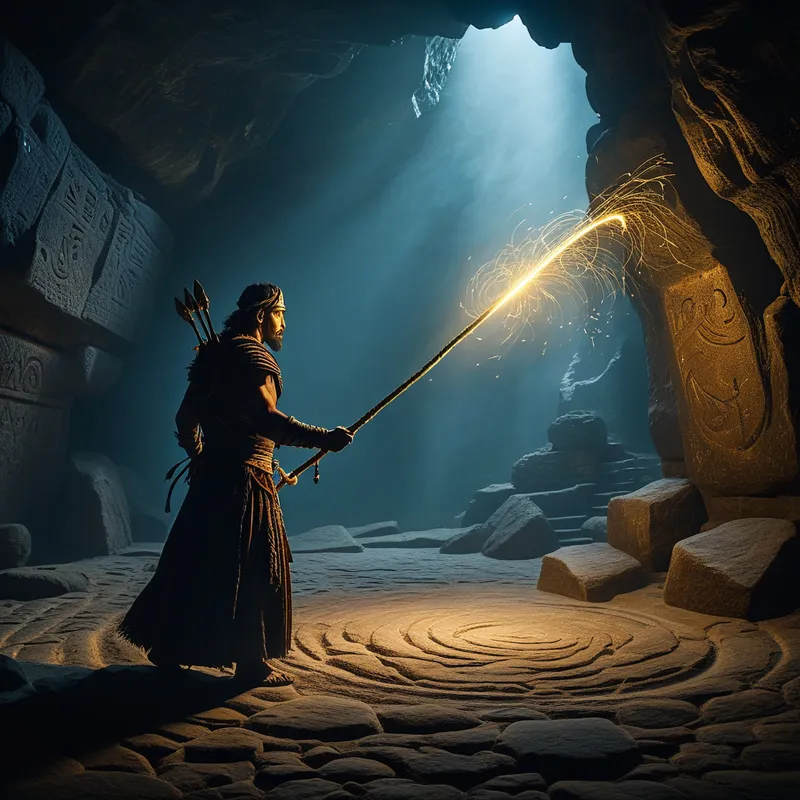
His journey was a subtraction of light and life. He navigated caverns where glowing fungi were the only stars, crossed subterranean rivers that flowed with whispers. He faced illusions—phantoms of fallen enemies, tempting visions of eternal peace—but he held the image of his people’s disordered camp in his mind, a knot he alone could untie. Finally, in a cavern lit by the cold luminescence of a thousand sülde trapped in crystal, he found it. The chotgor coiled around the Whip, which lay on a rough stone altar, its gold dulled but unbroken.
The spirit hissed, offering him power without responsibility, dominion without sacrifice. The Khan did not speak. Instead, he drew his father’s dagger and, in a move that was neither attack nor defense, cut his own palm. He let his blood, the blood of the line blessed by Tengri, drip onto the cavern floor. “I do not come to take,” he said, his voice echoing. “I come to reclaim what upholds the balance. My blood for the people’s order.” The chotgor, a creature born from taking, could not comprehend this willing sacrifice. With a wail of dissolution, it unraveled into mist.
The Khan took the Whip. As his fingers closed around the handle, warmth flooded back into it, and then into him. Light, golden and fierce, erupted from its length, illuminating the cavern, causing the captive sülde in the crystals to pulse in recognition. His return to the surface was not a climb, but a rising. He emerged as the sun broke the horizon, the Golden Whip held high. Its crack was not one of punishment, but of reunion—a sound that snapped the world back into its rightful alignment. The herds lifted their heads. The people felt the tension leave their shoulders. Order, tested and redeemed, was restored.
Cultural Origins & Context
This myth exists in the oral tradition of the Mongolian peoples, a cornerstone of the rich tapestry of stories that surround the figure of the Great Khan. It is less a historical account of a specific ruler like Chinggis Khan and more a mythic amplification of the very principle of sacred kingship within the Tengriist worldview. It would have been told by shamans (böö) and storytellers around campfires, especially during times of political uncertainty, succession disputes, or ecological stress.
Its societal function was multifaceted. Primarily, it served as a foundational narrative for the concept of Tengri’s Mandate. The Khan’s authority was legitimized not by brute force alone, but by his possession of this divine tool and, more importantly, by his willingness to journey into the underworld to reclaim it for his people. The myth taught that true leadership is a sacrificial service to the cosmic and social order. Furthermore, it reinforced the shamanic understanding of reality, where the upper, middle, and lower worlds are interconnected, and balance between them must be actively maintained by those with the courage and purity of purpose to traverse the boundaries.
Symbolic Architecture
At its [heart](/symbols/heart “Symbol: The heart symbolizes love, emotion, and the core of one’s existence, representing deep connections with others and self.”/), the myth is a profound [drama](/symbols/drama “Symbol: Drama signifies narratives, emotional expression, and the exploration of human experiences.”/) of the Ruler [archetype](/symbols/archetype “Symbol: A universal, primordial pattern or prototype in the collective unconscious that shapes human experience, behavior, and creative expression.”/) in [crisis](/symbols/crisis “Symbol: A crisis symbolizes turmoil, urgent challenges, and the need for immediate resolution or change.”/) and its necessary evolution. The Golden Whip is not a [symbol](/symbols/symbol “Symbol: A symbol can represent an idea, concept, or belief, serving as a powerful tool for communication and understanding.”/) of tyranny, but of conscious, [life](/symbols/life “Symbol: The symbol of ‘Life’ represents a journey of growth, interconnectedness, and existential meaning, encompassing both the joys and challenges that define human experience.”/)-directing will. It represents the individuated ego’s [capacity](/symbols/capacity “Symbol: A measure of one’s potential, limits, or ability to contain, process, or achieve something, often reflecting self-assessment or external demands.”/) to impose meaningful order on the [chaos](/symbols/chaos “Symbol: In Arts & Music, chaos represents raw creative potential, uncontrolled expression, and the breakdown of order to forge new artistic forms.”/) of internal drives and external circumstances—the [ability](/symbols/ability “Symbol: In dreams, ‘ability’ often denotes a recognition of skills or potential that one possesses, whether acknowledged or suppressed.”/) to “whip” one’s own potential into coherent [action](/symbols/action “Symbol: Action in dreams represents the drive for agency, motivation, and the ability to take control of situations in waking life.”/).
The artifact of power is lost not to an enemy, but to the shadow of the role itself—the envy, neglect, or inflation that inevitably haunts the seat of authority.
The chotgor represents this [shadow](/symbols/shadow “Symbol: The ‘shadow’ embodies the unconscious, repressed aspects of the self and often represents fears or hidden emotions.”/): the autonomous complex of [resentment](/symbols/resentment “Symbol: A deep-seated emotional bitterness from perceived unfairness or injury, often festering silently and poisoning relationships.”/), entitlement, and chaos that arises when power is taken for granted or exercised without [connection](/symbols/connection “Symbol: Connection symbolizes relationships, communication, and bonds among individuals.”/) to its sacred [source](/symbols/source “Symbol: The origin point of something, often representing beginnings, nourishment, or the fundamental cause behind phenomena.”/). Its theft plunges the psychic “[kingdom](/symbols/kingdom “Symbol: A kingdom symbolizes authority, belonging, and a sense of identity within a larger context or community.”/)” into disorder—a state of internal conflict, procrastination, and [loss](/symbols/loss “Symbol: Loss often symbolizes change, grief, and transformation in dreams, representing the emotional or psychological detachment from something or someone significant.”/) of [direction](/symbols/direction “Symbol: Direction in dreams often relates to life choices, guidance, and the path one is following, emphasizing the importance of navigation in personal journeys.”/). The Khan’s descent is the ultimate act of responsible rulership: the ego must voluntarily confront the disowned aspects of the psyche (the [underworld](/symbols/underworld “Symbol: A symbolic journey into the unconscious, representing exploration of hidden aspects of self, transformation, or confronting repressed material.”/)) to retrieve its authentic [authority](/symbols/authority “Symbol: A symbol representing power structures, rules, and control, often reflecting one’s relationship with societal or personal governance.”/).
The sacrifice of [blood](/symbols/blood “Symbol: Blood often symbolizes life force, vitality, and deep emotional connections, but it can also evoke themes of sacrifice, trauma, and mortality.”/) is the critical alchemical [moment](/symbols/moment “Symbol: The symbol of a ‘moment’ embodies the significance of transient experiences that encapsulate emotional depth or pivotal transformations in life.”/). It signifies the move from taking power to earning it through [vulnerability](/symbols/vulnerability “Symbol: A state of emotional or physical exposure, often involving risk of harm, that reveals authentic self beneath protective layers.”/) and a pledge of life-[energy](/symbols/energy “Symbol: Energy symbolizes vitality, motivation, and the drive that fuels actions and ambitions.”/) (libido) to a [purpose](/symbols/purpose “Symbol: Purpose signifies direction, meaning, and intention in life, often reflecting personal ambitions and core values.”/) greater than the self. The ruler archetype is redeemed not by conquest, but by a sacred exchange with the [depths](/symbols/depths “Symbol: Represents the subconscious, hidden emotions, or foundational aspects of the self, often linked to primal fears or profound truths.”/).
The Dreamer’s Resonance
When this mythic pattern stirs in the modern dreamer, it often manifests as dreams of lost objects of great personal significance—a stolen heirloom, a mislaid key to a vital door, a broken tool central to one’s identity. The somatic experience is one of acute anxiety, a feeling of being “unmoored” or having one’s foundational authority undermined. One may dream of a crumbling office, a mutinous committee within one’s own mind, or a vehicle (modern analogue to the horse/herd) that will not respond to command.
Psychologically, this indicates a crisis in the dreamer’s executive function—their inner “Khan.” This could be triggered by a failure at work, a challenge to one’s authority in a relationship, or a deep-seated feeling of fraudulence. The dream is pointing to a theft of self-efficacy. The “chotgor” may be a projected critic, an internalized voice of shame, or a burst of repressed chaos (rage, desire) that has disarmed the conscious mind. The dreamer is being called to their own underworld journey: to stop trying to reassert control on the surface and instead descend into the feelings of inadequacy, fear, or anger to find where their true, authentic power has been hidden.
Alchemical Translation
The myth models the process of psychic transmutation—the journey of individuation—with stark clarity. The initial state is a conscious identification with the Ruler (the ego in control). The theft of the Whip is the inevitable enantiodromia, where this identification breaks down, plunging the psyche into its opposite: chaos and impotence (Lus Savdag).
Individuation demands not the building of a taller throne, but the courageous excavation of the ground upon which it stands.
The descent is the confrontation with the Shadow. The illusions faced are the persona’s defenses and the seductions of inflation (“power without responsibility”). The retrieval of the Whip is not a simple grabbing back of old power dynamics. It is impossible until the sacrifice is made—the conscious offering of one’s own vitality (blood) to the process. This is the integration of the shadow, where the libido bound up in maintaining a false front is redeemed and reinvested.
The returned Whip is the symbol of the transformed ruler archetype. It is no longer an external badge of authority but an integrated function of the Self. The order it restores is not rigid control, but a dynamic, resilient balance that includes the wisdom of the depths. For the modern individual, this translates to the hard-won ability to lead one’s own life from a place of authentic, vulnerable authority, where will is in service to wholeness, not domination.
Associated Symbols
Explore related symbols from the CaleaDream lexicon:
- Golden Whip — The central artifact, symbolizing divine mandate, conscious will, and the authority to direct life-energy and impose meaningful order upon chaos.
- Journey — Represents the necessary descent into the unconscious (the underworld) to reclaim lost or fragmented aspects of the self, a non-negotiable pilgrimage for wholeness.
- Shadow — Embodied by the chotgor, it is the repressed chaos, envy, and neglected darkness that steals power when the conscious attitude becomes one-sided or inflated.
- Sacrifice — The Khan’s offering of his blood signifies the crucial exchange: surrendering a part of the self (old ego attachments) to redeem a greater power (authentic authority).
- Order — The state of balance and harmony in the psyche and the world that the Whip upholds, representing the integrated Self’s governance after the underworld ordeal.
- Hero — The Khan in his aspect as the one who ventures into the unknown territory of the psyche to retrieve a boon for his people (the integrated self).
- Cave — The entrance to and landscape of the underworld, representing the deep, unconscious layers of the psyche where shadow material resides.
- Earth — The realm of the underworld and the grounding element, symbolizing the instinctual, chthonic reality that must be confronted and integrated.
- Light — The illuminating power of the redeemed Whip and of consciousness regained, which restores clarity and direction after the journey through darkness.
- Ruler — The core archetype enacted in the myth, representing the psyche’s capacity for structure, responsibility, and sovereign self-governance.