
The Gordian Knot from Greek my Myth Meaning & Symbolism
A legendary knot, an impossible challenge, and a king who solved it not by untying it, but by cutting it with a single, decisive stroke.
The Tale of The Gordian Knot from Greek my
The dust of Phrygia is ancient and remembers everything. It remembers [the ox-cart](/myths/the-ox-cart “Myth from Chinese culture.”/) of a poor farmer, its wooden wheels groaning as it crested a hill. It remembers the sudden silence of the birds, and [the way](/myths/the-way “Myth from Taoist culture.”/) the man, Gordias, stood dumbstruck as an eagle, the messenger of Zeus, descended from the burning sun to perch upon the yoke of his humble cart. This was no accident; it was an omen written in lightning across the mundane sky. The people, seeing the divine favor upon this stranger, hailed him as their king. In gratitude, Gordias dedicated his cart—the very vehicle of his destiny—to the gods. He bound it to a sacred plinth in the citadel of the new capital, Gordium, with a knot.
But this was no ordinary knot. It was a confabulation of cornel bark, woven and twisted by the king’s own hands or perhaps by the cunning of the gods themselves. Its ends were hidden, its weave so cunningly complex that it seemed less a fastening and more a living puzzle, a physical riddle growing harder with each passing year. The air around it grew thick with prophecy. A voice, perhaps from the oracle of Delphi, whispered a promise into the winds of Asia Minor: He who undoes the knot of Gordias shall rule all of Asia.
For generations, it sat. Kings, princes, and wise men made pilgrimages to its side. They would kneel, their fingers tracing the gnarled, sun-warmed bark, seeking a beginning, an end, a loose thread. They would puzzle for hours, days, their brows furrowed, their minds tangled in [the labyrinth](/myths/the-labyrinth “Myth from Greek culture.”/) of its making. The knot became a taunt, a symbol of the insolubility of fate itself. It gathered not just dust, but the weight of human ambition and frustration.
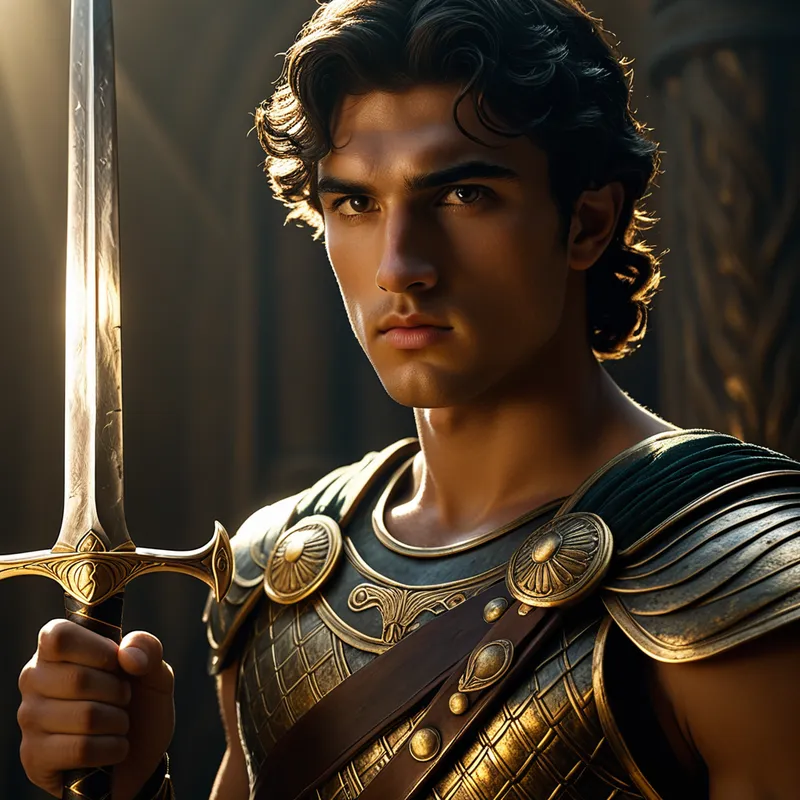
Then came the sound of an army. The rhythmic tread of the Macedonian phalanx shook the ground of Gordium. And with them came a young king, barely more than a boy in years but an age in ambition: Alexander. He was shown the cart, the plinth, the legendary tangle. He listened to the prophecy. A crowd gathered, breath held—the learned men of his court, the skeptical generals, the hopeful locals. They watched as he approached. He did not kneel. He did not probe with delicate fingers. He stood before the physical manifestation of an age-old dilemma and saw not a puzzle to be solved, but a barrier to be removed.
A moment of silence, heavier than the centuries that preceded it. Then, the rasp of steel. In one fluid, decisive motion, he drew his sword and brought it down. The crack of sundering wood echoed through the citadel. The knot, severed at its heart, fell away in two parts. The cart was free. The prophecy, in a blast of shocking clarity, was fulfilled. He had undone the knot. Not by the rules of the game, but by changing the game itself. That night, the skies roared with thunder, a sign from Zeus—approval for the one who dared to cut the thread of convention.
Cultural Origins & Context
The myth originates from the historical and cultural crossroads of ancient Anatolia (modern Turkey). It is a Greek story about a Phrygian artifact, reflecting the Hellenic world’s fascination with the exotic East and its own ideological absorption of foreign legends. Our primary sources are later Greek and Roman historians, like Arrian and Plutarch, who recorded it centuries after the alleged event involving Alexander the Great in 333 BCE.
The tale functioned on multiple levels. For the Phrygians, it may have been an aetiological myth explaining a strange religious artifact. For the Greeks, and later for Alexander’s propagandists, it was a powerful piece of political theater. It transformed Alexander from a foreign invader into a figure of destiny, one recognized and validated by an ancient, local oracle. The story was passed down not just as history, but as a paradigm of genius and decisive leadership, a tool to legitimize power and inspire awe at the audacity of a world-conqueror.
Symbolic Architecture
At its core, the Gordian [Knot](/symbols/knot “Symbol: A knot symbolizes connections, commitments, complications, and the binding or untying of relationships and situations.”/) is the archetypal “impossible [problem](/symbols/problem “Symbol: Dreams featuring a ‘problem’ often symbolize internal conflicts or challenging situations that require resolution and self-reflection.”/).” It represents the complex, intractable dilemmas that [life](/symbols/life “Symbol: The symbol of ‘Life’ represents a journey of growth, interconnectedness, and existential meaning, encompassing both the joys and challenges that define human experience.”/) presents—situations where every thread of [logic](/symbols/logic “Symbol: The principle of reasoning and rational thought, often representing order, structure, and intellectual clarity in dreams.”/), [obligation](/symbols/obligation “Symbol: A perceived duty or responsibility imposed by social norms, relationships, or internalized expectations, often involving a sense of being bound to act.”/), tradition, and fear is so interwoven that no conventional [solution](/symbols/solution “Symbol: A solution symbolizes resolution, clarity, and the overcoming of obstacles, often representing a sense of accomplishment.”/) seems possible. The [knot](/symbols/knot “Symbol: A knot symbolizes connections, commitments, complications, and the binding or untying of relationships and situations.”/) is the bureaucratic deadlock, the lifelong grudge, the psychological complex, the creative block.
The knot is not the problem; it is the altar upon which our old ways of thinking are sacrificed.
Alexander represents the eruptive force of the [hero](/symbols/hero “Symbol: A hero embodies strength, courage, and the ability to overcome significant challenges.”/) [archetype](/symbols/archetype “Symbol: A universal, primordial pattern or prototype in the collective unconscious that shapes human experience, behavior, and creative expression.”/), but not in its purely brute-[strength](/symbols/strength “Symbol: ‘Strength’ symbolizes resilience, courage, and the ability to overcome challenges.”/) form. His [action](/symbols/action “Symbol: Action in dreams represents the drive for agency, motivation, and the ability to take control of situations in waking life.”/) symbolizes lateral thinking or [paradigm](/symbols/paradigm “Symbol: A fundamental model or framework in arts and music that shapes creative expression, perception, and cultural understanding.”/) shift. He redefines the terms of engagement. The sword is not violence per se, but the [instrument](/symbols/instrument “Symbol: An instrument symbolizes creativity, communication, and the means by which one expresses oneself or influences the world.”/) of decisive [clarity](/symbols/clarity “Symbol: A state of mental transparency and sharp focus, often representing resolution of confusion or attainment of insight.”/), of cutting through complexity to the essential [truth](/symbols/truth “Symbol: Truth represents authenticity, honesty, and the quest for knowledge beyond mere appearances.”/). It is the flash of [insight](/symbols/insight “Symbol: A sudden, deep understanding of a complex situation or truth, often arriving unexpectedly and illuminating hidden connections.”/) that bypasses years of [rumination](/symbols/rumination “Symbol: Repetitive, cyclical thinking patterns that often focus on problems, past events, or anxieties without reaching resolution.”/). Psychologically, Alexander embodies [the ego](/myths/the-ego “Myth from Jungian culture.”/)’s [capacity](/symbols/capacity “Symbol: A measure of one’s potential, limits, or ability to contain, process, or achieve something, often reflecting self-assessment or external demands.”/) for audacious [action](/symbols/action “Symbol: Action in dreams represents the drive for agency, motivation, and the ability to take control of situations in waking life.”/) when confronted with the stifling, tangled [authority](/symbols/authority “Symbol: A symbol representing power structures, rules, and control, often reflecting one’s relationship with societal or personal governance.”/) of the super-ego (the “rules” of the knot) or the bewildering complexity of the unconscious.
The Dreamer’s Resonance
To dream of a [Gordian Knot](/myths/gordian-knot “Myth from Greek culture.”/) is to feel the somatic weight of entanglement. The dreamer may be physically bound, or find themselves in a room filled with endless, knotted cords they are compelled to untie. There is often a profound sense of frustration, of time running out, of being tested and found wanting. The knot in a dream is a direct manifestation of a psychic impasse—a relationship at a stalemate, a career path with no visible exit, an internal conflict between heart and duty.
The psychological process here is one of confrontation with a complex that has “knotted” itself around a core issue. The dream presents the problem in its raw, tangled form. The presence or absence of a “sword” in the dream is critical. Its absence indicates the dreamer feels powerless, trapped in the problem’s logic. Its appearance, even if not used, signals the nascent emergence of the psychic force needed for resolution—a potential for decisive insight or action that is gathering in the unconscious.

Alchemical Translation
The alchemical journey mirrored in this myth is the transition from [Nigredo](/myths/nigredo “Myth from Alchemical culture.”/) (the blackening, the state of confusion and entanglement) directly to Albedo (clarity and enlightenment), often bypassing the lengthy, analytical processes in between. For the modern individual pursuing individuation, [the Gordian Knot](/myths/the-gordian-knot “Myth from Greek culture.”/) myth models a crucial, often terrifying, stage: the necessity of the creative violation.
We spend years trying to “untie” our knots—analyzing our past, negotiating with our flaws, trying to satisfy every internal and external demand. The alchemical translation of Alexander’s stroke is the realization that some knots are not meant to be untied; they are meant to be cut. This is the act of setting a radical boundary, making an irrevocable choice, quitting the soul-killing job, ending the toxic dynamic, or shattering a limiting self-belief. It is not an act of anger, but of supreme, focused will.
The cut does not destroy the problem’s history; it severs its power to constrain the future.
This is psychic transmutation. The sword’s stroke is the application of conscious will (the ego) aligned with a deeper, intuitive truth ([the Self](/myths/the-self “Myth from Jungian culture.”/)). It sacrifices the safety of the known, tangled state for the freedom of an unknown solution. The thunder of Zeus that follows is the psychic confirmation—the deep, often disorienting sense of rightness that comes when we finally act in accordance with our own sovereignty, cutting through the inherited and self-made complexities to claim our destined path.
Associated Symbols
Explore related symbols from the CaleaDream lexicon: