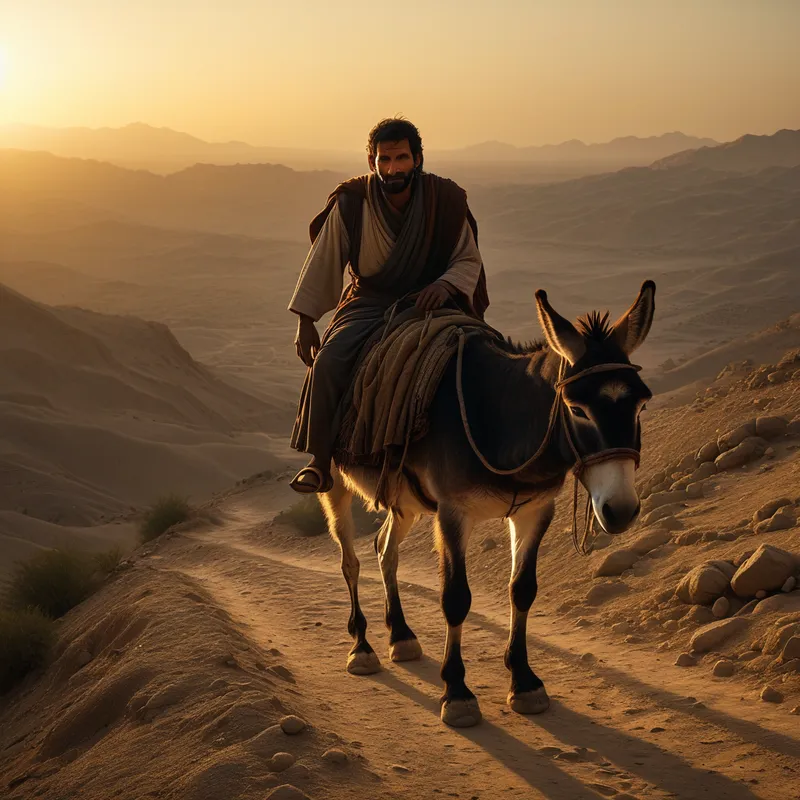
The Good Samaritan Myth Meaning & Symbolism
A parable of radical compassion, where a despised outsider becomes the hero by tending to a broken stranger on a dangerous road.
The Tale of The Good Samaritan
The road from [Jerusalem](/myths/jerusalem “Myth from Biblical culture.”/) down to [Jericho](/myths/jericho “Myth from Biblical culture.”/) is a descent into the throat of [the world](/myths/the-world “Myth from Tarot culture.”/). It is a sun-bleached scar on the face of [the earth](/myths/the-earth “Myth from Hindu culture.”/), a winding track through barren hills where the rocks themselves seem to hold their breath. The air shimmers with heat and menace. This is no mere path; it is a gauntlet, a place where civilization’s thin veneer cracks and the wildness of men and beasts bleeds through.
On this day, a traveler walked this road. He was a man of means and faith, a son of Judah, his purpose his own. But the road had eyes. From the jagged outcrops, shadows detached themselves—not spirits, but men whose humanity had been scoured away by want and violence. They fell upon him with the cruelty of those who have forgotten their own faces. Fists and stones became the language of the encounter. They stripped him of his cloak, his coins, his dignity, and left him broken in the dust, a mere vessel of pain, half-dead and bleeding into the thirsty ground.
Time passed, measured only by the crawl of the sun. The first sound to break the silence was the careful, rhythmic tread of a priest, descending from the holy city, his robes bright against the dun earth. He saw the form in the ditch. A ripple of distress crossed his face, a calculation of ritual purity, of danger, of inconvenient duty. He adjusted his garments and passed by on the other side, his eyes fixed on [the horizon](/myths/the-horizon “Myth from Various culture.”/).
Later came a Levite, a man of [the temple](/myths/the-temple “Myth from Jewish culture.”/) service. He approached closer, perhaps drawn by a pang of kinship. He looked upon the wreckage of a fellow man. He saw the blood, the flies, the profound need. And he, too, found the weight of involvement too great. He quickened his step and moved on, the image searing itself behind his eyes.
Then came a different sound. The plodding of a donkey, the soft footfall of a man not in a hurry. He was a Samaritan. To the wounded man’s people, his very identity was a blasphemy, his worship corrupted, his bloodline impure. He was the “other,” the heretic, the perpetual stranger.
He saw the ditch. He saw the man. And he was moved with compassion—a visceral, gut-deep stirring. He did not cross to the other side. He crossed into the ditch. Kneeling in the filth, he did not see a Jew or an enemy. He saw a human being shattered. From his own journey’s provisions, he poured oil and wine onto the wounds, the sting of the wine a brutal kindness, the oil a promise of healing. He tore his own cloth for bandages. He lifted the dead weight of [the stranger](/myths/the-stranger “Myth from Biblical culture.”/) onto his own beast, walking while the injured rode. He brought him to an inn, a haven of smoke and low voices, and through the night, he himself played the servant, keeping watch.
At dawn, he took out two silver coins—a substantial sum. He gave them to the innkeeper. “Take care of him,” he said, his voice quiet but firm. “And whatever more you spend, I will repay you when I return.” He made the stranger’s recovery his own debt. Then, the Samaritan went on his way, leaving behind a mystery of mercy in a world ruled by boundaries.

Cultural Origins & Context
This story is not a myth of gods and monsters, but a parable—a subversive and revolutionary form of teaching attributed to [Jesus of Nazareth](/myths/jesus-of-nazareth “Myth from Christian culture.”/). It is recorded in the Gospel of Luke, Chapter 10. Its context is critical: it is [Jesus](/myths/jesus “Myth from Christian culture.”/)’s response to a legal scholar’s question, “Who is my neighbor?” The scholar sought a limit to the commandment to “love your neighbor,” a definition he could manage.
The parable was a grenade tossed into the careful social and religious order of 1st-century Judea. The tension between Jews and Samaritans was ancient, ethnic, and theological, a story of schism and mutual hatred. Priests and Levites were not villains; they were pillars of religious society, bound by laws that could deem them unclean for touching a corpse or blood, potentially disqualifying them from temple service. Their passing by was, in a twisted way, logical.
By making the hero a Samaritan, Jesus utterly redefined “neighbor.” It was no longer a geographic or tribal category but a moral and existential one. The parable functioned as societal shadow-work, forcing his audience to confront their own projected evil onto the “other” and to recognize that divine law, when stripped to its essence, was not about ritual compliance but about the raw, risky act of compassion that obliterates categories.
Symbolic Architecture
The myth’s power lies in its stark, almost brutal [symbolism](/symbols/symbolism “Symbol: The use of symbols to represent ideas or qualities, often conveying deeper meanings beyond literal interpretation. In dreams, it’s the language of the unconscious.”/). Every element is an archetypal marker on a map of the [human](/symbols/human “Symbol: The symbol of a human represents individuality, complexity of emotions, and social relationships.”/) [psyche](/myths/psyche “Myth from Greek culture.”/).
The Road to Jericho is the [journey](/symbols/journey “Symbol: A journey in dreams typically signifies adventure, growth, or a significant life transition.”/) of [life](/symbols/life “Symbol: The symbol of ‘Life’ represents a journey of growth, interconnectedness, and existential meaning, encompassing both the joys and challenges that define human experience.”/) itself, fraught with perils both external and internal. The Thieves represent the sudden, traumatic incursions of [fate](/symbols/fate “Symbol: Fate represents the belief in predetermined outcomes, suggesting that some aspects of life are beyond human control.”/), cruelty, and misfortune that can leave any of us spiritually and psychologically “half-dead” by the roadside.
The [Priest](/symbols/priest “Symbol: A priest symbolizes spirituality, guidance, and the quest for understanding the deeper meanings of life.”/) and the Levite symbolize the conscious ego’s structures of order, [identity](/symbols/identity “Symbol: Identity represents the sense of self, encompassing personal beliefs, cultural background, and social roles.”/), and purity. They are not evil, but they are limited. They represent the part of us that, when confronted with the messy, bloody, demanding [reality](/symbols/reality “Symbol: Reality signifies the state of existence and perception, often reflecting one’s understanding of truth and life experiences.”/) of profound need (in others or in our own [shadow](/symbols/shadow “Symbol: The ‘shadow’ embodies the unconscious, repressed aspects of the self and often represents fears or hidden emotions.”/)), chooses self-preservation, ideological purity, or social standing over messy engagement.
The true neighbor is not the one who shares your blood or your creed, but the one who shares your moment of suffering.
The Samaritan is the ultimate [symbol](/symbols/symbol “Symbol: A symbol can represent an idea, concept, or belief, serving as a powerful tool for communication and understanding.”/) of the integrated shadow. He is the despised, rejected “other” who becomes the [savior](/symbols/savior “Symbol: A figure representing rescue, redemption, or deliverance from crisis, often embodying hope and external intervention in times of need.”/). Psychologically, he represents those rejected parts of ourselves—our [vulnerability](/symbols/vulnerability “Symbol: A state of emotional or physical exposure, often involving risk of harm, that reveals authentic self beneath protective layers.”/), our irrational [compassion](/symbols/compassion “Symbol: A deep feeling of empathy and concern for others’ suffering, often involving a desire to help or alleviate their pain.”/), our “impure” impulses—that hold the very [medicine](/symbols/medicine “Symbol: Medicine symbolizes healing, transformation, and the pursuit of knowledge, addressing both physical and spiritual health.”/) needed for healing. His Oil and [Wine](/symbols/wine “Symbol: Wine often symbolizes celebration, indulgence, and the deepening of personal connections, but it can also represent excess and escape.”/) are the balm of [empathy](/symbols/empathy “Symbol: The capacity to understand and share the feelings of others, often manifesting as emotional resonance or intuitive connection in dreams.”/) and the antiseptic sting of [truth](/symbols/truth “Symbol: Truth represents authenticity, honesty, and the quest for knowledge beyond mere appearances.”/). His Donkey is the humble, enduring [strength](/symbols/strength “Symbol: ‘Strength’ symbolizes resilience, courage, and the ability to overcome challenges.”/) of the [body](/symbols/body “Symbol: The body in dreams often symbolizes the dreamer’s self-identity, personal health, and the relationship they have with their physical existence.”/) and instinct that carries our wounded [spirit](/symbols/spirit “Symbol: Spirit symbolizes the essence of life, vitality, and the spiritual journey of the individual.”/). The Inn is a temporary sanctuary of the psyche, a [space](/symbols/space “Symbol: Dreaming of ‘Space’ often symbolizes the vastness of potential, personal freedom, or feelings of isolation and exploration in one’s life.”/) for convalescence provided by [community](/symbols/community “Symbol: Community in dreams symbolizes connection, support, and the need for belonging.”/) (the innkeeper) but funded by the ongoing commitment of the compassionate Self.

The Dreamer’s Resonance
When this myth surfaces in modern dreams, it signals a profound encounter with the archetype of the Caregiver in its most demanding form. To dream of being the wounded traveler is to experience a somatic cry of the psyche—a feeling of being betrayed, neglected, or attacked by life or by aspects of oneself (the passing figures). The body in the dream may feel heavy, paralyzed, or in pain, mirroring a psychological state of helplessness or burnout.
To dream of being the Priest or Levite who passes by is to confront one’s own avoidance. The dream ego witnesses suffering (perhaps of another dream figure representing a neglected talent, a relationship, or an inner child) and consciously chooses to turn away. This dream often brings a wave of shame or anxiety upon waking, a prompt to examine where one is prioritizing law over love, cleanliness over contact, safety over salvation.
To dream of being the [Good Samaritan](/myths/good-samaritan “Myth from Christian culture.”/) is a powerful indication of emerging psychic integration. It suggests the dreamer is accessing a deep, instinctual well of compassion that transcends old prejudices and self-concepts. The act of tending to a repulsive or “foreign” figure in the dream is the psyche healing itself by reclaiming its disowned parts. It is a dream of profound moral and emotional courage, often occurring during periods of significant inner growth or after a crisis has cracked open the heart.

Alchemical Translation
The parable of the Good Samaritan is a perfect map for the individuation process. It models the alchemical transmutation of leaden, tribal identity into the gold of universal humanity.
The process begins with the [nigredo](/myths/nigredo “Myth from Alchemical culture.”/), the blackening: the traveler is beaten and left in [the shadow](/myths/the-shadow “Myth from Jungian culture.”/) of death. This is the necessary dissolution of the old, rigid [persona](/myths/persona “Myth from Greek culture.”/)—the comfortable identities of tribe, status, or certainty. We must all be broken open on the road to some degree.
The albedo, the whitening, is the moment of seeing. It is the Samaritan’s “he was moved with compassion.” This is not an intellectual decision but a visceral, emotional response that arises from the unconscious. It is the silver light of [the moon](/myths/the-moon “Myth from Tarot culture.”/)—receptive, reflective, feeling—breaking through the solar consciousness of rules and roles.
The alchemy occurs not in the temple of purity, but in the filthy ditch of shared humanity.
The citrinitas, the yellowing, is the active work of healing: the pouring of oil and wine, the binding of wounds. This is the conscious ego, now in service to the deeper Self, applying its skills and resources to the task of integration. It is practical, embodied work.
Finally, the [rubedo](/myths/rubedo “Myth from Alchemical culture.”/), the reddening, is the promise of return: “I will repay you when I come back.” The Samaritan does not stay; he entrusts the ongoing care to another (the innkeeper/community) but assumes ultimate responsibility. This symbolizes the enduring commitment of the integrated Self. The process of compassion and integration is never a one-time act but a permanent orientation, a debt of care we willingly carry. The hero leaves, but the transformed relationship—between [the self](/myths/the-self “Myth from Jungian culture.”/) and the other, between [the ego](/myths/the-ego “Myth from Jungian culture.”/) and the shadow—remains, forever altering the inn of our being.
Associated Symbols
Explore related symbols from the CaleaDream lexicon: