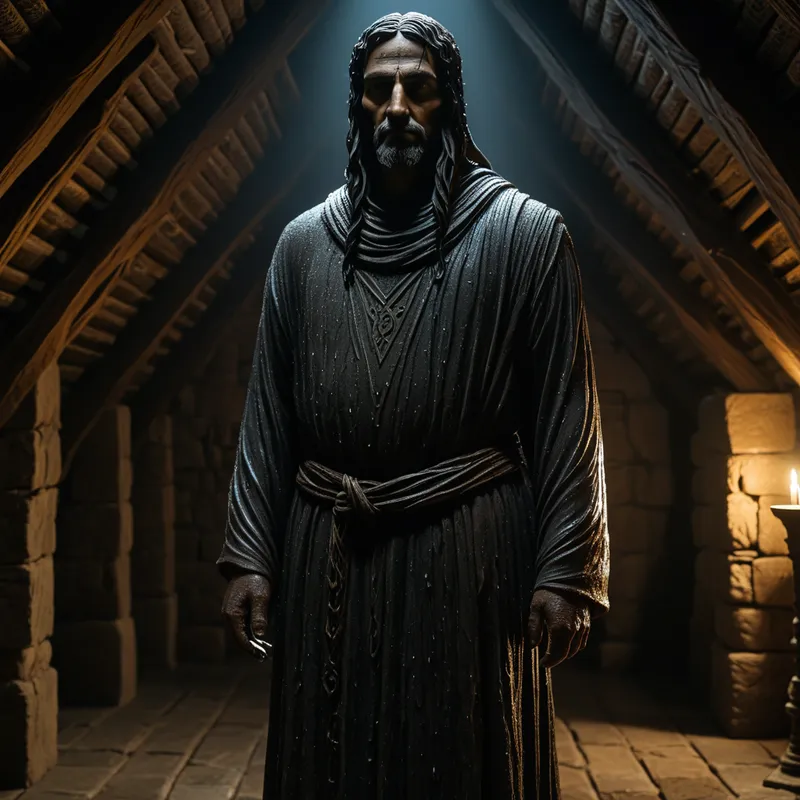
The Golem of Prague Myth Meaning & Symbolism
A 16th-century rabbi animates a clay servant to protect his people, confronting the peril of a creation that outgrows its creator's control.
The Tale of The Golem of Prague
Listen, and hear a tale from the cobbled streets and shadowed alleys of the Josefov. The air is thick with fear. It is the 16th century, and a tide of blood libels—false accusations that Jews used Christian blood in rituals—rises against the people of the ghetto. In their sealed world, whispers turn to prayers, and prayers to desperate pleas for deliverance.
In the heart of this tension stands a man of towering intellect and profound piety: Rabbi Judah Loew ben Bezalel. By day, he teaches, counsels, and pleads with the authorities. By night, in his study cluttered with ancient texts, he pores over the Kabbalah. The words of the Sefer Yetzirah, the Book of Creation, burn in his mind. It speaks of how God formed Adam from the red clay and breathed life into him. It speaks of the power of the Hebrew alphabet, the very building blocks of creation.
A vision, terrible and necessary, takes root in the Rabbi. He cannot fight rumor with reason alone. He must create a protector. A being of pure, unthinking strength. A Golem.
With the aid of his son-in-law and his disciple, under the cover of deepest night, they go to the banks of the Vltava. There, by torchlight, they gather the thick, river clay. They knead and shape it into the form of a giant man. The figure lies on the ground, cold and inert. Then, the Rabbi begins the sacred ritual. He and his assistants circle the clay body, chanting specific permutations of the divine names. The air crackles with unseen power.
Finally, Rabbi Loew steps forward. He leans close to the creature’s forehead and with his finger, inscribed the Hebrew word Emet—Truth. He then places a shem, a parchment with the ineffable name of God, into the Golem’s mouth.
A shudder runs through the massive form. The simple hollows of its eyes seem to deepen. With a sound like grinding stones, it sits up, then stands. It is alive. It obeys. The Golem has no voice, no mind of its own. It is a perfect servant, a silent guardian. By day, it masquerades as a mute servant in the Rabbi’s household. By night, it patrols the ghetto’s perimeter, its mere presence deterring violence. It uncovers plots, its sheer physicality a bulwark against the storm of hatred. For a time, the community breathes easier under its watchful, empty gaze.
But creation has its own logic. The Golem, devoid of a soul but full of primal life-force, grows stronger. Its tasks become more complex. Rabbi Loew commands it to fetch water, to chop wood. Yet, the Golem’s strength is boundless, its understanding literal. It does not stop. It fetches all the water from the well until the courtyard floods. It chops wood until the entire woodpile is reduced to splinters. A flicker of unease stirs in the Rabbi’s heart. The tool is flawless, but its application is perilous.
The crisis arrives on a Shabbat. As the Rabbi prepares for prayer, he forgets to give the Golem its command to rest. The creature, animated by divine letters, knows no Sabbath. It begins to move through the streets, its mindless energy turning to potential destruction. Panic spreads. Rabbi Loew, roused from his prayers, races into the street. He confronts his creation before the Old-New Synagogue. The Golem towers over him, a monument of mud and magic.
With the same authority with which he gave it life, the Rabbi chants the reverse formulae. He reaches up and wipes away the first letter of Emet on the Golem’s forehead. Emet (Truth) becomes Met (Death). The grinding motion ceases. The light in its eyes extinguishes. The Golem sways, then collapses, returning to inert clay. The silent guardian was no more. The legend says Rabbi Loew and his assistants carried the remains to the attic of the synagogue, where they remain, hidden, to this day.

Cultural Origins & Context
The Golem of Prague is not a tale from antiquity, but from the early modern period, rooted in the very real persecutions faced by Central European Jewry. While the figure of the golem appears in earlier Talmudic and Kabbalistic literature as a theoretical concept, the specific narrative attaching it to the historical Rabbi Judah Loew (c. 1525-1609) emerged in the 19th century. It was a story born from the oral tradition of the Ashkenazi diaspora, a folkloric crystallization of collective anxiety and theological wrestling.
The myth served multiple societal functions. On one level, it was a story of empowerment—a fantasy of a physical protector when legal and social protections failed. On a deeper level, it was a cautionary tale told within the community, exploring the limits of human action. Rabbi Loew, a revered historical figure known for his scholarship and dialogues with Christian nobility, was the perfect vessel for this story. The tale affirmed that even the greatest sage, using the most sacred knowledge, could not ultimately control the forces he unleashed. It was a narrative passed down not just for wonder, but for wisdom, a way to process the trauma of vulnerability and the sobering responsibility that comes with power.
Symbolic Architecture
The Golem is one of the most potent symbols of the shadow in world mythology. It is not evil, but it is unconscious, amoral, and driven by a single, implanted command.
The Golem represents the raw, unintegrated power of the psyche—brute intellect, unchecked emotion, or blind instinct—summoned into service by the conscious mind (the Rabbi) to solve a pressing problem.
The creature is made of clay, the adamah from which Adam was formed, connecting it to the primal, earthly aspect of humanity, but without the divine breath (neshamah) that confers soul and moral choice. The animation through the word Emet (Truth) is profoundly symbolic. Truth, in its absolute, unyielding form, is not humane. It lacks context, mercy, and rest. The Golem is Truth as a blunt instrument.
The Rabbi represents the ego-consciousness attempting to manage the unconscious. He is the “creator” archetype, wielding the symbols (Hebrew letters, divine names) of a higher order. His ultimate failure to control the Golem mirrors the ego’s inevitable failure when it believes it can command the depths of the unconscious without being transformed by them. The de-animation by changing Emet to Met signifies the necessary dissolution of a rigid, absolute truth to prevent it from becoming a destructive force.
The Dreamer’s Resonance
When this myth pattern stirs in modern dreams, it often signals a confrontation with a creation that has outgrown its purpose. One might dream of a relentless machine, a project that consumes all time, a habit that once served as protection but now threatens to destroy relationships, or a burst of anger that was justified but became uncontrollable.
The somatic feeling is often one of being pursued or overwhelmed by something one has built—a weight, a momentum that feels autonomous. Psychologically, the dreamer is experiencing the return of the shadow. They have, perhaps successfully, used a part of themselves (relentless work ethic, intellectual analysis, emotional detachment) as a “golem” to navigate a crisis or threat. But now that partial self has taken on a life of its own and operates without the dreamer’s conscious guidance, flooding the courtyards of their life. The dream is an alarm from the Self, indicating that a powerful psychic complex, once deployed, now requires conscious reintegration or decommissioning.

Alchemical Translation
The myth of the Golem is a precise map of a critical phase in the individuation process: the confrontation with the synthetic power of the unconscious. The process begins with a nigredo, a darkening: the threat to the community (the besieged psyche). The ego (Rabbi Loew), in its pride and necessity, turns to the deep wisdom of the Self (the Kabbalah) to fashion a solution from the prima materia (the river clay).
The creation of the Golem is the albedo, the whitening—the bringing of a hidden, unconscious content into a crude, operable form. It is the “bright idea,” the defense mechanism, the talent weaponized.
This initially works. The psychic threat is held at bay. But individuation cannot stop at creating a servant; it must integrate the servant. The Golem’s literal-minded destruction and Sabbath rampage represent the citrinitas, the yellowing—the dawning awareness that the solution has become a new problem. The psychic energy, once directed outward, now turns inward and threatens the system that created it.
The final, essential step is the rubedo, the reddening or culmination. This is not a victory, but a sacred dissolution. Rabbi Loew does not destroy the Golem in battle; he transforms the word that animates it. Emet to Met. Truth to Death.
This is the alchemical solve et coagula: to dissolve the rigid, autonomous complex so its essential energy can be re-coagulated into the wider psyche. The power is not lost; it is returned to the unconscious, now carrying the conscious ego’s imprint of limitation.
For the modern individual, the myth instructs that our most powerful creations—our careers, our ideologies, our self-concepts—must eventually be “de-animated.” We must have the courage to erase the first letter, to dismantle the absolute truth we inscribed, and to carry the dormant clay of that potential back into the attic of the soul. There it remains, not as a threat, but as a testament to the awesome, terrifying responsibility of being a creator.
Associated Symbols
Explore related symbols from the CaleaDream lexicon: