
The Golden Bough Myth Meaning & Symbolism
Aeneas must pluck a sacred golden bough to enter the underworld, guided by the Sibyl, on a quest to meet his father's shade.
The Tale of The Golden Bough
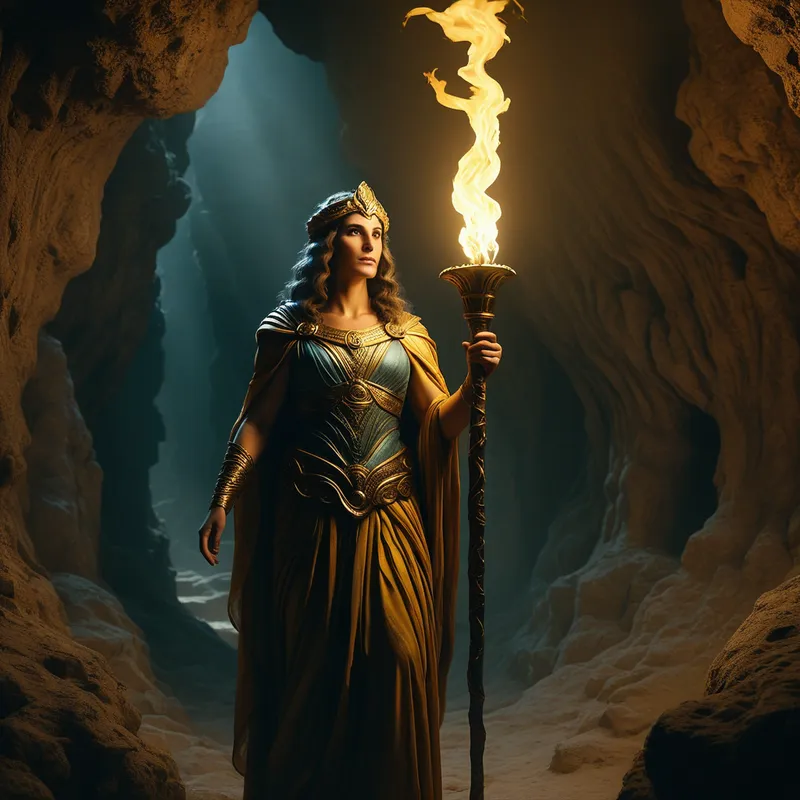
The air in the grove was thick, not with mist, but with a silence so profound it felt like a weight upon the soul. This was no ordinary wood. This was the sacred precinct of Proserpina, a place where the veil between the world of the living and the realm of the dead grew thin as a ghost’s whisper. Here, among the ancient, twisted oaks and cypresses that clawed at a starless sky, Aeneas stood, his heart a drum of dread and destiny.
He had been commanded by the shade of his father, Anchises, to seek him in the land of the dead. But the path to Dis was barred to living flesh. His guide, the Cumaean Sibyl, her voice rasping with centuries of prophecy, had given him the key: “First, you must find in this forest a bough, sacred to the Queen of the Underworld. Its stem and leaves are of pliant gold. It hides deep in the shaded thicket. Pluck it, and if the Fates call you, it will come willingly. If not, no strength of hand or blade of steel will avail you.”
Aeneas wandered, the oppressive gloom pressing in. He prayed to his mother, Venus, and as his plea faded, two doves—her sacred birds—appeared, fluttering ahead. With a surge of hope, he followed their guidance. They led him to a tree unlike any other. In the heart of the deepest shadow, it glimmered. A branch, not of wood, but of living, breathing gold, its leaves tinkling with a soft, metallic chime in a breeze that touched nothing else. It was a piece of the sun buried in the kingdom of night.
His hand trembled as he reached out. This was the test. Would the bough, this divine passport, yield to him? He grasped it, and with a sound like a sigh of release, it broke away freely. In his hand, it was both light and impossibly heavy, a symbol of a burden accepted and a privilege granted. Armed with this radiant key, he returned to the Sibyl at the mouth of a cavern that breathed forth a stench of rot and primordial cold—the entrance to Avernus. With the Golden Bough held before them like a talisman against the dark, hero and prophetess began their descent into the land from which no mortal is meant to return.
Cultural Origins & Context
This profound narrative is not originally Greek, but Roman, immortalized in Book VI of Virgil’s epic, the Aeneid, composed in the 1st century BCE. Virgil, a master poet of the Augustan age, wove older threads into his national epic. The motif of a magical bough granting access to the underworld likely draws from far older, possibly Italic or even broader Indo-European, shamanic and initiatory traditions. The figure of the Sibyl—an ecstatic, oracle-priestess—roots the story in the very real religious practices of the ancient Mediterranean, where seekers would journey to oracular sites like Cumae for guidance.
Virgil’s telling served a crucial societal function: it provided a mythic foundation for Rome’s divine destiny, linking its founder, Aeneas, directly to the heroic past and the underworld wisdom of his ancestors. The descent was not mere adventure; it was a necessary ordeal for the founding of a civilization. Passed down through the recitation of epic poetry and later through manuscripts, the story transcended its political purpose to become a universal archetype of the necessary descent, a theme that would echo through Dante’s Inferno and beyond.
Symbolic Architecture
The Golden Bough is the central, luminous paradox. It is a piece of the upper world—solar, precious, alive—that resides in and holds power over the chthonic realm. It represents the conscious, willed intention that must be present to navigate the unconscious. It is not taken by force, but received by fate; it symbolizes a sacred contract between the seeker and the depths.
The key to the underworld is not found in darkness, but is a fragment of light that has taken root within it.
Aeneas’s quest is the katabasis, a fundamental heroic pattern. He does not descend for treasure or glory, but for gnosis—knowledge, specifically the knowledge of his lineage and fate from his father’s shade. The Sibyl represents the mediating function, the guide who knows the rituals and the risks, the voice of prophetic wisdom that can interpret the signs of the unconscious but cannot undergo the transformation for the hero.
The willing yielding of the bough signifies a crucial psychological truth: the unconscious does not yield its secrets to brute force, but only to the one who is called, who approaches with a necessary and destined purpose. The bough is both the permission and the burden of that purpose.
The Dreamer’s Resonance
When this myth stirs in the modern psyche, it often manifests in dreams of necessary but frightening journeys. One may dream of finding a key of strange, luminous material in a basement, of being led by an animal or an unknown guide through a tunnel or down a staircase that seems to have no end, or of receiving a crucial, glowing object in a place of decay or shadow.
Somatically, this can accompany periods of profound depression, grief, or life transition—a feeling of being pulled “downward.” Psychologically, this is the process of confronting the personal shadow and the ancestral layers of the psyche. The dreamer is undergoing the initial phase of the katabasis: the recognition that to move forward in life, one must first go back and down, into forgotten pains, inherited patterns, and unresolved griefs. The golden object in the dream is the nascent, fragile sense of meaning or purpose that makes this terrifying descent endurable and necessary.
Alchemical Translation
The myth of the Golden Bough is a precise map for the alchemical process of individuation. The first stage, nigredo (the blackening), is represented by the dark grove and the descent into Avernus—a confrontation with the primal, chaotic material of the psyche. The Golden Bough itself is the symbol of the albedo (the whitening), the first dawning of illuminating consciousness within that darkness, the “star in the darkness” that guides the work.
The psyche’s gold is forged not in the sunlight of easy living, but in the nocturnal crucible of the underworld journey.
Aeneas’s goal is not to conquer the underworld, but to commune with the anima figure of the Sibyl and the wise old man archetype of Anchises. This represents the integration of deep intuitive wisdom (the feminine Sibyl) and ancestral, structural knowledge of the Self (the masculine Anchises). He does not stay; he returns. This is the final stage, the rubedo (the reddening), or return with the boon. The psychic transmutation is complete when the insights from the depths are brought back to the surface world of daily life, transforming the individual’s conscious orientation. The hero who has held the Golden Bough is no longer the same; he has internalized its light, becoming a vessel for the hard-won wisdom that can found a new world within.
Associated Symbols
Explore related symbols from the CaleaDream lexicon: