The Gauntlet Myth Meaning & Symbolism
A sacred challenge where a knight must endure a ritual blow to prove his worth, testing the union of strength, virtue, and divine right.
The Tale of The Gauntlet
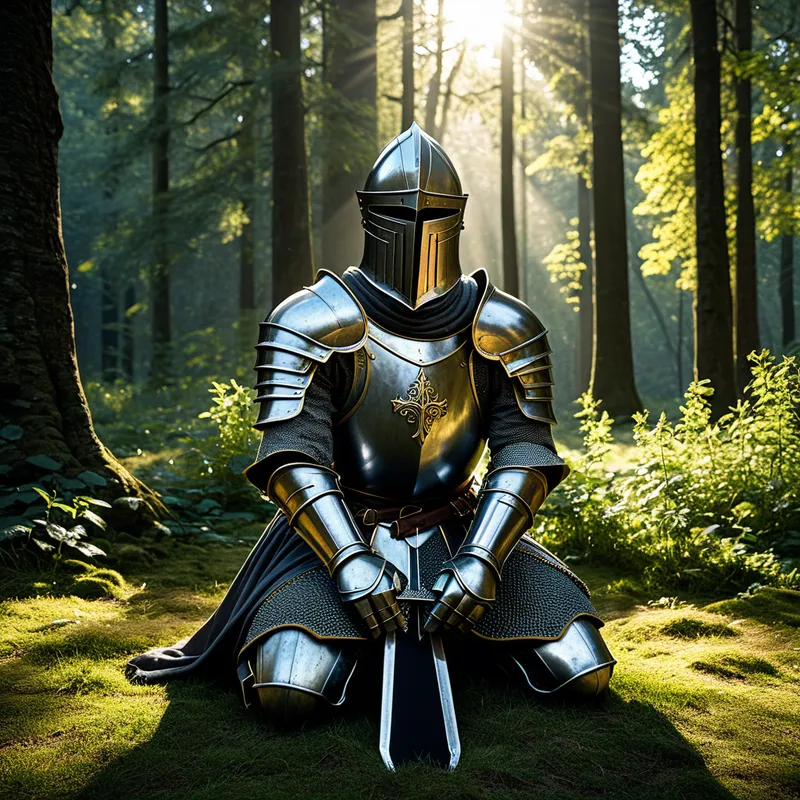
Listen, and hear the tale not of a quest, but of a moment. A moment that hangs in the air like the pause between the raising of the sword and its fall. It begins not on a battlefield, but in the hallowed quiet of a forest glade, where the light falls in pillars through ancient oaks, and the air smells of damp earth and cold stone.
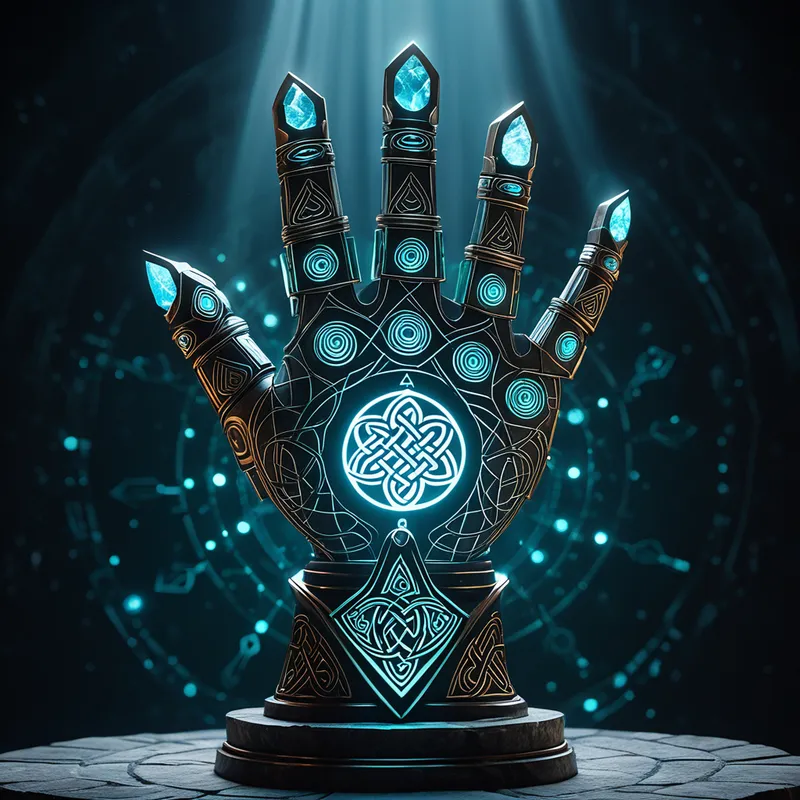
Here stands a knight. Not yet a legend, but a man of sinew and sorrow, of ambition and unspoken doubt. His name is lost to us, for in this moment, he is every knight. Before him, upon a moss-grown altar of a forgotten people, rests a single object: a gauntlet. It is not part of a pair. It is a sovereign [thing](/myths/thing “Myth from Norse culture.”/), forged of steel that drinks the light and gives back a colder gleam. Its surface is chased with patterns older than the [Round Table](/myths/round-table “Myth from Arthurian culture.”/)—interlacing beasts and spirals that speak of an endless, watchful cycle.
He has been led here by dream, by rumour, by the quiet insistence of his own spirit. [The law](/myths/the-law “Myth from Biblical culture.”/) of this place is simple, whispered by [the wind](/myths/the-wind “Myth from Various culture.”/) in the leaves: to claim the right, you must endure the rite. To prove yourself worthy of the authority you seek—be it over a land, a people, or the unruly kingdom of your own soul—you must offer your body to the judgment of the unseen.
He kneels. [The dew](/myths/the-dew “Myth from Alchemical culture.”/) soaks through the wool of his hose. He removes his own glove, letting the chill air kiss his palm. Then, with a breath that steadies the hammering of his heart, he reaches out and takes the Gauntlet. It is heavier than any metal has a right to be. As his fingers close around the cold steel, the glade changes. The birds fall silent. The very light seems to thicken.
From the shadows between the trees, a figure emerges. It is not a man, though it has the shape of one. It is the spirit of the challenge, the Keeper of [the Threshold](/myths/the-threshold “Myth from Folklore culture.”/). In its hands is a sword, not for cutting, but for striking—a great, blunt thing the colour of a storm cloud. No words are exchanged. The knight knows. He turns his left shoulder to the figure, presenting the Gauntlet that now encases his fist. He braces, not with the rigidity of fear, but with the resilient tension of a bowstring.
The Keeper raises the sword. Time stretches. The knight hears the blood in his ears, feels the grain of the leather strap beneath his chin. He does not close his eyes.
The blow falls.
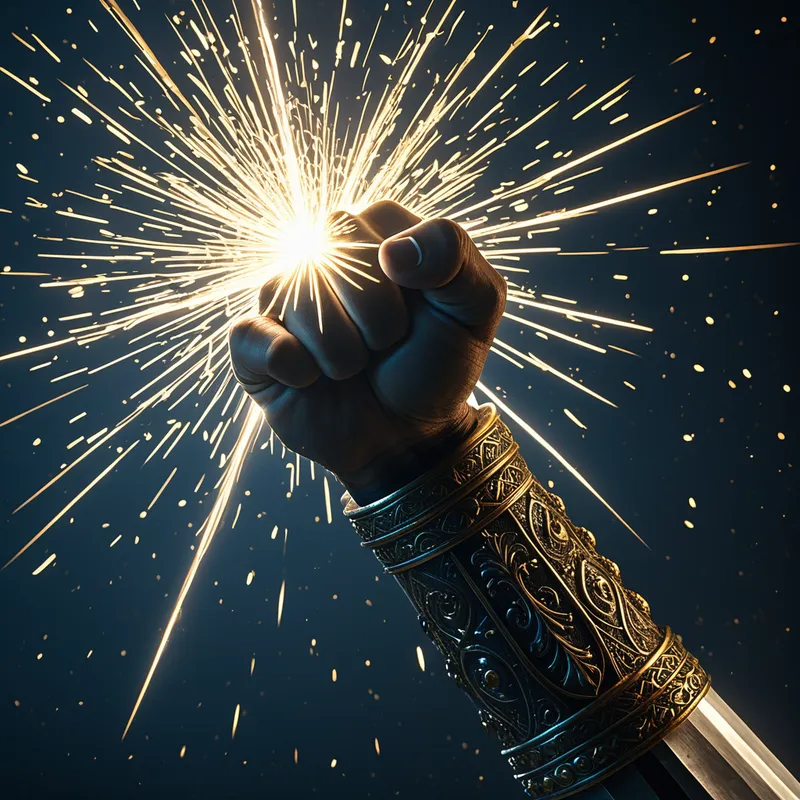
It is not a sound of clashing metal, but a deep, resonant gong, as if the altar itself were a bell. Light, white and searing, erupts from the point of impact. The shock travels through the Gauntlet, up the knight’s arm, and into the very core of him. It is not merely pain; it is a revelation. It is the weight of every crown, the loneliness of every command, the cost of every oath made in good faith. It is the blow that separates the boy seeking glory from the man who must bear responsibility.
He does not break. He does not cry out. The light fades. The Keeper lowers the sword, gives a slow, deep nod that is both acknowledgment and dismissal, and melts back into the forest.
The knight rises. The Gauntlet is now his. It is no longer cold, but holds the warmth of his own endured life. And he knows, with a certainty deeper than victory, what he is now worthy of. He walks from the glade, not as a knight who has passed a test, but as a sovereign who has met his kingdom.
Cultural Origins & Context
The motif of the Gauntlet, as a ritual of ordeal and investiture, weaves through the later tapestry of Arthurian romance, often found in the sprawling, lesser-known tales that orbit the core legends of the [Grail](/myths/grail “Myth from Christian culture.”/) and [the sword in the stone](/myths/the-sword-in-the-stone “Myth from Global/Universal culture.”/). It is a myth of the periphery, told not in the roaring hall of Camelot but in the hermetic verses of monastic scribes and the travelling stories of bards who spoke of the older, wilder magic that existed before Arthur’s table unified the land.
Its societal function was multifaceted. For a culture obsessed with codes of chivalry and legitimate sovereignty, it provided a mythic template for the transition from martial prowess to true authority. Anyone could swing a sword, but to stand and receive the blow—to willingly accept the full consequence of power—was the mark of a ruler. It was a story told to young knights to illustrate that kingship was a burden as much as a privilege, and to common folk, it mythologized the idea that their leaders were, in theory, tempered by a sacred and painful covenant.
The myth served as a narrative anchor for real-world rituals of vassalage and homage, where symbolic blows or the handling of arms were part of swearing fealty. It translated a legal and social contract into the language of the soul, suggesting that true loyalty and right to rule were forged in a crucible that tested the spirit’s mettle as surely as a smith tests steel.
Symbolic Architecture
At its [heart](/symbols/heart “Symbol: The heart symbolizes love, emotion, and the core of one’s existence, representing deep connections with others and self.”/), the [Gauntlet](/symbols/gauntlet “Symbol: A protective glove or armored covering for the hand, historically used in combat and jousting. Symbolizes challenge, protection, and readiness for confrontation.”/) is not a test of [strength](/symbols/strength “Symbol: ‘Strength’ symbolizes resilience, courage, and the ability to overcome challenges.”/), but a test of containment. The [knight](/symbols/knight “Symbol: The knight symbolizes honor, chivalry, and the pursuit of noble causes, reflecting the ideal of the noble warrior.”/) does not attack; he receives. The symbolic [architecture](/symbols/architecture “Symbol: Architecture in dreams often signifies structure, stability, and the framing of personal identity or life’s journey.”/) here is profound.
The solitary Gauntlet represents sovereign, individual [authority](/symbols/authority “Symbol: A symbol representing power structures, rules, and control, often reflecting one’s relationship with societal or personal governance.”/). It is incomplete, yearning for the hand that can fill it and bear its [weight](/symbols/weight “Symbol: Weight symbolizes burdens, responsibilities, and emotional loads one carries in life.”/). To take it up is to consciously accept a specific [destiny](/symbols/destiny “Symbol: A predetermined course of events or ultimate purpose, often linked to spiritual forces or cosmic order, representing life’s inherent direction.”/) or burden—to say “yes” to a calling that will demand everything.
The ordeal is the alchemical vessel where the base metal of ambition is transmuted into the gold of authentic sovereignty.
The [ritual](/symbols/ritual “Symbol: Rituals signify structured, meaningful actions carried out regularly, reflecting cultural beliefs and emotional needs.”/) blow is the central [symbol](/symbols/symbol “Symbol: A symbol can represent an idea, concept, or belief, serving as a powerful tool for communication and understanding.”/). It is the necessary [trauma](/symbols/trauma “Symbol: A deeply distressing or disturbing experience that overwhelms the psyche, often manifesting in dreams as unresolved emotional wounds or psychological injury.”/) of incarnation, the shock of [reality](/symbols/reality “Symbol: Reality signifies the state of existence and perception, often reflecting one’s understanding of truth and life experiences.”/) that meets every ideal. Psychologically, it represents the confrontation with the [Shadow](/symbols/shadow “Symbol: The ‘shadow’ embodies the unconscious, repressed aspects of the self and often represents fears or hidden emotions.”/)—all that one fears, denies, or considers too heavy to bear. The knight does not fight his shadow in the form of a dark knight; he allows it to strike him, integrating its power rather than projecting it onto an [enemy](/symbols/enemy “Symbol: An enemy in dreams often symbolizes an internal conflict, self-doubt, or an aspect of oneself that one struggles to accept.”/). The light that erupts is the [illumination](/symbols/illumination “Symbol: A sudden clarity or revelation, often representing spiritual awakening, intellectual breakthrough, or the dispelling of ignorance.”/) born of this [integration](/symbols/integration “Symbol: The process of unifying disparate parts of the self or experience into a cohesive whole, often representing psychological wholeness or resolution of internal conflict.”/), the sudden, painful [clarity](/symbols/clarity “Symbol: A state of mental transparency and sharp focus, often representing resolution of confusion or attainment of insight.”/) of self-[knowledge](/symbols/knowledge “Symbol: Knowledge symbolizes learning, understanding, and wisdom, embodying the acquisition of information and enlightenment.”/).
The Keeper of the Threshold is the personified function of [the Self](/myths/the-self “Myth from Jungian culture.”/), the archetypal totality of the [psyche](/myths/psyche “Myth from Greek culture.”/) that administers the necessary trials for growth. It is impersonal, divine law made manifest. The knight’s silent endurance signifies [the ego](/myths/the-ego “Myth from Jungian culture.”/)’s submission to a higher, transpersonal order, moving from a state of “I want” to a state of “I am willing to serve.”
The Dreamer’s Resonance
When this myth stirs in the modern unconscious, it rarely appears as a medieval tableau. More often, the dreamer finds themselves in a stark, institutional space—a blank room, an empty stage, a doctor’s office. The “Gauntlet” may be a job title on a desk, a wedding ring on a pillow, or simply a dense, heavy object they are compelled to pick up.
The “blow” is the ensuing wave of somatic and emotional reality: a crushing sense of responsibility, a surge of anxiety about failure, or a profound feeling of exposure. The dream is an enactment of the psyche’s preparation for a major life initiation—a promotion, a commitment, a creative unveiling, or the daunting task of integrating a powerful new aspect of identity.
The somatic process is key. The dreamer often wakes with a tightness in the chest or shoulder, the body remembering the impact that the spirit has rehearsed. This is the psyche’s way of stress-testing [the vessel](/myths/the-vessel “Myth from Alchemical culture.”/) of the self, asking: “Can you contain the energy of this new role? Can you withstand the pressures and judgments that will come with stepping into your power?” The dream is not a warning, but a forging. It indicates the individual is on the threshold of claiming an authority they have, until now, perhaps felt unworthy to hold.
Alchemical Translation
The alchemical journey of the Gauntlet is a perfect model for the Jungian process of individuation—the becoming of one’s true, whole self. It maps the transition from the [nigredo](/myths/nigredo “Myth from Alchemical culture.”/), the blackening, to the albedo, the whitening.
First, the call (taking the Gauntlet): The individual feels the pull toward a greater, more integrated state of being. This is often accompanied by a sense of fate or destiny, a feeling that one must step up, even if the path is unclear.
Second, the crucible (the blow): This is the nigredo. The chosen path leads not to immediate glory, but to a confrontation with one’s own limitations, fears, and the painful weight of consciousness. It is the dissolution of the old, naive self. In therapy or self-work, this is the phase of shadow work, of facing repressed trauma, insecurity, and the arrogant or cowardly parts of the ego.
The knight does not win the Gauntlet; he becomes it. The vessel and its contents become one.
Third, the illumination (the erupting light): The albedo. By enduring the blow without shattering—by consciously holding the tension of the opposites (strength/vulnerability, ambition/service, power/cost)—a new awareness is born. This is the insight, the cleansing realization that one’s authority comes not from dominating others, but from having mastered the relationship to one’s own inner law.
Finally, the return (leaving the glade): The integrated individual returns to [the world](/myths/the-world “Myth from Tarot culture.”/), transformed. The Gauntlet is no longer an external artifact but an internal condition. They wield their power with the humility of one who knows its price and the steadiness of one who has been tempered in the fire of their own ordeal. They have moved from seeking a crown to embodying the sovereignty of the Self.
Associated Symbols
Explore related symbols from the CaleaDream lexicon: