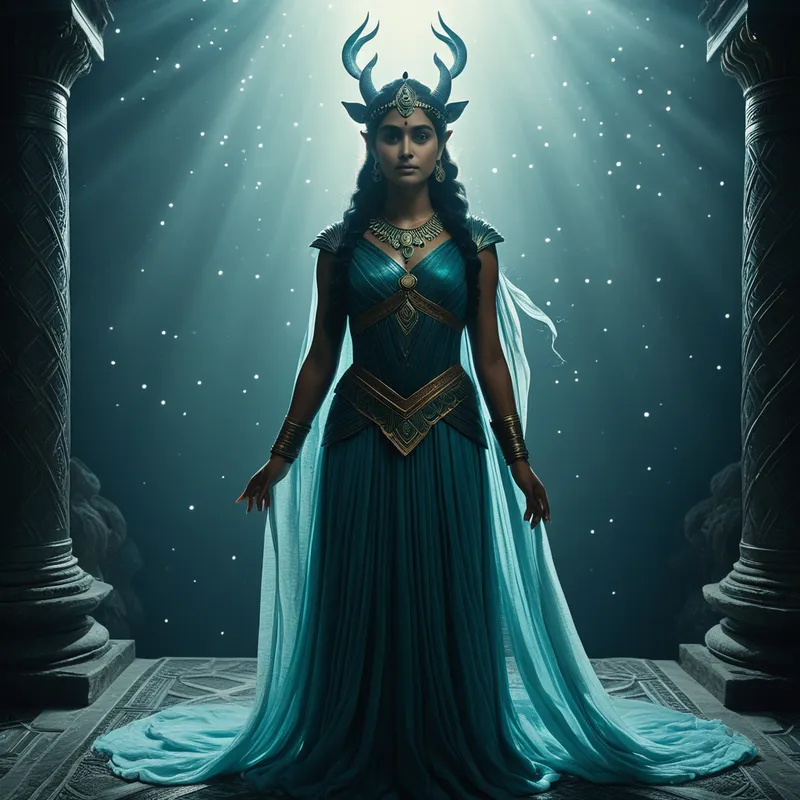
The Fountain of Zamzam
A miraculous spring in Mecca, revealed to Hagar and Ishmael, that became a sacred source of water and spiritual significance in Islamic tradition.
The Tale of The Fountain of Zamzam
[The desert](/myths/the-desert “Myth from Biblical culture.”/) was a crucible of light and silence. [Hagar](/myths/hagar “Myth from Biblical culture.”/), alone with her infant son Ishmael, wandered through the barren valley of Bakkah, a place that would one day be known as Mecca. Her husband, the prophet [Abraham](/myths/abraham “Myth from Abrahamic culture.”/), had left them there at God’s command, with only a skin of [water](/myths/water “Myth from Chinese culture.”/) and a pouch of dates. When the last drop was gone, the vast, unyielding horizon closed in. Ishmael’s cries grew weak, his tiny body parched by the sun’s relentless gaze. In her desperation, [Hagar](/myths/hagar “Myth from Biblical culture.”/) began to run. She ascended the rocky outcrop of Safa, scanning the emptiness for a caravan, a mirage, anything. Seeing nothing, she descended into the valley and climbed the neighboring hill of Marwa. Again, nothing. Seven times she ran between the two hills, her heart a drumbeat of primal fear and unyielding hope, her feet scoring a path of maternal anguish into [the earth](/myths/the-earth “Myth from Hindu culture.”/).
As Ishmael lay whimpering, his heel scraped against the dry sand. Then, a miracle. Where his foot touched the ground, water began to well up—not a trickle, but a spring, clear and cool, bubbling forth with a force that seemed to come from the very heart of [the world](/myths/the-world “Myth from Tarot culture.”/). Hagar rushed to contain it, crying out “Zamzam! Zamzam!”—meaning “Stop! Stop!”—as she cupped her hands to form a basin around the precious flow. The spring did not stop, but it heeded her, becoming a steady, life-giving fountain. In that moment, the silence of the desert was broken by the sound of survival, and a wilderness was transformed into a sanctuary.
Cultural Origins & Context
The [Zamzam well](/myths/zamzam-well “Myth from Arabian culture.”/) is not merely a historical site but the living, beating heart of Islamic sacred geography. Its story is integrally woven into the narratives of the Qur’an and the Hadith, establishing the spiritual lineage of Mecca. The spring’s revelation to Hagar and Ishmael is the foundational act that made human settlement in the valley possible, directly prefiguring Abraham’s later construction of the [Kaaba](/myths/kaaba “Myth from Abrahamic culture.”/) at God’s command. Thus, Zamzam is the prerequisite for Islam’s holiest site.
Its water is considered mu’tabar (honored and respected) and barakah (imbued with divine blessing). Pilgrims performing the Hajj or Umrah reenact Hagar’s desperate search in the ritual of Sa’i, running between Safa and Marwa, before drinking deeply from Zamzam. This act is not simple commemoration; it is a participatory immersion in the myth of desperate faith rewarded. The well itself, now housed within the Masjid al-Haram complex, is a tangible link to the primordial [covenant](/myths/covenant “Myth from Christian culture.”/) between God and the family of Abraham, a physical testament to divine providence in the starkest of circumstances. It represents the moment the abstract promise of God’s care became manifest, quenching both physical and spiritual thirst.
Symbolic Architecture
At its core, Zamzam is an archetypal [symbol](/symbols/symbol “Symbol: A symbol can represent an idea, concept, or belief, serving as a powerful tool for communication and understanding.”/) of the [Caregiver](/symbols/caregiver “Symbol: A spiritual or mythical figure representing nurturing, protection, and unconditional support, often embodying divine or archetypal parental energy.”/) made manifest. It is the [universe](/symbols/universe “Symbol: The universe symbolizes vastness, interconnectedness, and the mysteries of existence beyond the individual self.”/) responding to a fundamental cry of need. The myth constructs a powerful symbolic [architecture](/symbols/architecture “Symbol: Architecture in dreams often signifies structure, stability, and the framing of personal identity or life’s journey.”/) where absolute [vulnerability](/symbols/vulnerability “Symbol: A state of emotional or physical exposure, often involving risk of harm, that reveals authentic self beneath protective layers.”/) meets boundless provision.
The desert represents the nihil, the void of meaning and resource, the existential crisis. The running between Safa and Marwa is the psyche’s frantic oscillation between hope and despair, a ritual of active surrender. The spring’s emergence at the child’s foot signifies that salvation often arises precisely at the point of greatest exhaustion, from the ground of our suffering itself.
The [fountain](/symbols/fountain “Symbol: A symbol of purification, renewal, and abundance, fountains evoke themes of life-giving water and wisdom flowing freely.”/) is a [paradox](/symbols/paradox “Symbol: A contradictory yet true concept that challenges logic and perception, often representing unresolved tensions or profound truths.”/): it is a fixed point, a “center of the world,” yet its [origin](/symbols/origin “Symbol: The starting point of a journey, often representing one’s roots, source, or initial state before transformation.”/) [story](/symbols/story “Symbol: The symbol of ‘Story’ represents the narrative woven through our lives, embodying experiences, lessons, and emotions that shape our identities.”/) is one of frantic [movement](/symbols/movement “Symbol: Movement symbolizes change, progress, and the dynamics of personal growth, reflecting an individual’s desire or need to transform their circumstances.”/) and displacement. It symbolizes rootedness born from [exile](/symbols/exile “Symbol: Forced separation from one’s homeland or community, representing loss of belonging, punishment, or profound isolation.”/), [abundance](/symbols/abundance “Symbol: A state of plentifulness or overflowing resources, often representing fulfillment, prosperity, or spiritual richness beyond material needs.”/) erupting in [scarcity](/symbols/scarcity “Symbol: A dream symbol representing lack, limitation, or insufficient resources, often reflecting fears of deprivation or unmet needs.”/). It is the [axis](/symbols/axis “Symbol: A central line or principle around which things revolve, representing stability, orientation, and the fundamental structure of reality or consciousness.”/) mundi of Islamic tradition, a vertical channel connecting the barren earthly [plane](/symbols/plane “Symbol: Dreaming of a plane often symbolizes a desire for freedom, adventure, and new possibilities, as well as transitions in life.”/) with the subterranean and celestial waters of divine grace. The command to “Stop!” is profoundly [human](/symbols/human “Symbol: The symbol of a human represents individuality, complexity of emotions, and social relationships.”/)—an attempt to manage the overwhelming, unbidden gift of grace.
The Dreamer’s Resonance
For the individual [psyche](/myths/psyche “Myth from Greek culture.”/), the myth of Zamzam resonates with the universal human experience of being stranded in an emotional or spiritual desert. It speaks to anyone who has felt abandoned, resources depleted, with a cherished hope ([the Child](/myths/the-child “Myth from Alchemy culture.”/)) withering. Hagar’s run is the internal struggle—the frantic searching of the mind for solutions, the pacing between anxiety (Safa) and longing (Marwa).
The miracle arrives not during her run, but in its aftermath, in the stillness of exhausted surrender beside her child. Psychologically, this mirrors the moment when conscious striving ceases, and a deeper, unconscious resource can bubble up. Zamzam represents that inner wellspring of resilience, intuition, or creativity we discover only when our ego’s plans have utterly failed. It is the sustenance that emerges from the wound of abandonment, the nurturing voice that arises within when all external support has vanished. To drink from Zamzam in a dream or meditation is to connect with one’s own innate, God-given capacity for survival and regeneration.
Alchemical Translation
In the alchemy of the soul, the Zamzam narrative describes the transformation of aridity into vitality, of despair into faith. The elements undergo a sacred transmutation. The scorching fire of the sun and the barren earth of the valley are the initial [nigredo](/myths/nigredo “Myth from Alchemical culture.”/), the blackening, the stage of dissolution and utter hopelessness.
The running is the albedo, the whitening—a purifying, relentless effort that agitates the soul’s matter. The bubbling forth of water is the citrinitas, the yellowing or dawning of divine light into matter. The resulting well, a perennial source of life, is the rubedo, the reddening or culmination: the creation of a sacred, enduring center from the chaotic ordeal.
Hagar is [the alchemist](/myths/the-alchemist “Myth from Various culture.”/), and her instruments are her feet, her eyes, and her unwavering maternal love. The water itself is the [aqua vitae](/myths/aqua-vitae “Myth from Alchemical culture.”/), the divine water of life, hidden beneath the dry surface of literal reality. The entire process is fueled not by human will alone, but by the catalyzing agent of divine command and trust (tawakkul). The miracle is the proof of the formula: utter dependence on the Divine, when met with active striving, yields a sustenance that never runs dry.
Associated Symbols
Explore related symbols from the CaleaDream lexicon:
- Water — The primordial substance of life, cleansing, and spiritual grace; it represents the unconscious, emotion, and the flow of divine blessing into barren reality.
- Mother — The nurturing, protective, and fiercely devoted principle embodied by Hagar, who actively co-creates the miracle through her striving and her cry to shape the flow.
- Child — Symbol of vulnerable potential, future promise, and the innocent need that calls forth providence; Ishmael represents the destiny of a people born from a trial of faith.
- Desert — A landscape of austerity, trial, and purification where [the ego](/myths/the-ego “Myth from Jungian culture.”/) is stripped bare, forcing a confrontation with absolute dependency and the raw elements of existence.
- Journey — The sacred pilgrimage, both physical and interior, that involves displacement, searching, and ritual movement toward a transformative encounter with the divine.
- Survival Instinct — The deepest, most primal drive to preserve life, which in this myth is elevated into an act of sacred trust and is met by a supernatural response.
- Faith — The active, trembling trust in divine providence even in the face of impossible circumstances; the bedrock upon which the miracle is built.
- Miracle — An irruption of the sacred into the profane order, suspending natural law to affirm a relationship between the divine and the human.
- Cup — A vessel for receiving sacred sustenance; the hands and hearts of the faithful who drink from Zamzam, containing and integrating the blessing.
- Well — A deep, hidden source drawn from the earth, symbolizing access to the unconscious, to ancestral memory, and to the sustaining waters of tradition.
- Thirst — The acute physical and spiritual longing that drives the search and makes the eventual quenching a moment of profound salvation and gratitude.
- Tapestry of Faith — The interconnected narrative of prophets, trials, and divine promises into which the story of Zamzam is woven, forming the foundational fabric of Islamic identity.