The Foundation Stone Myth Meaning & Symbolism
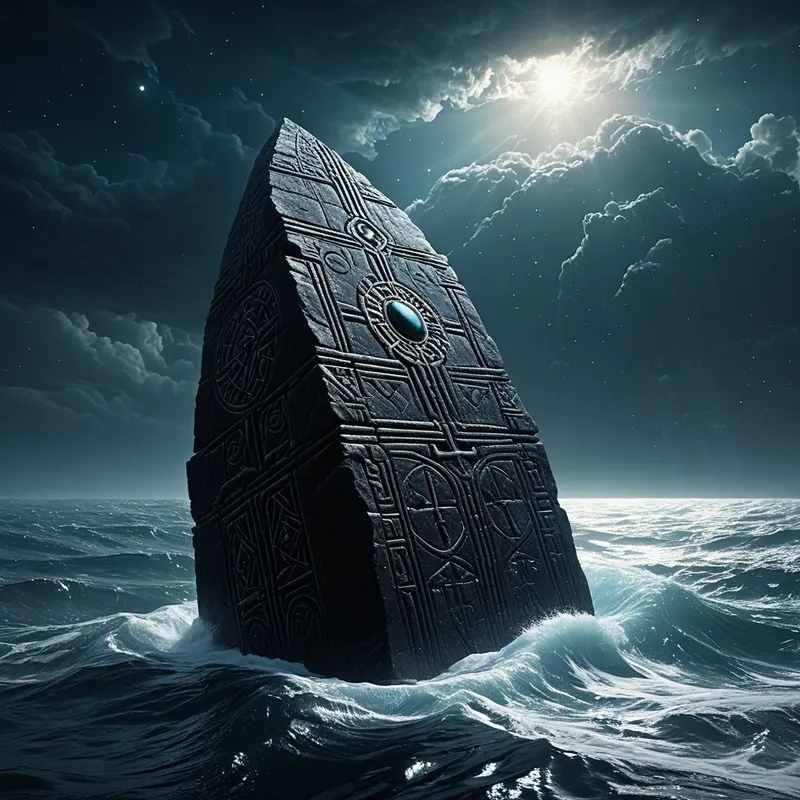
The myth of the primordial stone cast into the cosmic waters to create the first land, establishing order from chaos and anchoring the world.
The Tale of The Foundation Stone
In the time before time, there was only NUN. No name, no form, no above, no below. Just the silent, dark, and boundless deep, where fresh waters and salt waters churned together in a timeless, dreaming tumult. It was [the womb](/myths/the-womb “Myth from Various culture.”/) and the tomb, the potential of all things and the negation of all things.
Then, a stirring. A will. From the heart of this formless abyss arose the first divine thought, the first separation. The gods were born from the mingling waters, but they had no place to stand, no firm ground upon which to enact their will. They floated in the featureless void, their divine power adrift. The great god Enki, whose domain was the sweet waters beneath [the earth](/myths/the-earth “Myth from Hindu culture.”/), looked upon this chaos and knew it could not remain. Order required a point of origin, a fixed center from which [the world](/myths/the-world “Myth from Tarot culture.”/) could unfold.
He called upon the substance of the deep itself, the very essence of potential. From the silt of NUN, from the memory of solidity that slept within the waves, he fashioned a single Stone. It was not large, but it was immeasurably dense, containing the concept of “Here” within its core. It was black as [the abyss](/myths/the-abyss “Myth from Kabbalistic culture.”/), yet it held a captured star-gleam within its heart—a promise of definition.
With a word of power that echoed in the non-space, Enki cast the Stone. It flew, a solitary anchor, and struck the surface of the endless waters. Where it touched, a miracle of resistance occurred. The chaos recoiled. The waters stilled and parted. The Stone did not sink; it became the first “not-[water](/myths/water “Myth from Chinese culture.”/).” Around it, the suspended particles of earth and clay and rock, scattered since the beginning, felt a summons. They drew inward, coalescing, hardening. An island formed, a single, stable point of mud and firmament growing from that divine focal point.
This was the Duranki, the “Bond of Heaven and Earth.” Upon this first land, the gods could finally alight. From this fixed axis, Anu could decree the heavens, and Enlil could command the winds to separate the realms. The Foundation Stone was more than rock; it was the first decision in the face of the formless, the immutable point from which the measuring cord of creation could be stretched. Every temple, every city, every human home to follow would seek to echo this primordial act: to find its own center, to plant its own stone in the personal abyss, and to build a world upon it.
Cultural Origins & Context
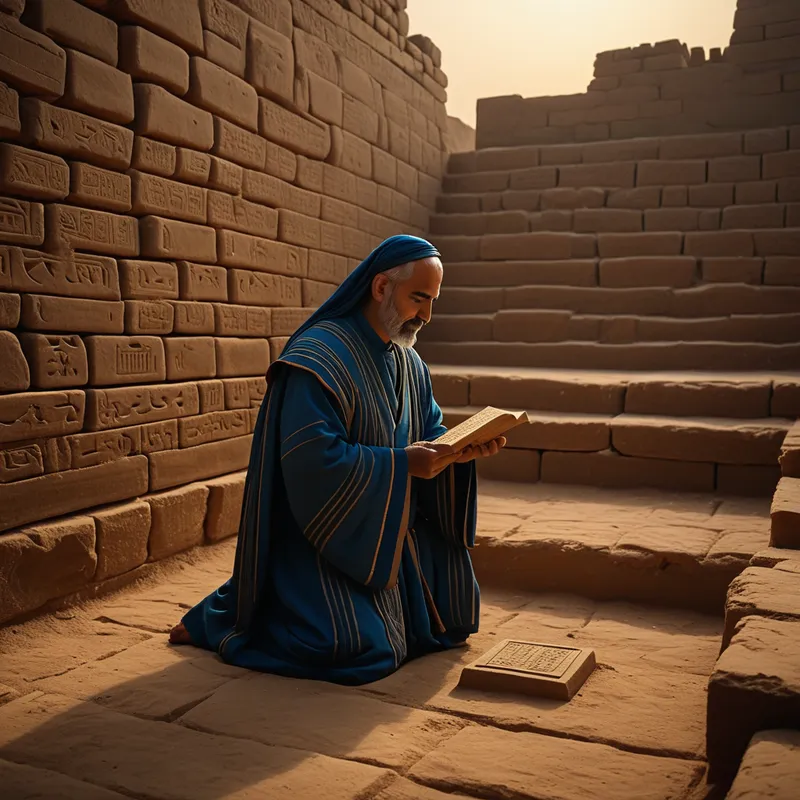
This myth is not a single story from one tablet, but a foundational concept woven into the very fabric of Mesopotamian thought, from Sumer through Babylonia to Assyria. It is the sacred precedent behind the most important ritual of Mesopotamian kingship and civic life: the foundation deposit ceremony.
Whenever a new temple or a palace was to be built—especially the towering [ziggurat](/myths/ziggurat “Myth from Mesopotamian culture.”/) that was the axis of a city—the first act was not merely digging a trench. It was a re-enactment of Enki’s primordial cast. The king, acting as the gods’ steward on earth, would place a deposit in the foundation: a stone peg, a clay tablet inscribed with his name and prayers, or a figurine. These objects were the symbolic successors of the first Stone. They anchored the building to the sacred Duranki, ensuring the structure was not just brick and bitumen, but a microcosm of the ordered world, protected from the ever-lurking chaos. The myth was told and retold in temple liturgies and royal inscriptions, less as a narrative for entertainment and more as a potent咒语, a reaffirmation of cosmic order with every new construction.
Symbolic Architecture
The [Foundation](/symbols/foundation “Symbol: A foundation symbolizes the underlying support systems, values, and beliefs that shape one’s life, serving as the bedrock for growth and development.”/) [Stone](/symbols/stone “Symbol: In dreams, a stone often symbolizes strength, stability, and permanence, but it may also represent emotional burdens or obstacles that need to be acknowledged and processed.”/) is the archetypal [symbol](/symbols/symbol “Symbol: A symbol can represent an idea, concept, or belief, serving as a powerful tool for communication and understanding.”/) of the [axis](/symbols/axis “Symbol: A central line or principle around which things revolve, representing stability, orientation, and the fundamental structure of reality or consciousness.”/) mundi, the world center. It represents the establishment of [consciousness](/symbols/consciousness “Symbol: Consciousness represents the state of awareness and perception, encompassing thoughts, feelings, and experiences.”/) itself from the undifferentiated waters of the unconscious.
To place the Stone is to make the first distinction: this is not that. I am not the chaos. Here, I stand.
Psychologically, it symbolizes [the ego](/myths/the-ego “Myth from Jungian culture.”/)’s necessary and heroic first act: the creation of a stable point of [identity](/symbols/identity “Symbol: Identity represents the sense of self, encompassing personal beliefs, cultural background, and social roles.”/) and [perception](/symbols/perception “Symbol: The process of becoming aware of something through the senses. In dreams, it often represents how one interprets reality or internal states.”/) from the swirling, potent, but terrifying formlessness of early psychic [life](/symbols/life “Symbol: The symbol of ‘Life’ represents a journey of growth, interconnectedness, and existential meaning, encompassing both the joys and challenges that define human experience.”/). The NUN is the primal, maternal, all-containing unconscious—[source](/symbols/source “Symbol: The origin point of something, often representing beginnings, nourishment, or the fundamental cause behind phenomena.”/) of all creativity and all madness. The Stone is the differentiating principle, the fathering will of Enki (who is also god of wisdom and me, the divine decrees of civilization). The myth tells us that order is not the [default](/symbols/default “Symbol: The baseline state, unaltered condition, or standard setting from which all variations and changes originate.”/) state; it is a sacred imposition, a creative act that requires a force of will upon the raw [material](/symbols/material “Symbol: Material signifies the tangible aspects of life, often representing physical resources, desires, and the physical world’s influence on our existence.”/) of existence.
The Dreamer’s Resonance
When this myth stirs in the modern [psyche](/myths/psyche “Myth from Greek culture.”/), it often manifests in dreams of profound instability and the search for grounding. The dreamer may find themselves in endless, shifting landscapes—quicksand, crumbling floors, tidal waves, or featureless plains. There is a somatic sense of sinking, of having no purchase. The emotional tone is one of free-floating anxiety or existential dread, the fear of dissolution.
The appearance of a stone, a cornerstone, a solid platform, or even the act of digging to find something solid in these dreams is the myth breaking through. It signals a critical phase in psychological life where the old foundations of identity—perhaps a career, a relationship, a belief system—have proven unstable, dissolved back into the personal NUN. The psyche is now in the pre-creative chaos, and the dreaming mind is rehearsing the primordial act: searching for the new, non-negotiable truth upon which a renewed sense of self can be built. It is a call to find one’s own Duranki.
Alchemical Translation
The alchemical journey of individuation begins in the massa confusa, the chaotic first matter. The Mesopotamian myth provides the precise initial operation: the fixation. The volatile, watery, and unconscious elements must be given a center around which to crystallize.
For the modern individual, this translates to the often arduous work of finding and declaring one’s foundational truths. What is the stone you will cast into the chaos of your life? It may be a core value (“I value integrity”), a sacred “no” that defines a boundary, a commitment to a creative act, or the humble acceptance of a painful truth. This is not about building the entire temple of [the Self](/myths/the-self “Myth from Jungian culture.”/) yet. It is about the single, definitive act that makes building possible.
The Foundation Stone is the first and most sacred sacrifice: the sacrifice of infinite possibility for the sake of a single, actual reality.
The process is one of contraction before expansion. By limiting the chaos with a defining choice, you create [the vessel](/myths/the-vessel “Myth from Alchemical culture.”/) that can eventually hold the universe of your potential. You move from being subject to the tides of the unconscious to establishing a conscious standpoint from which to relate to them. You become, like Enki, the ruler of the sweet waters from a position of firm ground, able to draw up the riches of the deep without being drowned by them. The myth assures us that order is not a prison, but the necessary ground of freedom; the stone is not a limit, but [the anchor](/myths/the-anchor “Myth from Christian culture.”/) that allows the soul to safely explore the vastness of its own depths.
Associated Symbols
Explore related symbols from the CaleaDream lexicon: