The Fon Creation Myth Meaning & Symbolism
The world is born from the union of cosmic principles, forged in the coils of a serpent and solidified by the ultimate sacrifice of a divine artisan.
The Tale of The Fon Creation Myth
In the beginning, there was Nu, the great, silent, and endless ocean of potential. From its dark, dreaming depths, a presence stirred. It was not one, but two, and yet they were a single heart. Mawu, whose essence was cool like the moon, moist like the earth, and vast like the night sky. And Lisa, whose spirit burned with the fire of the sun, the clarity of day, and the unyielding strength of stone. Together, they were Mawu-Lisa, the one who contains the two, the divine unity of complementary forces.
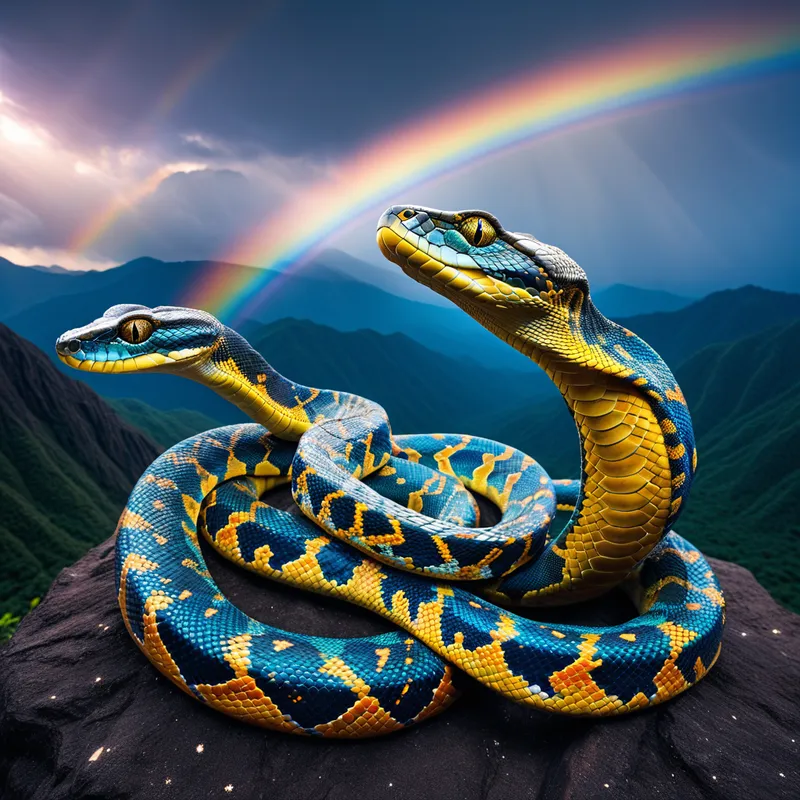
But a formless unity cannot create form. They needed a foundation, a canvas, a means to move through the featureless Nu. So Mawu-Lisa called forth Aido-Hwedo, the Cosmic Serpent. Aido-Hwedo emerged, a being of impossible beauty and power, its scales shimmering with all the colors that ever were or would be. At the command of the creators, the great serpent coiled itself into a mighty spiral, a living platform in the void. Mawu-Lisa descended to stand upon its head.
Then began the great work. Mawu, with gentle, deliberate hands, began to shape the substance of Nu. She formed the soft, yielding clay of the earth, the deep valleys, and the rolling hills. She breathed moisture into the air and gathered waters into pools and streams. Lisa, with fierce and brilliant energy, followed. He hardened the earth with his heat, thrust up mighty mountains that scraped the heavens, and set the very stones. He took the sparks from his being and flung them into the firmament, where they caught and burned as the sun and the countless stars.
Yet the world was unstable, trembling on the back of the mighty serpent. Aido-Hwedo, bearing this incredible weight, needed sustenance. Mawu-Lisa created the Xevioso, the red beings of thunder and iron. Their task was eternal: to feed the serpent iron bars, which it consumed, its excrement becoming the rich, red soil and the precious metals of the earth. And so the world was made solid, fed by sacrifice and labor.
But the world was silent, a beautiful but empty sculpture. Mawu-Lisa saw it was good, but not complete. It needed inhabitants, beings who could tend this garden, who could know it and give it voice. For this final, most delicate act of creation, a different kind of power was needed—not just shaping, but infusion. The divine twins called upon their son, Gu, the master of all that is forged and made.
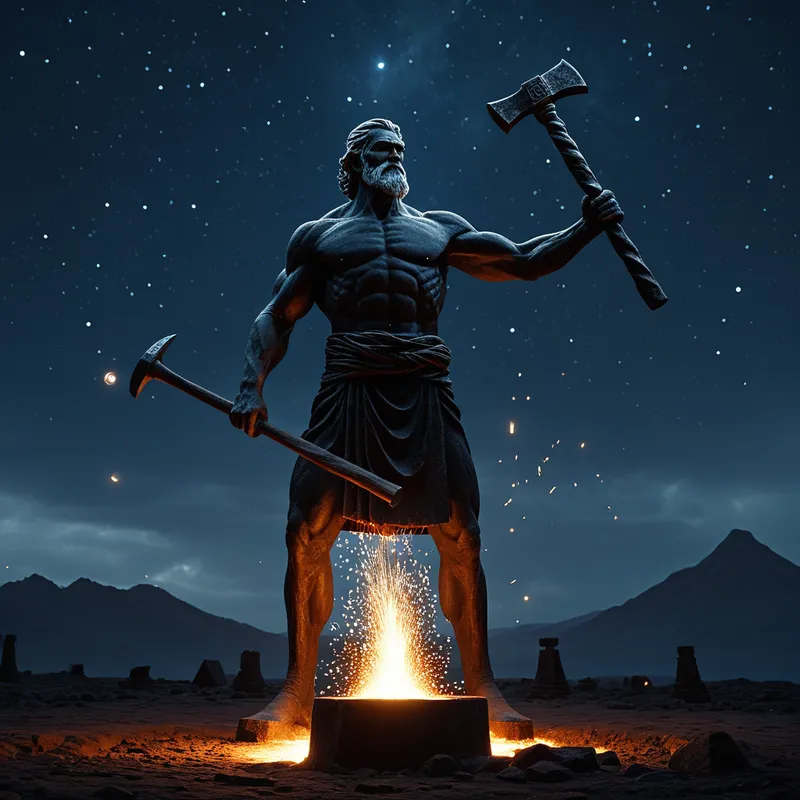
Gu, the divine blacksmith, approached the raw materials of the new earth. But to create life, to instill the spark of motion and will into clay, required a sacrifice of the highest order. Gu did not hesitate. He took his own essence, his divine substance, and placed it within his forge. With hammer blows that echoed the first heartbeat of the cosmos, he worked. He did not sculpt from the outside, but sacrificed from within, pouring his own being into the form. And from this ultimate offering, the first humans were struck into being—imperfect, fragile, but alive, carrying within them a fragment of the divine artisan’s own soul and purpose.
Cultural Origins & Context
This myth originates from the Fon people of what is now Benin, and it is the foundational narrative of the Vodun spiritual system. It was not a story confined to a sacred text, but a living breath passed down through generations by griots and priests. Its telling was an act of worship and remembrance, often performed during rituals, festivals, and rites of passage.
The myth served as the ultimate map of reality, explaining not only the origin of the physical world but the very structure of the cosmos and society. It established the divine hierarchy (Vodun), the sacred relationship between humanity and the gods (anchored in Gu’s sacrifice), and the interdependence of all things, as seen in the serpent Aido-Hwedo’s need for iron and its gift of soil. It was a narrative that justified kingship (linked to Lisa’s ordering power), informed agricultural practice (linked to Mawu’s fertility and the serpent’s excrement), and sanctified the smith’s craft. The myth was the lens through which the Fon understood their place in a world that was willed, shaped, and sustained by conscious, dynamic divine forces.
Symbolic Architecture
The myth presents a profound symbolic architecture of creation as an act of relationship, tension, and necessary sacrifice.
Creation is not an explosion from nothing, but a careful ordering born from the marriage of complementary opposites.
The primary symbol is the unity-in-duality of Mawu-Lisa. They represent the fundamental polarities that generate existence: feminine and masculine, moon and sun, night and day, receptivity and action, matter and spirit. Their cooperation models the first and most essential creative act: the reconciliation of opposites to produce a third thing—the world.
Aido-Hwedo, the serpent coiled beneath all things, symbolizes the foundational, often unconscious, life force that supports conscious reality. It is the psychic and physical substrate, the “ground of being.” Its need for iron speaks to the fact that the structures of our world (societies, psyches, bodies) require constant “feeding,” effort, and the integration of hard, defining elements (discipline, law, bones) to remain stable.
The climax of the symbolic architecture is the sacrifice of Gu. Here, creation turns inward. To create conscious life, the divine must limit itself, must pour its boundless essence into fragile, finite form.
The soul is forged, not born. It is an artifact of a sacred sacrifice, carrying the scars and the strength of the hammer and anvil.
Humanity, therefore, is not an afterthought but the intended masterpiece, bearing the imprint of the sacrificer. Our capacity for creation, technology, art, and war (all domains of Gu) is not a mere tool, but our inherited divine nature.
The Dreamer’s Resonance
When this myth stirs in the modern psyche, it often manifests in dreams of profound beginnings and foundational pressures. To dream of a great serpent supporting the earth, or of being on the back of such a creature, can signal a confrontation with the foundational structures of one’s identity or life. The dreamer may be feeling the immense, often unconscious, weight of their own existence—their family system, cultural conditioning, or deep psychic patterns (the coiled serpent). The dream asks: What is supporting you? What are you being asked to carry? Is your foundation stable, or is it hungry, needing to be fed with the “iron” of conscious attention and effort?
Dreams of a dual-gendered or twin figure engaged in a creative act point to an internal process of reconciling opposites within the self. The dreamer may be struggling to integrate their own Mawu and Lisa aspects: perhaps their nurturing and assertive sides, or their intuitive and logical minds. The creative act in the dream is the psyche’s attempt to birth a new, more unified state of being from this reconciliation.
Most powerfully, dreams echoing Gu’s sacrifice—of being in a forge, of being hammered into shape, of willingly giving up a part of oneself to create something new—indicate a profound somatic and psychological process of individuation. This is the “sacrifice of the innocent self.” The old, undifferentiated personality must be broken down and reforged with intentionality. It is a painful, necessary dream of becoming who you are meant to be, not who you were casually made. The dreamer is the blacksmith and the iron, actively participating in their own creation.
Alchemical Translation
The Fon creation myth is a perfect map for the alchemical process of psychic transmutation, or individuation. The journey begins in the Nu—the massa confusa, the chaotic, undifferentiated state of the unconscious psyche. The first task is not to act, but to call forth the unifying principle: the recognition of the primal opposites within (Mawu-Lisa). One must acknowledge both the soft, receptive, fertile depths and the hard, defining, conscious will.
The serpent Aido-Hwedo represents the next stage: creating a vas, a vessel or a stable psychological structure (like a therapy practice, a creative discipline, a spiritual routine) that can contain the transformative process. This structure requires constant maintenance—the “iron” of daily practice, honest self-reflection, and disciplined effort. Without this feeding, the process collapses back into chaos.
The culmination is Gu’s sacrifice, the mortificatio and sublimatio of the alchemical opus. This is the heart of individuation: the conscious ego must offer up its pretensions, its outdated self-image, its “divine” autonomy. It must be humbled, broken down in the forge of lived experience and introspection.
Individuation is the self forging the Self. It is the ego’s sacrifice of its kingship to serve the greater sovereignty of the soul.
The “iron” of one’s hardest experiences—failures, griefs, shames—is not discarded but becomes the essential material for the new creation. The transformed individual who emerges is not a god, but a true human: a being consciously crafted, bearing the marks of their own sacrifice, and endowed with the creative, shaping power (Gu) that was always their inheritance. They become, in a sense, their own creator, living in a world they have consciously participated in making solid and meaningful.
Associated Symbols
Explore related symbols from the CaleaDream lexicon:
- Serpent — The cosmic serpent Aido-Hwedo represents the foundational, often unconscious life force that supports and shapes reality, a symbol of the primal energy that must be integrated for creation to stand.
- Earth — The world shaped by Mawu and Lisa, symbolizing the manifest realm, the physical body, and the grounded reality that emerges from the union of cosmic principles.
- Water — The primordial Nu from which all creation emerges, representing the unconscious, the formless potential, and the womb of all existence.
- Sun — Embodied by Lisa, representing consciousness, active will, defining force, masculine energy, and the power to order and solidify.
- Moon — Embodied by Mawu, representing the unconscious, receptive fertility, feminine energy, intuition, and the power to shape and moisten.
- Sacrifice — The central act of Gu, who gives of his own essence to create humanity, modeling the necessary offering of self required for any true creation or transformation.
- Fire — The forge of Gu and the heat of Lisa, symbolizing the transformative power, the purifying ordeal, and the energetic spark required for creation and change.
- Iron — The sustenance of Aido-Hwedo and the medium of Gu’s craft, representing strength, structure, technology, and the hard, defining elements that stabilize reality and the psyche.
- Mountain — Formed by Lisa’s fiery power, representing achievement, stability, enduring challenges, and the solid structures of consciousness raised from the formless earth.
- Circle — Represented by the coiled form of Aido-Hwedo, the cyclical nature of feeding and creation, and the unity of the Mawu-Lisa duality, symbolizing wholeness and containment.
- God — The collective divine principle of Mawu-Lisa and the Vodun pantheon, representing the transcendent source of order, creativity, and the archetypal forces that govern existence.
- Root — The foundational support of Aido-Hwedo deep beneath the earth, symbolizing connection to origin, ancestral wisdom, and the deep, often hidden, structures that nourish growth.