
The Flaying of Marsyas (Greek Myth Meaning & Symbolism
A satyr challenges the god Apollo to a musical contest, loses, and is flayed alive for his hubris, his suffering giving birth to a river of sorrow.
The Tale of The Flaying of Marsyas
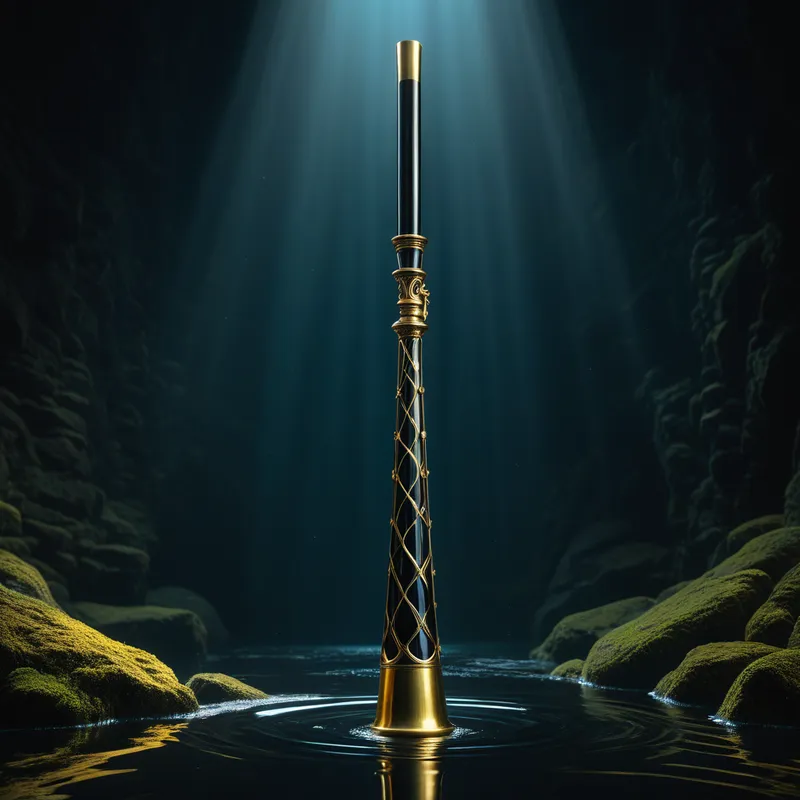
Hear now the song of the skin and the scream. It begins not with a hero, but with a creature of the wild edges: Marsyas the satyr. In the dappled light of the Phrygian woods, where the scent of pine sap was thick and the chatter of nymphs echoed, he found it. The aulos</abtitle="A double-piped reed flute, often associated with frenzied, ecstatic music">aulos—crafted by the goddess Athena and discarded for the way it distorted her face—lay gleaming by a stream. When he lifted it to his lips, the forest held its breath. Then it erupted. The music that poured forth was not the ordered harmony of the spheres, but the very breath of the earth itself: the gurgle of streams, the groan of ancient trees, the mad, joyful cry of the untamed beast.
Word of this wild symphony reached the golden ears of Apollo, he who plays the lyre. To the god of measured beauty and perfect form, this riotous noise was an affront, a challenge from the chaotic flesh to the sovereign mind. A contest was declared. The Muses would judge. The victor could demand any price from the vanquished.
On the appointed day, the mountainside became an amphitheater. Apollo, radiant and serene, plucked his lyre. The notes fell like sunlight, structuring the air itself into geometries of pure sound. It was sublime, leaving the audience in awed silence. Then Marsyas blew. His music was a torrent. It smelled of damp soil and animal musk. It conjured the frenzy of the vine, the agony of birth, the ecstasy of the hunt. It was life, raw and unbidden.
The verdict fell like an axe: Apollo was victor. The god of light had one condition, born of cold wrath, not hot passion. For the crime of daring to rival a god, for elevating the earthy aulos to challenge the celestial lyre, Marsyas would be flayed alive.
They bound the satyr to a stout pine. The executioner’s knife, cold and precise, found a seam at the wrist. The sound that followed was not a musical note, but a tearing. The satyr’s scream was his final, most terrible song. As his skin—the very boundary of his being—was peeled from his flesh, the world wept. The nymphs, the dryads, the very spirits of the stream cried so fiercely their tears became a river, the Marsyas River, which runs red in remembrance. His story ends not with a hero’s death, but with the transformation of agony into a perpetual, murmuring flow.

Cultural Origins & Context
This harrowing tale comes to us from the Greek world, primarily via poets like Ovid in his Metamorphoses, and was a known subject in the visual arts, notably a famous statue group by the Hellenistic sculptors believed to depict the myth. It is a deeply Phrygian story, set in Anatolia (modern Turkey), a land often associated with ecstatic, non-Greek cults and the worship of Cybele. The myth functioned as a powerful cultural boundary marker. It delineated the civilized (Apollo, Greek order, the mind) from the barbaric or primal (Marsyas, Phrygian ecstasy, the body). It was a cautionary tale about hubris, warning against challenging divine order and the established hierarchy of values. The contest was not merely musical; it was a clash of entire worldviews: Apollonian clarity versus Dionysian frenzy, a conflict at the very heart of the Greek understanding of themselves.
Symbolic Architecture
At its core, the flaying of Marsyas is an allegory of consciousness confronting the unconscious, of form attempting to subdue raw vitality.
The price of confronting the god is to have your mortal boundary—your identity, your persona—utterly stripped away.
Marsyas represents the instinctual, chthonic spirit. He is not evil, but other—the untamed creative impulse, the body’s wisdom, the shadow that dances to a different rhythm. The aulos, born from Athena’s rejected creation, is a symbol of divine inspiration that has fallen into the realm of nature, becoming wild and dangerous. Apollo represents the ruling principle of the psyche: logos, order, differentiation, and the tyranny of perfection. His victory asserts that the conscious ego must govern the chaotic forces of the instinctual self.
The flaying is the ultimate deconstruction. It is the brutal, literal removal of the persona (from the Latin for "mask"), the skin we show the world. Marsyas’s suffering is the agony of the natural self being forcibly separated from its own nature. Yet, from this horrific act, a river is born. The river symbolizes the eternal flow of feeling that arises from profound suffering—a transformation of raw, silent agony into something that moves, communicates, and nourishes the land. His spirit, once confined to a satyr’s form, becomes a landscape feature, a mythic geography of sorrow.
The Dreamer's Resonance
To dream of this myth is to be in a state of profound psychic vulnerability. One might dream of being publicly exposed, of one’s clothes (a modern skin) tearing away to reveal something shameful or raw. Or, one might dream of a contest where, despite pouring one’s entire soul into a performance, a cold, authoritative figure declares it worthless, followed by a sensation of peeling or unraveling.
Somnatically, this points to a process of psychic flaying. The dreamer is likely undergoing an experience where a deeply held self-concept—a talent, a role, an identity (“the musician,” “the rebel,” “the natural genius”)—is being brutally challenged and dismantled by an inner or outer authority (the inner Apollo). The body in the dream may feel the terror of boundary loss, of having no protection. This is not a dream of death, but of excruciation—the feeling of being alive and conscious during a process of unmaking. It signals that the persona has become a prison, and the Self demands a more authentic, if initially more painful, mode of being.

Alchemical Translation
In the alchemy of the soul, the myth models the nigredo—the blackening, the putrefaction, the most painful stage of dissolution necessary for transformation. Marsyas’s hubris is, psychologically, the necessary inflation that forces a confrontation with a superior power within the psyche.
The lyre cannot integrate the aulos; it must annihilate it to begin the work of transmutation. The old skin must die for the new consciousness to be born.
The contest is the ego’s bold, flawed attempt to integrate a powerful complex (the wild, creative instinct). Its failure is inevitable and necessary. The flaying, then, is the agonizing process of individuation where the ego is stripped of its identification with a single talent or trait. One is no longer “the gifted one” or “the free spirit”; that identity is torn away.
What remains is the raw, screaming essence—the unadorned psychic reality. This is the crucial matter for the alchemist. From this suffering, the river flows. The alchemical translation is that sustained, conscious suffering has a creative product. The river Marsyas is the aqua permanens, the permanent water of the alchemists—the transformative fluid of emotion and insight that arises from enduring one’s own dissolution. One does not become Apollo, nor does one return to being Marsyas. One becomes the landscape that contains both the radiant sun and the weeping river. The integrated Self learns the disciplined melody of the lyre but remembers the wild, bloody price of the song.
Associated Symbols
Explore related symbols from the CaleaDream lexicon: