The Five Suns of Creation Myth Meaning & Symbolism
An Incan creation myth of five successive worlds, each destroyed and reborn, revealing the cyclical nature of existence and the cost of cosmic order.
The Tale of The Five Suns of Creation
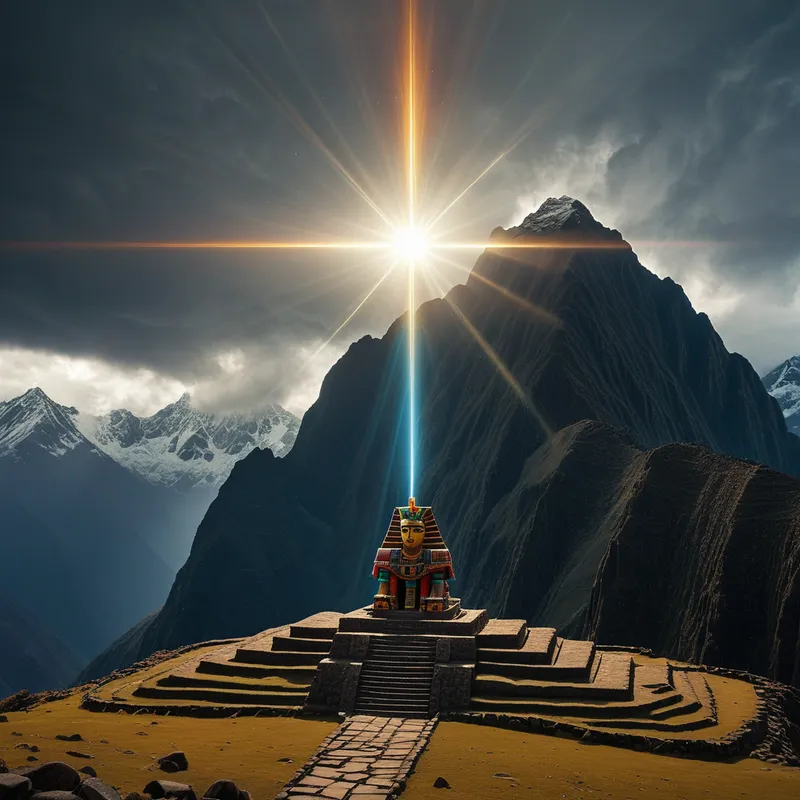
In the time before time, there was only [Viracocha](/myths/viracocha “Myth from Incan culture.”/), the sea of potential, and the endless, silent dark. From this abyss, the first thought stirred. It was [Viracocha](/myths/viracocha “Myth from Incan culture.”/) who willed himself into being, and his first breath was light. With this light, he fashioned the first world.
He sculpted giants from the living stone of the mountains, breathing into them a slow, ponderous life. This was the age of the Wari Runa, the Giants. They walked the raw earth under a sun of pure stone, a cold, dim orb that cast long shadows. But these giants forgot their creator. They grew arrogant and still. Their hearts turned to the very rock from which they were carved. Seeing this, Viracocha wept a flood of tears that became a great deluge, washing the stone giants back into the clay, and the first sun set forever.
From the mud of that flood, Viracocha tried again. He called forth the second world, the age of the Wari. He gave them the sun of gold, a blazing, generous light that nurtured simple, peaceful lives. Yet without challenge, without striving, their spirits grew soft and dull as unworked metal. Compassion turned to apathy. And so Viracocha summoned the winds, the Wayra, who scoured the land with a hurricane that lasted forty days and forty nights. The golden sun was torn from the sky, and the second people were scattered like dust.
Undaunted, the Creator shaped a third attempt from the hardened ash of the storm. This was the world of the Purun Runa, the Wild People. For them, he kindled a sun of copper, a fiery, passionate star. They were fierce and inventive, but their fire burned unchecked. They warred amongst themselves, their tools becoming weapons, their passions consuming them. Their world became a forge of violence. Viracocha, in sorrow and resolve, unleashed a rain of fire from the volcanoes. The copper sun melted in the sky, and the earth itself burned until it was barren.
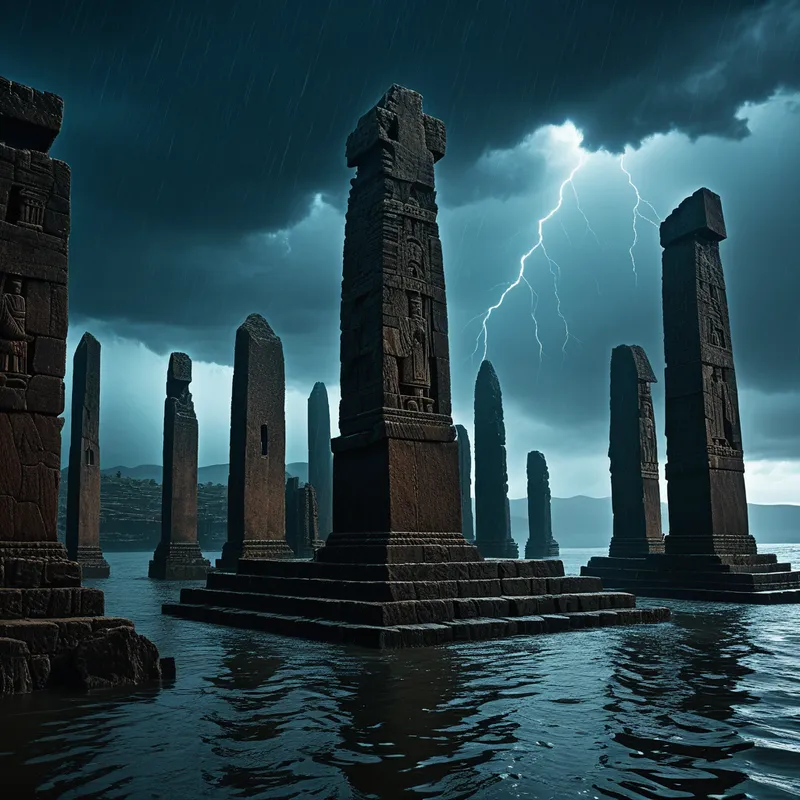
From the embers and fertile volcanic soil, the fourth world was born: the age of the Auca Runa, the War People. Theirs was a sun of silver, a cool, intellectual light. They built great cities of stone, like Tiahuanaco, and devised laws and kingdoms. But intellect divorced from heart bred tyranny and endless conflict. Their silver light reflected only ambition. Seeing the cycle of power and ruin repeat, Viracocha commanded the heavens to open. A great flood, Uno Pachacuti, engulfed the world. The silver sun drowned in the endless waters, and the fourth age was washed away.
Then, in the stillness after the flood, Viracocha walked upon the waters. He went to [the Island of the Sun](/myths/the-island-of-the-sun “Myth from Incan culture.”/). There, from the sacred clay of Titicaca, he fashioned new beings, perfecting his art. He shaped men and women, and to them he gave the fifth sun: the Sun of Inti, a living, breathing orb of light that would die each night and be reborn each dawn. He taught them language, the arts of agriculture, weaving, and worship. He sent them forth in pairs to populate the valleys and mountains, giving them a sacred mandate: to live in ayni, sacred reciprocity. This is our world, the age of the Hanan Pacha, forever balanced on the knife-edge between memory of the fallen suns and the promise of each new dawn.
Cultural Origins & Context
This cosmological narrative, while often synthesized under the banner of “Incan,” draws from a deep well of Andean oral traditions that predate the Inca Empire. The Inca, as masterful integrators, wove the creation myths of conquered peoples into their own state cosmology to legitimize their rule. The story of the Five Suns is more accurately a pan-Andean myth, with core elements found in the traditions of cultures like the Tiwanaku. It was not a single, fixed text but a living narrative performed by priests and amautas during state rituals and agricultural ceremonies.
Its primary function was ontological and social. It explained the palpable evidence of ancient ruins and fossils (the giants of the first age) and the cataclysmic geology of the Andes. More importantly, it served as a divine charter for the Inca state. By placing themselves as the children of the fifth and current Sun, Inti, the Inca Sapa (Emperor) claimed a direct, mandated role as the sustainer of this fragile cosmic order. The myth justified social hierarchy, agricultural practice, and the constant ritual labor required to prevent the fifth sun from setting permanently, thus averting a sixth Pachacuti.
Symbolic Architecture
The myth’s power lies not in [linear](/symbols/linear “Symbol: Represents order, predictability, and a direct, step-by-step progression. It symbolizes a clear path from cause to effect.”/) progress, but in sacred [recursion](/symbols/recursion “Symbol: A process that repeats itself within itself, creating infinite loops or self-similar patterns at different scales.”/). Each sun is not merely a historical epoch but a [layer](/symbols/layer “Symbol: Layers often symbolize complexity, depth, and protection in dreams, representing the various aspects of the self or situations.”/) of the [human](/symbols/human “Symbol: The symbol of a human represents individuality, complexity of emotions, and social relationships.”/) [condition](/symbols/condition “Symbol: Condition reflects the state of being, often focusing on physical, emotional, or situational aspects of life.”/), a psychological “world” we collectively and individually inhabit and must transcend.
Each cataclysm is not a punishment, but the necessary dissolution of a world that has become too absolute, too identified with a single mode of being.
The [sequence](/symbols/sequence “Symbol: The symbol of ‘sequence’ often signifies the order of events and the progression towards a desired outcome or goal.”/)—[Stone](/symbols/stone “Symbol: In dreams, a stone often symbolizes strength, stability, and permanence, but it may also represent emotional burdens or obstacles that need to be acknowledged and processed.”/), Gold, [Copper](/symbols/copper “Symbol: Copper symbolizes conductivity and connection, representing the ability to channel energy, ideas, and emotions between people or concepts.”/), Silver, and finally the Living Sun—maps an [alchemy](/symbols/alchemy “Symbol: A transformative process of purification and creation, often symbolizing personal or spiritual evolution through difficult stages.”/) of [consciousness](/symbols/consciousness “Symbol: Consciousness represents the state of awareness and perception, encompassing thoughts, feelings, and experiences.”/). The [Stone](/symbols/stone “Symbol: In dreams, a stone often symbolizes strength, stability, and permanence, but it may also represent emotional burdens or obstacles that need to be acknowledged and processed.”/) Sun represents the inertia of unconscious matter. The Gold Sun is the naive, paradisiacal state lacking [depth](/symbols/depth “Symbol: Represents profound layers of consciousness, hidden truths, or the unknown aspects of existence, often symbolizing introspection and existential exploration.”/). The [Copper](/symbols/copper “Symbol: Copper symbolizes conductivity and connection, representing the ability to channel energy, ideas, and emotions between people or concepts.”/) Sun is raw, untamed instinct and [passion](/symbols/passion “Symbol: Intense emotional or physical desire, often linked to love, creativity, or purpose. Represents life force and deep engagement.”/). The Silver Sun is the intellect that builds empires but loses the [soul](/symbols/soul “Symbol: The soul represents the essence of a person, encompassing their spirit, identity, and connection to the universe.”/). Each is a necessary but incomplete stage. The destruction, always initiated by [water](/symbols/water “Symbol: Water symbolizes the subconscious mind, emotions, and the flow of life, representing both cleansing and creation.”/) or fire—the primary elements of [dissolution](/symbols/dissolution “Symbol: The process of breaking down, dispersing, or losing form, often representing transformation, release, or the end of a state of being.”/) and transformation—clears the psychic ground.
The fifth Sun of Inti is the [symbol](/symbols/symbol “Symbol: A symbol can represent an idea, concept, or belief, serving as a powerful tool for communication and understanding.”/) of integrated consciousness. It is not a [static](/symbols/static “Symbol: Static represents interference, disruption, and the breakdown of clear communication or signal, often evoking feelings of frustration and disconnection.”/) perfection but a dynamic process, dying and being reborn daily. It represents the fragile, earned state of balance (ayni) where matter and [spirit](/symbols/spirit “Symbol: Spirit symbolizes the essence of life, vitality, and the spiritual journey of the individual.”/), individual and collective, past and present, are held in conscious, reciprocal [relationship](/symbols/relationship “Symbol: A representation of connections we have with others in our lives, often reflecting our emotional state.”/). It is a sun that requires our participation to rise.
The Dreamer’s Resonance
When this myth stirs in the modern dreamer, it often manifests as dreams of sequential, world-ending catastrophes. One may dream of their childhood home crumbling, then a great fire consuming their workplace, followed by a flood washing away a city of abstract ideas. These are not prophecies of doom, but somatic signals of a psyche undergoing a Pachacuti—an inner overturning.
The dreamer is experiencing the death of an outworn “world” or identity structure. The body may feel heavy (the Stone World), or the dreamer may experience nostalgic paralysis (the Gold World), uncontrolled rage (the Copper World), or cold, analytical detachment (the Silver World). The cataclysm in the dream is the psyche’s brutal but necessary method of disintegration. It is the flood of tears that softens a petrified heart, the fire that burns away a worn-out persona. The dream asks: What world are you currently living in? And what element—water of emotion or fire of purifying will—is needed to dissolve its limiting form to make way for a more conscious dawn?
Alchemical Translation
For the individual on the path of individuation, the Five Suns model the process of psychic transmutation. We are all born into a given “world”—the familial, cultural, and personal complexes that form our initial sun. The journey begins when that world starts to feel constricting, its light inadequate.
Individuation is the conscious endurance of the cataclysm, the holding of the tension as one world dies so a more authentic one can be born.
The first alchemical stage is recognizing the sun you are under. Are you living by the rigid law of the Stone Father? The pleasing but shallow light of the Golden Child? The burn of the Copper passions? The cold reflection of the Silver intellect? The subsequent “destructions” are the painful but liberating processes of shadow-work, where these dominant attitudes are confronted and dissolved. The flood is the dissolution of the old in the waters of the unconscious; the fire is the nigredo, the burning away of dross.
The goal is not to arrive at a static fifth state, but to internalize the principle of the fifth Sun: to become the ayni-practicing individual who can consciously participate in the daily death and rebirth of the self. It is to become, in a sense, both Viracocha and the caretaker of Inti—the one who has the courage to dissolve outworn forms and the devotion to nurture the fragile, living light of conscious awareness in the fertile dark that remains. This is the ultimate creation: a self that is a conscious, reciprocal partner in its own becoming.
Associated Symbols
Explore related symbols from the CaleaDream lexicon:
- Sun — The central, evolving deity of the myth, representing the ruling consciousness of each age and the integrated, cyclical life of the current world.
- Water — The primary element of dissolution and purification, appearing as the flood that ends the first and fourth worlds, washing away stagnant forms.
- Fire — The transformative element that ends the third world, representing both destructive passion and the purifying force necessary for rebirth.
- Mountain — The sacred landscape from which life is sculpted and upon which Viracocha performs his acts of creation, symbolizing stability and connection to the divine.
- Flood — The cataclysmic event of Uno Pachacuti, embodying the overwhelming power of the unconscious to dissolve rigid, outworn structures of reality.
- Circle — The fundamental shape of the myth, representing the cyclical, non-linear nature of time, creation, destruction, and rebirth.
- Sacrifice — The implicit cost of each new creation, as every world and its people are surrendered to make way for the next, more conscious iteration.
- Rebirth — The core promise of the narrative, illustrated by the daily resurrection of Inti and the emergence of new humanity from the sacred clay of Lake Titicaca.
- Stone — The material of the first world and its giants, symbolizing primordial matter, inertia, and the foundational, often rigid, structures of existence.
- Gold — The metal of the second sun, representing a state of naive, untested potential and value that lacks the resilience forged through struggle.
- Temple — The kind of structure built in the fourth, silver age, symbolizing the intellectual and political order that, when divorced from heart, becomes a prison.
- Fires of Creation — The paradoxical force that both destroys the copper world and is the essential spark within Viracocha’s generative will.