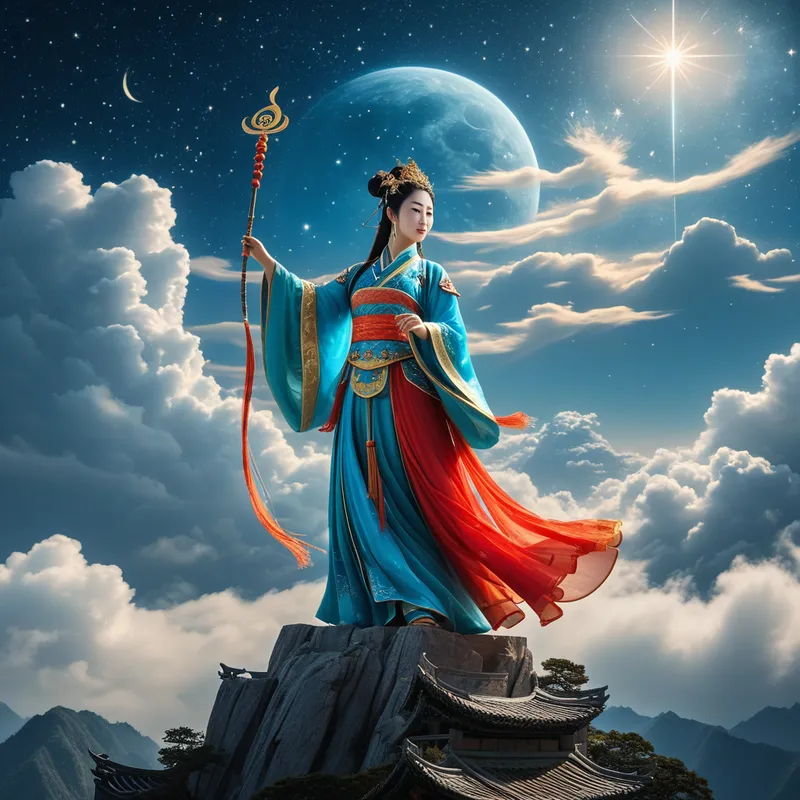
The Five Colored Clouds Myth Meaning & Symbolism
A celestial weaver goddess mends the torn sky with clouds of five sacred colors, restoring cosmic order and beauty to the world.
The Tale of The Five Colored Clouds
In the time before time, when the sky was a fresh canvas and the earth a tender clay, a great calamity shook the pillars of heaven. A titan of chaos, Gong Gong, in a fit of rage and shame, smashed his head against the celestial mountain Buzhou. The mountain shuddered and cracked. A jagged tear ripped through the vault of the sky, a wound of deepest black against the twilight. From this gash, the supporting pillars of the world tilted, the heavens slumped towards the northwest, and the earth sank in the southeast. Stars wept from their sockets. A great flood, born of this cosmic imbalance, began to rise, swallowing the plains and forests.
All creatures wailed in terror. The harmony of Yin and Yang was shattered. The world was drowning in chaos and darkness.
Then, from the primordial waters, she arose. Nüwa, the serpent-tailed goddess, she who had fashioned humanity from the yellow earth. Her heart, a lodestone of compassion, felt every tremor of fear from her children. She looked upon the broken sky, not with despair, but with the calm resolve of a mother surveying a torn garment. It was not beyond mending.
She journeyed to the sacred river at the edge of the world, where the primal elements still swirled in their pure, unformed state. There, she gathered stones—not ordinary stones, but the crystallized essence of the five directions and their sacred colors. From the fiery south, she took vermilion stones. From the watery north, stones of deepest azure. From the woody east, jade-green stones. From the metallic west, stones of bright gold. And from the central earth, stones of purest alabaster.
With divine breath and will, she lit a celestial fire that burned not with heat, but with intention. One by one, she melted the five-colored stones in a great cauldron of stars. The molten essences did not mix into mud, but remained as distinct as strands of silk—red, blue, green, yellow, white. Dipping her hands into the cosmic forge, she began to weave. She spun the molten colors into clouds, not of water vapor, but of solidified light and order. Each cloud was a tapestry of meaning, a patch of regulated cosmos.
Standing upon the highest remaining peak, her serpent body coiled against the wind of creation, Nüwa began her sacred labor. She took a cloud of azure and sealed the northern tear. She took a cloud of vermilion and anchored the southern sky. East and west were secured with jade and gold. With the alabaster clouds, she filled the central void, stitching the heavens back together with threads of luminous white. The work took days and nights uncounted. Finally, with the last cloud placed, the terrible black gash was gone. In its place shimmered a magnificent panorama of five-colored clouds, glowing softly with an inner light. They held the sky firm.
To ensure it would never fall again, she slew a great celestial turtle, using its four mighty legs to replace the broken pillars of the world, steadying the four corners of the earth. The floods receded, channeled into new rivers and seas. The sky, now mended, rested securely. But the repair was not invisible; it was a testament. Where the wound had been, the five-colored clouds remained, a permanent, beautiful scar across the firmament—a reminder of rupture and restoration, of chaos transformed into a higher, more complex harmony.

Cultural Origins & Context
The myth of Nüwa mending the sky with five-colored stones is one of the foundational narratives of Chinese cosmology, collected in texts like the Shan Hai Jing (Classic of Mountains and Seas) and later refined by scholars such as Liezi. It is a myth that belongs to the deep, pre-imperial stratum of Chinese thought, emerging from a worldview where the human, natural, and celestial realms were intimately connected and maintained through ritual and virtue.
This was not merely a story for entertainment, but a sacred etiology. It explained the geographical tilt of China (higher in the northwest, lower in the southeast), the origin of rainbows and colorful sunset clouds, and most importantly, the nature of cosmic order. The myth served a vital societal function: it modeled the ideal of proactive restoration. The cosmos, like society, could be damaged by pride and rage (as embodied by Gong Gong), but it could—and must—be repaired through compassionate, creative, and disciplined action (as embodied by Nüwa). It was a narrative told by shamans and later by philosophers to illustrate the principle of Tianming and the ruler’s duty to maintain harmony. The five colors directly correspond to the Wuxing system, anchoring the myth into the fundamental symbolic language of Chinese medicine, statecraft, and art.
Symbolic Architecture
At its heart, this myth is a profound allegory for the integration of complexity. The torn sky represents a catastrophic psychic rupture—a trauma, a deep depression, a shattering of one’s worldview or self-concept. The formless flood is the ensuing chaos of unregulated emotions and disintegrated instincts.
The wound in the cosmos is the necessary void that calls the creator forth from within.
Nüwa symbolizes the anima in its most potent, archetypal form: not as a romantic figure, but as the innate, restorative drive of the psyche itself. She is the instinct to heal, to make whole, to give form. Her serpent tail connects her to the chthonic, instinctual wisdom of the earth, while her divine upper body reaches for the celestial order. She is the bridge.
The five-colored stones are the raw, disparate elements of the self—the different complexes, conflicting emotions, and unintegrated potentials that, in their raw state, cause inner conflict. The fiery red of passion, the deep blue of melancholy, the growing green of vitality, the structuring gold of the ego, the unifying white of the spirit. Nüwa does not destroy these elements; she transmutes them. The celestial fire is the heat of conscious attention and suffering. The act of weaving is the patient, meticulous work of psychotherapy, introspection, or artistic creation—taking disparate parts and crafting them into a functional, beautiful whole.
The resulting Five Colored Clouds are the integrated psyche. The repair is not a return to a naive, unbroken unity, but the achievement of a higher synthesis. The sky is stronger and more beautiful for having been mended. The clouds are the visible symbol of a personality that has consciously integrated its wounds and complexities into a resilient, multifaceted identity.
The Dreamer’s Resonance
When this myth pattern stirs in the modern dreamer, it often signals a profound process of psychic repair following a period of fragmentation or crisis. To dream of a torn sky or a collapsing ceiling is to experience the terror of a failing psychic structure—perhaps a collapsed career, a broken relationship, or a loss of faith.
Dreams of gathering colored stones, threads, or fragments speak to the beginning of the integrative process. The dream-ego is tasked with collecting the scattered pieces of the self. Dreams of weaving, sewing, or patching are direct somatic metaphors for the neural and emotional work of healing. The appearance of a serene, determined feminine figure (not necessarily “goddess-like”) who aids in this work can be understood as the emergence of the nurturing, creative Self, guiding the conscious ego.
The somatic experience accompanying such dreams can be one of deep fatigue (the labor of mending) followed by profound relief and lightness (the sky holding firm). The dreamer may awaken with a sense of purpose, a quiet knowing that the pieces, however scattered, can be reassembled into a new, more conscious whole.
Alchemical Translation
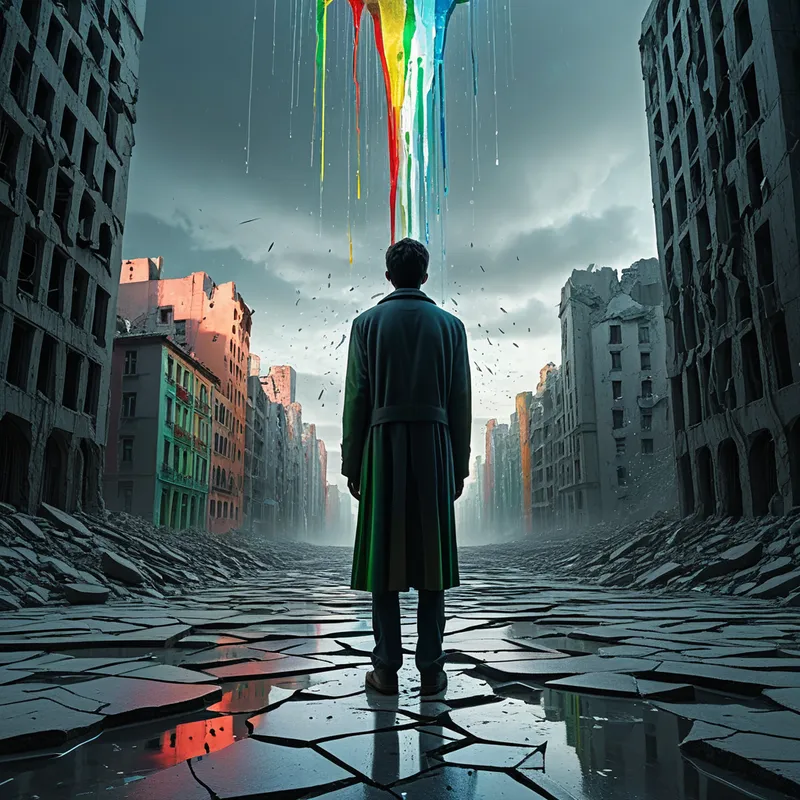
The alchemical journey modeled here is not of seeking a philosopher’s stone, but of becoming the mender of one’s own sky. The modern individual’s “Buzhou Mountain” is often a cherished ideal, a foundational belief, or a pillar of identity that is shattered by reality—failure, betrayal, mortality.
Individuation is the work of gathering the colored stones of our fractured experience and, in the crucible of conscious suffering, weaving them into a canopy for a new soul.
The first stage is Confrontation with the Rupture (Gong Gong’s rage). One must acknowledge the catastrophe, the flood of anxiety, without being swept away. The second is The Gathering (collecting the stones). This is the often tedious work of therapy, journaling, and reflection—identifying the core emotional complexes (the five colors/elements) that have been exposed by the break. The third is The Celestial Fire (melting the stones). This is the most painful phase: submitting these hard, crystallized patterns of behavior and belief to the heat of honest examination and emotional experience. They must be liquefied, made malleable.
The fourth and most sacred stage is The Weaving (creating the clouds). This is the active reconstruction of meaning. It is the patient, daily practice of choosing new narratives, forging new neural pathways, and consciously crafting a personality that contains its wounds as sources of strength and color. The final stage is The Steadying (the turtle’s legs). This involves establishing new, resilient structures—healthy habits, supportive relationships, guiding principles—to hold the renewed psyche firm.
The triumph is not a life without scars, but a life where the scar tissue is luminous. The Five Colored Clouds are the integrated Self, a psychic reality that is more vibrant, complex, and resilient precisely because it has been consciously made whole from its own broken pieces. We look up, not at a perfect, blank heaven, but at a sky artfully mended with the colors of our own hard-won wisdom.
Associated Symbols
Explore related symbols from the CaleaDream lexicon: