
The First Tool Myth Meaning & Symbolism
A primal story of a being who, through theft or gift, brings the first tool from the gods, forever altering humanity's relationship with nature and the divine.
The Tale of The First Tool
In the time before time, when the world was young and soft, the people lived in the long shadow of the gods. They were naked to the wind, their bellies hollow with hunger, their nights long with the fear of tooth and claw. They ate what they could gather with bare hands, and when the cold came, they huddled together for warmth, their breath steaming in the dark.
The gods lived in the high places—in the crack of thunder, in the heart of the volcano, in the blinding flash of lightning that split the sky. They held the secrets of the world in their hands: the secret of the sharp edge, the secret of the lasting flame, the secret of making the earth itself obey. These were not for the people. The order was clear: the people would live by grace, and the gods would rule by power.
But one being looked upon this order and found it wanting. In some tales, he is a cunning Prometheus, a titan with pity in his heart. In others, she is a Coyote or Maui, driven by restless curiosity. In the oldest whispers, it is no named god at all, but the first human whose soul caught fire with a question: "Why not?"
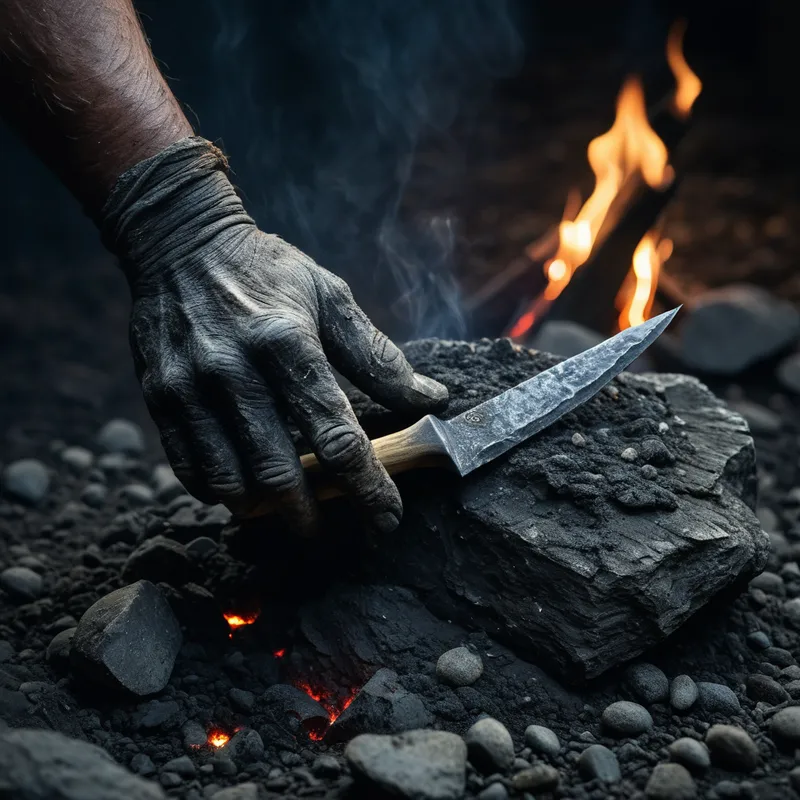
So this one climbed. They left the safe, murmuring forests and scaled the bones of the earth, where the air grew thin and the voices of the gods roared like rivers. They passed the nests of storm eagles and crossed fields of black glass, until they stood before the forge of heaven. There it lay, not a weapon, but a primal cause. Sometimes it is a flaming branch snatched from the sun-chariot's wheel. Often, it is a piece of the mountain's heart—a chunk of flint, obsidian, or ore—resting beside the divine anvil, already shaped by a god's intent into a wedge, a blade, a point.
The theft was not silent. The shriek of parting stone echoed in the vault. The hiss of stolen fire drowned the wind. The keeper of the secret turned, and their gaze was like a weight of stone. But the thief was already falling, tumbling down the mountain, clutching the tool to their chest, its new heat branding their skin.
They fell back into the world of the people, broken but breathing, the secret smoking in their grasp. And they did not hoard it. With blistered hands, they showed the others: how to strike the stone to release its sharp soul, how to coax the spark into a flame that did not die. That night, for the first time, the darkness was pushed back by a circle of light. For the first time, the smell of roasting meat, not carrion, filled the air. For the first time, a hand held something it had made, and in that holding, the world changed.
But the high places had gone quiet. A new sound descended—the slow, terrible sound of divine footsteps, coming to settle the account.
Cultural Origins & Context
The myth of the First Tool is not the property of a single culture, but a cosmopolitan motif etched into the collective memory of humanity. It appears in the foundational stories of ancient Greece, the trickster cycles of Indigenous North America, the epics of West Africa, and the ancestral narratives of Polynesia. Its tellers were the elders and the shamans, the poets and the griots, who recited it not as mere history, but as a sacred charter for human existence.
Its societal function was profound. It explained the fundamental paradox of the human condition: our immense power coupled with our profound suffering. The myth answered the child's question, "Why do we have fire?" with a story that also explained, "Why do we toil, and why do we die?" It established technology (techne) as a divine—or stolen—knowledge, placing it in a sacred, ambivalent context. The story was told at gatherings, during initiations, and at times of technological change, to remind the people of the cost of their power and the eternal tension between aspiration and the established order.
Symbolic Architecture
Psychologically, the myth maps the birth of consciousness itself. The pre-tool humans represent the undifferentiated state of the psyche, living in instinctual unity with the Mother Nature, but also in passive vulnerability. The tool—be it fire, blade, or hammer—is the symbol of the differentiating ego. It is the capacity to act upon the world rather than merely be acted upon.
The First Tool is not an object, but an event in the soul: the moment when awareness becomes agency.
The gods represent the unconscious totality, the Self in its primordial form, which contains all potentials, including the potential for conscious separation. The theft is the necessary, traumatic act of individuation—the ego wresting a piece of autonomous power from the unconscious whole. The divine punishment that inevitably follows (the vulture for Prometheus, the curses from Maui's exploits) symbolizes the inherent burden of consciousness: anxiety, guilt, alienation, and the relentless responsibility that comes with freedom. The tool-bringer, the rebel, embodies the courageous, disruptive force within the psyche that pushes for growth, even at great personal cost.

The Dreamer's Resonance
When this myth stirs in the modern dreamscape, it often manifests as dreams of discovery or transgression. You may dream of finding a strange, potent object in a forgotten room—a key, a crystal, a USB drive humming with energy. You may dream of sneaking into a forbidden laboratory or library and taking a book of formulas. The somatic feeling is one of thrilling dread: a racing heart, the adrenaline of the thief, coupled with the awe of holding something world-altering.
This dream pattern signals a critical phase of psychological development. The dreamer is on the cusp of integrating a new "tool"—a skill, a perspective, a truth about themselves—that has been held in the "divine" or unconscious realm of their own potential. The conflict in the dream mirrors the internal resistance: the part of the self that fears change, that upholds the old, safe order (the inner "gods"). To take the tool is to commit to a more conscious, but more complex and responsible, way of being. The dream is the psyche's dramatic rehearsal for this awakening.

Alchemical Translation
The alchemical journey of individuation is perfectly modeled in this myth. The initial state (massa confusa) is the unconscious, tool-less existence. The nigredo, the blackening, is the arduous climb—the feeling of alienation, the hard work of confronting inner and outer obstacles as one seeks a new level of understanding.
The theft of the tool is the separatio and the coniunctio in one fiery moment. It is the separation of a specific, usable consciousness (the tool) from the diffuse, unconscious whole (the gods). Simultaneously, it is the sacred marriage of the human with the transformative principle. The tool-bringer is the alchemist, performing the forbidden operation to obtain the philosopher's stone—which, in psychological terms, is the enduring, transformative insight.
The punishment is not the end of the work, but its continuation. To bear the consequence is to fully incarnate the insight, to let it reshape one's life from the inside out.
Finally, the sharing of the tool with the community represents the rubedo, the reddening, where the achieved insight is made manifest in the world. The individual's transformation radiates outward, altering their reality. The myth tells us that true psychic transmutation is always a rebellious, costly, and ultimately communal act. We steal fire not for ourselves alone, but to illuminate the shared human cave, forever changing the nature of the darkness.
Associated Symbols
Explore related symbols from the CaleaDream lexicon: