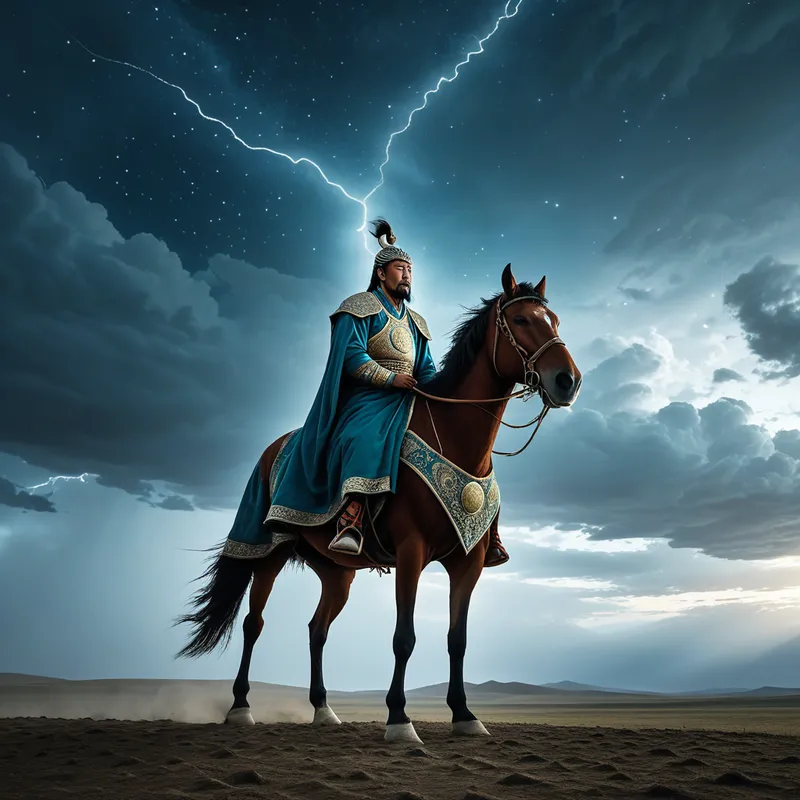
The First Horse Race Myth Meaning & Symbolism
A celestial wager between a god and a hero establishes the first horse race, forging an eternal covenant between humanity and the spirit of the steppe.
The Tale of The First Horse Race
Listen. Before time was counted in years, when the Tengri was closer to the earth, the world was a place of raw power and silent pacts. The wind did not just blow; it carried the breath of spirits. The grass did not just grow; it whispered the secrets of the Etugen. And humanity lived in a fragile balance, blessed by the sky but bound to the soil, their lives a slow, earthbound tread.
Then came a great drought. The springs wept dry tears. The herds grew thin, their ribs like the struts of a forgotten ger. Despair, a heavy dust, settled on the people. In their desperation, they raised their voices to the Tengri, not with words, but with the silence of a dying land.
Their silence was heard. From the vault of the eternal blue descended Erleg Khan, a deity of the deep earth and the unyielding laws of fate. He did not come with rain, but with a challenge. He stood before the people, his form both man and mountain, his eyes holding the cold glitter of distant stars.
“Your suffering is the friction of worlds,” his voice echoed, a rumble from beneath the steppe. “You are of the earth, yet you yearn for the speed of the wind, the freedom of the sky. I will make a wager. Bring forth your fastest runner, your most loyal companion from the herds. Let him race against my chosen steed, a creature born of the northern wind and stone. If your runner wins, I will break the drought. The rains will come, and more—I will grant your people the secret kinship with the horse, a bond that will make you lords of distance, children of the horizon. If you lose, your spirits will be bound to the deep earth, to toil without song, forever.”
A terrible stillness followed. Then, from the crowd stepped a young man. He was not the strongest, nor the eldest. But his eyes held the calm of a deep lake. His name is lost, for in this moment, he ceased to be a man and became the Hero. By his side was a horse, not the largest, but one whose spirit burned like a clean flame. They had grown together; they knew each other’s breath as their own.
The course was set across the vast belly of the steppe, from the foot of a sacred mountain to the shores of a vanished lake. Erleg Khan’s steed was a creature of terrifying beauty, its coat the color of iron, its hooves striking sparks from the flinty earth. At the signal—a crack of lightning from a clear sky—they launched.
The god’s horse was a bolt, a blur of raw power, opening a vast lead. The people’s hearts sank. But the young man leaned close to his horse’s ear, speaking not of victory, but of the smell of rain on the far hills, of the taste of sweet grass after a storm. He spoke of partnership, not demand. And the horse found a reserve not of muscle, but of soul.
The gap closed. The iron horse began to falter, for it ran on command alone. The people’s horse ran on a promise shared. Neck and neck they thundered toward the finish, the dust of their passage a great cloud behind them. At the final stride, the young man did not whip or shout. He gave his own strength, his very breath, to his companion in a final, silent offering. With a last, explosive effort, the horse surged forward, its nose crossing the line a heartbeat before the god’s steed.
Silence. Then, a single drop of rain struck the hero’s brow. It was followed by a roar as the skies opened. Erleg Khan looked not with anger, but with solemn respect. “The pact is sealed. You have won not by dominating spirit, but by joining with it. The horse is now your ally, your wings upon the earth. Honor this bond, and the steppe will provide. Forget it, and you will be lost.”
Thus, the first race was run. Not for sport, but for survival. Not for glory, but for covenant.
Cultural Origins & Context
This myth is a cornerstone of the equestrian soul of the Mongolian peoples, rooted in the ancient, animistic worldview of Tengrism. It was not written in books but carried on the wind of the open steppe, passed down through generations by storytellers and shamans (böö) around evening fires. Its function was multifaceted: it was an etiological myth explaining the origin of horse racing (a central pillar of the Naadam festival), a sacred charter for the human-horse relationship, and a moral lesson on the nature of true power.
The story encodes a profound ecological and social contract. The horse is not merely a domesticated animal; it is a gift from the spirit world, earned through courage, respect, and symbiotic partnership. The myth served to instill in every rider, from childhood, that the horse was a companion in destiny. The race itself became a ritual re-enactment of this primal covenant, a way to honor the spirits (gazriin ezed) and ensure the continued balance and fertility of the land. It taught that humanity’s place was not as conqueror of nature, but as a conscious participant in a sacred, living order.
Symbolic Architecture
At its heart, the myth is a drama of consciousness negotiating its relationship with the instinctual and the elemental. Erleg Khan represents the impersonal, often harsh, laws of reality—the underworld of necessity, limitation, and raw, untamed nature. The drought is a psychic state of aridity, where life energy (water) has receded, and the ego feels parched and powerless.
The hero is not the one who conquers the wild, but the one who learns its language and makes a pact with its soul.
The hero’s horse symbolizes the instinctual, bodily wisdom—the libido or life force—that is native to the human psyche but often alienated or treated as a mere beast of burden. The god’s horse is pure, undomesticated instinct, powerful but ultimately soulless because it lacks the conscious relationship. The race, therefore, is the process of the emerging ego (the hero) learning to relate to, guide, and ultimately merge with this tremendous inner power, not through domination, but through communication, empathy, and shared purpose.
The climax—the sharing of breath and strength—is the symbol of conjunctio, the sacred marriage of conscious and unconscious. The prize is not mere victory, but a transformed identity: humanity becomes “lords of distance” only through this union, gaining the capacity for purposeful action, journey, and cultural expansion.
The Dreamer’s Resonance
When this myth stirs in the modern dreamer, it often manifests as dreams of urgent, high-stakes races, chases, or tests of endurance where the vehicle or companion is crucial. To dream of a horse race, especially one where the outcome feels tied to one’s very survival or identity, can signal a critical phase of psychic integration.
Somatically, one might feel the tension of the starting line, the burning lungs of the effort, or the exhilaration of a final sprint. Psychologically, this is the process of the ego being called to a profound responsibility: to engage with a powerful, instinctual drive (perhaps related to passion, ambition, creativity, or a deep life force that has been neglected) and form a conscious partnership with it. The anxiety in the dream mirrors the hero’s fear—the risk of failure is the risk of remaining earthbound, disconnected from one’s own vital energy. The dream is the psyche’s Naadam, its ritual arena where this essential inner pact is tested and, potentially, renewed.
Alchemical Translation
The myth of the First Horse Race is a perfect allegory for the individuation process. The initial state is one of nigredo—the drought, the psychic stagnation and suffering that forces a cry (even a silent one) to the Self. Erleg Khan’s challenge is the call to adventure, the daunting, often terrifying demand from the deeper psyche to engage in a transformative struggle.
The race itself is the long, arduous work of albedo and citrinitas—the clarifying and refining process. The hero must differentiate himself from the collective despair (stepping forward alone) and then engage in the meticulous, moment-by-moment work of relating to his instinctual nature (the horse). This is the analysis, the conscious attention to the unconscious.
The finish line is not a destination, but the moment of psychic transmutation, where effort becomes essence, and two become a functioning whole.
The final, willing sacrifice of the hero’s own breath—the conscious ego yielding its claim to absolute control—is the rubedo, the reddening. It is the supreme act of humility and trust that catalyzes the final union. The resulting rain is the aqua permanens, the divine blessing of psychic fluidity and renewed life. The eternal covenant granted is the achievement of a new, stable attitude where consciousness and the instinctual realm are in a dynamic, cooperative partnership. The individual is no longer at war with their own nature but has earned, through respectful struggle, the right to be carried by it toward their destiny.
Associated Symbols
Explore related symbols from the CaleaDream lexicon:
- Horse — The core symbol of instinctual power, vitality, and the untamed spirit that must be partnered with, not broken, to achieve wholeness and forward motion.
- Race — The archetypal journey of the ego, a high-stakes test against time, fate, or the unconscious self, where the process defines the outcome.
- Sacrifice — The hero’s voluntary offering of his own breath and strength, representing the ego’s necessary surrender of control to achieve a higher union.
- Drought — A psychic state of aridity, depletion, and stagnation that forces the confrontation with deeper, life-giving forces.
- Covenant — The sacred pact born from the race, symbolizing the hard-won, enduring relationship between conscious intention and unconscious power.
- Hero — The aspect of the psyche that answers the call to engage with the great challenge, moving from passive suffering to active, relational struggle.
- Journey — The transformative passage across the inner landscape (the steppe), from a state of lack to a state of fulfilled potential and connection.
- Destiny — The horizon that calls, the fate earned not by chance but through the courageous enactment of the sacred pact with one’s own spirit.
- Sky — The realm of consciousness, spirit, and divine law (Tengri) that witnesses and sanctions the transformative struggle.
- Earth — The grounding, nurturing, and challenging realm of reality, the body, and instinct (Etugen) where the race is necessarily run.
- Lightning — The sudden, divine signal that initiates the transformative ordeal, a spark of consciousness that splits the stagnant sky of the old condition.
- Water — The symbol of life, emotion, and psychic fluidity that is both the prize of the race and the blessing that flows from successful integration.