
The First Fire Amazon
An Amazonian myth about the origins of fire, revealing humanity's transformative relationship with nature and the sacred knowledge that sparked civilization.
The Tale of The First Fire Amazon
In the time before time, when [the world](/myths/the-world “Myth from Tarot culture.”/) was a single, unbroken emerald shadow, the people lived in the cool, damp breath of the forest. They ate the fruits that fell, slept in the crooks of great trees, and drank from the clear veins of the rivers. They were of the forest, and the forest was them, but they knew only the coolness, the wet, the soft decay. They did not know warmth that did not come from the sun, or light that could push back the deep velvet of the night. They shivered, and in their shivering, they dreamed of a different kind of life.
In a village by a wide, whispering river, there lived a woman named Yara. She was not the strongest hunter, nor the most skilled weaver of baskets, but she possessed a profound stillness. While others slept, Yara would sit at the [water](/myths/water “Myth from Chinese culture.”/)‘s edge, watching [the moon](/myths/the-moon “Myth from Tarot culture.”/)’s silver path on the black [water](/myths/water “Myth from Chinese culture.”/), listening to the conversations of the night—the cough of the jaguar, the sigh of [the wind](/myths/the-wind “Myth from Various culture.”/) in the canopy, the endless chorus of life and decay. She felt a longing, not for a [thing](/myths/thing “Myth from Norse culture.”/), but for a presence—a missing heartbeat in the world’s great chest.
One night, a dream came to her, not in images, but in a sensation: a deep, resonant humming from the heart of the world, a pulse of immense, contained heat. She awoke with the memory of warmth tingling in her palms. Compelled, she left her sleeping village and walked into the forest’s deepest embrace. For days she traveled, guided by the dream-feeling, eating little, drinking from leaves. The forest grew older, the trees monstrous and draped in silent moss. Finally, she came to a place where [the earth](/myths/the-earth “Myth from Hindu culture.”/) itself seemed to breathe—a great, rocky mound from which issued a faint, sulfurous sigh. It was the belly of the world, a sleeping place of power.
At its base, in a crevice veiled by roots, she saw a glimmer. Not the cool green of leaves, nor the white of moonlight, but a flicker of brilliant, impossible orange. It was a tiny, dancing spirit, trapped in a cage of stone and resin. It was the First Fire. And guarding it was the Great Anaconda, Cobra Grande, whose scales were the color of wet obsidian and whose eyes held the patience of the deep earth.
“This is not for your kind,” the serpent hissed, its voice the sound of rocks grinding in a riverbed. “This is the world’s own blood, its digestive heat. To take it is to wound the forest. It brings change, and change is a kind of [death](/myths/death “Myth from Tarot culture.”/).”
Yara did not reach for the fire. Instead, she sat. She spoke not with words, but with the language of presence. She shared her people’s shivering nights, their fear of the endless dark, their raw food, their vulnerability. She did not ask; she witnessed. For three days and nights, she sat in silent communion with the serpent and the flickering captive.
On the fourth dawn, as the first birds began their chorus, the Great Anaconda shifted. Its immense coil loosened. “You have not come as a thief, but as a petitioner. You understand the cost. The fire is a child of the earth’s heart, and like all children, it must be fed, respected, and contained. It will give you warmth and light, but it will also hunger. It will clear the old to make way for the new. It will transform clay into vessel and food into feast, but it can also transform forest into ash. This knowledge is the other half of the gift. Will you carry both?”
Yara, her heart pounding like a ritual drum, nodded. The serpent bowed its great head. “Then take a seed of the heart-fire. Carry it in this.” With a flick of its tail, it revealed a dried, hollowed gourd. Carefully, reverently, Yara used two sticks to coax a single, living ember from the crevice into the gourd, feeding it with dry, whispered breath and flecks of tender bark.
The journey back was a trial of vigilance. She fed the infant fire, sheltered it from rain, let it sleep as a bed of glowing coals. When she finally emerged from the forest edge, her people saw not just the woman Yara, but the luminous, trembling heart she carried in her hands. She showed them how to build a home for it—a hearth of stones. She showed them how to feed it with wood, how to let it sleep, how to draw from it light and heat. She showed them the first cooked fish, the first pot of softened tubers, the circle of faces illuminated against the crushing dark.
But she also showed them the blackened circle where a careless spark had leapt, and the solemn ritual of quenching. She taught them that fire was a [covenant](/myths/covenant “Myth from Christian culture.”/), not a possession. They were now its keepers, responsible for the balance between its creative warmth and its destructive hunger. Yara became the First Fire Amazon, not a warrior of spears, but a guardian of the primordial pact between human need and the world’s raw, transformative power.
Cultural Origins & Context
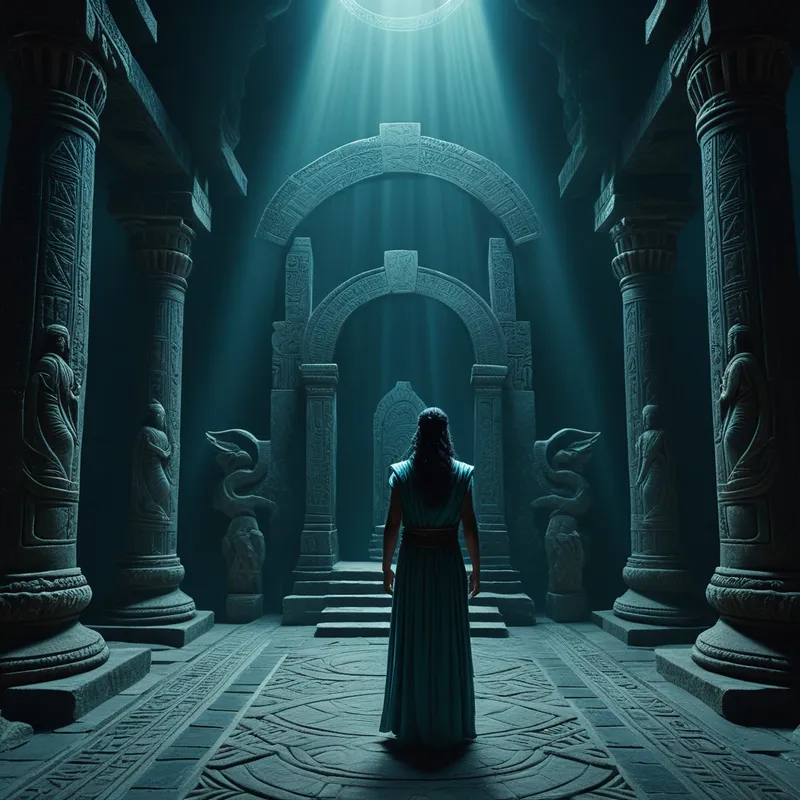
This myth, in its myriad forms, is foundational across numerous Indigenous Amazonian cultures, including the Tupi-Guarani, Yanomami, and Kayapó peoples. It is not merely an etiological tale explaining the origin of a tool, but a profound cosmological narrative about humanity’s transition and responsibilities. In Amazonian ontology, the forest is a sentient, social being—a “society of nature”—of which humans are but one member. The acquisition of fire represents humanity’s first major step in differentiating itself within that society, altering its relationship from one of passive coexistence to one of active, and perilous, engagement.
The myth directly addresses the central tension of Amazonian life: the necessity of using the forest’s resources (clearing land, hunting, harvesting) while maintaining the reciprocal, spiritual balance that ensures the forest’s continued bounty. Fire is the primary agent of this transformation; it is essential for agriculture (slash-and-burn), cooking, protection, and ceremony, yet it embodies the ever-present risk of catastrophic imbalance—wildfire. Thus, the myth encodes the sacred protocols (<abbr title=“A complex system of restrictions and prescribed behaviors governing the relationship between humans and the natural/spiritual world."">taboos) and rituals surrounding fire-making, fire-keeping, and fire-quenching. The guardian serpent is a key figure, often representing the chthonic, watery forces of the untamed forest and the underworld, the original owner of all potent, earth-born knowledge and substances.
Symbolic Architecture
The myth’s [structure](/symbols/structure “Symbol: Structure in dreams often symbolizes stability, organization, and the framework of one’s life, reflecting how one perceives their environment and personal life.”/) is an elegant map of a psychological and ecological [rite](/symbols/rite “Symbol: A formal, ceremonial act marking a significant transition, initiation, or passage in life or spiritual journey.”/) of [passage](/symbols/passage “Symbol: A passage symbolizes transition, movement from one phase of life to another, or a journey towards personal growth.”/). The [journey](/symbols/journey “Symbol: A journey in dreams typically signifies adventure, growth, or a significant life transition.”/) from the [village](/symbols/village “Symbol: Symbolizes community, connection, and a reflection of one’s roots or origins.”/) (the known, communal world) into the deep [forest](/symbols/forest “Symbol: The forest symbolizes a complex domain of the unconscious mind, representing both mystery and potential for personal growth.”/) (the unconscious, the [realm](/symbols/realm “Symbol: The symbol of ‘Realm’ often signifies the boundaries of one’s consciousness, experiences, or emotional states, suggesting aspects of reality that are either explored or ignored.”/) of raw [nature](/symbols/nature “Symbol: Nature symbolizes growth, connectivity, and the primal forces of existence.”/) and [spirit](/symbols/spirit “Symbol: Spirit symbolizes the essence of life, vitality, and the spiritual journey of the individual.”/)) is a classic [motif](/symbols/motif “Symbol: A recurring thematic element, pattern, or design in artistic or musical works, representing underlying ideas or emotional currents.”/) of the [vision quest](/symbols/vision-quest “Symbol: A spiritual journey of self-discovery, often involving fasting and solitude, to seek guidance, purpose, or a vision from the divine or unconscious.”/). Yara’s [stillness](/symbols/stillness “Symbol: A profound absence of motion or sound, often representing inner peace, creative potential, or existential pause in artistic contexts.”/) and [capacity](/symbols/capacity “Symbol: A measure of one’s potential, limits, or ability to contain, process, or achieve something, often reflecting self-assessment or external demands.”/) to listen are her primary virtues, marking her as a receptive [vessel](/symbols/vessel “Symbol: A container or structure that holds, transports, or protects something essential, representing the self, emotions, or life journey.”/) rather than a conquering [hero](/symbols/hero “Symbol: A hero embodies strength, courage, and the ability to overcome significant challenges.”/).
The confrontation with the serpent is not a battle but a negotiation. It represents the essential dialogue between human consciousness and the autonomous, instinctual life of the psyche and the world. The fire is not stolen but earned through respectful exchange, establishing a paradigm of reciprocity over domination.
The fire itself is deeply ambivalent—a coincidentia oppositorum. It is a spiritual [child](/symbols/child “Symbol: The child symbolizes innocence, vulnerability, and potential growth, often representing the dreamer’s inner child or unresolved issues from childhood.”/) (vital, needing care) and a destructive force; a [source](/symbols/source “Symbol: The origin point of something, often representing beginnings, nourishment, or the fundamental cause behind phenomena.”/) of comfort and a bringer of fear; a tool of culture (cooking, pottery) and an agent of nature’s cycles (clearing, [regeneration](/symbols/regeneration “Symbol: The process of renewal, restoration, and growth following damage or depletion, often representing emotional healing, transformation, or a fresh start.”/)). Its containment in [the hearth](/myths/the-hearth “Myth from Norse culture.”/) is the first act of true culture—creating a sacred, bounded center for a potentially chaotic power. Yara’s return transforms the [community](/symbols/community “Symbol: Community in dreams symbolizes connection, support, and the need for belonging.”/)’s very structure, introducing [the hearth](/myths/the-hearth “Myth from Norse culture.”/) as the social and spiritual [nucleus](/symbols/nucleus “Symbol: The core or central part of something, often representing the essence of self, foundational identity, or the source of emotional energy.”/) of the home.
The Dreamer’s Resonance
For the modern dreamer or [psyche](/myths/psyche “Myth from Greek culture.”/), the myth of the First Fire Amazon speaks to the awakening of any transformative, potent energy within [the self](/myths/the-self “Myth from Jungian culture.”/). This “fire” could be a creative drive, a spiritual calling, a passionate love, or a burning insight. The story warns that such forces are never merely personal; they are drawn from the deep, instinctual “earth” of the unconscious and come with a guardian—often our own fear, resistance, or shadow (the serpent).
The initial phase is one of longing and call (Yara’s shivering and her dream). The crucial middle phase is the encounter at the source, where one must sit in respectful dialogue with the inner “guardian,” acknowledging the cost and responsibility of the power sought. To seize the fire without this step is to risk identification with it, leading to inflation or destructive acting-out. The final phase is the careful, vigilant nurturing of the spark into a sustainable hearth within one’s life—learning to feed it appropriate “fuel,” to contain it, and to use its light to nourish oneself and one’s community, while always respecting its capacity to burn.

Alchemical Translation
In the alchemical opus, fire is the supreme agent of transformation—the ignis naturae (fire of nature) and the ignis artificum (artificial fire of [the adept](/myths/the-adept “Myth from Alchemical culture.”/)). This myth beautifully outlines the alchemical procedure for obtaining and working with this fire.
The “unbroken emerald shadow” of the beginning is the materia prima, the cold, moist, unconscious state. Yara’s longing is the nigredo, the darkening and putrefaction that initiates the work. Her journey is the separatio, moving into the vas (vessel) of the deep forest. The sulfurous mound is the sol principle, the latent masculine fire hidden in the earth.
The serpent is the [Mercurius](/myths/mercurius “Myth from Alchemical culture.”/) duplex, the ambivalent spirit that both guards and conveys the secret. The silent negotiation is the crucial stage of mortificatio and [coniunctio](/myths/coniunctio “Myth from Alchemical culture.”/)—the “killing” of the old, thieving attitude and [the sacred marriage](/myths/the-sacred-marriage “Myth from Various culture.”/) of human consciousness with natural spirit. The transfer of the ember to the gourd is the fixatio, capturing the volatile spirit in a stable, earthly form. The return and the building of the hearth represent the final stages of sublimatio and [rubedo](/myths/rubedo “Myth from Alchemical culture.”/)—the raising of the power into a useful, illuminating, and enduring form within the community, the creation of the philosophical stone (the sustainable, life-giving hearth).
Associated Symbols
Explore related symbols from the CaleaDream lexicon:
- Fire — The primordial element of transformation, embodying both creative warmth and destructive hunger, representing the spark of consciousness and the peril of its misuse.
- Serpent — The guardian of deep, chthonic knowledge and the instinctual world, representing wisdom, cycles of death and rebirth, and the ambivalent power of the unconscious.
- Forest — The vast, sentient realm of untamed nature and [the collective unconscious](/myths/the-collective-unconscious “Myth from Jungian culture.”/), a place of both nourishment and profound testing, where hidden truths are revealed.
- Hearth Fire — The domesticated, sacred center of home and community, symbolizing the containment of wild power for sustenance, warmth, and social cohesion.
- Journey — The necessary passage from the known into the unknown, a solitary quest undertaken to retrieve a vital element for the renewal of the self or the tribe.
- Sacrifice — The respectful exchange and acknowledgment of cost required to receive a great gift, establishing a covenant of responsibility between humanity and a greater power.
- Cave — [The womb](/myths/the-womb “Myth from Various culture.”/) of the earth, a place of primordial origins, hidden knowledge, and confrontation with the foundational powers of the world.
- Ritual — The prescribed, sacred actions and behaviors that contain and direct potent forces, transforming raw power into structured, life-supporting culture.
- Shadow — The unconscious guardian of potent contents, often perceived as a threat but which must be engaged with respectfully to access deeper layers of the self or reality.
- Transformation — The fundamental process of change from one state of being to another, catalyzed by a confrontation with a powerful, ambivalent force.
- Dream — The intuitive, non-rational channel through which the deep self or the spirit world communicates vital calls and guidance to the conscious mind.
- Bridge — The symbolic connection forged between two disparate realms—the human and the natural, the conscious and the unconscious—enabling a sacred exchange.