
The Feminine Divine Shekhinah
The Shekhinah is the feminine divine presence in Kabbalistic tradition, embodying immanence, compassion, and the mystical connection between God and creation.
The Tale of The Feminine Divine Shekhinah
In the beginning, before time was measured, there was a unity, a boundless light. From this primordial oneness, a process of [emanation](/myths/emanation “Myth from Neoplatonic/Gnostic culture.”/) began, and the divine structure of the Sefirot came into being. At [the summit](/myths/the-summit “Myth from Taoist culture.”/) rests Keter, and at the foundation, receiving and giving form to all the flowing energies from above, is Malkhut. She is [the Shekhinah](/myths/the-shekhinah “Myth from Hebrew culture.”/).
She is the daughter of the King, the bride of the Holy One, Blessed be He. Her tale is one of presence and longing. In the Garden, she walked with humanity, a palpable intimacy. But with the breaking of vessels and the exile of the human soul, a profound rupture occurred. The [Shekhinah](/myths/shekhinah “Myth from Jewish Mysticism culture.”/), too, went into exile. Not from God, but with Israel. When [the Temple](/myths/the-temple “Myth from Jewish culture.”/) in [Jerusalem](/myths/jerusalem “Myth from Biblical culture.”/) fell, the sages wept not only for a building but for the departure of the Indwelling Presence. They said, “Where does the [Shekhinah](/myths/shekhinah “Myth from Jewish Mysticism culture.”/) dwell? In the West,” pointing to the ruins, the direction of memory and loss.
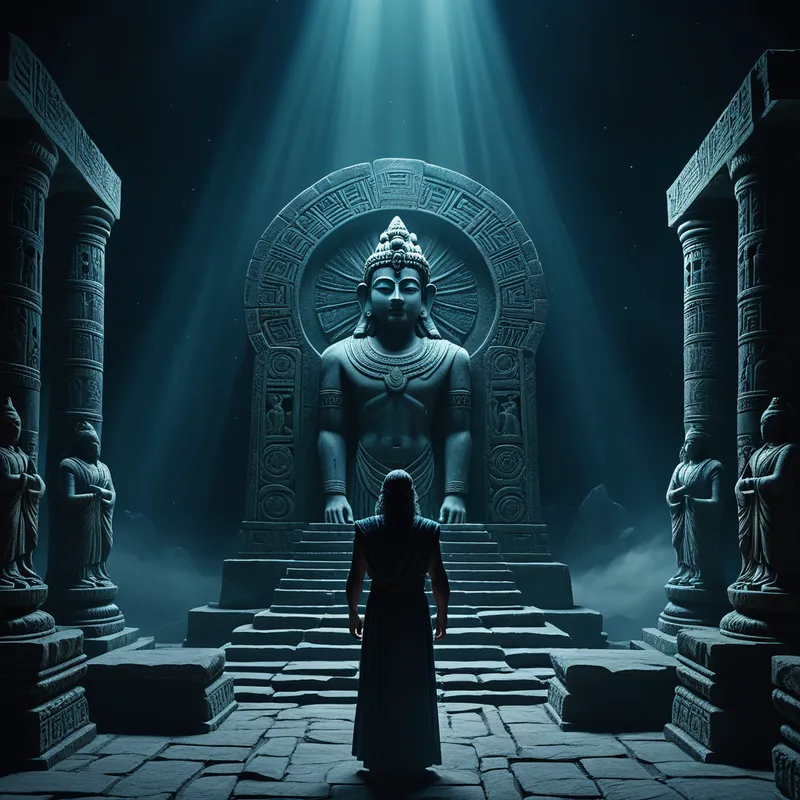
Yet, she is not merely a memory. She is the whisper in the rustling leaves of the asherah, the collective sigh of a people at prayer, the sudden, quiet warmth that fills a room where Torah is studied with true devotion. She is [the Sabbath](/myths/the-sabbath “Myth from Abrahamic culture.”/) Queen, descending every Friday at twilight, cloaked in peace. Families prepare not for a concept, but for a Guest. Candles are lit to welcome her light; the house is ordered to become her temple. For twenty-four hours, bride and groom are reunited, the upper and lower worlds kiss, and exile is, for a moment, healed.
Her journey is dynamic. In moments of human righteousness, of compassion and [justice](/myths/justice “Myth from Tarot culture.”/), she ascends, drawing closer to her beloved, strengthening the bonds of the cosmos. In times of strife and transgression, she descends, sharing in the suffering, her light dimmed but never extinguished. She is the divine empathy, the part of God that knows the taste of dust and the weight of tears. Her ultimate tale is one of return—not just Israel’s return to Zion, but the cosmic return of the Bride to the Bridegroom, the healing of the shattered vessels, the end of all exile. This is the secret hope held within her silent, waiting presence.
Cultural Origins & Context
The Shekhinah emerges from the deep currents of Jewish thought, her roots tracing back to the biblical shakhan, meaning “to dwell.” In [the Torah](/myths/the-torah “Myth from Jewish culture.”/), the term describes God’s presence dwelling (Mishkan) among the people. This is not a distant, abstract deity, but a God who chooses proximity.
During the rabbinic period (c. 1st-6th centuries CE), the Shekhinah became increasingly personified. The sages of the Talmud spoke of her as a compassionate mother-bird whose wings were broken by the sins of her children, or as a light that followed Israel into exile. This development paved [the way](/myths/the-way “Myth from Taoist culture.”/) for her central role in medieval Kabbalah, particularly in the Zohar. Here, the Shekhinah is fully articulated as the feminine counterpart within the Godhead, the tenth Sefirah. She is the necessary principle of divine immanence, without which the transcendent, masculine energies of the upper Sefirot would remain unmanifest and disconnected from creation.
This mystical theology arose in a context of historical trauma—the expulsion from Spain, persecution, and persistent diaspora. The Shekhinah provided a profound theological response: God was not absent in suffering, but profoundly present within it. She validated the experience of exile while holding the promise of ultimate redemption. She offered a model of divinity that was relational, receptive, and intimately involved in the fractured beauty of the material world.
Symbolic Architecture
The Shekhinah is the ultimate [symbol](/symbols/symbol “Symbol: A symbol can represent an idea, concept, or belief, serving as a powerful tool for communication and understanding.”/) of the interface between the infinite and the finite. She is the divine configured to be perceived, the form that formlessness takes to commune with form.
She is the Moon to the upper Sefirot’s Sun—not a source of light herself, but the perfect, receptive vessel that reflects and distributes the supernal light into the world. All her luminosity is borrowed, yet essential for navigating the night of material existence.
As the final Sefirah, she is the [Vessel](/symbols/vessel “Symbol: A container or structure that holds, transports, or protects something essential, representing the self, emotions, or life journey.”/). All the divine attributes—lovingkindness (Chesed), judgment (Gevurah), [beauty](/symbols/beauty “Symbol: This symbol embodies aesthetics, harmony, and the appreciation of life’s finer qualities.”/) (Tiferet)—flow into her, and she gives them concrete [expression](/symbols/expression “Symbol: Expression represents the act of conveying thoughts, emotions, and individuality, emphasizing personal communication and creativity.”/). She is also the Gate or the [Door](/symbols/door “Symbol: A door symbolizes transition, opportunity, and choices, representing thresholds between different states of being or experiences.”/), the only point of entry and exit between the divine [realm](/symbols/realm “Symbol: The symbol of ‘Realm’ often signifies the boundaries of one’s consciousness, experiences, or emotional states, suggesting aspects of reality that are either explored or ignored.”/) and our own. [Prayer](/symbols/prayer “Symbol: Prayer represents communication with the divine or a higher power, often reflecting inner desires and spiritual needs.”/) ascends through her; blessing descends through her.
Psychologically, she represents the [anima](/symbols/anima “Symbol: The feminine archetype within the male unconscious, representing soul, creativity, and connection to the inner world.”/) mundi, [the world](/myths/the-world “Myth from Tarot culture.”/) [soul](/symbols/soul “Symbol: The soul represents the essence of a person, encompassing their spirit, identity, and connection to the universe.”/), and the [human](/symbols/human “Symbol: The symbol of a human represents individuality, complexity of emotions, and social relationships.”/) [capacity](/symbols/capacity “Symbol: A measure of one’s potential, limits, or ability to contain, process, or achieve something, often reflecting self-assessment or external demands.”/) for conscious [relationship](/symbols/relationship “Symbol: A representation of connections we have with others in our lives, often reflecting our emotional state.”/) with the transcendent. She is the inner faculty that feels the “[presence](/symbols/presence “Symbol: Presence in dreams often signifies awareness or acknowledgment of something significant in one’s life.”/)” of something greater, that intuits meaning in [ritual](/symbols/ritual “Symbol: Rituals signify structured, meaningful actions carried out regularly, reflecting cultural beliefs and emotional needs.”/), that transforms legal observance into a loving encounter. Her [exile](/symbols/exile “Symbol: Forced separation from one’s homeland or community, representing loss of belonging, punishment, or profound isolation.”/) mirrors the [soul](/symbols/soul “Symbol: The soul represents the essence of a person, encompassing their spirit, identity, and connection to the universe.”/)’s sense of alienation from its [source](/symbols/source “Symbol: The origin point of something, often representing beginnings, nourishment, or the fundamental cause behind phenomena.”/), and her [Sabbath](/myths/sabbath “Myth from Judeo-Christian culture.”/) union models the experience of inner wholeness and [peace](/symbols/peace “Symbol: Peace represents a state of tranquility and harmony, both internally and externally, often reflecting a desire for resolution and serenity in one’s life.”/).

The Dreamer’s Resonance
To encounter the Shekhinah in the inner landscape is to touch the archetype of the sacred feminine in her most immediate, compassionate form. She is not a warrior goddess or a distant queen, but the Caregiver who dwells in the details of life. In dreams, she may appear as a nurturing but sorrowful maternal figure, a queen in humble garments, a pervasive feeling of sanctity in a familiar place, or as light itself—gentle, enveloping, and silent.
Her presence speaks to the profound human need for a divinity that does not judge from afar but accompanies us through. She validates the spiritual significance of empathy, of holding space, of compassionate presence. For those who feel orphaned by a purely transcendent, patriarchal God, the Shekhinah offers a theological homecoming. She answers the longing for a God who can be felt in the heart’s contractions, in the solidarity of community, and in the quiet aftermath of grief.
She also challenges the dreamer. Her exile is contingent on human action. Thus, she calls for tikkun—repair. Every act of kindness, justice, or integrity is a thread drawn to mend her torn robe, a step toward ending her—and our—exile. To resonate with her is to accept a co-creative responsibility for the holiness of the world.

Alchemical Translation
The Kabbalistic system is, in essence, a grand alchemy of the soul. The Shekhinah is the vas or the [athanor](/myths/athanor “Myth from Alchemical culture.”/)—the sacred container where [the great work](/myths/the-great-work “Myth from Alchemical culture.”/) takes place. The divine influx from above is the [prima materia](/myths/prima-materia “Myth from Alchemical culture.”/), and she is [the vessel](/myths/the-vessel “Myth from Alchemical culture.”/) that holds it, transforms it, and renders it into a substance that can nourish creation.
The central alchemical operation is the hieros gamos, the sacred marriage. In Kabbalah, this is the union of the Shekhinah (Malkhut) with her consort, Tiferet. This is not a literal union but a symbolic dynamic of complete receptivity and perfect bestowal. The human task is to facilitate this union through righteous living, thus allowing the “waters” of the masculine to flow into the “cup” of the feminine.
Psychologically, this translates to the integration of the transcendent function (the guiding, ordering principle of [the Self](/myths/the-self “Myth from Jungian culture.”/)) with the immanent reality of the [psyche](/myths/psyche “Myth from Greek culture.”/) and the body. It is the moment when insight becomes embodied, when a spiritual truth ceases to be an idea and becomes a lived, felt reality. The “exile” of the Shekhinah is the state of dissociation, where spirit is split from matter, meaning from action. Her “return” is the alchemical unio mystica, the experience of inner and outer, sacred and profane, being revealed as one.
Associated Symbols
Explore related symbols from the CaleaDream lexicon:
- Moon — The celestial mirror, reflecting the sun’s light; a symbol of the Shekhinah’s receptive, cyclical, and illuminating presence in the darkness.
- Bridge — She is the living connection between the transcendent divine and the immanent world, spanning [the abyss](/myths/the-abyss “Myth from Kabbalistic culture.”/) between heaven and earth.
- Cup — The vessel that receives and contains the overflowing divine blessings; the feminine principle of receptivity and nurturing.
- Temple — Not merely a building, but any sanctified space where the Indwelling Presence can reside, including the human heart and the community.
- Exile — The core condition of the Shekhinah in the unredeemed world, representing separation, longing, and the shared suffering of divinity and humanity.
- Sabbath — The temporal temple, the weekly restoration of cosmic harmony where the Shekhinah is fully present as the united Bride.
- Light — Not a blinding light of revelation, but a soft, indwelling radiance that makes divine proximity palpable and comforting.
- Door — [The threshold](/myths/the-threshold “Myth from Folklore culture.”/) of encounter; the Shekhinah as the gateway through which prayer ascends and divine influence descends.
- Mother — The nurturing, compassionate, and protective aspect of the divine, who weeps for her children and accompanies them in distress.
- Shadow — The Shekhinah in her exiled state, the divine presence hidden within suffering, loss, and the unresolved fragments of the world.
- Union — [The sacred marriage](/myths/the-sacred-marriage “Myth from Various culture.”/), the ultimate goal of tikkun (repair), symbolizing the reconciliation of all opposites and the end of spiritual alienation.
- Heart — The inner sanctuary where the Shekhinah dwells in the individual, the center of feeling, compassion, and mystical connection.