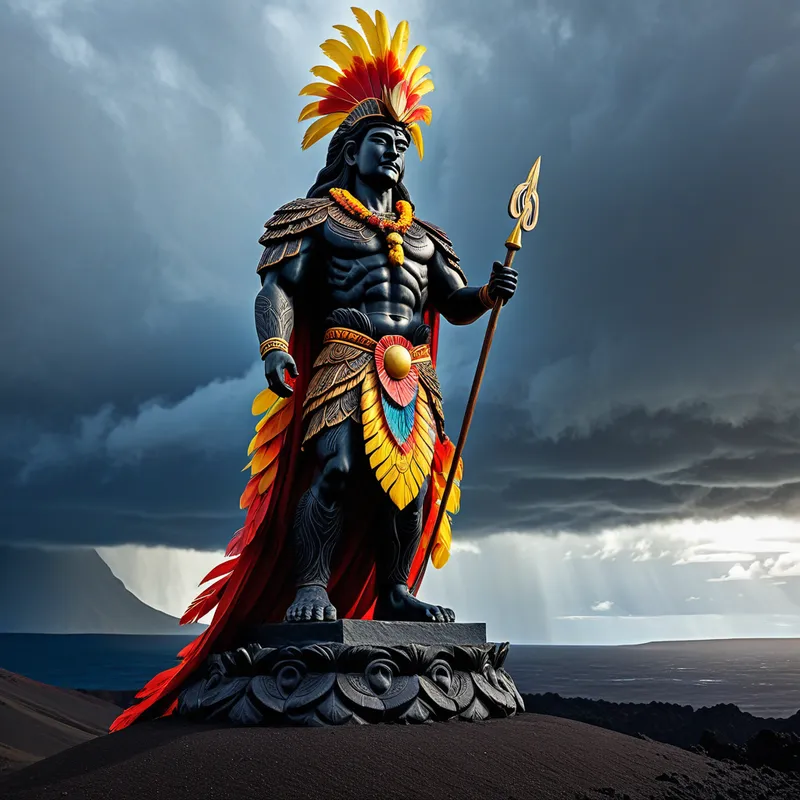
The Feathered God Ku Myth Meaning & Symbolism
A myth of the Hawaiian god Ku, whose sacrifice and transformation from a god of war to a life-giving force reveals the sacred cycle of death and renewal.
The Tale of The Feathered God Ku
Listen. Before the songs of men, when the land was raw stone and the sea a newborn’s cry, there was a stillness. A waiting. In that primal quiet stood Ku, the Unmoved. His form was like the dark basalt of the cliffs, his gaze the unblinking sun at its zenith. He was the god of the standing one, the upright spear, the firmament that holds the sky apart from the earth. His realm was the fierce order of the warrior, the clear boundary, the decisive act.
But a world of only standing stones is a dead world. The people, born from the very breath of the gods, struggled. The uala</abbr> vines were thin, the fish scarce, the children’s cries a constant wind. The other great gods—Kanaloa, Lono—offered their gifts, but the foundation was brittle. The world needed a deeper nourishment, a sacrifice that would root life into the very bones of the earth.
Ku looked upon his creation, upon the fragility he had helped frame. He did not speak, for his nature was action. In the sacred grove of wauke and towering iliahi</abbr>, he called to the master carvers. “Take my form,” his silence commanded. “Not as I am in the heavens, but as I must become for the earth.”
And so they carved. From the heartwood of the great koa tree, they shaped his fierce visage, his powerful limbs, his stance of eternal vigilance. This was the first kii</abbr>. But the carving was not the god; it was an empty vessel, a promise. Then began the great work, the act of binding heaven to earth. From the forests came the hunters, moving with the silence of Io, the hawk. They sought not for meat, but for glory—the tiny, brilliant feathers of the iiwi and the apapane. Bird by bird, a single feather gifted, a life released back to the forest spirit.
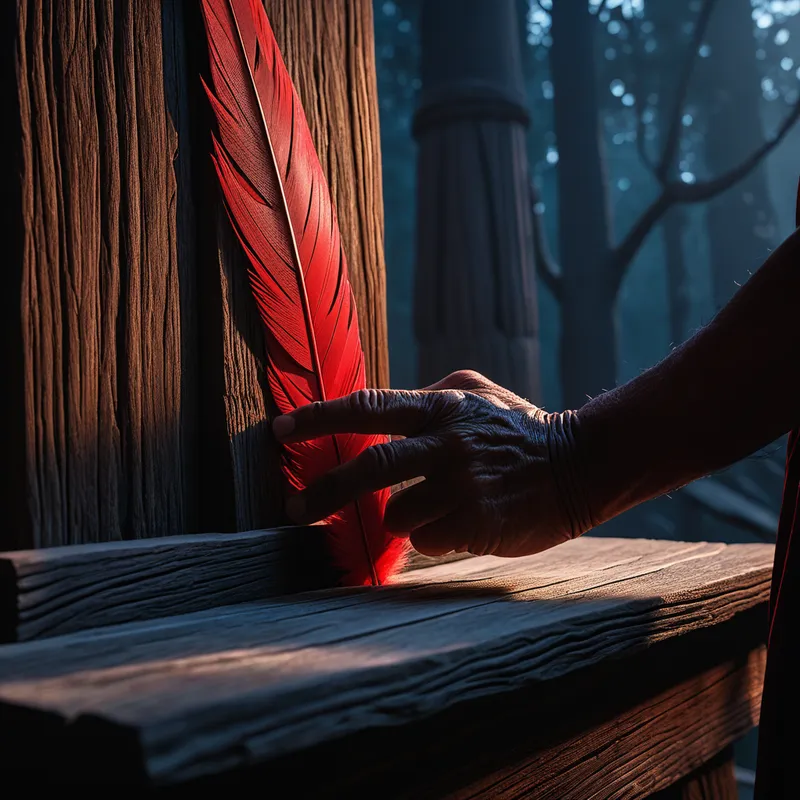
For generations, the work continued. A net of olona cord was woven over the wooden form, a lattice waiting for light. And feather by precious feather, each tied with a prayer, the cloak was built. A cascade of crimson, the color of life-blood and sacred power, of the setting sun that promises a new day. Yellow feathers, like captured sunlight, traced patterns of lineage and connection. The akua hulu manu was born.
In the moment the final feather was knotted, a great sigh moved through the world. The rigid, standing god had poured himself into this new, vibrant form. The sacrifice was complete. Ku, the god of war, had become Ku-kaili-moku, Ku the Snatcher of Land, but also Ku of the Life-Giving Feathers. His fierce energy was now channeled, not for destruction alone, but for the fierce protection of life’s fertility. Where his feathered gaze fell, the uala swelled in the soil, the taro ponds grew rich, and the people thrived. He stood no longer as a distant pillar, but as a woven bridge, his very body a testament that the highest power must stoop to be touched, must be clothed in the fragile, beautiful stuff of the world to make it sacred.
Cultural Origins & Context
This myth is not a single story from a book, but the living spine of pre-contact Hawaiian cosmology and kingship. It was breathed into existence through the oli (chants) of the kahuna (priests) and realized in the most sacred political act: the creation of the feathered god images for the <abbr title="The high chief, a descendant of the gods">alii nui. The process of feather gathering and cloak-making was a state-level, ritualized activity that could take decades, binding the entire society to the god’s service.
The myth was performed, not merely told. It encoded the fundamental Hawaiian principle of pono—right relationship and balance. The god’s “sacrifice” of his static, heavenly form mirrored the people’s sacrifice of time, labor, and the precious life of the birds. In return, Ku bestowed mana upon the land and legitimacy upon the ruler who cared for his image. The feathered Ku was the ultimate symbol of the covenant between the gods, the land (`aina), and the people. His presence in the heiau was a constant reminder that order (Ku) must be infused with the generative, connective life-force (Lono) to sustain a civilization.
Symbolic Architecture
At its core, the myth of the Feathered God Ku is a profound [allegory](/symbols/allegory “Symbol: A narrative device where characters, events, or settings represent abstract ideas or moral qualities, conveying deeper meanings through symbolic storytelling.”/) for the transformation of raw, undifferentiated power into conscious, [life](/symbols/life “Symbol: The symbol of ‘Life’ represents a journey of growth, interconnectedness, and existential meaning, encompassing both the joys and challenges that define human experience.”/)-sustaining [structure](/symbols/structure “Symbol: Structure in dreams often symbolizes stability, organization, and the framework of one’s life, reflecting how one perceives their environment and personal life.”/). Ku begins as pure archetypal masculine principle: will, [boundary](/symbols/boundary “Symbol: A conceptual or physical limit defining separation, protection, or identity between entities, spaces, or states of being.”/), assertion. This is necessary—without the “standing [stone](/symbols/stone “Symbol: In dreams, a stone often symbolizes strength, stability, and permanence, but it may also represent emotional burdens or obstacles that need to be acknowledged and processed.”/),” there is no form. But in its pure state, it is sterile, even destructive.
The sacrifice is not a loss, but a translation. The god must die to his absolute nature to be born into relationship.
The wooden ki`i represents the [skeleton](/symbols/skeleton “Symbol: A skeleton symbolizes the foundational aspects of life and mortality, representing both the physical body and the spiritual essence of being.”/), the underlying [framework](/symbols/framework “Symbol: Represents the underlying structure of one’s identity, emotions, or life. It signifies the mental or emotional scaffolding that supports or confines the self.”/) of [identity](/symbols/identity “Symbol: Identity represents the sense of self, encompassing personal beliefs, cultural background, and social roles.”/) or a cultural [system](/symbols/system “Symbol: A system represents structure, organization, and interrelated components functioning together, often reflecting personal or social order.”/). It is rigid, defining shape but lacking vitality. The feathers represent the [soul](/symbols/soul “Symbol: The soul represents the essence of a person, encompassing their spirit, identity, and connection to the universe.”/), the countless individual acts of [beauty](/symbols/beauty “Symbol: This symbol embodies aesthetics, harmony, and the appreciation of life’s finer qualities.”/), [attention](/symbols/attention “Symbol: Attention in dreams signifies focus, awareness, and the priorities in one’s life, often indicating where the dreamer’s energy is invested.”/), and life that must be gathered and integrated. The red feathers, from the honeycreepers that sip the nectar of flowers, are particularly potent. They symbolize the transformation of something fleeting and wild (the [bird](/symbols/bird “Symbol: Birds symbolize freedom, perspective, and the connection between the earthly and spiritual realms, often representing the soul’s aspirations or personal growth.”/)’s life, the flower’s [bloom](/symbols/bloom “Symbol: Represents growth, vitality, and the flourishing of potential, often tied to emotional awakening or physical health.”/)) into a permanent, concentrated [source](/symbols/source “Symbol: The origin point of something, often representing beginnings, nourishment, or the fundamental cause behind phenomena.”/) of spiritual power—the [alchemy](/symbols/alchemy “Symbol: A transformative process of purification and creation, often symbolizing personal or spiritual evolution through difficult stages.”/) of instinct into sacred [symbol](/symbols/symbol “Symbol: A symbol can represent an idea, concept, or belief, serving as a powerful tool for communication and understanding.”/).
The final feathered god is the integrated Self. It is the [warrior](/symbols/warrior “Symbol: A spiritual archetype representing inner strength, discipline, and the struggle for higher purpose or self-mastery.”/)’s [strength](/symbols/strength “Symbol: ‘Strength’ symbolizes resilience, courage, and the ability to overcome challenges.”/) clothed in the [artist](/symbols/artist “Symbol: An artist symbolizes creativity, expression, and the exploration of the human experience through various forms of art.”/)’s sensitivity, the ruler’s [authority](/symbols/authority “Symbol: A symbol representing power structures, rules, and control, often reflecting one’s relationship with societal or personal governance.”/) rooted in the [caretaker](/symbols/caretaker “Symbol: A figure representing nurturing, responsibility, and protection, often symbolizing internal or external support systems.”/)’s devotion. It teaches that true power ([mana](/symbols/mana “Symbol: A spiritual energy or life force in Polynesian cultures, now widely adopted in gaming as a resource for magical abilities.”/)) is not brute force, but the [capacity](/symbols/capacity “Symbol: A measure of one’s potential, limits, or ability to contain, process, or achieve something, often reflecting self-assessment or external demands.”/) to attract, contain, and beautifully manifest the fragmented, beautiful energies of the world.
The Dreamer’s Resonance
When this myth stirs in the modern psyche, it often surfaces in dreams of profound personal transformation, where an old, rigid structure of the self is being dismantled to make way for a new, more vibrant identity. One might dream of a stern, stone-like figure (an inner critic, an outdated father-complex, a rigid career identity) that begins to crack. From the cracks, vibrant red flowers bloom or birds take flight.
Somatically, this process can feel like a deep, necessary exhaustion—the “carving” away of an old way of being. This is followed by a period of meticulous, often frustrating, gathering—the “feather work.” This corresponds to the conscious, patient effort of therapy, artistic practice, or spiritual discipline, where one collects the scattered, beautiful insights and experiences that feel true to the emerging self. The final act of “tying on the feather” in a dream can manifest as a moment of profound integration—a sense that a long struggle has coalesced into a new, empowered, and authentic way of standing in the world. The dreamer is becoming their own akua hulu manu, weaving their disparate parts into a sovereign whole.
Alchemical Translation
The individuation journey mapped by Ku’s myth is the opus contra naturam—the work against one’s own initial, unconscious nature. The first stage is Recognizing the Stone God: confronting the inner Ku, the hardened patterns of will, defense, and control that have provided structure but now constrict growth. This is the critical ego-function that says “I am this,” but it has become a prison.
The alchemical mortificatio or sacrifice is the voluntary dissolution of this identification. “I am not only this.” This is the carving, the painful but conscious decision to let the old self-image be shaped into a vessel for something greater.
The nigredo, the blackening, is the empty wooden frame—the terrifying void after the old god has stepped down, before the new one is woven.
The albedo, the whitening, is the meticulous gathering of the feathers. This is the analysis, the gathering of soul-images (archetypes), memories, and creative sparks that have been neglected. Each feather is a piece of living truth, a recovered instinct or beauty.
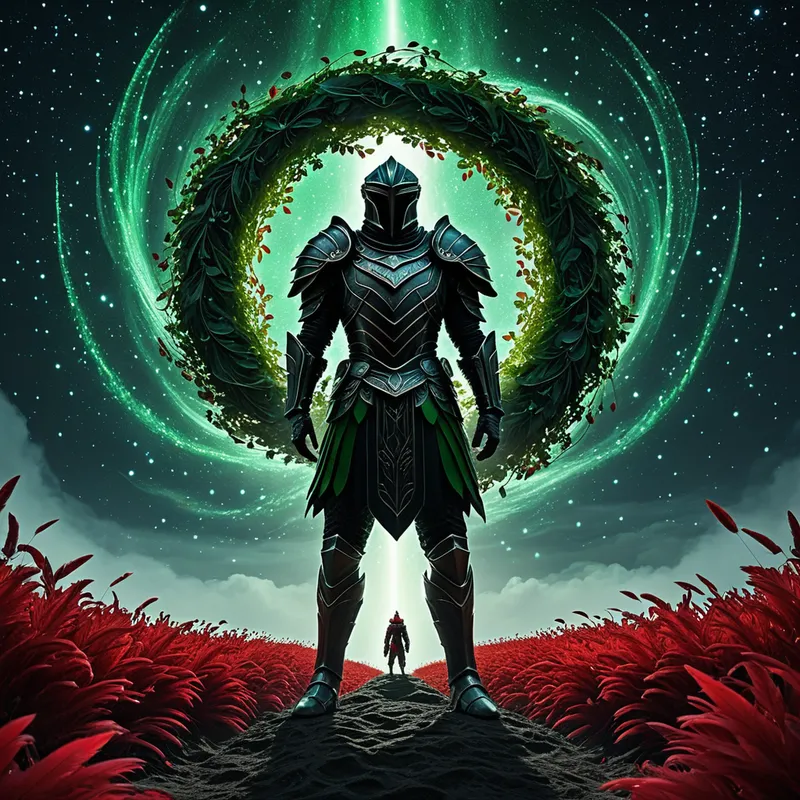
Finally, the rubedo, the reddening, is the integration. The feathered cloak is the new, vibrant personality—the Philosopher’s Stone of the psyche. The raw power of the Self is no longer projected outward as blind aggression or rigid dogma but is worn as a majestic, life-affirming garment. The individual becomes a conduit, a “snatcher of land” in the sense of claiming their own inner territory, and a giver of life through their now-authentic presence in the world. They have achieved a state of pono within themselves, where order and fertility, structure and flow, are in sacred marriage.
Associated Symbols
Explore related symbols from the CaleaDream lexicon:
- Feathered Cape — The ultimate symbol of transformed power, representing the meticulous integration of countless individual acts of beauty, sacrifice, and attention into a garment of divine authority and connection.
- Sacrifice — The core dynamic of the myth; not a loss, but the essential act of translating a higher, abstract power (the god) into a form that can nourish and sustain concrete, earthly life.
- God — Represents the archetypal realm of pure principle and power (Ku as war, order) that must engage with the mortal world to fulfill its purpose and become truly whole.
- Order — The fundamental principle Ku initially embodies; the necessary structure, boundary, and hierarchy that provides the stable framework upon which the vibrant cloak of life can be woven.
- Tree — The source of the wooden ki`i, symbolizing the living framework of identity, culture, and the Self, rooted in the earthly realm but aspiring skyward.
- Bird — The source of the feathers, representing the free, instinctual, and spiritual aspects of the psyche that must be respectfully gathered and integrated into the conscious structure.
- Red — The color of the sacred
iiwi feathers, symbolizing life-blood, divine mana, sacrificial love, and the vibrant, passionate energy that animates a once-static form. - Temple — The heiau where the feathered god resides, representing the consecrated inner space where this alchemical transformation of the self is enacted and honored.
- Warrior — The initial, unrefined aspect of Ku, representing the psychic energy of assertion, protection, and will that is the raw material for the transformative work.
- Ritual — The prescribed, sacred process of carving, gathering, and weaving that transforms the myth from story into lived reality, mirroring the disciplined inner work of individuation.
- Light — The divine mana that fills and radiates from the completed feathered image, symbolizing the enlightenment and spiritual potency achieved through complete integration.