The Feast of the Dead / Día de Muertos Myth Meaning & Symbolism
A sacred pact between worlds, where love and remembrance build a bridge of marigolds for the souls of the departed to return and feast.
The Tale of The Feast of the Dead / Día de Muertos
Listen. The veil is thin. In the time before time, when the world was raw and the gods walked closer, there was a silence in the land of the living—a hollow ache. The dead were gone, truly gone, vanished into the silent kingdom of Mictlán, ruled by the skeletal lords Mictlantecuhtli and his consort Mictecacíhuatl. Their realm was a place of stillness, of dust and shadows, where memory did not reach and love could not cross the great divide. The living mourned in perpetual gray, their songs muted, their tables set for one less, their hearts heavy with unspoken words.
But in one village, a warrior’s daughter named Xóchitl could not bear the silence. Her father had fallen in battle, and his absence was a cold stone in her chest. While others accepted the separation, she raged against it. She went to the elders, to the priests, and asked the forbidden question: “Why must love end at the grave?” They spoke of the natural order, of the nine treacherous rivers of Mictlán, of the finality decreed by the gods of death. Yet, in her heart, a seed of defiance sprouted.
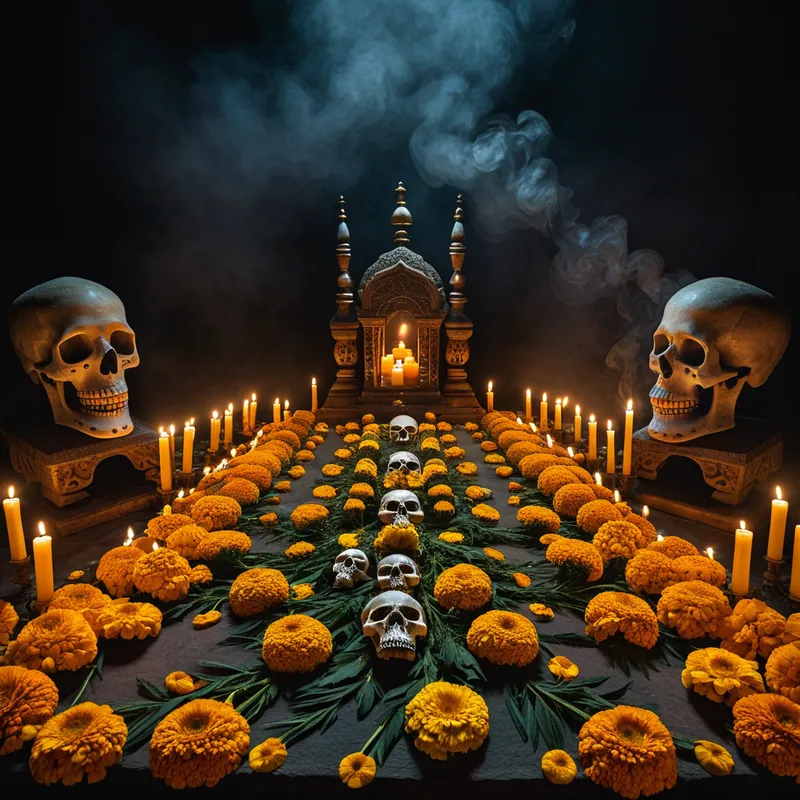
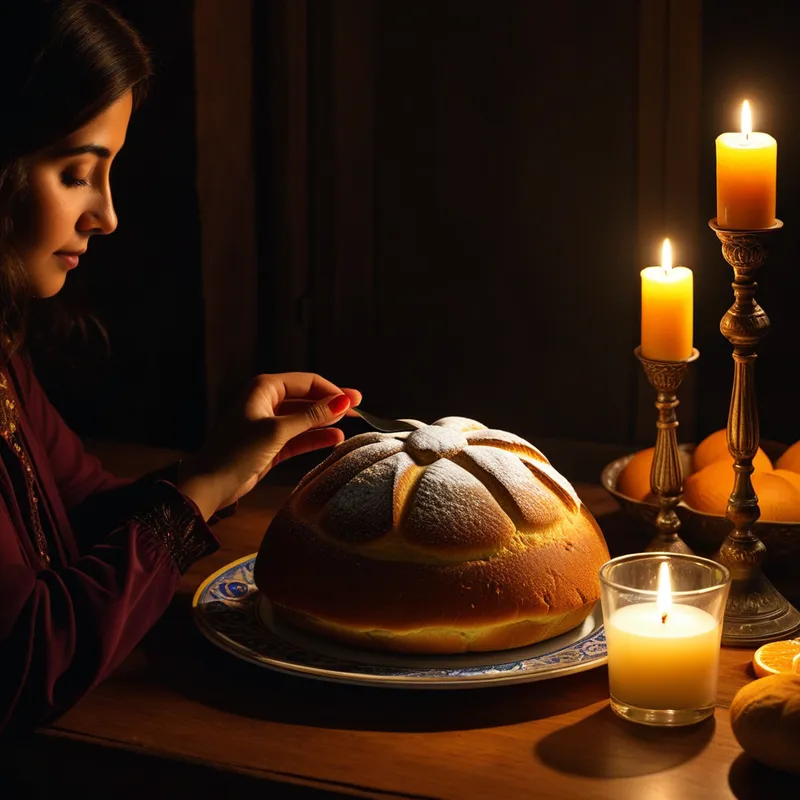
Driven by a love that refused to be bound by earth or bone, Xóchitl embarked on a pilgrimage not of conquest, but of devotion. She did not seek weapons, but offerings. She gathered the brightest marigolds, whose scent was like the sun itself. She baked the sweetest pan de muerto, shaped like bones, anointed with orange blossom. She prepared her father’s favorite foods, roasted meats and spiced chocolate, and laid out clear water to quench a long journey’s thirst. She did not build an altar in a temple, but in her own home, at the heart of her hearth.
As the sun set on the days dedicated to the forgotten, Xóchitl lit copal incense, its sacred smoke curling into the twilight like a prayer given form. She sang her father’s favorite songs, her voice trembling but clear. She spoke to the empty chair, telling him of the harvest, of his grandson’s first steps, of her enduring love. She wept, and her tears fell upon the marigold petals.
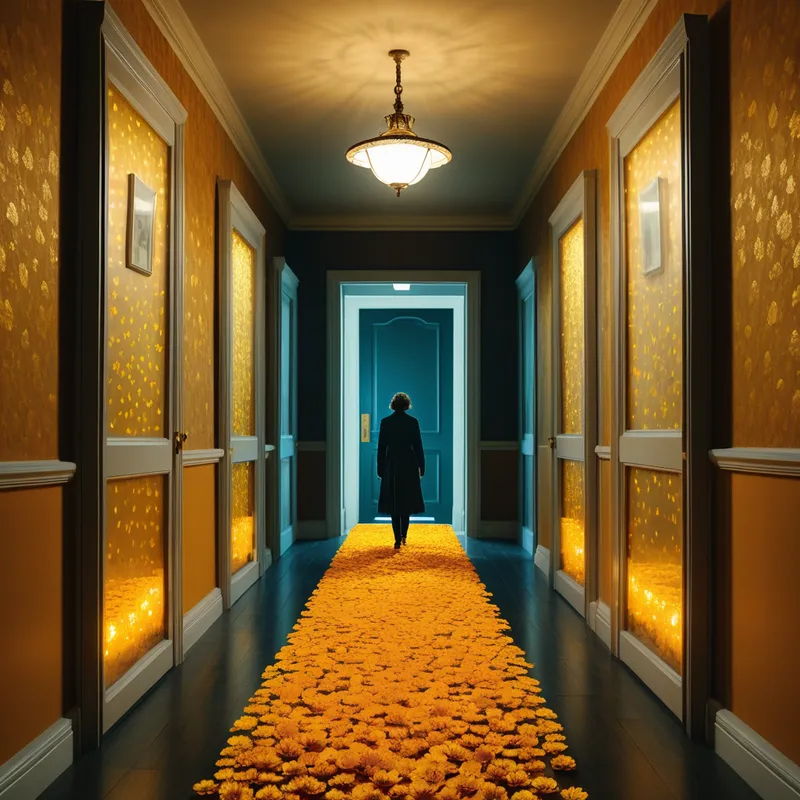
And a miracle, quiet and profound, unfolded. The scent of the marigolds, carried by the smoke and her unwavering love, did not dissipate into the air. Instead, it coalesced, forming a bridge of luminous orange-gold light. It pierced the veil, a fragrant path cutting through the gloom of Mictlán. The skeletal lords, Mictlantecuhtli and Mictecacíhuatl, beheld this bridge not as an invasion, but as an invitation woven from pure remembrance. They were not angered, but moved. For the first time, the silence of their realm was touched by the music of memory.
Along that bridge of flowers and faith, the souls of the departed began to walk. Not as ghosts, but as welcomed guests, drawn by the warmth of their names being spoken, the pull of their favorite tastes, the light of a candle lit just for them. Xóchitl’s father arrived, not as a warrior, but as a smiling essence of love. They feasted together—not on the physical food, but on its essence, on the joy of connection renewed. For two nights, the village was alive with a second, softer population. Laughter echoed from empty spaces, a cool breeze that was a caress passed through warm rooms, and a profound peace settled over the living.
When dawn came, the souls returned along the fading bridge, not with sorrow, but with contentment, their spiritual hunger sated for another year. Mictlantecuhtli and Mictecacíhuatl, witnessing this sacred exchange, decreed that henceforth, the gates of Mictlán would open each year when the living, with clean hearts and clear memory, built bridges of love. Thus, the Feast of the Dead was born—not from a battle, but from a daughter’s devotion, a pact sealed between the realms of the living and the dead.
Cultural Origins & Context
This mythic tapestry is woven from deep indigenous Mesoamerican threads, primarily from the Aztec (Mexica), Purépecha, and Nahua peoples, later syncretized with Spanish Catholic traditions. For cultures like the Aztecs, death was not an end but a phase in a cyclical continuum. The ruler of the underworld, Mictlantecuhtli, was a central deity, and the journey through his nine-level realm, Mictlán, was a central cosmological concept. The modern Día de Muertos is not a single myth from one text, but a living narrative tradition, passed down through oral history, ritual practice, and family custom.
Its societal function was and remains profound: it is a cultural technology for grief. It provided a sanctioned, communal framework for confronting mortality, not with terror, but with ritualized respect and even celebration. It reinforced family and community bonds across generations, literally inviting ancestors to the table. The storytellers were grandmothers arranging ofrendas, fathers explaining the symbols on sugar skulls, and whole communities gathering in cemeteries for all-night vigils. It taught that the dead remain part of the social fabric, and that remembrance is a duty and a joy that sustains both worlds.
Symbolic Architecture
At its core, the myth is a symbolic map for navigating the most fundamental human anxiety: the fear of oblivion and the pain of separation. It asserts that consciousness and relationship can transcend physical decay.
The altar is not for the dead; it is a mirror for the living, a structured space where memory is made tangible and love performs its alchemy.
The marigold bridge is the central symbol—it represents the active faculty of memory and devotion, the psychic energy required to maintain connection. The ofrenda itself is a mandala of offering: water for the soul’s thirst, salt for purification, food for sustenance, candles as guiding light, and photographs as anchors of identity. The skeletal figures, the calacas, are not symbols of horror but of egalitarian humor and the essential, stripped-down self that remains after all worldly distinctions fade. Mictecacíhuatl, transformed into the modern Catrina, mocks the vanity of social status, reminding us that death is the great equalizer.
Psychologically, the myth represents the ego’s conscious effort to integrate the contents of the personal and collective unconscious—the “dead” or repressed aspects of our psyche, our forgotten memories, ancestral patterns, and unlived potentials. The “feast” is the act of bringing these contents to the table of consciousness, acknowledging them, and thereby robbing them of their haunting power.
The Dreamer’s Resonance
When this myth surfaces in modern dreams, it often signals a process of psychic integration related to loss, legacy, or forgotten parts of the self. Dreaming of preparing a lavish meal for unseen guests, wandering in a vibrant but empty festival, or encountering a deceased loved one who is peaceful and communicative points to this archetypal pattern at work.
Somatically, this may coincide with a feeling of “hollow” grief in the chest or a weight of unexpressed emotion. The dream is the psyche’s ritual. Building an altar in a dream is the mind structuring itself to process a complex emotion. Meeting the dead in a friendly, festive setting suggests the dreamer is moving from a state of traumatic rupture to one of reconciled connection. The dream is an internal Día de Muertos, where the conscious self (the living) creates the conditions (the ofrenda of attention) to safely commune with aspects of the self or relationships that have been “laid to rest” but not properly honored.
Alchemical Translation
The alchemical journey modeled here is the transmutation of nigredo—the blackening of grief, loss, and alienation—into the albedo and citrinitas of illuminated memory and ongoing relationship. The modern individual’s “Mictlán” is the shadowland of repression, unresolved grief, familial trauma, or personal history we have tried to leave behind. The lords of this realm are our own resistances: denial, fear of pain, and the belief that what is past is utterly lost.
Individuation requires we become the faithful daughter, Xóchitl, for our own inner dead. We must build the altar of conscious attention and lay out the offerings of honest feeling.
The “marigold path” is cultivated through practices of active remembrance: journaling, therapy, art, genealogy, or simple, dedicated reflection. The “feast” is the moment of integration, where the reclaimed memory or accepted loss is no longer a source of poison, but of nourishment. It ceases to be a ghost that haunts and becomes an ancestor that guides. This ritual, internalized, allows us to carry our dead—our past selves, our losses, our heritage—not as burdens, but as companions. We achieve a psychic state where nothing human is alien, where the continuum of our being is acknowledged, and where life is lived more fully because we have made peace with the presence of absence. In honoring our dead, we ultimately sanctify our own living.
Associated Symbols
Explore related symbols from the CaleaDream lexicon: