The Exodus Myth Meaning & Symbolism
A people enslaved cry out. A reluctant prophet confronts a divine power. Plagues fall, a sea parts, and a nation is born in the desert's crucible.
The Tale of The Exodus
Hear now the tale of the groaning. For four hundred years, the sound rose from the mud-brick pits of Goshen, a low thunder of crushed spirits beneath the Egyptian sun. The descendants of Jacob were no longer guests but chattel, their lives measured in bricks, their backs bent under the whips of taskmasters.
And the groaning pierced the heavens.
In the barren silence of Sinai, a shepherd named Moses, a fugitive prince, tended another man’s flock. There, a bush blazed with unearthly fire, leaves curling in gold and crimson flame, yet it was not consumed. From its heart spoke a Voice that was both whisper and earthquake, naming itself YHWH, the God of his forgotten fathers. “I have seen the affliction of my people. I have heard their cry. I will deliver them. You will go to Pharaoh, and you will say, ‘Let my people go.’”
Trembling, Moses returned to the jeweled court of the Pharaoh, a place of cold granite and colder hearts. His plea was met with scorn. “Who is this YHWH that I should obey his voice?” And so, the contest of wills began, a duel between the god-king of the Nile and the God of the slaves.
The river, Egypt’s lifeblood, turned to blood, thick and foul. Frogs erupted from the ooze, covering the land in a living, croaking carpet. Gnats and flies became a tormenting plague. Livestock died in the fields. Boils broke upon human skin. Hail, fire, and ice rained from the sky. Locusts descended like a living darkness, devouring every green shoot. Finally, a palpable, suffocating darkness fell—a darkness one could feel. Through each terror, Pharaoh’s heart hardened, a will of stone against the divine imperative.
Then came the final, dreadful night. The Israelites were instructed: take an unblemished lamb, sacrifice it, and mark your doorposts with its blood. Roast the meat, eat it with haste, staff in hand. For at midnight, the Destroyer would pass through the land. In the Egyptian homes, a cry of unimaginable grief erupted—the firstborn of every household, from the dungeon to the throne, lay dead. In the homes marked with blood, there was only the tense silence of waiting. Broken, Pharaoh relented. “Go!”
They fled, a ragged column of hundreds of thousands, into the desert’s jaw. But Pharaoh’s rage reignited. His chariots, gleaming bronze and swift horses, thundered after them, trapping the fugitives against the shores of the Sea of Reeds. Panic seized the people. They turned on Moses. “Were there no graves in Egypt, that you have brought us here to die?”
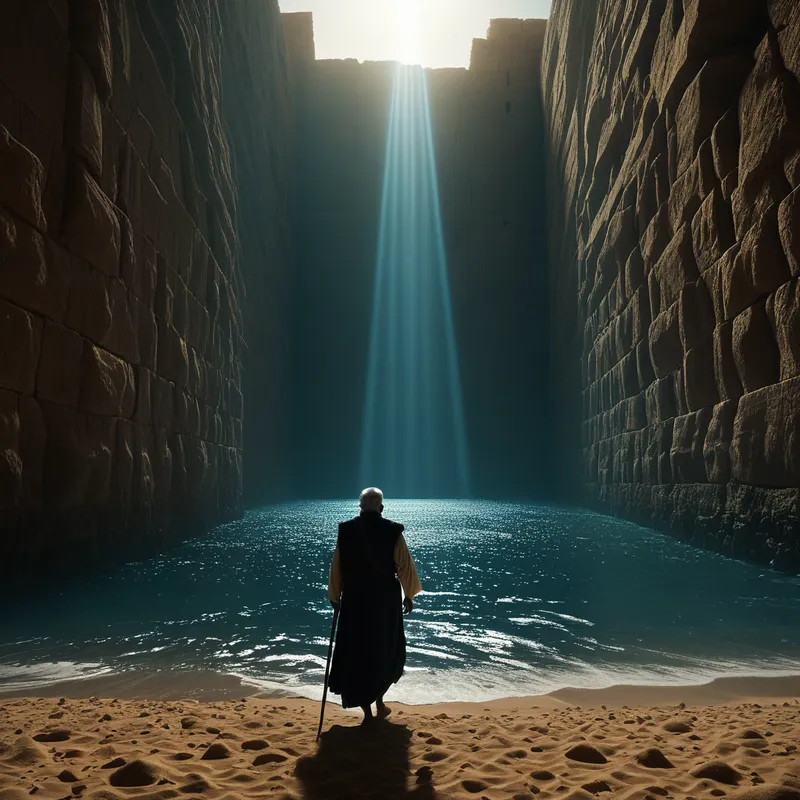
Then Moses raised his staff over the waters. And a wind from the east, a roaring, divine breath, blew all that night. It drove the sea back, heaping the waters into towering, glassy walls, revealing a path of damp, firm earth through the deep. The people walked between the liquid mountains, their footsteps silent in the awe. The Egyptians followed, but the wheels of their chariots clogged in the mud. As the last Israelite reached the far shore, Moses stretched out his hand again. The walls collapsed. The sea returned to its power with a roar, swallowing the host of Egypt whole.
On the far shore, they sang. Miriam the prophetess took a timbrel and led the women in dance. They were free. But before them lay not a promised land, but the vast, howling wilderness—the true crucible where a slave mentality would perish, and a people bound by covenant would be born.
Cultural Origins & Context
The Exodus narrative is the foundational national myth of ancient Israel, the story that answers the question, “Who are we?” It is not a single-authored history but a tapestry woven from oral traditions, likely compiled during the monarchy or the Babylonian exile. Scholars identify potential sources like the Jahwist and Elohist texts, which were later edited into the sweeping theological history we find in the books of Exodus, Leviticus, Numbers, and Deuteronomy.
It was told and retold at Passover (Pesach), where the ritual meal—the bitter herbs, the unleavened bread, the lamb—was not merely a memorial but a participatory re-enactment. “You shall tell your child on that day, ‘It is because of what the LORD did for me when I came out of Egypt.’” The story functioned as the ultimate justification for Israel’s unique laws and social structure: their God was a liberator, therefore justice for the stranger, the orphan, and the widow was non-negotiable. It established the template of the covenant, a reciprocal bond of loyalty and law that defined their identity against the imperial cosmologies of Egypt and Canaan.
Symbolic Architecture
At its core, the Exodus is the archetypal drama of liberation from internalized oppression. Egypt (Mitzrayim, literally “the narrow place”) represents the complex, ordered, yet soul-crushing system of the known world. It is the psyche’s identification with a familiar suffering, the “security” of bondage.
The journey to freedom does not begin with a map to the promised land, but with the agonizing cry from within the brick kiln of the familiar.
Pharaoh symbolizes the tyrannical, rigid aspect of the ego or the internalized oppressor—the voice that says, “You are only what you produce,” or “This is all you deserve.” The ten plagues are not merely punishments but a systematic deconstruction of the Egyptian cosmos, revealing the impotence of its gods (Nile, sun, fertility) before the power of transformative consciousness (YHWH).
The Passover lamb’s blood is a profound symbol of demarcation. It marks the boundary between the old, doomed identity and the nascent, chosen one. The crossing of the sea is the ultimate rite of passage—a baptism not of water, but through the very walls of impossibility. One does not walk around the obstacle of the unconscious or the past; one must pass directly through its terrifying depths, trusting a path will open.
The forty years in the wilderness are not a detour but the essential process. It is the liminal space where the slave dies and the free person is forged. The giving of the Torah at Sinai provides the new internal structure to replace the external tyranny of Pharaoh. Freedom is not license, but the capacity to bear responsibility for one’s own soul and community.
The Dreamer’s Resonance
When this myth stirs in the modern dreamscape, it signals a profound somatic and psychological process of breaking a deep, often ancient, pattern of bondage. The dreamer may find themselves in a vast, oppressive bureaucracy (modern Egypt), unable to leave a job or relationship that feels like a “gilded cage.” They may dream of murky, impassable waters blocking their path, or of being pursued by faceless, relentless authorities.
Somatically, this can manifest as a feeling of constriction in the chest (the narrow place), chronic fatigue (the weight of bricks), or a literal “lump in the throat”—the suppressed cry for liberation. Dreaming of marking a doorway, or of a protective symbol on one’s home, speaks to the need to consciously delineate a psychic boundary, to say, “This suffering ends here. It does not define my inner sanctum.”
A dream of walking through a parted sea often coincides with a life crisis where all options seem catastrophic, yet an unexpected, narrow path forward reveals itself. The anxiety is palpable, as the walls of water (of emotion, of circumstance) threaten to collapse. This dream marks the active, terrifying phase of transition itself.
Alchemical Translation
The alchemy of the Exodus is the transmutation of a collective, victimized identity (the slaves) into a conscious, covenantal Self (the people of Israel). For the individual, it models the journey of individuation.
The first stage, nigredo, is the recognition of the “groaning”—the deep, often buried dissatisfaction and pain of an inauthentic life. Moses’s encounter with the burning bush is the call, the eruption of the Self (YHWH) into consciousness, which feels both terrifying and numinous.
The confrontation with Pharaoh is the necessary mortificatio—the killing of the old, rigid ego-structure. Each plague is a deconstruction of a cherished illusion: the security of the river (emotional patterns), the health of the body (self-image), the light of reason (old paradigms).
The Passover is the separatio, the sacred sacrifice that creates a boundary. One must “sacrifice” the lamb of one’s previous, innocent identification with the oppressor/system. The crossing of the sea is the solutio—dissolution into the primal waters of the unconscious, where the old self is drowned and a new one emerges, dripping with potential.
The long wilderness wanderings represent the albedo and citrinitas—the whitening and yellowing, the often tedious, frustrating work of integration. Here, one faces the hunger for the “fleshpots of Egypt” (regression), the rebellion of the “golden calf” (substituting a tangible idol for the intangible covenant), and learns to gather just enough “manna” (insight, sustenance) for each day. Finally, receiving one’s own “law” at the personal Sinai is the rubedo—the reddening, the creation of an authentic, internal ethical framework from the fire of experience. One does not reach the promised land in this alchemy; one becomes a person capable of envisioning it. The journey itself is the transformation.
Associated Symbols
Explore related symbols from the CaleaDream lexicon: