The Exaltation of Inanna
A Sumerian hymn celebrating Inanna's rise to supreme authority, revealing divine hierarchies and cosmic order in ancient Mesopotamia.
The Tale of The Exaltation of Inanna
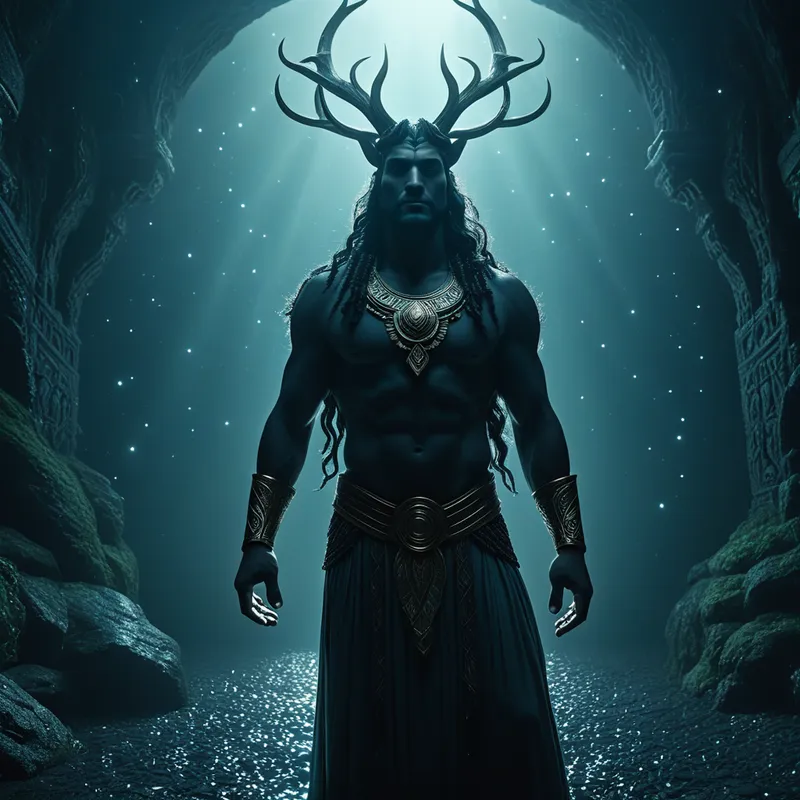
The tale begins not with a birth, but with a declaration. [Inanna](/myths/inanna “Myth from Sumerian culture.”/), the Queen of Heaven, the Lady of the Morning and Evening Star, stands in her city of Uruk. A divine discontent stirs within her breast—a knowing that her station, though glorious, is not yet complete. She perceives the structures of the cosmos, the me, the foundational powers that govern everything from kingship to lovemaking, and she desires them. Her gaze turns toward the abode of her father, Enki, the god of wisdom and the deep, sweet waters, who holds the me in his watery realm, the Abzu.
With cunning and majestic audacity, Inanna voyages to Eridu, Enki’s city. She arrives not as a supplicant daughter, but as a sovereign equal, radiating such splendor that Enki is captivated. In a feast of celebration, Enki, in his expansive and inebriated generosity, begins to present her with gifts. One by one, he bestows upon her the sacred me: the divine ordinances of lordship, the scepter, the throne, the exalted shrine, the art of the hero, the craft of the scribe, truth, descent into [the underworld](/myths/the-underworld “Myth from Greek culture.”/) and ascent from it, the art of lovemaking, the raging storm, the council, the kindling of strife and the making of peace. Over one hundred fundamental powers of civilization and cosmic order pass from the god of wisdom to the goddess of love and war.
As the intoxicating effects of the feast wear off, Enki awakens to the emptiness of his treasury. He realizes the totality of what he has given. A cold dread replaces his warmth. He dispatches his minister, Isimud, and a series of monstrous demons to pursue Inanna’s “Boat of Heaven,” to reclaim what was, in his sober mind, given in error. The pursuit is a cosmic chase, a tension between the static wisdom of the deep and the dynamic, acquisitive power moving toward the surface world.
At each of the seven gates of the Eanna in Uruk, Inanna’s loyal minister, Ninshubur, awaits with wise counsel. As Enki’s creatures demand entry, Inanna, from within her boat, refuses to yield the me. She declares they are no longer Enki’s to reclaim; they have been given, received, and are now hers by right. Her words carry the finality of a completed transaction. The pursuers, thwarted by her unwavering sovereignty and the protective rituals of Ninshubur, return to Eridu empty-handed.
Inanna enters Uruk in triumphant procession. The me are unloaded from the Boat of Heaven amidst the jubilant cheers of her people. She installs them in her holy temple, weaving them into the very fabric of her city. The hymn crescendos: “Inanna, you are the exalted one! You have lifted the me, you have brought the me into your hand!” The goddess of love and conflict has become the holder of all cosmic offices, the nexus of divine power. Her exaltation is complete, not through birthright alone, but through a daring psychological and political maneuver that permanently alters the balance of the divine assembly.
Cultural Origins & Context
The Exaltation of Inanna is a Sumerian hymn, a literary and liturgical masterpiece from the late 3rd millennium BCE. It exists within a corpus of texts that simultaneously praise the deity and articulate profound theological and political ideas. This hymn is not merely a story; it is a ritual text, likely performed to reaffirm Inanna’s patronage of Uruk and, by extension, the legitimacy of Uruk’s kings who derived their right to rule from her.
The narrative reflects very real tensions in the Sumerian [pantheon](/myths/pantheon “Myth from Roman culture.”/) and worldview. Enki represents the older, chthonic order of wisdom, magic, and the primordial waters—a power that is deep, hidden, and foundational. Inanna represents a new, dynamic, and manifest power: the power that operates in the social, political, and martial spheres of the city-state. Her acquisition of the me symbolizes the transfer of cultural and cosmic authority from the hidden depths to the visible, urban center. It is a myth about the ascendancy of civilization itself, with all its glorious and terrifying potentials, over the formless potential of [the abyss](/myths/the-abyss “Myth from Kabbalistic culture.”/).
Furthermore, the hymn validates a particularly Sumerian understanding of power: it is not purely innate, but can be acquired, negotiated, and consolidated. Inanna’s success relies on her charisma, her strategic use of a celebratory context, and her steadfast refusal to relinquish what she has gained. This mirrors the precarious and negotiated nature of kingship in Mesopotamia, where rule required the favor of the gods, the support of the priesthood, and the strength to defend one’s claims.
Symbolic Architecture
The myth is built upon a profound symbolic [architecture](/symbols/architecture “Symbol: Architecture in dreams often signifies structure, stability, and the framing of personal identity or life’s journey.”/). The Boat of [Heaven](/symbols/heaven “Symbol: A symbolic journey toward ultimate fulfillment, spiritual transcendence, or connection with the divine, often representing life’s highest aspirations.”/) is the [vessel](/symbols/vessel “Symbol: A container or structure that holds, transports, or protects something essential, representing the self, emotions, or life journey.”/) of transition, carrying the essence of cosmic order from one psychic domain (the unconscious, watery Abzu) to another (the conscious, structured [city](/symbols/city “Symbol: A city often symbolizes community, social connection, and the complexities of modern life, reflecting the dreamer’s relationships and societal integration.”/)). The feast represents a liminal state of [consciousness](/symbols/consciousness “Symbol: Consciousness represents the state of awareness and perception, encompassing thoughts, feelings, and experiences.”/) where boundaries dissolve and profound exchanges can occur; it is the [ritual](/symbols/ritual “Symbol: Rituals signify structured, meaningful actions carried out regularly, reflecting cultural beliefs and emotional needs.”/) container for the transference of power.
The pursuit by Enki’s creatures is the psyche’s inevitable resistance to a radical reordering. The old order, upon realizing its depletion, mobilizes to reclaim its contents, forcing the nascent consciousness to defend its hard-won integration.
The seven gates of the Eanna are the stages of final [integration](/symbols/integration “Symbol: The process of unifying disparate parts of the self or experience into a cohesive whole, often representing psychological wholeness or resolution of internal conflict.”/), each one a test and a consolidation. Inanna’s [passage](/symbols/passage “Symbol: A passage symbolizes transition, movement from one phase of life to another, or a journey towards personal growth.”/) through them with the me intact signifies that her new wholeness is not a theft, but a successfully completed process of [assimilation](/symbols/assimilation “Symbol: The process of integrating new experiences, identities, or knowledge into one’s existing self, often involving adaptation and transformation.”/). She does not fight her way out; she stands her ground, and her claim is recognized as legitimate. The final unloading of the me in Uruk is the ultimate [symbol](/symbols/symbol “Symbol: A symbol can represent an idea, concept, or belief, serving as a powerful tool for communication and understanding.”/) of incarnation—the abstract powers of the [cosmos](/symbols/cosmos “Symbol: The entire universe as an ordered, harmonious system, often representing the totality of existence, spiritual connection, and the unknown.”/) now have a home in the tangible world, administered by their [goddess](/symbols/goddess “Symbol: The goddess symbolizes feminine power, divinity, and the nurturing aspects of life, embodying creation and wisdom.”/).
The Dreamer’s Resonance
For the modern dreamer or [psyche](/myths/psyche “Myth from Greek culture.”/), The Exaltation of Inanna is a myth of profound self-authorization. It speaks to the moment when an individual claims the full spectrum of their inherent powers, often from an internalized source of “wisdom” (Enki) that has hoarded these capacities in a latent, unused state. This is not a violent overthrow, but a cunning and celebratory acquisition.
The dreamer may resonate with Inanna’s initial discontent—a sense of possessing potential yet lacking the official “decrees” to enact it. The journey to the “Abzu” is the descent into one’s own depths to parley with the inner keeper of resources. Enki’s inebriated generosity mirrors how our deepest wisdom often releases its treasures not through rigid will, but in moments of expanded consciousness, openness, or even “drunken” inspiration. The subsequent pursuit represents the inner critic, the voice of the old order, the fear that says, “You are not entitled to this power. Give it back.” Inanna’s steadfastness models the necessary defense of one’s new, more complex identity against regressive forces. To exalt oneself, in this sense, is to successfully install the me of one’s own being into [the temple](/myths/the-temple “Myth from Jewish culture.”/) of the conscious self.

Alchemical Translation
In the alchemy of the soul, this myth narrates the transmutation of latent potential into manifest authority. Enki’s Abzu is the [prima materia](/myths/prima-materia “Myth from Alchemical culture.”/), the chaotic, watery beginning where all archetypal patterns swim unformed. Inanna is the conscious animating spirit that enters this matrix. The feast is the conjunctio, [the sacred marriage](/myths/the-sacred-marriage “Myth from Various culture.”/) where the masculine principle of deep wisdom (Enki) engages with the feminine principle of will and desire (Inanna), resulting in a prolific generation.
The me themselves are the philosopher’s stone—not a single object, but the complete set of perfected principles necessary for the creation and governance of a world. Their transfer is the ultimate opus, shifting the center of gravity of the psyche from potential to actuality.
The journey back to Uruk is the [albedo](/myths/albedo “Myth from Alchemical culture.”/), the whitening, where the acquired treasure is purified and tested. The failure of the pursuers signifies the fixation of the transformation; the process cannot be reversed. Finally, the procession and installation in the Eanna represent the [rubedo](/myths/rubedo “Myth from Alchemical culture.”/), the reddening or glorious culmination, where the transformed substance—now the sovereign self—is revealed in its full, regal power, radiating order and vitality to its entire domain.
Associated Symbols
Explore related symbols from the CaleaDream lexicon:
- Crown — The manifest symbol of hard-won sovereignty and the right to wield the powers of order, claimed rather than merely inherited.
- Throne — The established seat of authority and judgment, one of the primary me, representing the stable center from which power is exercised.
- Key — The instrument that unlocks the treasury of the deep, granting access to hidden powers and fundamental principles of existence.
- Temple — The sacred structure where the acquired cosmic decrees are housed and integrated, the point where divine order meets human community.
- [Water](/myths/water “Myth from Chinese culture.”/) — The primordial, undifferentiated source of all potential and wisdom, the realm of Enki from which the structures of life emerge.
- Bridge — The perilous connection between the deep, unconscious source of power and the conscious city of [the self](/myths/the-self “Myth from Jungian culture.”/), crossed during a moment of daring transition.
- Order — The ultimate prize, the complex system of divine decrees that structures reality, wrested from [chaos](/myths/chaos “Myth from Greek culture.”/) and installed in the heart of civilization.
- Power Dynamics — The essential tension of the myth: the negotiation, transfer, and consolidation of authority between different divine and psychological principles.
- Ritual — The ceremonial context of the feast and the procession, the structured container that makes the dangerous transference of power possible and legitimate.
- Goddess — The dynamic, multifaceted feminine principle that actively seeks, claims, and embodies supreme authority, challenging static hierarchies.