
The Everyman Myth Meaning & Symbolism
An ordinary soul, chosen by fate, journeys through a world of trials to discover the sacred spark hidden within their own humble humanity.
The Tale of The Everyman
Listen. This is not a story of gods born in lightning, nor of kings with swords of star-metal. This is a story that begins in the dust. It begins with a breath, drawn in a small room, and the weight of an ordinary day.
There was once a person—no name is remembered, for names are for those who stand apart. This person was the Everyman. Their life was a circle of known things: the feel of worn tools, the taste of simple bread, the familiar path from hearth to field and back again. The world was vast beyond the hills, but that was a vastness for other tales.
Until the day the Call came. It did not arrive on thunder-wings. It was a silence that fell in the market square. It was a stranger’s cough that echoed too long. It was the way the river, one morning, seemed to flow backwards for a single, heart-stopping moment. A crack appeared in the world of known things, and through it seeped a chill wind of possibility, smelling of ozone and distant soil.
Refusal was the first, instinctual step. To mend the crack with busyness, to explain the omen as a trick of the light. But the crack widened. A beloved task turned to ash in their hands. A familiar face became a mask. The Threshold was not a gate of pearl or iron, but the moment they turned from the lit window of their home and walked into the gathering dusk without knowing why.
The road was the Road of Trials. Here, the stories multiply like reflections in broken glass. In one telling, the Everyman faced the Dragon of the Dull Mind, whose breath was the fog of forgetfulness. In another, they crossed the River of Tears, which could only be forged by feeling the weight of every drop. They met the Shadow-Merchant, who sold convincing masks of who they should be. They were lost in the Forest of Names, where voices called to them with the accents of parents and rulers and old shames.
They had no magic sword. Their weapon was a question. Their shield was a breath, held in the dark. They fell, and the earth received them. They bled, and their blood was the same red as any other.
Then, in the deepest pit, at the hour when even hope seems a childish tale, came the Ordeal. Stripped of all titles, all tools, all memories of the path that led there, the Everyman was faced with a single, terrible truth: the void before them was a mirror. The monster was their own unrecognized face. The prison was of their own making. In that moment of utter, devastating clarity, there was no heroism—only the raw, unbearable fact of existence.
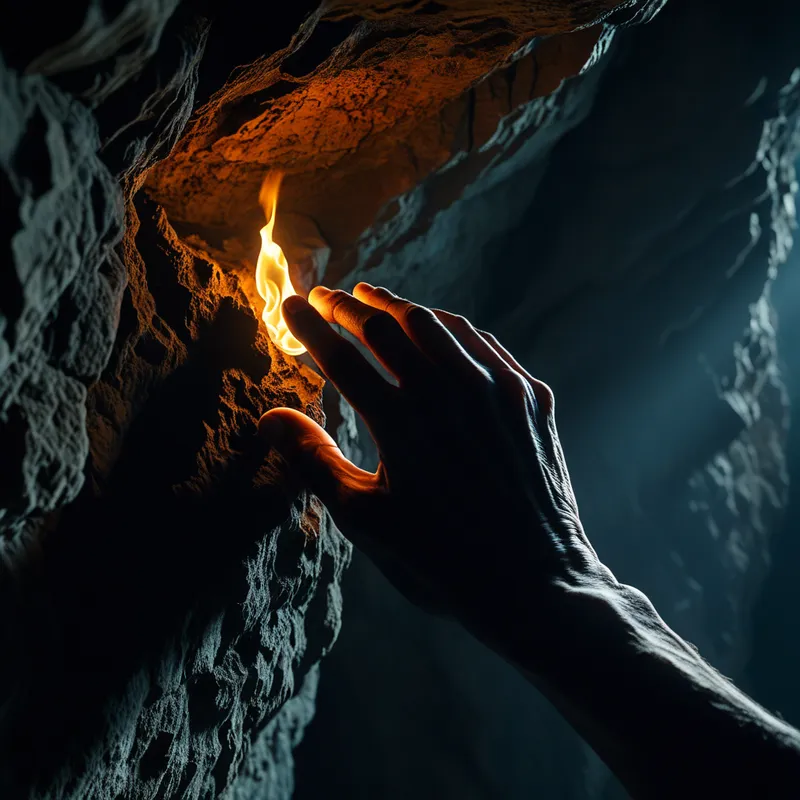
And from that surrender, from that touch with the absolute nadir, something stirred. Not a flash of light, but a warmth. Not a commanding voice, but a whisper from their own hollow chest. The Boon, the sacred spark, had been within all along, buried under the layers of the ordinary life it had powered. It was the will that had lifted the tool, the love that had tasted the bread, the curiosity that had once looked at the hills.
The return was the hardest journey. The world had not changed. The field was still there, the hearth cold. But the Everyman saw it through transformed eyes. They carried the spark back, not to rule, but to kindle. Their task was not to proclaim a truth, but to live, authentically, in the place where their story began. The circle was complete, but it was now a spiral, leading into a depth of ordinary moments that held, within them, the echo of the sacred.
Cultural Origins & Context
The myth of the Everyman is unique in that its “culture” is human consciousness itself. It is the ur-narrative, emerging independently in the folklore, morality plays, and oral traditions of countless peoples. In Medieval Europe, it was crystallized in the allegorical play Everyman, where the protagonist is summoned by Death and must find companions for the final journey. In a hundred tribal initiations, the young are stripped of their childhood identity (their “ordinary” life) and sent into the wilderness to confront the spirit world and return as adults.
Its societal function is dual. For the collective, it is a reaffirmation of shared values and the ultimate worth of the individual soul within the communal fabric. It says that greatness is not the sole province of the high-born or divinely conceived. For the individual, it is a map—a psychic schema for the process of maturation, crisis, and self-realization. It was told by firesides and from pulpits not merely as entertainment, but as an implicit instruction: your life, however humble, follows this pattern. You are the hero of a story you have yet to fully read.
Symbolic Architecture
The Everyman is the Ego in its nascent state: identified wholly with its social persona and the conscious, daylight world. The Call is the stirring of the Self, the pressure from within the psyche for greater wholeness, which first manifests as discontent, restlessness, or crisis.
The road is walked not to find a new land, but to see the old land with new eyes. The treasure was never buried on the island; it was buried in the act of setting sail.
The Dragon, the River, the Shadow-Merchant—these are all personifications of the Shadow and the Archetypes of the collective unconscious. To face them is to engage in a dialogue with all that has been excluded from the tidy house of the conscious mind. The Ordeal in the abyss is the symbolic death of the ego’s illusion of control, a necessary dissolution for the Individuation process to advance.
The Boon or spark is the nascent, integrated Self—the realization of one’s own unique center of being, which paradoxically connects one to the universal.
The Dreamer’s Resonance
When this myth activates in the modern psyche, dreams cease to be mere echoes of the day. They become the Road of Trials. You may dream of being unprepared for a crucial exam in a forgotten subject (the Ordeal of Inadequacy). You may wander through endless, shifting airports or malls (the Forest of Names, the loss of direction). A cherished home in the dream becomes dilapidated or unfamiliar (the cracking of the ordinary world).
Somatically, this process can feel like a persistent low-grade anxiety, a sense of “living the wrong life.” There is a profound disorientation, a homesickness for a home that no longer exists—because the “home” was a psychological configuration you have outgrown. The dream-ego, like the Everyman, is being forced to relinquish its old identity. The body may hold this as tension, fatigue, or a feeling of being unreal, because the psychic ground is literally dissolving.

Alchemical Translation
The alchemical opus is the perfect metaphor for the Everyman’s journey. It begins with the prima materia—the base, common, “worthless” substance. This is the ordinary life, the neuroses, the mundane struggles. The Call is the nigredo, the blackening, the descent into the murky waters of the unconscious, where all seems lost and chaotic.
The lead of your limitations is not an error to be corrected, but the essential ingredient for the gold of your character.
The trials are the albedo and citrinitas—the washing and the yellowing, the purification and the dawning of intellectual understanding. The confrontation in the abyss is the core of the nigredo revisited at a deeper level, a mortificatio or death of the old, rigid self-structure.
The discovery of the inner spark is the rubedo, the reddening. It is not a flashy enlightenment, but the emergence of a sustained, warm, embodied consciousness—the Philosopher’s Stone. This “stone” is the integrated personality, the Everyman who has realized they contain the spark of the divine. The return is the final stage: multiplicatio and projectio. The gold must be multiplied and used to “transmute” the world, not in a grandiose way, but by living with authenticity, thereby subtly altering the psychic reality around them. The goal is not to escape being human, but to become fully, consciously, and responsibly so—to make the ordinary life itself the vessel of the extraordinary.
Associated Symbols
Explore related symbols from the CaleaDream lexicon: